It is the deepest honor to have been joined by Michael Levin (@drmichaellevin), Victoria Klimaj, Zahra Sheikhbahaee (@zah_bah), Dalton Sakthivadivel (@DaltonSakthi), Adeel Razi (@adeelrazi), David Ha (@hardmaru), Nick Hay, Kevin Schmidt, Irina Rish (@irinarish), David Krakauer (@sfiscience), Melanie Mitchell (@MelMitchell1), Samuel Gershman (@gershbrain), and Joshua Tenenbaum in organizing this special issue of the Royal Society’s (@RSocPublishing) Philosophical Transactions A:
“World models, A(G)I, and the Hard problems of life-mind continuity: Toward a unified understanding of natural and artificial intelligence”
https://t.co/XMYB2SAofX
This collection was motivated by a question with far reaching implications, ranging from the fundamental nature(s) of mind to choices that may determine the future of our civilization/species: what kinds of world modeling capabilities are likely to be realized by which kinds of minds and what world might we be in with respect to increasingly advanced artificial intelligences?
Will the scaling and refinement of present approaches result in AI with human-like (and beyond) cognitive abilities, or do we need radically different paradigms that more closely follow the principles of natural intelligence? Learning “world models” to predict/compress information may be how biological learners so efficiently learn (to learn) to achieve goals and generalize that knowledge across a broad range of task environments. World models may also be useful for reverse-engineering forms of “System 2” cognition, or the self-reflexive, deliberate, multi-step reasoning associated with cognitive capabilities that may be unique to humans. Predictive models that reflect how the world may be causally modified by actions allow agents to adaptively control their behavior with flexibility and context-sensitivity. Spatiotemporally and causally coherent models of the physical world may not only be the key for creating AIs that we can rely on for real-world deployment, but may even be the (dynamic) core of conscious cognition.
The contributions to this special issue consider the varieties of world models worth modeling from diverse points of view:
Douglas Hofstadter explores whether sufficiently coherent self-referential world modeling could ground meaning, consciousness, and a genuine “I” in future AI systems.
David Krakauer (@sfiscience), Melanie Mitchell (@MelMitchell1), and John Krakauer (@blamlab) examine the principles of emergent intelligence from a complex systems perspective.
Alexander Ku (@alex_y_ku), Declan Campbell, Xuechunzi Bai (@baixuechunzi), Jiayi Geng (@JiayiiGeng), Ryan Liu (@theryanliu), Raja Marjieh (@RajaMarjieh), R. Thomas McCoy (@RTomMcCoy), Andrew Nam, Ilia Sucholutsky (@sucholutsky), Liyi Zhang (@LiyiZhang_Leo), Jian-Qiao Zhu (@JQ_Zhu), and Thomas Griffiths (@cocosci_lab) argue for using the tools of cognitive science to understand and evaluate LLMs across multiple levels of analysis.
Evelina Leivada (@EvelinaLeivada), Gary Marcus (@GaryMarcus), Fritz Günther, and Elliot Murphy (@ElliotMurphy91) test whether LLMs deeply understand language and the “world behind words,” or primarily learn surface statistical regularities.
Pedro Tsividis (@ptsividis), João Loula, Jake Burga, Juan Pablo Rodriguez, Sergio Arnaud, Nate Foss (@_npfoss), Andres Campero, Ajay Subramanian (@ajaysub110), Thomas Pouncy, Samuel Gershman (@gershbrain), and Joshua Tenenbaum introduce a theory-based meta-learning architecture inspired by the remarkable flexibility and efficiency of human cognition.
Eunice Yiu (@eunice_yiu_), Kelsey Allen, Shiry Ginosar (@shiryginosar), and Alison Gopnik (@AlisonGopnik) explore empowerment, controllability, and causal reasoning as means of understanding the remarkable learning abilities of both child and adult minds.
Nadav Amir, Stas Tiomkin, and Angela Langdon investigate how goals shape the structure of experience and how the world modeling abilities of natural intelligences may be inseparable from values.
Vickram Premakumar, Michael Vaiana, Florin Pop (@FlorinPop17), Judd Rosenblatt (@juddrosenblatt), Diogo Schwerz de Lucena, Kirsten Ziman, and Michael Graziano show unexpected benefits of self-modeling as an inductive bias and regularizer for training artificial agents.
Hanlin Zhu, Baihe Huang, and Stuart Russell analyze why model-based reinforcement learning may fundamentally outperform model-free approaches in representational efficiency.
Bradly Alicea (@balicea1), Morgan Hough (@mhough), Amanda Nelson, and Jesse Parent (@JesParent) revisit fundamental cybernetic principles of regulation, adaptation, and world modeling across a wide assortment of complex adaptive systems.
Francesco Sacco (@FrancescoSacco1), Dalton Sakthivadivel (@DaltonSakthi), and Michael Levin explore topological constraints on self-organization and suggest that biological systems maintain long-range coherence in ways that are fundamentally different from current transformer architectures.
Georg Northoff (@NorthoffL), Yasir Catal, and Samira Abbasi examine how biological intelligence may depend on capabilities for flexible “inner time” to ensure adaptive alignment between the dynamics of system and world.
Nicolas Rouleau (@DrNRouleau) and Michael Levin explore whether theories of consciousness generalize beyond brains to unconventional embodiments and living systems more broadly.
Benjamin Lyons and Michael Levin investigate economies and collective intelligence as systems coordinated by “cognitive glues” in the form of shared models of scarcity and value.
Katherine Collins (@katie_m_collins), Umang Bhatt (@umangsbhatt), and Ilia Sucholutsky (@sucholutsky) consider “Rogers’ paradox” to demonstrate ways in which collective learning is impacted by different kinds of human-AI interactions.
Ruairidh Battleday (@RMBattleday) and Samuel Gershman (@gershbrain) distinguish between the “easy” and “hard” problems of science, and describe how while current AI systems demonstrate powerful narrow forms of optimization with respect to well-defined inference-spaces, further developments are needed for achieving capabilities for novel scientific discovery.
Fritz Breithaupt (@FritzBreithaupt) explores narrative world models and the roles of uncertainty and transformative experiences in natural intelligences, suggesting that coherent agency may depend on better understanding human-like meaning-making.
Taken together, these diverse perspectives suggest that while LLMs can clearly learn powerful generative models of language, they likely do so without having world models of sufficient spatiotemporal and causal coherence to achieve human-like reasoning abilities, capacities for generating subjective conscious experiences, or pathways to realizing artificial general superintelligence. However, by further developing world modeling architectures, we may eventually be able to create forms of intelligence that recapitulate the remarkable flexibility and generality of human intelligence. Finally, enhanced (e.g. more coherent/integrated) world models may not only afford expanded capabilities, but could potentially help ensure that increasingly powerful AI systems achieve both inner and outer alignment with human(e) values.
Distinguishing between different senses of uses for words seems crucial for avoiding misunderstandings regarding the risks and opportunities associated with increasingly advanced AI capabilities (and what kinds of alignment measures may be desirable/feasible). It's also why I organized a recent special issue of Royal Society on the varieties of "world models" worth modeling in both natural and artificial intelligences:
https://t.co/ON1paoXrNY
I think we need similar taxonomies for every other major topic in AI and cognitive science, which is why I'm organizing another special issue on the varieties of "agency" worth enacting, and their different implications for capabilities and alignment:
https://t.co/aG5X8bIFW9
There are a few slots left among planned contributions. If you're a well-established academic or industry researcher and think you might have work that fits this topic, please don't hesitate to contact me with your potential submission (even if only a provisional title and abstract).
As someone who's worked in all these fields for a good number of years and seen much of "how the sausage is made," I couldn't agree more.
Excerpt below:
"[T]he conversion of a partial truth into a total worldview.
"This is where confirmation bias and reverse inference reinforce each other. Confirmation bias selects the evidence we find compelling. Reverse inference supplies the story that makes the evidence feel explanatory. Together, they create a loop. We begin with a belief: psychedelics heal by dissolving the ego; meditation trains attention and compassion; neural networks reveal the general principle of intelligence. We then observe data: altered connectivity, changed questionnaire scores, improved task performance, larger models producing better outputs. Finally, we infer that the data confirm the belief. The circle closes, and the hypothesis becomes harder to question because it now appears “evidence-based.”
But evidence-based science is not the same as evidence-decorated belief. The difference lies in whether evidence has the power to surprise us, constrain us, and force revision. A scientific claim should not merely accumulate supportive examples. It should expose itself to meaningful risk. What would count against the claim? What alternative explanations remain viable? What would make us reduce our confidence? Which analyses were specified in advance? Which outcomes were primary? Which negative findings were published? Which measures were chosen because they were theoretically diagnostic, and which because they were convenient or likely to produce a story?
Evidence-Based or Evidence-Decorated?
John Ioannidis argued that the probability a research finding is true depends not only on statistical significance, but also on bias, power, multiplicity, and the ratio of true to false hypotheses being tested [8]. This point is particularly important in fast-moving fields with high public interest. When a field is exciting, underpowered positive findings travel quickly. Negative findings remain unpublished. Ambiguous findings become narratives. Small mechanistic studies are used to support large translational claims. Investors, journalists, universities, and advocacy groups amplify the most attractive version of the story. The scientific ecosystem itself becomes a confirmation machine.
What, then, is the remedy? It is not cynicism. Cynicism is just confirmation bias with a negative prior. Nor is the remedy to exclude believers from science. Many transformative fields are built by people who care deeply about the phenomenon under study. The remedy is disciplined pluralism: a culture in which enthusiasm is permitted but not allowed to substitute for inference.
What Better Science Would Look Like
For psychedelic science, this means separating therapeutic efficacy from mechanism, and mechanism from metaphysics. It means studying adverse events, expectancy, therapist effects, set and setting, participant selection, and long-term outcomes with the same seriousness as acute mystical experience. It means asking whether impressive subjective experiences are necessary, sufficient, neither, or merely correlated with benefit. It means resisting the temptation to treat every neural change as a signature of healing.
For meditation science, it means defining practices precisely, using credible active controls, measuring harms, distinguishing state effects from trait effects, and avoiding the assumption that ancient practices must map neatly onto modern constructs. It means allowing the possibility that meditation is useful, but not universally useful; powerful, but not always benign; psychologically meaningful, but not automatically mechanistically understood.
For artificial intelligence, it means distinguishing engineering success from scientific explanation. Scaling laws are important, but they are not a theory of mind. Predictive performance is important, but it is not a complete account of intelligence. Neural networks are extraordinary tools, but their success should invite deeper inquiry, not methodological monopoly. The right question is not whether deep learning works. It plainly does. The right question is what kind of understanding its success gives us, what it leaves unexplained, and where alternative principles remain necessary.
Let the Evidence Surprise Us
Across all these domains, the deeper issue is intellectual humility. Scientists must be especially suspicious of findings that flatter their priors, vindicate their identities, or reward their communities. The most dangerous result is not the one that contradicts us. It is the one that confirms us too easily.
Good science is not self-serving. It is not the ritual production of evidence for conclusions we already hoped were true. It is a method for being answerable to the world. That requires more than data. It requires adversarial collaboration, preregistration where appropriate, open materials, publication of null results, serious engagement with critics, and conceptual restraint. It requires asking whether our favourite explanation is uniquely supported by the evidence, or merely compatible with it.
The goal is not to remove human passion from science. Without passion, many difficult fields would never advance. The goal is to ensure that passion remains upstream of the question, not downstream of the answer. Personal transformation can motivate research, but it cannot validate a theory. Technological success can inspire a programme, but it cannot license universal prescription. A beautiful hypothesis can guide inquiry, but it must still be vulnerable to defeat.
The test of a scientific culture is not how confidently it celebrates its successes. It is how willingly it investigates its own temptations. Psychedelics may transform some lives. Meditation may cultivate important capacities. Neural networks may reveal powerful principles of learning. But none of these possibilities frees us from the first principle. We must not fool ourselves. And we are still the easiest people to fool."
Scientists are not immune to belief.
Psychedelic researchers who were transformed by psychedelics.
Meditation scientists who built their careers around contemplative practice.
AI researchers convinced deep learning is the only path to intelligence.
Sometimes science stops testing ideas and starts defending them.
I wrote about confirmation bias, reverse inference, and the danger of turning partial truths into total worldviews.
An excerpt below. Read the full article on my substack and subscribe to it if you like getting notifications for new posts (not very frequent).
https://t.co/qLtEqhRFBp
"When Experience Becomes Evidence"
Confirmation bias, reverse inference, and the stories we tell about AI, psychedelics, and meditation
Science is often imagined as a disciplined escape from belief. In practice, it is more fragile than that. Scientists are human beings before they are methodologists. They have experiences, communities, intellectual lineages, incentives, and hopes. Sometimes these forces inspire great science. At other times, they quietly bend the arc of inquiry towards conclusions that were desired before the evidence arrived. This is not fraud. It is often more ordinary and more dangerous: confirmation bias dressed as discovery.
Confirmation bias refers to the tendency to seek, interpret, and remember evidence in ways that support what we already believe. Peter Wason’s classic work on hypothesis testing showed how readily people fail to test alternatives that might disconfirm their favoured hypothesis [1]. Raymond Nickerson later described confirmation bias as a “ubiquitous phenomenon,” not an occasional defect of poor reasoning but a general vulnerability of human cognition [2]. The implication for science is sobering. The scientific method is not powerful because scientists are naturally objective. It is powerful because it creates structures that make self-deception harder.
Richard Feynman put this with characteristic clarity in his 1974 lecture on “Cargo Cult Science”: “The first principle is that you must not fool yourself, and you are the easiest person to fool” [3]. That warning is especially relevant in domains where the scientist’s personal experience is entangled with the object of study. Psychedelic science, meditation research, and contemporary artificial intelligence all provide timely examples. Each field contains genuine promise. Each has produced important insights. Yet each also risks being shaped by communities of believers who are, understandably, tempted to convert transformative personal or professional experience into universal prescription.
Thank you, Joel. And thank you @CIMCAI for organizing/hosting such a wonderful event, and for everything they're doing to try to help grow this new field of inquiry.
For anyone who's interested, a copy of the slides I presented, and a Claude transcript made from talk (and papers and emails?):
https://t.co/b7M1iuCX5g
https://t.co/UWeGm0ForS
(I think it might be a better encapsulation of Integrated World Modeling Theory (IWMT) than anything I've written. Brave new world, that has such mind tools in it. The only major error is that Claude didn't understand that I think "conscious access" is a more complicated cognitive process only partly explainable in terms of workspace ignition/broadcasting.)
https://t.co/RKz566jsaA
https://t.co/nCWAKw8bW4
Exceptional presentations by @franz_hiha and @adamsafron kicking off Sunday programming at @CIMCAI conference.
(Tho sad @adamsafron skipped over auto encoders and turbo code)
@_3l3ktr4_@jefrankle@mcarbin@MLStreetTalk@ykilcher A copy of the slides I presented:
https://t.co/C6a1iB2Ixu
A Claude transcript of my talk:
https://t.co/1KANbO3CKv
(I think it might be a better encapsulation of IWMT than anything I've written. Brave new world, that has such mind tools in it.)
Will read!
Potential connections with the "Lottery Ticket Hypothesis" (@jefrankle, @mcarbin, @MLStreetTalk, @ykilcher)?
https://t.co/M6HdBg5u8N
https://t.co/Oq5RtHXC54
Global workspaces in LLMs?!
Or evolution towards small-worldness as necessary/universal precondition for efficient information exchange (and thereby inferential synergy) in networks of functional/effective connectivity?
This seems different from (shared latent) workspaces in brains, which are dynamic cores that undergo dual phase evolution with fluctuating periods of local and global modularity with critical transitions, potentially entailing/calculating likely system-world states via iterated Bayesian model selection:
https://t.co/nCWAKw7E6w
Preprint time:
“A Brain-like Synergistic Core in LLMs Drives Behaviour and Learning”
https://t.co/69ZQBj4cze
LLMs are clearly different from actual brains… but could they share a similar functional architecture related to how they process information?
🙏❤️🔥
Where I began thinking of minds in terms rhythmic entrainment:
https://t.co/Hg5WnF7uwF
https://t.co/WmMDUqLEo3
Where I began thinking of rhythms/oscillators/attractors as harmonics:
https://t.co/RKz566jsaA
https://t.co/nCWAKw8bW4
https://t.co/owT8goDw5h
Where I began thinking of emotions/feelings in terms of musical metaphors:
https://t.co/0mhFyqm9jc
"To use a musical metaphor, in experiences of pain and unfulfilled desire, the overall melody is played in a more minor, or entropic [390,391] key/timbre. Alternatively, in experiences of pleasure and fulfilled desire—potentially including virtual fulfillment (i.e., pleasurable anticipation)—affective orchestras play melodies with greater consonance. One could view such soundtracks to the (fully immersive virtual reality) movies of experience as separate streams of information that help contextualize what is being seen on ‘screens’ over which we see stories unfold (Figure 6). However, it may be closer to experience to say that this metaphorical music enters into what we see and feel, imbuing (or synesthetically coloring) it with meanings. Indeed, we may be able to find most of the principles of affective phenomena to be well-reflected in our experiences of music [16,385,422], where we play with building and releasing tension, enjoying the rise and fall of more and less consonant (or less and more dissonant) melodies. In musical pleasure, we explore harmony and the contrast of disharmony, eventually expecting to return home to the wholeness of the tonic, but with abilities of our “experiencing selves” [423,424,425] to find satisfaction in the moment not necessarily being the reasons that our “remembering selves” find ourselves attracted to particular songs.
The affective melodies played by neural orchestras will be dominated by interoceptive modalities, the most ancient—both developmentally and evolutionarily speaking—and reliable indicators of homeostatic and reproductive potential [63,130,285,426,427]. Do we have relaxed and dynamic cardiac rhythms? Is our breathing easy or forced? Do we feel warm—but not too hot—or cold? Are our bowels irritated or copacetic? Do we feel full or empty inside? Do we feel like our body is whole and strong, ours to command where we will, if we wanted it? Or do we feel damaged and weak? This interoceptive information speaks to foundations of life and the cores of value out of which persons may grow."
Where I began thinking of minds as literally being music (as combinations of time-changing harmonics):
https://t.co/LD8dV7oQv6
https://t.co/ckkRBZJOkG
Not sure if this is along the lines of what you have in mind, but in work with @thesmartrobot, I suggested that we might find both maps and causal graphs implemented via the "place" fields of the hippocampal/entorhinal system, functioning as a kind of neurosymbolic AI (@GaryMarcus_) architecture.
https://t.co/LD8dV7oQv6
While many use a broader conception of "world models" that does not necessarily involve causation, @eunice_yiu_, Kelsey Allen, @shiryginosar, and @AlisonGopnik compellingly describe how the remarkable learning abilities of children may depend on a fundamental entanglement between world modeling and causal discovery via intrinsic drives for "empowerment" (defined as mutual information between actions and outcomes).
https://t.co/qdgIsHM9TP
It is the deepest honor to have been joined by Michael Levin (@drmichaellevin), Victoria Klimaj, Zahra Sheikhbahaee (@zah_bah), Dalton Sakthivadivel (@DaltonSakthi), Adeel Razi (@adeelrazi), David Ha (@hardmaru), Nick Hay, Kevin Schmidt, Irina Rish (@irinarish), David Krakauer (@sfiscience), Melanie Mitchell (@MelMitchell1), Samuel Gershman (@gershbrain), and Joshua Tenenbaum in organizing this special issue of the Royal Society’s (@RSocPublishing) Philosophical Transactions A:
“World models, A(G)I, and the Hard problems of life-mind continuity: Toward a unified understanding of natural and artificial intelligence”
https://t.co/XMYB2SAofX
This collection was motivated by a question with far reaching implications, ranging from the fundamental nature(s) of mind to choices that may determine the future of our civilization/species: what kinds of world modeling capabilities are likely to be realized by which kinds of minds and what world might we be in with respect to increasingly advanced artificial intelligences?
Will the scaling and refinement of present approaches result in AI with human-like (and beyond) cognitive abilities, or do we need radically different paradigms that more closely follow the principles of natural intelligence? Learning “world models” to predict/compress information may be how biological learners so efficiently learn (to learn) to achieve goals and generalize that knowledge across a broad range of task environments. World models may also be useful for reverse-engineering forms of “System 2” cognition, or the self-reflexive, deliberate, multi-step reasoning associated with cognitive capabilities that may be unique to humans. Predictive models that reflect how the world may be causally modified by actions allow agents to adaptively control their behavior with flexibility and context-sensitivity. Spatiotemporally and causally coherent models of the physical world may not only be the key for creating AIs that we can rely on for real-world deployment, but may even be the (dynamic) core of conscious cognition.
The contributions to this special issue consider the varieties of world models worth modeling from diverse points of view:
Douglas Hofstadter explores whether sufficiently coherent self-referential world modeling could ground meaning, consciousness, and a genuine “I” in future AI systems.
David Krakauer (@sfiscience), Melanie Mitchell (@MelMitchell1), and John Krakauer (@blamlab) examine the principles of emergent intelligence from a complex systems perspective.
Alexander Ku (@alex_y_ku), Declan Campbell, Xuechunzi Bai (@baixuechunzi), Jiayi Geng (@JiayiiGeng), Ryan Liu (@theryanliu), Raja Marjieh (@RajaMarjieh), R. Thomas McCoy (@RTomMcCoy), Andrew Nam, Ilia Sucholutsky (@sucholutsky), Liyi Zhang (@LiyiZhang_Leo), Jian-Qiao Zhu (@JQ_Zhu), and Thomas Griffiths (@cocosci_lab) argue for using the tools of cognitive science to understand and evaluate LLMs across multiple levels of analysis.
Evelina Leivada (@EvelinaLeivada), Gary Marcus (@GaryMarcus), Fritz Günther, and Elliot Murphy (@ElliotMurphy91) test whether LLMs deeply understand language and the “world behind words,” or primarily learn surface statistical regularities.
Pedro Tsividis (@ptsividis), João Loula, Jake Burga, Juan Pablo Rodriguez, Sergio Arnaud, Nate Foss (@_npfoss), Andres Campero, Ajay Subramanian (@ajaysub110), Thomas Pouncy, Samuel Gershman (@gershbrain), and Joshua Tenenbaum introduce a theory-based meta-learning architecture inspired by the remarkable flexibility and efficiency of human cognition.
Eunice Yiu (@eunice_yiu_), Kelsey Allen, Shiry Ginosar (@shiryginosar), and Alison Gopnik (@AlisonGopnik) explore empowerment, controllability, and causal reasoning as means of understanding the remarkable learning abilities of both child and adult minds.
Nadav Amir, Stas Tiomkin, and Angela Langdon investigate how goals shape the structure of experience and how the world modeling abilities of natural intelligences may be inseparable from values.
Vickram Premakumar, Michael Vaiana, Florin Pop (@FlorinPop17), Judd Rosenblatt (@juddrosenblatt), Diogo Schwerz de Lucena, Kirsten Ziman, and Michael Graziano show unexpected benefits of self-modeling as an inductive bias and regularizer for training artificial agents.
Hanlin Zhu, Baihe Huang, and Stuart Russell analyze why model-based reinforcement learning may fundamentally outperform model-free approaches in representational efficiency.
Bradly Alicea (@balicea1), Morgan Hough (@mhough), Amanda Nelson, and Jesse Parent (@JesParent) revisit fundamental cybernetic principles of regulation, adaptation, and world modeling across a wide assortment of complex adaptive systems.
Francesco Sacco (@FrancescoSacco1), Dalton Sakthivadivel (@DaltonSakthi), and Michael Levin explore topological constraints on self-organization and suggest that biological systems maintain long-range coherence in ways that are fundamentally different from current transformer architectures.
Georg Northoff (@NorthoffL), Yasir Catal, and Samira Abbasi examine how biological intelligence may depend on capabilities for flexible “inner time” to ensure adaptive alignment between the dynamics of system and world.
Nicolas Rouleau (@DrNRouleau) and Michael Levin explore whether theories of consciousness generalize beyond brains to unconventional embodiments and living systems more broadly.
Benjamin Lyons and Michael Levin investigate economies and collective intelligence as systems coordinated by “cognitive glues” in the form of shared models of scarcity and value.
Katherine Collins (@katie_m_collins), Umang Bhatt (@umangsbhatt), and Ilia Sucholutsky (@sucholutsky) consider “Rogers’ paradox” to demonstrate ways in which collective learning is impacted by different kinds of human-AI interactions.
Ruairidh Battleday (@RMBattleday) and Samuel Gershman (@gershbrain) distinguish between the “easy” and “hard” problems of science, and describe how while current AI systems demonstrate powerful narrow forms of optimization with respect to well-defined inference-spaces, further developments are needed for achieving capabilities for novel scientific discovery.
Fritz Breithaupt (@FritzBreithaupt) explores narrative world models and the roles of uncertainty and transformative experiences in natural intelligences, suggesting that coherent agency may depend on better understanding human-like meaning-making.
Taken together, these diverse perspectives suggest that while LLMs can clearly learn powerful generative models of language, they likely do so without having world models of sufficient spatiotemporal and causal coherence to achieve human-like reasoning abilities, capacities for generating subjective conscious experiences, or pathways to realizing artificial general superintelligence. However, by further developing world modeling architectures, we may eventually be able to create forms of intelligence that recapitulate the remarkable flexibility and generality of human intelligence. Finally, enhanced (e.g. more coherent/integrated) world models may not only afford expanded capabilities, but could potentially help ensure that increasingly powerful AI systems achieve both inner and outer alignment with human(e) values.
Important theme issue on "World Models" from a variety of perspectives. It's still hard for me to extract answers to the question: Who needs world models, or, could we do without them, or, what is their computational role. @eliasbareinboim@GaryMarcus@DavidDeutschOxf@adamsafron
Awesome new theme issue of Philosophical Transactions:
‘World models in natural and artificial intelligence’
Thank you @adamsafron!
https://t.co/Tzu1OH9Hib
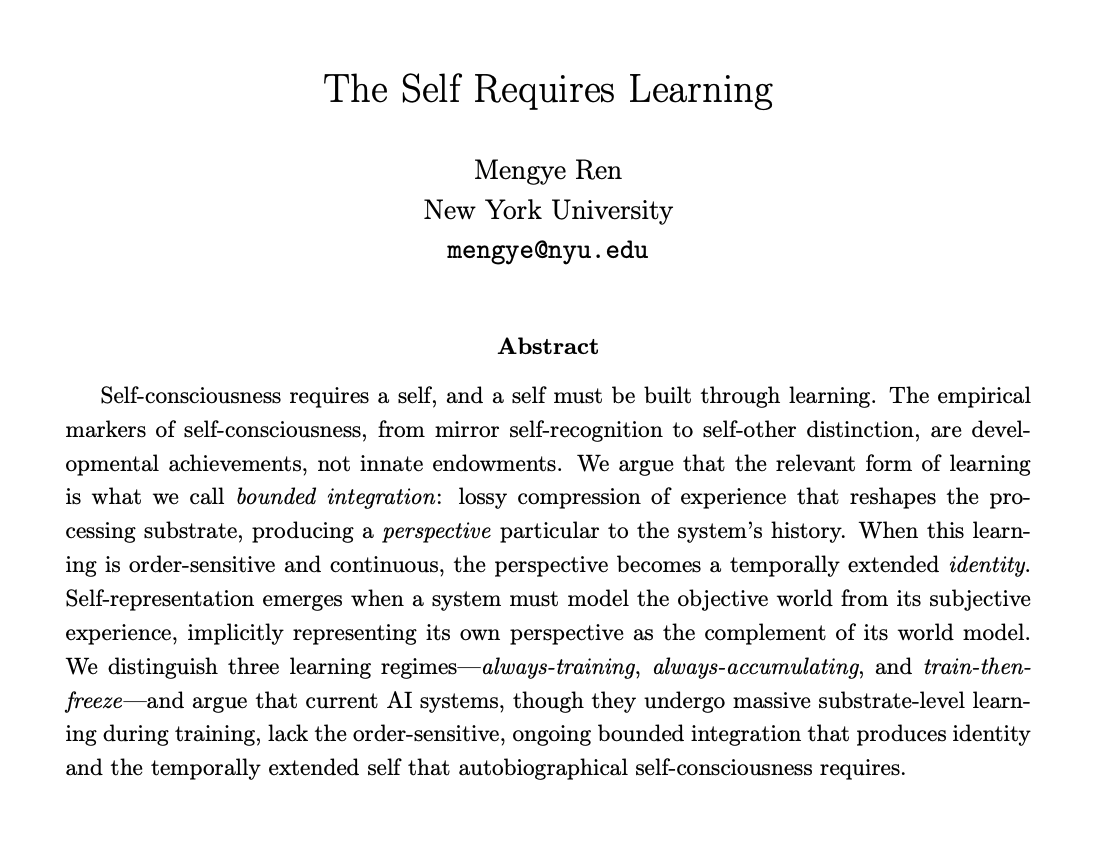
New preprint: The Self Requires Learning. Self-consciousness requires continual learning + world-modeling. I introduce "bounded integration" to connect perspective, identity, and self-representation — and diagnose what current AI systems have and lack.
Potentially (very) deflationary account of using connectomic datasets to reproduce animal behavior?
https://t.co/oArdosctZM
To what extent is it the morphological intelligence of evolved embodiments that provides the illusion of sophisticated control (c.f. "The world is its own best model")?
Alternatively, perhaps the fact that C. elegans could generate fly-like behavior in virtual drosophila points to the surprising power of relatively small (and perhaps especially evolved (c.f. small world connectivity?)) recurrent systems (e.g. spontaneous meta-learning?)?
@bingbrunton@rodneyabrooks@DoctorJosh@KennethHayworth@doristsao@dileeplearning@tweetsatpreet@koerding
@m_botvinick
@alexwg@PeterDiamandis
While I doubt this is anywhere close to a path to human whole-brain emulation (let alone uploads), controlling a fruit fly body in MuJoCo with a connectome-derived computational model is amazing. Looking forward to learning more about this.
Here's the longer version of our Nature piece.
Our argument is simple: statistical approximation is not the same thing as intelligence.
Strong benchmark scores often say very little about how LLMs behave under novelty, uncertainty, or shifting goals.
Even more importantly, similar behaviors can arise from fundamentally different processes. In another paper, we identified seven epistemological fault lines between humans and LLMs.
For example, LLMs have no internal representation of what is true. They often generate confident contradictions, especially in longer interactions, because they do not track what is actually true.
Another example. Yes, LLMs have solved some open mathematical problems, but these cases typically involve applying known methods to well-defined problems. LLMs cannot invent anything that is truly new and true at the same time, because they lack the epistemic machinery to determine what is true.
None of this means LLMs are useless. Quite the opposite: they are extraordinarily useful.
But we should be careful about what they are and what they are not.
Producing plausible text is not the same as understanding.
Statistical prediction is not the same as intelligence.
So despite the hype from the usual suspects, AGI has not been achieved.
*
paper in the first reply
Joint with @Walter4C and @GaryMarcus