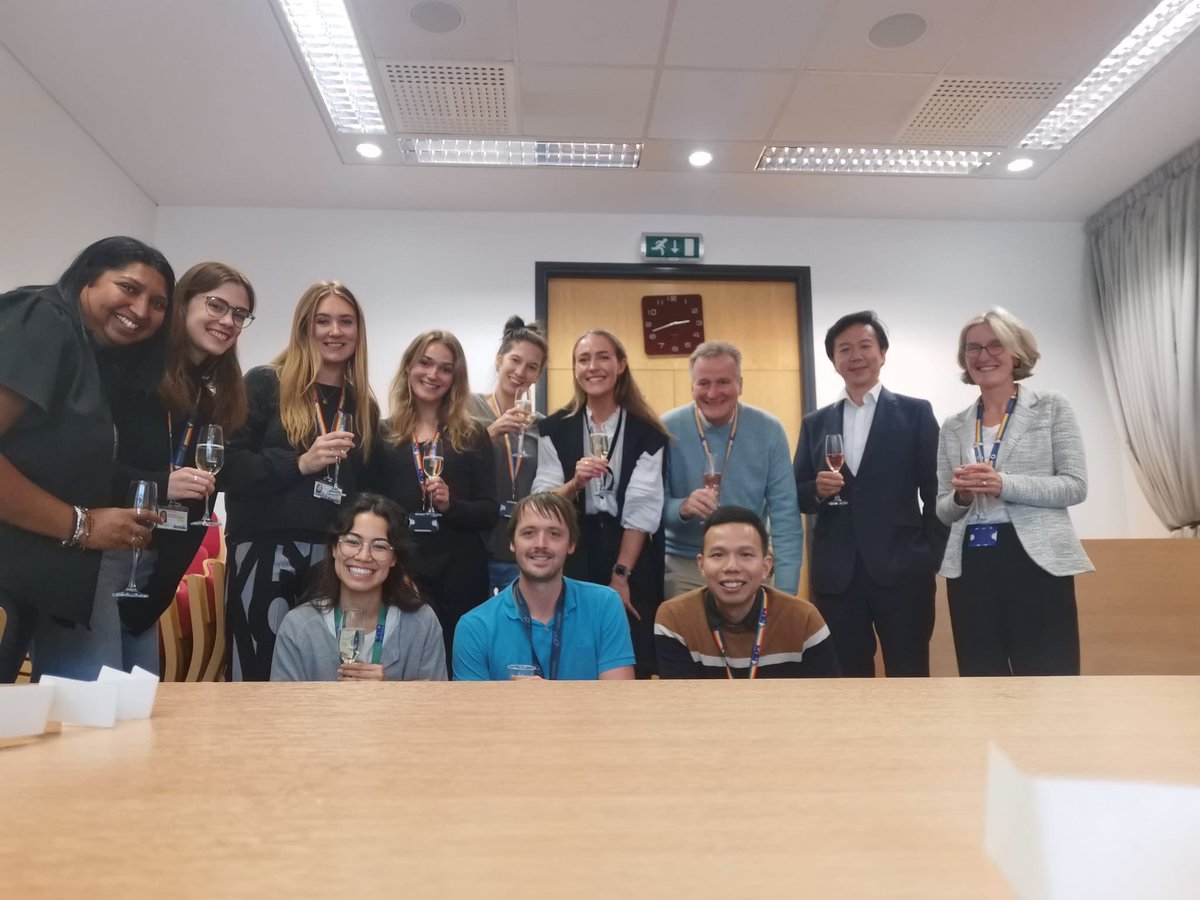
Delighted to have completed my DPhil! Thanks very much to @PKlenermanLab and @Leo1401j for the great discussion.
I’ll be staying with @Carroll_Lab_Ox until the end of the year before starting a postdoctoral fellowship at the Vaccine Research Centre @NIH
Our RAEFISH spatial transcriptomics technology is now published in Cell @CellCellPress! RAEFISH enables sequencing-free whole genome spatial transcriptomics at single molecule resolution. This work represents the first time that transcripts from more than 23,000 genes were directly probed and imaged in situ with any technology, and the first time numerous different gRNAs were directly probed and distinguished by imaging in a high-content CRISPR screen.
The challenge:
Recent breakthroughs in spatial transcriptomic technologies, from us and others, have greatly improved our ability to profile cell types, states, cellular interactions, and the underlying gene programs within the native tissue contexts. However, these technologies have limitations. Methods based on 2D-array-capture/tagging and ex situ sequencing offer genome-scale coverage, but lack the resolution needed to accurately study fine spatial organization. In contrast, image-based methods that rely on highly multiplexed fluorescence in situ hybridization or in situ sequencing provide single-molecule resolution and resolve fine spatial organization, but require pre-selecting a limited set of target genes (typically hundreds to a few thousand genes), which limits discovery and sometimes leads to only validations of prior knowledge due to the pre-selected targets being well studied in the context.
The solution:
RAEFISH, our lab's new flagship image-based spatial transcriptomics technology, simultaneously enables single-molecule spatial resolution and whole-genome level coverage of long and short, endogenous and engineered RNA species in cell cultures and intact tissues.
The results:
🔥 We performed RAEFISH targeting 23,312 human genes in cell cultures, and demonstrated hypothesis-free discovery of cell cycle associated genes and subcellular localization patterns of transcripts, including nearly the entire protein coding transcriptome and additional long noncoding RNAs.
🔥 We performed RAEFISH targeting 21,955 mouse genes in mouse liver, placenta, and lymph node tissues. Our analyses on immediately neighboring cells uncovered intriguing cell-cell interactions and previously unknown gene expression programs underlying the interactions, such as those between cholangiocytes and immune cells.
🔥 Finally, we further developed RAEFISH to directly read out guide RNAs (gRNAs), demonstrating Perturb-RAEFISH in an image-based high-content CRISPR screen. The capacity of Perturb-RAEFISH to directly read out gRNAs addresses a crucial limitation of previous techniques that read out a barcode/identifier sequence paired with each gRNA species, as the pairing can be shuffled due to RNA recombination intrinsic to lentivirus used in such screens, which limits screen sensitivity and accuracy.
In summary, RAEFISH provides the biomedical research community with a generalizable research tool, which will bring more spatial and mechanistic insights across health and disease.
This work was co-led by my postdocs Drs. @ChengYubao, Shengyuan Dang, and Yuan Zhang, and was supported by the @NIH, @genome_gov, @sennetresearch, and @psscra. I would like to thank our co-authors, funding agencies, editor, reviewers, and my whole lab @YaleGenetics@YaleCellBio@YaleCancer@YaleMed@Yale.
Link to paper:
https://t.co/6HtwylwjdN
Proud to share that our manuscript was published this week in @Nature_NPJ Vaccines! This paper is the first instalment of my PhD work on a project that I was very lucky to be a part of
The wait is over!! We are thrilled to announce that we have chosen Spatial Proteomics as 2024’s Method of the Year! 🥳
For more on Spatial Proteomics and a road map to this special issue, please see this month’s Editorial or read on in this thread.
https://t.co/phXooJzJda
Very pleased to share that MuSpAn (Multiscale Spatial Analysis), @MuSpAn_Tweets, our Python package for quantitative spatial biology, has landed! Take a look at the preprint on bioRxiv now
Immensely proud to tell you all my first paper of my PhD is out in Nature Medicine now! We wanted to know if the immune response to COVID-19 was distinct in an African cohort (spoiler alert: our data suggest it is!) Give it a read! https://t.co/zcp8WmBqKg
I’d like to thank Miles in particular for his support and supervision, I can’t recommend the Carroll Lab enough!
My project also involved a lot of collaboration. Next task is to finish the manuscript so I can share our work 😄
Delighted to have completed my DPhil! Thanks very much to @PKlenermanLab and @Leo1401j for the great discussion.
I’ll be staying with @Carroll_Lab_Ox until the end of the year before starting a postdoctoral fellowship at the Vaccine Research Centre @NIH
New paper led by our former DPhil student @hannahjklim out now in @NatureComms ‘Serological analysis in humans in Malaysian Borneo suggests prior exposure to H5 avian influenza near migratory shorebird habitats’
Some media coverage in the thread below
https://t.co/HvV5ybdGlg
NEW | @OxfordVacGroup have launched their new season of The Oxford Colloquy - conversations with leading experts in science and healthcare.
Listen now as Dr Anthony Fauci, Chief Scientific Advisor to 7 US Presidents, joins Prof Sir @ajpollard1 ⬇️
https://t.co/A2cUCLUuTO
Here we go…repurposing spatial imaging techs to achieve ultra-low to ultra-high, multiplexing, nuclei, cells, single (RNA or Protein), multimodal (RNA and Protein), super cheap! NO SEQUENCING!
@10xGenomics @nanostringtech @AkoyaBio@bruker
Congratulations to @caolann_b who passed her DPhil viva yesterday! Thanks to Prof Helen McShane and Prof @ChrisChiuLab for being viva examiners
Caolann is now starting medicine @UniofOxford and we wish her all the best in her career!
Join us on the 20th of September at 12pm when @WoltersRachael from @OHSUNews will be presenting a talk titled 'Transforming viral defense: The role of Monoclonal antibodies in modern medicine' @HumanGeneticsOx as part of the @PSIOxford satellite seminars
https://t.co/oRzvhVJTWX
📢We are recruiting! Ready for #HumanImmunology 2.0? Join the revolution! Multiple positions available in Atomic Lab - all levels! #PhD#postdoc#researchers
👩💻Dry Lab positions: https://t.co/EIG4hhBLyO
🧑🔬Wet lab positions: https://t.co/LcA4cMO6fZ
🥷Senior RA positions: https://t.co/OQ9zWL9sgR
👩🔬👨💻 More positions: https://t.co/8O5BYdaw9z
I’ve really enjoyed doing my PhD in the Carroll group! This project will have an exciting mix of cutting-edge techniques (spatial transcriptomics, organoids etc) with a very important pandemic-potential virus. Highly recommend! #phd#nipah
New PhD position available with us and @dstlmod: Characterising the host-pathogen interaction of henipaviruses
The student will have the opportunity to use in vivo samples and organoids to study the neurological pathology of henipaviruses
Please share! https://t.co/Ram3MHkF7U