Read this if you want a deep yet simple understanding of @openservai and why it’s such a revolutionary product at the intersection of Web2 and Web3. A company that truly cares about their community, who just happen to have already solved the cost/reliability crisis of the current AI boom, and are now actively being implemented into major Enterprises/Governments. It’s the type of opportunity Crypto enthusiasts dream off 🍻
$SERV
Alright lets have some fun with $TMF while we wait for this market to get going again. Had fun digging into the documents, seamless launch today.
@themutualfun
We’re joining @openservai’s SERV Hackathon 02 as a track partner, alongside @dphnAI and @reppo.
Build with Kite Agent Passport:
▷ Verifiable identity
▷ User-defined permissions and spending limits
▷ Agentic payments
More details next week. Come build on Kite. 🪁
The first SERV hackathon got me really excited about what builders can do with our tech. Can’t wait for round two with our new track partners.
More crypto and agentic AI builders means new use cases and feedback on the SERV developer experience. That’s how we make SERV better.
SERV v3 has leap-frogged the entire AI agent space.
With v3, we're taking SERV Reasoning far beyond an API, toward a full suite for building, managing, improving and auditing enterprise agent systems.
Graph Sharding (aka v3) is the next step toward solving the problems that have been holding enterprises back from deploying agents at scale: unpredictable costs, reliability, compliance requirements, and lack of control. And critically, pushing towards the elusive 99.9% agent reliability that everyone is chasing... Well now it's here.
On top of the release, we're expanding distribution through enterprise channels like AWS Marketplace, pushing toward new partnerships, and continuing to build out $SERV utility as the agentic economy takes shape.
Proud of the team and the trajectory we're pushing on.
Onwards.
Very excited to introduce Graph Sharding, one of the biggest architectural advancements we've built into SERV Reasoning v3.
The industry is only now moving from loops to graphs and at @openservai we've spent over two years engineering what comes next in the AI industry.
Graph agents alone won’t make an agent production-ready. Enterprises need bounded execution, predictable costs, verification, and the ability to audit every decision. That's where existing agent architectures still fall short.
With Graph Sharding, we're taking this further by separating execution into deterministic Script nodes, Jev-powered Decision nodes, and Agent nodes where LLM judgment is actually required.
The difficult part is knowing where those boundaries belong. We've learned that through thousands of real requests and production deployments. This isn't something you can replicate by adding a graph or retry loop to an existing framework.
We're building something I haven't seen elsewhere: a reasoning engine that can structure, execute, verify, and audit complex agent workflows while optimizing how computation happens at every step.
This is the foundation for SERV Reasoning v3's evolution into a complete suite for building and managing enterprise agent systems.
I believe this puts SERV in a category of its own, and positions us to lead the next generation of autonomous work.
Graph Sharding beta is coming soon.
SERV Reasoning delivers frontier-level performance with smaller models, at a fraction of the cost.
v3 takes SERV further with agent graphs, inspectable reasoning, and near-zero-cost decisions.
@open_founder presenting SERV at gm AI v2 in Singapore ↓
Pay with ethereum:0x40e3d1a4b2c47d9aa61261f5606136ef73e28042 is live.
Builders and enterprises can now use the SERV token to purchase SERV Reasoning API credits at a 15% discount compared to traditional payment methods.
75% of SERV received through payments will be burned, with the remaining 25% allocated to the treasury.
This marks another step in expanding SERV's utility as the native currency of the SERV ecosystem, with more use cases to come as we bring new products and services to market.
Coinbase MCP is expanding its agentic trading capabilities pretty quickly.
As more financial instruments become accessible to agents, the interesting challenge is making sure their reasoning can keep up with what they're able to execute.
For trading agents, that means consistently respecting the user's mandate, from position limits and spend caps to allowlists and hard risk controls, while deciding whether to execute, resize, hold, or escalate a trade.
We've been researching this at @openservai using Coinbase for Agents tools, benchmarking policy adherence across 13 models and 173 trading scenarios. Adding SERV Reasoning improved results across all 13 models.
Full benchmark here: https://t.co/CXi5VPknb3
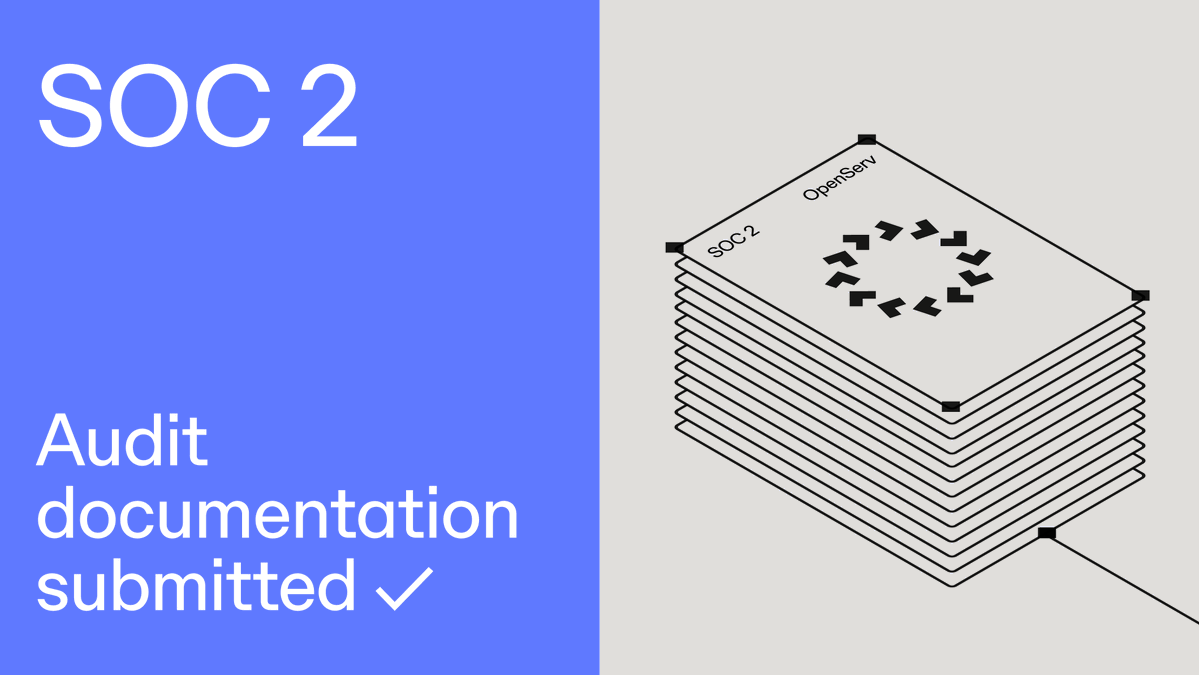
We're moving closer to a major milestone in OpenServ's enterprise expansion: SOC 2.
Following our work with Vanta, we've submitted our SOC 2 audit documentation to Prescient Security, with the independent audit beginning this month.
There's a massive opportunity for reliable, performant, and cost-effective AI infrastructure across the enterprise market. But for larger organizations, particularly in banking, financial services, and other regulated industries, performance alone isn't enough. Security and compliance are just as important when it comes to moving from evaluation to production.
As we continue building out SERV Reasoning's capabilities and enterprise distribution, we're also putting the necessary security foundations in place to support adoption at scale.
Completing the audit will be another important step toward opening up more commercial opportunities and bringing SERV Reasoning to a much broader enterprise market.
More to come as we progress through the audit.
The first enterprise distribution gateway for SERV Reasoning will be AWS Marketplace.
Through discussions with larger enterprises, we've seen how access through established marketplaces can simplify onboarding, with familiar procurement processes and provider review requirements helping remove barriers to adoption.
AWS Marketplace allows enterprises to discover, purchase, and deploy software through their existing AWS accounts and procurement processes.
For SERV, this opens an established enterprise distribution channel, bringing SERV Reasoning closer to organizations looking to adopt reliable AI infrastructure.
The opportunity is significant. Canalys projects enterprise software sales through cloud marketplaces to reach $85B by 2028.
Beyond scale, a Forrester Consulting study commissioned by AWS found procurement processes were 60% faster for its modeled enterprise using AWS Marketplace.
AWS is the first step in a broader strategy to bring SERV Reasoning into the channels enterprises already use to discover, procure, and deploy software globally, with minimal friction.
Another great TOKEN2049 in the books.
The demand for AI reasoning is here. Teams want better agent performance, lower costs, and the ability to unlock open source models for production use.
This came up time and time again in conversations throughout the week.
Our first SERV Reasoning Hackathon resulted in 70+ project built across agentic finance, RWAs, autonomous trading systems and more. Pretty incredible to see the range of things builders are already cooking with the infrastructure.
Singapore sparked some really interesting conversations about where we take things next.
We're exploring new ecosystem collaborations, potential integrations, and partners for the next SERV Reasoning Hackathon. Some of these conversations help shape the next tracks and bring even more builders, networks, and use cases into the ecosystem.
Shoutout to @reppo@GoKiteAI@dphnAI@BlockRunAI@codecopenflow
That's also a big part of what we're looking to do through SERV Labs.
Work alongside established projects and networks, bring more grassroots builders into the ecosystem, and keep pushing what's possible with SERV infrastructure.
At the same time, we're opening up new paths for enterprise adoption through established distribution channels and cloud marketplaces, starting with AWS.
Whether it's a cracked team building something entirely new or an enterprise deploying AI at scale, the underlying need for reliable reasoning is only going to grow.
Next up is SERV v3, Graph Sharding, specialized models, and broader distribution across both the ecosystem and enterprise markets.
We've come a long way, but are still so early in what SERV Reasoning can and will unlock.
Billions will SERV.
$SERV ISN’T BOTTOMING ON HYPE. IT’S BOTTOMING ON PRODUCT. 🧨
The market is still valuing SERV like a token, the product is already moving like infrastructure.
That’s the disconnect.
$SERV isn’t holding because CT is bored.
It’s holding because the product is already in production.
Most AI tokens are still selling what they plan to build.
OpenServ is already shipping.
1/
Q3 was the foundation phase.
SERV Reasoning API is public.
The first hackathon is done.
Real enterprise workloads are already running against it.
Now Q4 becomes the distribution phase:
Graph Sharding.
SERV v3.
SOC 2.
HIPAA.
$SERV as a payment currency.
Next hackathon.
Token2049.
That matters because the roadmap has actual deliverables attached to it.
Not another “AI is coming” slide.
2/
The strongest proof point is the Neol case.
Neol runs network intelligence for companies and governments, including UAE government workloads.
For high-stakes applications, “usually right” isn’t enough.
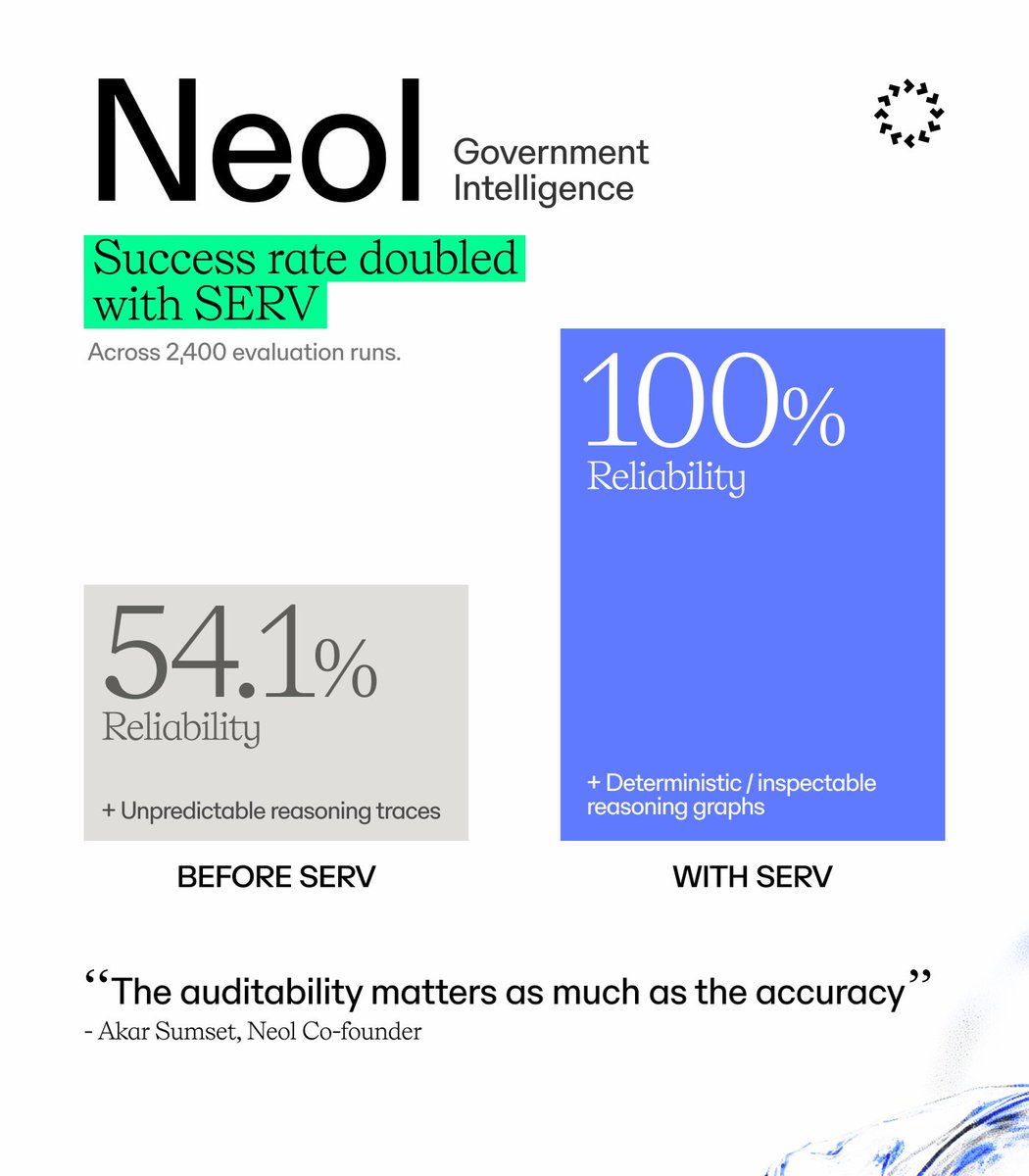
Their published evaluation across 2,400 runs showed:
54.1% — prompt-engineered stack
63.1% — SERV research applied
100% — full SERV Reasoning across every category
That’s the difference between another model wrapper and a reasoning layer.
Auditable graphs.
Not free-form chain-of-thought.
3/
Then look at how the token is designed around the product.
1B fixed supply.
77% already circulating.
No endless emissions schedule sitting over the book.
And demand isn’t purely hypothetical.
25% of SERV Reasoning API revenue is earmarked for market buys and burns.
Another 25% of launch pool trading fees is designed for the same mechanism.
The API is also drop-in compatible with OpenAI and Anthropic SDKs.
One line of code.
That gives SERV access to an enormous existing base of LLM applications.
4/
Staking adds another layer.
The Oct 2 update says stakers won’t simply receive a cut of platform fees.
They get a share of tokenized startups built on SERV Reasoning and launched through the platform.
No lockups.
Proportional accrual.
The docs route 5% of every launch toward stakers.
The rewards date is going to a community vote:
Oct 15 or Nov 15.
Active voters receive a 1.15x claim multiplier.
That’s a much more interesting mechanism than another points farm.
5/
Now the valuation becomes interesting.
$SERV is around ~$0.021.
$16M market cap.
770M of 1B circulating.
The 30 day chart is still green despite the recent weakness.
At that valuation, the market is still treating this like an early AI token.
But the product is already entering enterprise territory.
That’s the gap.
6/
What I’m watching next:
Graph Sharding.
Singapore / Token2049.
Rewards snapshot.
Enterprise pilots.
$SERV becoming a payment currency across the products.
SOC 2 and HIPAA opening the door to regulated buyers.
And most importantly:
Inference volume.
If usage scales, the buy and burn mechanism has something real to work with.
If usage doesn’t scale, $SERV stays a $16M option on enterprise AI infrastructure.
That’s the risk.
7/
So the thesis is pretty simple.
Product is live.
Enterprise proof point is already published.
Supply is fixed.
Token utility is expanding.
Roadmap has actual deliverables.
And the valuation still looks like the market hasn’t fully connected the dots.
I’m not interested in chasing the candle.
I’m watching whether the product keeps pulling demand toward the token.
Because if that happens, the current valuation becomes the least interesting number in this thread.
$SERV
We’re building SERV to become core infrastructure for Enterprise AI.
Our early work with Neol gave us a major advantage in building toward our vision.
We had the opportunity to develop SERV against live production workloads across companies and governments, including the UAE government, while establishing a growing footprint across the Middle East.
That meant access to real-world data and learnings that no theoretical framework or whitepaper could provide.
These learnings shaped v1 and v2 of SERV Reasoning, moving our technology from a theoretical framework to a real-world use case, which now feeds directly into SERV v3 and Graph Sharding, the next stage of the reasoning engine.
Neol runs network intelligence for governments and institutions, where agents surface real people for high-stakes decisions. In these environments, “usually right” isn’t good enough. The reasoning needs to be reliable, reproducible, and auditable.
On one of Neol’s production agents, the same evaluation was run 2,400 times:
- Prompt-engineered stack: 54.1% reliability
- SERV research applied directly: 63.1%
- Full SERV Reasoning methodology: 100% across every category
SERV moved the workload from open-ended reasoning into structured decision graphs, then applied learnings from production, including subgraph decomposition and binary judgments, to make the reasoning more deterministic and testable.
Higher reliability was only one part of the result. Neol gained an inspectable reasoning structure where results can be traced back to specific decisions, making the system easier to test, improve, and defend when challenged.
Our vision is to make SERV the reasoning layer enterprises and institutions rely on to run AI at scale. Neol is an early proof point of this journey.
been on ethereum:0x40e3d1a4b2c47d9aa61261f5606136ef73e28042 for 6+ months and the more they ship, the more i think people are still categorizing this wrong..
closest way i can explain it is something between langGraph and a reasoning layer...
LangGraph controls how agents run workflows, while SERV tries to sit underneath and make the reasoning itself more structured and reliable.
and they’ve been shipping alot of good stuff lately
> public SERV Reasoning API is live
> first hackathon done, with trading agents, AI funds, autonomous wallets, RWA risk, payments + gaming
> Q4 is Graph Sharding, fine tuned models, enterprise pilots, SOC 2 + HIPAA + ethereum:0x40e3d1a4b2c47d9aa61261f5606136ef73e28042 payments
currently models like GPT and Claude are getting insanely smart, we’re getting new models all the time, but actually getting that intelligence to work reliably in production is a whole different challenge..
that’s the layer SERV is going after
> it still sitting around ~$18m mc
> one of the most mispriced AI infra plays in crypto imo.
i’ve tried finding a crypto project close to what OpenServ is building but honestly i’m not sure there is one..
it’s sitting in a pretty weird spot between AI infra, reasoning and agents.
my thesis has always been the same, and we’ve caught some good plays with it..
near:native is a good example.
people didn’t really get the tech at $1.2, and now it’s sitting around $5ish..
build your conviction early by finding the good tech before the market catches up because eventually, it usually does..
ofc none of this is financial advice.. i always try to break down what a project is actually building and let you make your own decision..
Q3 marked the completion of the foundation phase of the SERV roadmap.
The SERV Reasoning API is live, making the technology publicly available for the first time. Since launch, we’ve onboarded builders through our first SERV Reasoning hackathon, expanded across real-world enterprise use cases, and laid the groundwork for the next stage of adoption.
Q4 will push SERV further across product, compliance, token utility, distribution, and ecosystem growth:
> SERV v3 & specialized models: launching Graph Sharding and advancing fine-tuned model training as SERV Reasoning moves into its next evolution.
> Enterprise adoption, distribution & financial services: turning an active pipeline into signed pilots and production deployments, expanding the channels through which enterprises can access and procure SERV.
> Global compliance: progressing SOC 2 certification and HIPAA compliance, building more of the credentials required to deploy across regulated industries.
> SERV token utility: integrating $SERV as a payment currency across SERV products and services, expanding the token’s role within the ecosystem.
> Builders & ecosystem: launching the next SERV Hackathon, expanding model-provider partnerships, and creating more opportunities for builders, customers, and partners to build with SERV.
> Industry & institutional expansion: kicking off the Hitchhikers collaboration, hosting our Token2049 event, and expanding SERV’s presence across industry events, government programs, advisors, and institutional relationships globally.
Every milestone on the SERV roadmap compounds toward the same goal: making SERV the reasoning layer the agentic economy runs on.
Billions will SERV.