A groundbreaking recent study has revealed that eating just one or more eggs per week can significantly reduce the risk of developing Alzheimer’s disease — by nearly 47%.
Researchers found that eggs are rich in choline, an essential nutrient that supports brain health, strengthens memory, and helps build cell membranes. Choline is a key ingredient for producing acetylcholine, a neurotransmitter involved in learning and focus. Lower levels of this compound have long been linked to cognitive decline.
While no food can guarantee protection from Alzheimer’s, this discovery highlights how small dietary choices can have profound effects on long-term mental health. One humble egg may hold part of the answer to keeping our memories alive — a simple breakfast with extraordinary potential.
[Pan, Y., Wallace, T. C., Kroska, T., Bennett, D. A., Agarwal, P., et Chung, M. (2025). Association of egg intake with Alzheimer’s dementia risk in older adults: The Rush Memory and Aging Project. The Journal of Nutrition]
🚨 Scientists Discover A Hidden “Second Brain” Inside Your Gut
Your gut may be thinking more than you realize.
Scientists say the human digestive system contains over 500 million neurons, forming a “second brain” that constantly communicates with the brain in your head. Research suggests it can influence mood, stress, sleep, memory, and even decision making.
This shocking discovery is changing how doctors view anxiety, depression, and overall health — proving the body is far more connected than we once believed.
Source: Stanford Medicine. The Enteric Nervous System: The Brain in the Gut
🚨 SCIENTISTS JUST DISCOVERED INTERSTELLAR “TUNNELS” CONNECTING OUR SOLAR SYSTEM TO OTHER STARS.
New data from the eROSITA X-ray telescope reveals that our Local Hot Bubble the 300-light-year-wide cavity of hot plasma surrounding the Sun isn’t an isolated pocket of space.
Instead, it’s linked by massive structural “tunnels” of hot, low-density gas stretching toward the constellations Centaurus and Canis Major.
Why this matters:
For decades we thought our cosmic neighborhood was a relatively empty void carved out by ancient supernovae.
eROSITA now shows it’s part of a much larger, foam-like network of hot interstellar channels.
These tunnels act as cosmic conduits for gas, energy, cosmic rays, and heat across the galaxy.
The deeper implication is staggering:
Our solar system isn’t sitting in a quiet little bubble.
We’re embedded in a dynamic, interconnected web of the Milky Way shaped by millions of years of stellar explosions and now revealed in stunning 3D detail.
Space around us is far more alive and connected than we ever imagined.
What happens when we start mapping the full galactic “foam” of these interstellar tunnels?
Follow for more frontier physics and cosmic discoveries.
A star can fight gravity for billions of years. But even stars have a breaking point.
Subrahmanyan Chandrasekhar discovered that a white dwarf cannot stay stable beyond about 1.44 times the mass of the Sun. Once it crosses that limit, collapse begins.
M ≈ 1.44 M☉
Beyond it, the star collapses and can trigger a supernova or form a neutron star.
🚨 What If Space Itself Is Made of Tiny Loops? The Theory That Could Rewrite Reality
Look around you. The ground beneath your feet, the air around you, the vast emptiness of space between stars — it all feels smooth and continuous. But what if that feeling is an illusion? What if the universe, at its deepest level, is not smooth at all… but built from unimaginably tiny pieces?
This is the strange and fascinating idea behind Loop Quantum Gravity.
For over a century, physicists have relied on two powerful theories to understand the universe. One is General Relativity, created by Albert Einstein, which explains gravity and the motion of planets, stars, and galaxies. The other is Quantum Mechanics, the strange science of atoms and particles. Both theories work incredibly well… but when scientists try to combine them, something goes terribly wrong.
The equations collapse. The laws of physics break down.
This problem becomes extreme inside black holes or at the moment our universe was born. Scientists realized that to truly understand reality, we need a completely new idea — a quantum theory of gravity.
That is where Loop Quantum Gravity enters the story.
According to this theory, space itself is not continuous. Instead, it is made from tiny building blocks woven together like a cosmic web. These structures are incredibly small — close to something called the Planck Length, the smallest meaningful size in nature. At that scale, space may look less like a smooth fabric and more like a network of microscopic loops.
Imagine zooming into space again and again, billions of billions of times smaller than an atom. Eventually, the smooth universe we see would dissolve into a shimmering lattice of quantum threads.
In this view, even space and time may not be fundamental. They could emerge from deeper connections between these tiny loops.
And this idea could change how we understand the most mysterious objects in the cosmos.
Inside a black hole, current physics predicts a singularity — a point where density becomes infinite and our equations stop working. But Loop Quantum Gravity suggests something astonishing: because space is made of discrete units, it cannot collapse forever. Instead of an infinite point, the collapse might stop and even bounce back.
Some physicists believe this could mean that black holes are not the ultimate end… but possibly gateways to new regions of space or even new universes.
The theory might also rewrite the story of our cosmic beginning. Instead of a singular Big Bang, the universe may have started with a cosmic bounce, where a previous universe collapsed and then rebounded into the one we live in today.
It sounds like science fiction. Yet mathematicians and physicists around the world are seriously exploring this possibility.
If Loop Quantum Gravity is correct, the universe is not an empty stage where reality unfolds. It is more like an immense, invisible network constantly weaving space, time, and existence itself.
And the most astonishing part?
All of this may be happening right beneath our feet — hidden in the smallest structure of reality.
The deeper scientists look into the universe… the more mysterious it becomes.
Scientists at Texas A&M University have developed an experimental nasal treatment that may help reverse some effects of brain aging, according to a recent animal study.
Researchers found that just two doses of the therapy improved memory, reduced chronic inflammation in the brain, and restored important cellular energy functions in older brains. While the treatment has not yet been tested in humans, the results have attracted attention because the effects appeared quickly and lasted for an extended period.
Aging brains are known to develop ongoing low-grade inflammation, often referred to as “neuroinflammation” or “inflammaging.” Over time, this process can affect memory, learning, concentration, and the brain’s ability to repair itself. It is also associated with conditions such as Alzheimer’s disease and other forms of dementia.
The treatment uses tiny naturally produced particles called extracellular vesicles (EVs), which cells use to communicate with one another. Scientists filled these vesicles with microRNAs, small molecules that help control gene activity and delivered them through a nasal spray designed to bypass the blood-brain barrier and reach the brain more directly.
The researchers reported that the therapy reduced inflammatory immune activity while also improving mitochondrial function. Mitochondria are responsible for producing the energy cells need to operate efficiently, and their decline is closely linked to aging and neurodegenerative disease.
In the study, treated brains performed better in memory and recognition tests than untreated groups. Researchers believe the therapy may help activate some of the brain’s natural repair mechanisms, although further studies especially in humans, are still needed.
This landmark study was published in the Journal of Extracellular Vesicles and funded by the National Institute on Aging.
This video looks like a rotating wheel. But watch just one single sphere. It never rotates. Every ball only moves in a perfectly straight line back and forth.
This is simple harmonic motion where linear position follows:
x = R cos(ωt)
By perfectly offsetting the timing of each straight path, the collective motion creates the illusion of rotation.
This is incredible!
Researchers are using stem cells to regenerate the lost cardiac muscle in heart failure patients, helping them to regain heart function without the need for a transplant.
And it seems to be working!
Grok gave, among other, this information:
"Important clarification (as noted in replies to the post and scientific coverage): This does not involve actual time travel, faster-than-light information transfer, or violations of causality. It's a wave-packet reshaping effect where the peak of the pulse appears to exit early, and the atomic response corroborates a negative dwell time in specific measurements. No information travels backward in time." ...
When an experiment is being prepared, the quantum waves are already starting. The quantum waves have infinite length. Then, it is natural that in some experiments something happen before the intuitively expected time. Nothing is violated, the strange descriptions happen just because the experimental settings were not rightly understood.
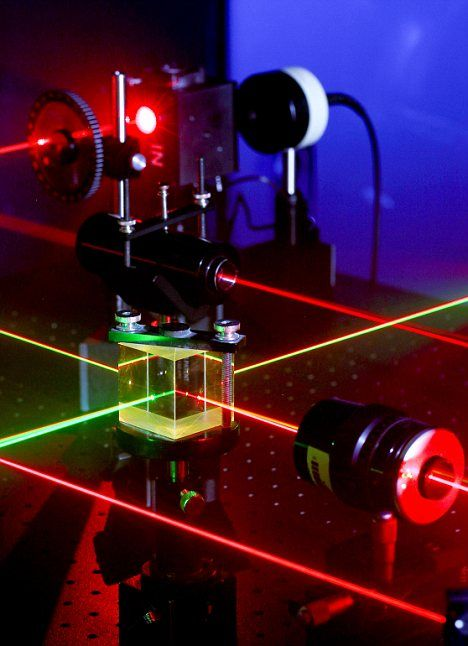
🚨: Physicists just measured negative time in lab
Researchers fired photons — particles of light — through a cloud of rubidium atoms. The photons emerged earlier than they should have — even at the speed of light. And the atoms themselves confirmed it — they stored the photon’s energy for a negative duration.
Here’s the part that makes your brain hurt.
Imagine leaving your house at 9am and arriving at work at 8:45am. You didn’t travel back in time. But somehow you arrived before you should have.
That’s exactly what these photons did.
The very fabric of space-time at the smallest scales is thought to be extremely turbulent and chaotic, described as a frothy sea called quantum foam. This concept, stemming from quantum mechanics and general relativity, suggests that the very nature of space-time is bubbling with tiny wormholes and fluctuations that appear and disappear within fractions of a second.
📷by Johann Rosario




![Rainmaker1973's tweet photo. A groundbreaking recent study has revealed that eating just one or more eggs per week can significantly reduce the risk of developing Alzheimer’s disease — by nearly 47%.
Researchers found that eggs are rich in choline, an essential nutrient that supports brain health, strengthens memory, and helps build cell membranes. Choline is a key ingredient for producing acetylcholine, a neurotransmitter involved in learning and focus. Lower levels of this compound have long been linked to cognitive decline.
While no food can guarantee protection from Alzheimer’s, this discovery highlights how small dietary choices can have profound effects on long-term mental health. One humble egg may hold part of the answer to keeping our memories alive — a simple breakfast with extraordinary potential.
[Pan, Y., Wallace, T. C., Kroska, T., Bennett, D. A., Agarwal, P., et Chung, M. (2025). Association of egg intake with Alzheimer’s dementia risk in older adults: The Rush Memory and Aging Project. The Journal of Nutrition]](https://pbs.twimg.com/media/HGvO6xoaUAA5kEZ.png)





