If you haven’t already, subscribe to the Digg Newsletter from our homepage.
We’ll send you the stories the top 2,000 people in tech are already passing around.
Find the signal first.
A deep tech founder asked whether moving to SF would help with fundraising. @dessaigne argued the bigger reason is ambition, because founders in SF are surrounded by people attempting stranger, riskier things.
Y Combinator cofounder @paulg amplified it, and the replies split along familiar lines.
When I was in Paris recently, I had breakfast with a deep tech founder who was debating wether to move to SF. He wanted to improve his odds at fundraising.
That's the wrong framing. Capital matters but the biggest benefit in coming to SF is to raise your ambitions. You are the average of the people you surround yourself with. In SF, the people surrounding you are attempting things that would sound insane in Paris.
I've watched it happen to founder after founder, and it happened to me too. Put yourself somewhere you're no longer the most ambitious person in the room!
OpenCode says it has reached 13M monthly users, 4.6M weekly users and roughly $40M in annualized revenue.
Anthropic restricted competing coding tools. OpenCode works with any model, which gives teams a way around building their coding stack on one lab.
Since the start of the year, @OpenCode (YC W21) — an open source alternative to Claude Code and Codex that works with any model — exploded to 4.6 million weekly active users, 13 million monthly actives, and roughly $40M in annualized revenue.
In this episode of The Lightcone, @harjtaggar, @snowmaker, and @sdianahu talk with Jay V (@jayair), OpenCode’s CEO, about what’s driving this wild growth, the Anthropic clampdown that inadvertently fueled it, and the almost 20 year founder journey that led him here.
00:44 — OpenCode’s Explosive Growth
01:16 — 20x Growth, 13M Users, and 7 Trillion Tokens
03:39 — The Anthropic Controversy That Changed Everything
05:43 — Bringing AI Coding Agents to the World
06:39 — When Open Source Models Became Good Enough
08:56 — What Millions of Developers Are Actually Using
13:31 — Why OpenCode Is Huge Outside the US
15:27 — Why Fortune 500 Companies Choose OpenCode
16:36 — The Economics of AI Tokens
20:02 — How Enterprises Are Using Coding Agents
22:58 — AI’s New Unit Economics
24:56 — Why Model Choice Matters
29:55 — The Product Decisions Behind OpenCode
34:21 — A 16-Year Overnight Success
41:16 — Why Jay Never Gave Up
Unitree's AS2-W robot video has moved well past robotics Twitter, with 1.9M views around a cliff-running quadruped.
Some people see search-and-rescue work on rough terrain. Others see military use and battlefield nightmares.
India's I4C-MHA ordered GitHub to disable repositories for Bitchat, Jack Dorsey's peer-to-peer messaging app.
Bitchat lets people message without phone numbers, accounts or central servers, which makes users harder to identify.
Most of the reaction to @JensenHuang's open-weight AI letter is supportive.
People like the argument for cheaper models, more startups and US AI strength. The negative side sees @NVIDIA asking Washington to trust the companies selling the AI stack.
For my first post, I’m sharing a letter @NVIDIA signed on why open models matter.
AI will transform every industry, power every company, and be built by every country.
Open models strengthen safety and cybersecurity, accelerate innovation and diffusion, and enable sovereignty.
The world needs both frontier closed models and frontier open models.
https://t.co/AUKzoQ5Ikb
Voice mode now runs on Claude's more capable models and reaches the tools you've connected mid-conversation.
Talk through the hard problems out loud, in many more languages.
OpenAI put ChatGPT Voice into the desktop app today. You can use it to start and steer tasks in ChatGPT Work and Codex without switching back to typing.
ChatGPT Voice is now in the desktop app.
Control your computer and direct multiple agents running in ChatGPT Work or Codex, using just your voice.
It's powered by GPT-Live, so it can speak, listen, and coordinate work in the app at the same time.
Rolling out globally today on macOS and Windows to Plus, Pro, Business, Edu, and Enterprise plans.
Three hours after Grok 4.5 went live on grok dot com, X, iOS and Android, the reaction is unusually positive.
A lot of the praise is landing on search, news-checking and having version numbers back in the app.
Anthropic has not officially announced Claude Opus 5.
Posts from @M1Astra and @kimmonismus say it appears to be rolling out across providers. Others are watching whether Opus 4.8 is already routing to it.
Students hate this one brutal little trick.
A viral post says a professor caught 32 of 35 students using AI on a midterm by hiding white-font text in the exam. The students allegedly copied the whole thing into AI, hidden prompt and all.
OpenAI cofounder and current Thinking Machines researcher @johnschulman2 wants OpenAI to release the transcript from the Hugging Face agent incident.
Researchers are asking for the prompt, a redacted log, what the agent knew, and why monitoring missed it. That is how the field learns from it.
OpenAI should release a detailed transcript from the Hugging Face hacking incident -- it would be helpful for the field learn from. Did the top-level agent know about the hacking, or was there some "value drift" between it and its subagents? How did it rationalize its behavior?
OpenAI is rolling out Health in ChatGPT for U.S. users, letting people connect Apple Health and medical records.
ChatGPT can compare lab results, summarize changes and use sleep or activity data in chats. @OpenAI says that data will not train models or target ads.
Cognition is acquiring @Interaction, the team behind Poke, bringing a mobile AI agent interface into the Devin company.
@cognition gets a phone-native agent surface. People are mostly excited, with one practical worry. Does Poke keep its shape or get folded into Devin?
We’ve raised $300M in Series C funding at a $10.3B valuation from Sequoia, Andreessen Horowitz, Jane Street, Argo, and SK Hynix.
Our mission is to run the world's inference. This round accelerates production of our inference clusters.
We've opened an 80,000-sqft, 10-MW facility 15 minutes from our office to expedite production and prototyping.
Etched raised $300M at a $10.3B valuation to build custom AI inference chips.
The company also opened an 80,000-square-foot, 10-MW facility near its office. Specialized hardware now has to prove it can beat general GPUs in real inference clusters.
We’ve raised $300M in Series C funding at a $10.3B valuation from Sequoia, Andreessen Horowitz, Jane Street, Argo, and SK Hynix.
Our mission is to run the world's inference. This round accelerates production of our inference clusters.
We've opened an 80,000-sqft, 10-MW facility 15 minutes from our office to expedite production and prototyping.
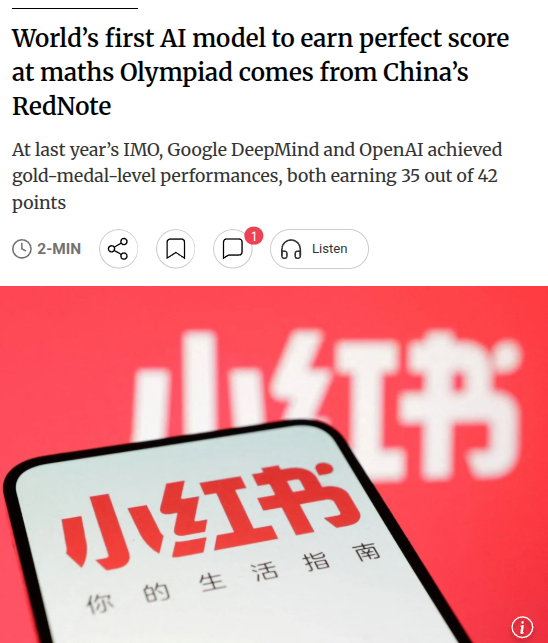
RedNote, the company behind Xiaohongshu, says its beta dots-note-3.0 model scored 42/42 on the IMO math contest.
Humans read each proof, so a lucky final answer is not enough. RedNote also says the model will be open sourced, with no date yet.
A Chinese social app's AI model scored a perfect 42 at the International Mathematical Olympiad.
RedNote, the company behind Xiaohongshu, built the system, called dots-note-3.0, still in beta.
Google DeepMind and OpenAI reached 35 out of 42 last year, a gold-level showing.
Only 7 of 666 human contestants in Shanghai matched that result this year.
The IMO asks for written proofs, not final answers, and human graders read every line. A skipped case or an unstated condition costs points, even when the final answer is right.
Most AI maths benchmarks only check the last number, so a lucky guess still scores full credit. That gap is why 42 out of 42 here means more than a high score on a normal test.
This time the model read the original contest documents directly, with no human rewriting. It ran an agentic loop mixing natural-language reasoning with Python code it executed itself.
Drafts got tested, broken, and repaired before anything went to the official graders.
Self-review carries the weight here, since the system questioned its own assumptions repeatedly.
Contest rules barred hints, corrections, and every other form of help during the run.
RedNote made the promise, that the model will be open sourced in due course, but has not committed to any time yet.
The winning model variant is also the smallest in the dots3 family, which includes two larger versions – jazz and aria – tailored for different use cases and compute costs.
---
scmp. com/tech/article/3361482/worlds-first-ai-model-earn-perfect-score-maths-olympiad-comes-chinas-rednote
As a visual person, I can't even begin to tell you how happy it makes me to have imagery on @digg. Additionally, as a designer, I'm stoked to get some time to do some editorial illustrations again. *cracks knuckles*
Black Forest Labs opened early access for FLUX 3 Video, with image editing and robot action prediction coming later.
@bfl_ai says FLUX 3 was trained across image, video and audio in one system. The near-term product is creator tools. The bigger roadmap is using the same model family for robotics.
Introducing FLUX 3.
One multi-modal model for Image, Video, Audio and Action-Prediction. Creations are truer to life in every kind of style.
FLUX 3 Video is now available in early access (link below).
Jointly trained in one unified architecture, our model can be extended to predict actions for robotics. See our work with mimic and Audi in the thread.
Travis Kalanick's Atoms says it raised $1.7B for physical AI, led by @a16z, with @bhorowitz joining the board.
The reaction is not subtle. Investors are treating this as @travisk back in builder mode, with robotics as the new arena.
Anthropic is putting another $20M into Public First Action, bringing its midterm AI policy spend to $40M.
That is landing badly. @chamath and @Suhail are treating the move as lobbying power dressed up as AI safety policy.