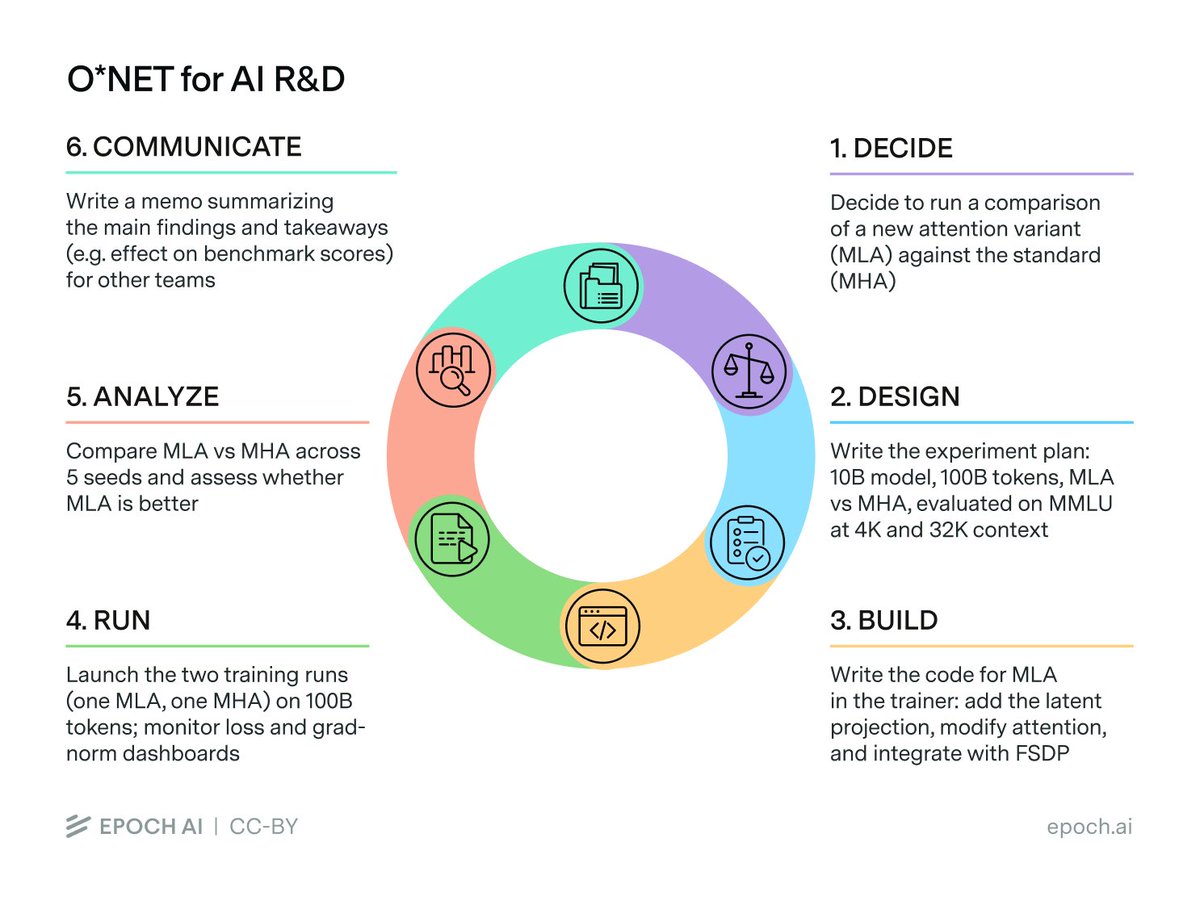
How close is AI to automating AI R&D? Right now, the tools economists use to track automation are too blunt to say.
In this week's newsletter, @datagenproc, @joemkwon, and @ansonwhho propose a sharper tool: a thorough taxonomy of 60+ tasks involved in frontier AI research. 🧵
I like working out of both Stanford and Constellation, because my econ-of-AI views are usually “right in between” the views of the people I respect in the singularitarian community and the people I respect in the economics community. Of course, the communities I happen to have wound up part of probably largely determine what my views are in the first place. But I do think it's an interesting sociological fact that there seem to be fewer people with something like my "in between" views than people at either extreme.
It’s funny to use the term “right in between” when the poles are so distant, but concretely--
On the technological question of whether by, say, 2040 we'll get superintelligence [machines that can shortly thereafter cure death, develop atomically precise manufacturing, solve or dissolve ~all our perennial philosophical disputes, and tell us how to quickly build von Neumann probes that put Dyson spheres around the stars]: For my singularitarian friends this is the default outcome of the trajectory we're on, and 2040 is late. For the economists (like almost everyone else), even contemplating this stuff is nutty. I give it a 10-20% chance.
On GDP: For my singularitarian friends, building fully humanoid bots (which I do think is more likely than not by 2040) will be analogous to a return to a Kremer (1993)-style Malthusian world in which GDP grows ~hyperbolically (so, with the growth rate itself rising to infinity). The economy, on this view, will ultimately grow at the rate at which robots can multiply, which is bounded below by the rate at which octopuses can multiply, which is 250,000x/yr. For my economist friends, humanoid bots would just be another step in the ongoing process of automation sustaining 2-3% growth. My central guess is that preferences for humans in some domains; nonhomothetic preferences for new goods (see https://t.co/Mmct8FgJX4, "New goods Baumol"); and regulation will all meaningfully constrain growth from the octopus baseline, so that this century contains "only" around 1 more OOM increase in the GDP growth rate, to ~20-30%/year.
Likewise, on real interest rates: central guess is their peak "steady state" this century is not >25 million %/yr, but ~30%/year
On wages: Singularitarians tend to think they'll fall to ~0; economists tend to say they'll grow roughly as fast as the economy at large; I think they'll rise but not as fast as the economy (so that the labor share will fall a lot)
Etc.
I think the reason is just that the communities somewhat seal themselves off from each other, so the insights from each take a while to seep through to the other. This doesn't mean that they're both doing something wrong--maybe one of them is just a cult (a majority too can be in a cult!) and the other shouldn't be updating toward them at all--but I do think it means that at least one of them is doing something wrong. Without going full "Aumann's theorem", I think that even without common priors or common knowledge of rationality, an environment with healthy information flow would usually exhibit single-peaked distributions of opinion on these sorts of questions.
Economics of AGI episode w Alex Imas and Phil Trammell.
There's a bunch of important questions about how we deal with AI that only economics can answer.
What is the optimal way to tax and redistribute the wealth that will be generated? How should countries not in the AI supply chain index into the gains? Is there any world where inequality doesn't explode?
It might seem like these questions have obvious answers, but the first thing economics teaches you is that your intuitions can often be entirely wrong.
It was very helpful to chat through these things with Alex and Phil.
Look up Dwarkesh Podcast on Apple Podcasts, YouTube, or Spotify. Enjoy!
00:00:00 – Will capital share increase?
00:19:36 – Messy Middle scenario
00:25:57 – How to tax and redistribute AI wealth
00:30:02 – Why demand collapse is unlikely
00:39:26 – Human employees would be hard to integrate into the machine economy
00:43:08 – What if some humans (or AIs) value wealth accumulation intrinsically?
01:01:28 – What should developing countries do?
With my great co-authors at @CenTaxUK, we have built a matched worker-to-firm database for the UK: the Business-to-Worker Register.
It covers the universe of UK workers (not just employees) and all UK organisations (not just employers, corporations or private sector).
Short 🧵
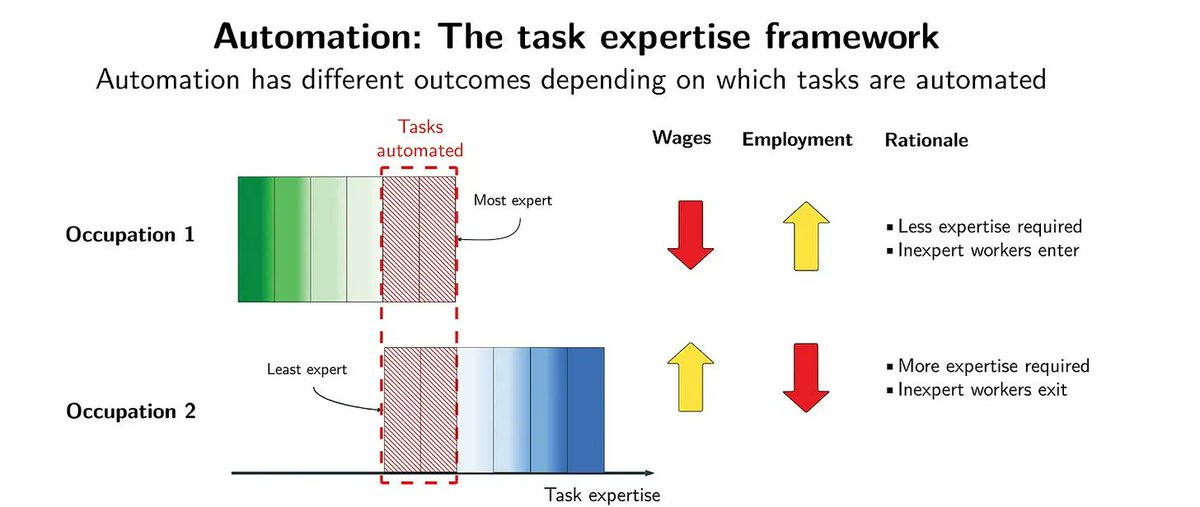
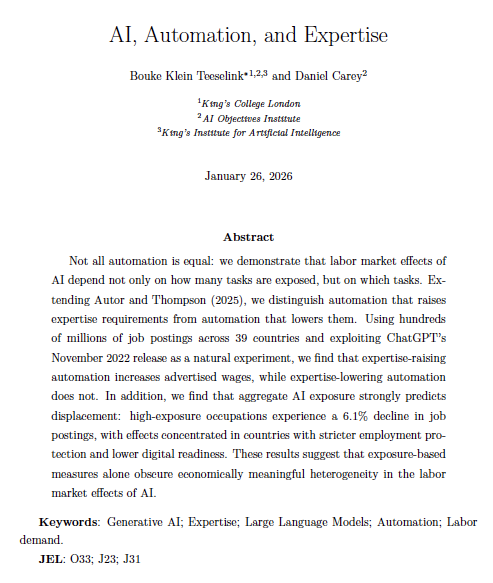
AI exposure reduced job postings by 6.1% across 39 countries — but wages haven't fallen. New @windfalltrust AI Economics Brief explains why expertise composition is the key variable.
🚨 New research: AI, Automation, and Expertise🚨
We analyze hundreds of millions of job ads across 39 countries to understand how AI is changing labor markets around the world.
Joint with @DanDaEconMan@KingsCollegeLon@AIObjectives
I'm concerned by some work around the growth effects of AI using aggregate production functions - I put together some thoughts here: https://t.co/HT8jSqpCML
New draft!
We develop a technique for safely delegating to a strategic AI that may be misaligned with your objectives—without assuming you can restrict its choices, punish it, or otherwise control it once deployed.
How? Sequential information design with imperfect recall. 🧵
New draft!
We develop a technique for safely delegating to a strategic AI that may be misaligned with your objectives—without assuming you can restrict its choices, punish it, or otherwise control it once deployed.
How? Sequential information design with imperfect recall. 🧵
This paper on AI and growth, posted to SSRN in February and blogged on Marginal Revolution on March 22, claims that even given AGI, global productivity growth will likely turn negative (Fig. 6). This sounds unlikely, and indeed it’s due to a mistake:
https://t.co/rdGPJtVEjR
Thank you to @GPIOxford and @OxfordEconDept for the invitation.
My talk next week will argue that human agency - the ability of humans to make decisions that shape their lives in environments – is a fundamental value, but is currently under two related threats:
RIP. Bob Solow an absolute giant in Economics, has passed away at age 99. Tremendously influential in the profession and one of the key founders of the MIT Economics department as we live it today. Will be sorely missed.
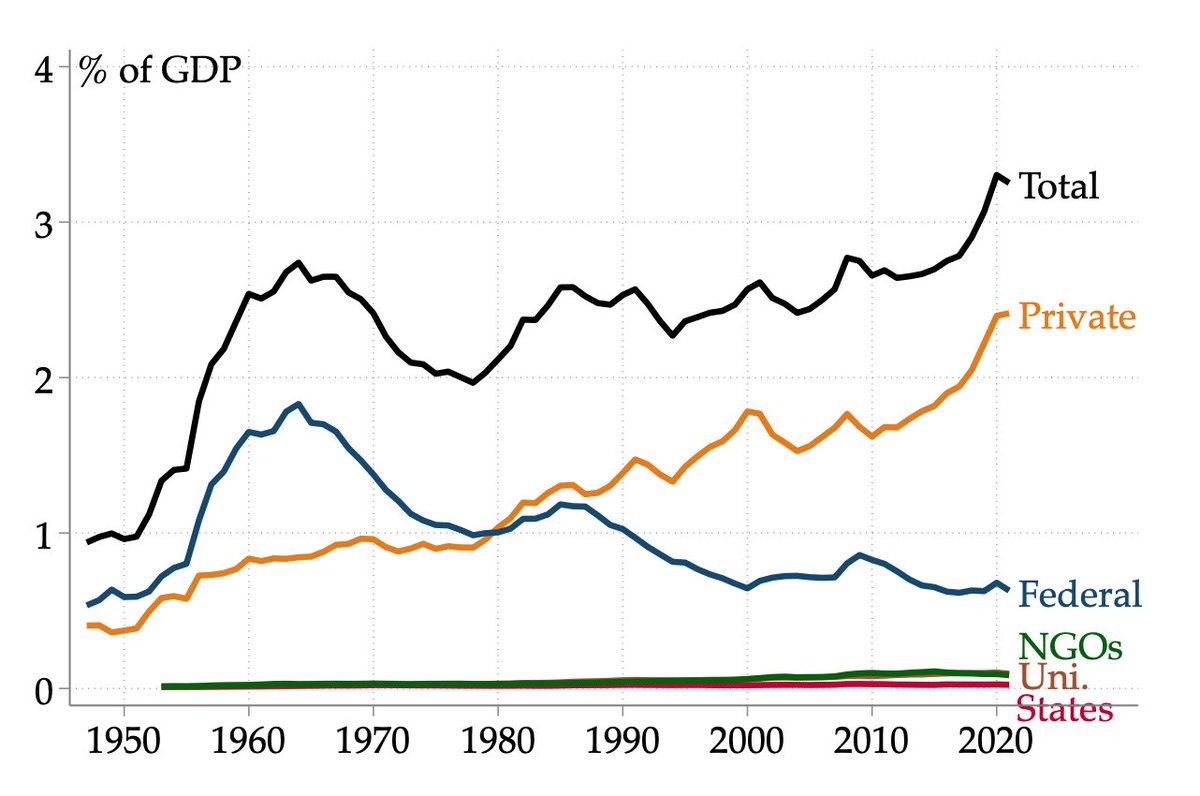
I am really excited to share my Job Market Paper "Public R&D Spillovers and Productivity Growth". (https://t.co/VNSWzWmyA3)
I investigate the consequences of the large decline in publicly-funded R&D on productivity growth in the US.
Short summary below 👇 1/15
Applications are now open for Postdoctoral and Senior Research Fellowships in economics (applications close noon UK time on 22 November)! More information can be found here: https://t.co/UO18M6UYYg
This is an incredibly unique and supportive institute to be doing cutting-edge and impactful economics research. Please send it to anyone who might be interested.
My paper, "The Cross-Sectional Implications of the Social Discount Rate", is forthcoming in Econometrica! The basic idea of the paper in 5 tweets, and then some acknowledgements
1/9
@TheZvi@mrgunn You misunderstand. The RC just says that, according to Total Utilitarianism, for any population of happy people W there in principle exists a population V consisting only of people with lives barely worth living such that the V is better than W. It's not an empirical claim.