AI may feel weightless, but its growth depends on very physical systems: electricity, cooling water, heat exchange, and urban infrastructure.
ESE's new cover article about “Global data-centre–wastewater symbiosis” reimagines this challenge as a circular infrastructure opportunity.
Read the article here: https://t.co/RvwH4fDlwx.
A focused scientific exchange, now published:
Wu et al. argue that global restoration models systematically overlook avoided emissions from degraded wetlands — an ongoing carbon source that dominates near-term climate value, particularly for peatlands.
Tölgyesi et al. respond with explicit quantification: incorporating wetland avoided emissions (~4% of global GHGs) shifts their projected offset from 3.7–12.0% to 3.7–12.3% — a modest adjustment that leaves their core conclusion intact, while acknowledging the methodological gap is real.
The exchange surfaces a question that extends well beyond these two papers: Are current restoration models asking the right question — "How much carbon can we sink?" — or should the primary metric be "What emissions can we stop?"
The answer has direct implications for where restoration funding flows.
We invite readers to engage with both perspectives:
📄 Wu et al.: https://t.co/JNunUEF0wF📄 Tölgyesi et al.: https://t.co/CH5sXs0AOo
#EcosystemRestoration #Peatlands #ClimatePolicy #NatureBasedSolutions
Engineering #OxygenVacancies in MnFe2O4 spinel oxide shifts the d-band center from −1.10 to −0.95 eV, driving two-electron #DirectOxidativeTransfer for selective phenol polymerization and sustained 97.5% removal with ultra-low oxidant.
Read the full article free of charge:
https://t.co/h2YcGdBoAB
Across 40,722 Chinese WWTPs, integrated SEM-IML analysis identifies ammonia removal as the strongest causal driver of #GHGemission intensity (5.65% surge per 10% increase) while 10% reduction in regional grid electricity emission factor enables 4.45% mitigation, revealing critical tension between stringent discharge standards and #climategoals.
Read the full article free of charge here:
https://t.co/FMvPtDW0PH
Data–water symbiosis: Coupling data centres with wastewater treatment plants could cut 84 million tonnes of CO₂ eq and save 1,300 million m3 of freshwater annually, via @EurekAlert! https://t.co/51BBLqAvTP
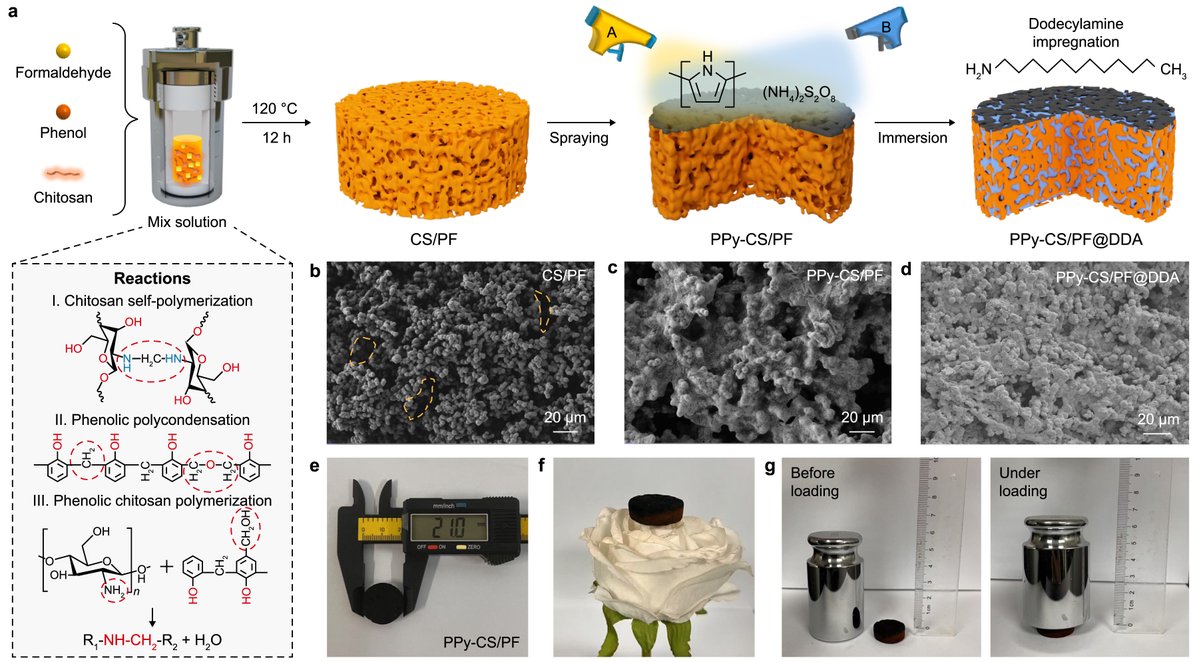
Solar-driven interfacial evaporation (SDIE), synonymous with interfacial solar evaporation, localizes photothermal conversion at the water–air interface. PPy-CS/PF@DDA foam achieves 95% solar absorption, 1.862 kg m⁻² h⁻¹ under 1 sun, 0.684 kg m⁻² h⁻¹ in darkness, 1.763 kg m⁻² h⁻¹ in 20 wt% NaCl brine, and 9.229 kg m⁻² freshwater in 10 h outdoor. https://t.co/KrAGhgY4VA
@OUC1924, @HaolanXu, @PengWang_KAUST, @JiaZhu_NJU, @AAlabastri, @XuanWu_USA, @GaryOwensUniSA, @LinZhou_NJU, @MeijieChen_USTC, @ChaoZhang_SJTU, @YingyingZhang_USTC, @BinZhu_NJU, @NingXu_NJU, @XiuqiangLi_NJU, @JinyouLu_NJU, @WeiHe_1, @DeyuWang_USA, @XingyuChen_USTC, @QinYe_USTC, @HongxiaLi_NJU