As promised, a 🧵 on our recent article now out in @NatureSMB! Co-led with @AbbyBartlett_@Pagliarini_Lab@JudithSimcox, we find ACAD10/11 are NOT like other acyl-CoA dehydrogenases and instead catabolize atypical lipids called 4-hydroxy acids 🤯#lipidtime https://t.co/u1E4kniIso
Reminder that xCT-driven cell death (for instance induced by glucose deprivation) does not mean disulfidptosis,
That iron-dependent cell death does not equal ferroptosis,
That cysteine toxicity does not mean ferroptosis even if it's iron-dependent,
etc
https://t.co/HmJtK0kOg8
Excited to share my new preprint from the @RutterLab! What sets a cell’s metabolic state? Using MPC1 as a readout in a CRISPR screen, we found that β-catenin regulates metabolic state in liver cancer cells, driving a switch from carbohydrate to fat oxidation. 🧵
Interested in studying the origins of lung cancer and regulation of development, cell fate, metabolism in human lung progenitors? All in a rigorous, science-loving, supportive environment?
I'm looking for postdoctoral fellows, students, technicians! DM me.
Please retweet!
STING is a conserved regulator of lipid metabolism
https://t.co/5BouFRj00i
Why are there so many evolutionarily conserved functions between lipid metabolism and inflammation? Eicosanoids, caspases...
What's the primordial connection?!
Lipid droplets for defense, @AlbertPol10?
Our paper on a new genome annotation for the pathogen Acanthamoeba castellanii is now online at @cellpressblue! https://t.co/09a4u5Dbm4. This was a key foundation for our separate AcMitoCarta paper. Grateful to John Samuelson and @VamsiMootha for their mentorship!
Our paper "Mitochondrial proteome of Acanthamoeba delineates aerobic and anaerobic pathways dynamically regulated by oxygen" is online now @CellCellPress! https://t.co/NPjdwdwcHD. Grateful to my amazing post-doc mentor @VamsiMootha and all the other team members!
Today, the MitoCarta Tree of Life Consortium (MitoTOL) is releasing high-accuracy mitochondrial proteomes across diverse eukaryotes to empower studies of physiology, evolution, and disease:
https://t.co/hRt6ZG4lQP
All data can be accessed at:
https://t.co/oPFODZBQ60
1/ Happy to see this collaborative work w/ Fangzhu Zhao, @realJimWells & colleagues now published in @PNASNews!
LRP8-targeted KineTACs degrade LRP8, reduce GPX4 & other selenoproteins, and sensitize cancer cells to ferroptosis.
https://t.co/TMJGr55NPd
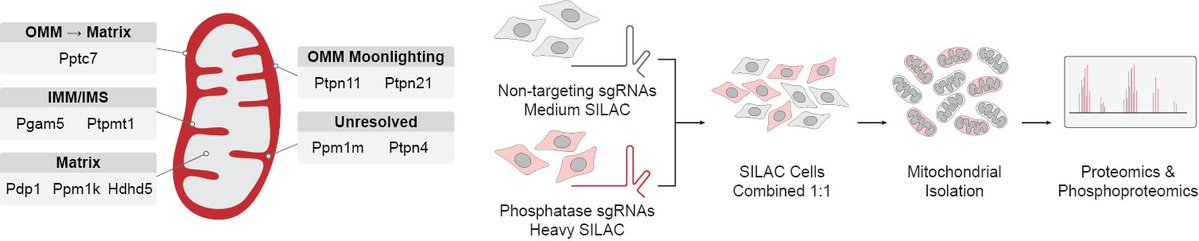
~90% of mitochondrial proteins have at least one phosphosite.
Only ~1% of these sites have a reported function.
Is this regulation or noise?
We silenced 10 resident mitochondrial phosphatases, one at a time, to find out. New preprint 🧵👇
Is phosphorylation broadly relevant to mitochondrial protein function? In work led by @AJsmith231, we silenced 10 mito phosphatases, mapped dynamic sites, and revealed functional implications for import, catalysis, and morphology.
https://t.co/eeu6BzKL7z
# Mitochondria
#HHMINews
Have you ever wanted to talk to your molecules? Now you can with Chat with PyMOL!
We built this in the Romero Lab to make PyMOL more accessible to our BME undergrads, but quickly found it’s simply a better way to interact with molecular structures. (1/2)
#lipidtime: It's a lipid universe. Today in Nature we publish the Lipid Brain Atlas, the first map of membrane lipid composition across the entire mouse brain, a layer of organisation that cell-type and transcript maps had left out. #lipidomics#neuroscience#BrainAtlas
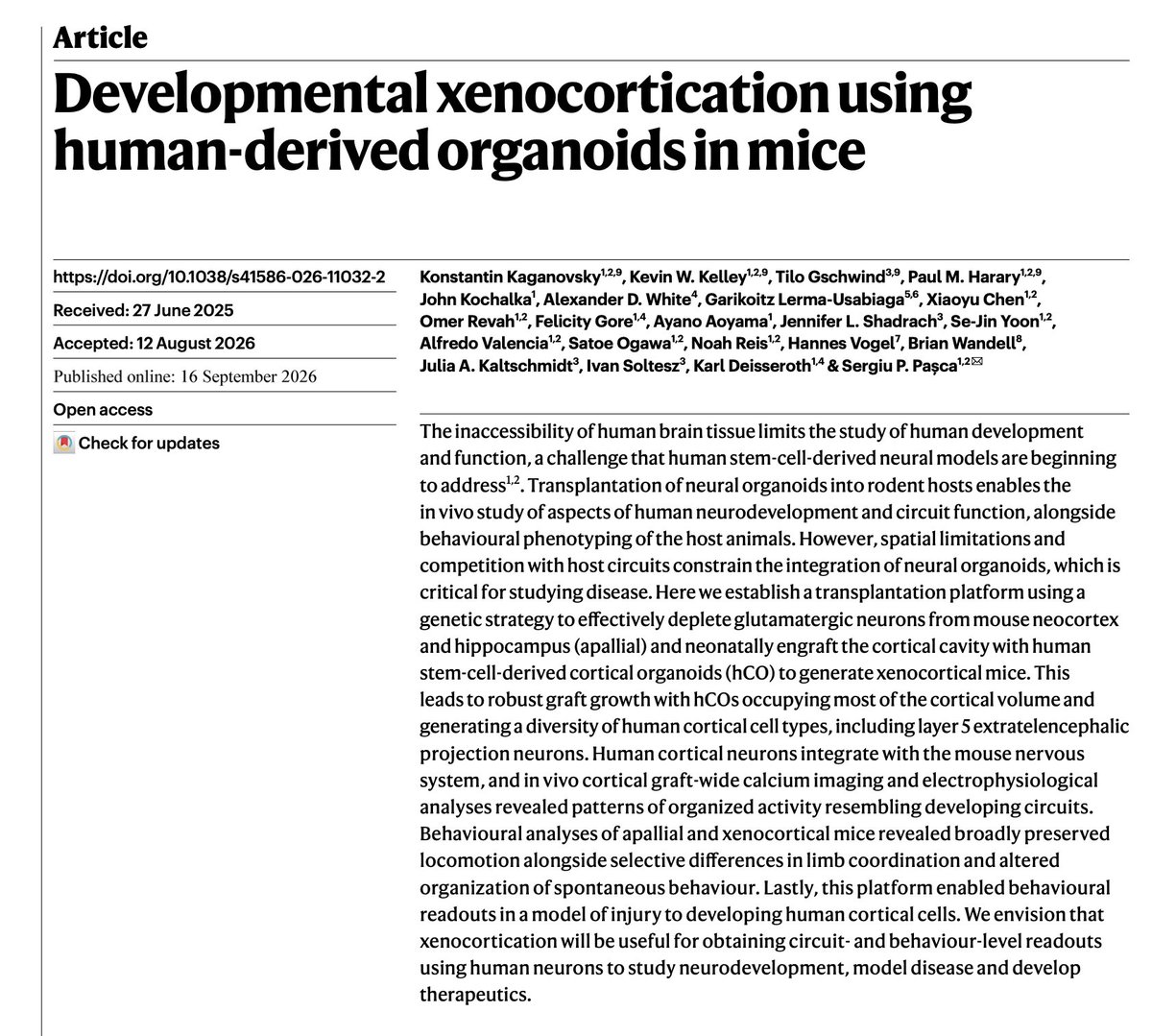
An extraordinary @Nature paper has just landed from the lab of @Sergiu_P_Pasca at @Stanford - led by Konstantin Kaganovsky. They have found a way to create "xenocortical mice" which have ~92% of their cortex occupied by a cortical organoid derived from human stem cells. This human-derived cortical graft integrates deeply with the host nervous system, supporting organised neural activity and behaviour.
This study is a milestone in synthetic biology and chimera research. It has the potential to generate multiple medical breakthroughs by providing an enhanced biological model of human brain tissue that allows behavioural as well as neural and genetic assays.
The Stanford team have been exceptionally thorough and proactive in addressing ethical concerns that comes from this frontier work. But their pioneering work nonetheless raises many open questions: are the xenocortical mice conscious? Do they have any human-like properties of consciousness or cognition?
@NitaFarahany and I will be addressing some of these questions in a forthcoming commentary - where we'll also offer an ethically-informed roadmap to guide this important research as it progresses. In this context, "pacing the frontier" really does make sense 😉
Read the Stanford @nature paper here, and buckle up. It's wild. https://t.co/Ky9HFb9nYI
Our Tabula Sapiens 2.0 is online at @CellCellPress! We doubled our dataset to >1.1M cells across 28 tissues, mapped expression of human transcription factors, and analyzed cellular senescence programs. The atlas is open access. Read the paper here: https://t.co/mwc44xhA9a