@Morning_Joe@JoeNBC : it might be good to just visit Columbia University! Your description is wrong. The focus is one two things: divestment and ceasefire, not antisemitism. These are activities that Columbia and USA are involved in. Other wars do not involve Columbia/USA
Ever had a list of gene hits and not known what to do? Maybe GO enrichment left you wondering what your favorite gene is doing in your experiment? Check out GeneWalk, our #ML method that determines the relevant functions for each gene @robertietswaart (1/4)https://t.co/UpbAr96laM
mRNA structure is necessary and sufficient for mRNA modification with pseudouridine: https://t.co/BRU9iZfmgC Carlile et al. @NatureChemBio So, how are the mRNA structures themselves regulated..? We're seeking new students and postdocs to find out!
@RonBreaker@snmalkowski@YaleChem@RNAJournal I wonder if ATP or ADP is the endogenous regulator...based on the EC50’s it seems like a lot of potential ligands are present at the right concentration to control this riboswitch. Could it function to integrate a host of adenosine metabolites, rather than just one?
@yegracechen@HowardYChang Really interesting story, but hard to reconcile w/ Anderson paper saying that contaminants are the cause of immune responses. But still cool to see m6A can suppress immune responses in foreign circular (not linear) RNA. https://t.co/ZjWOkUJfr7
How do you identify RNA molecules that are subcellularly localized? This #WIREs RNA review by @JMTali summarizes classical and modern methods: https://t.co/Ah2S2HzUmK @rnabioco
Twisters! Litke and @SamieJaffrey describe in @NatureBiotech (https://t.co/GRS48nkjsx) how to make circular #RNA in cells using the "Tornado" method - a good #SynBio use for twister #ribozyme motifs. Now, why are there so many natural twisters? Image from Eiler et al., 2014.
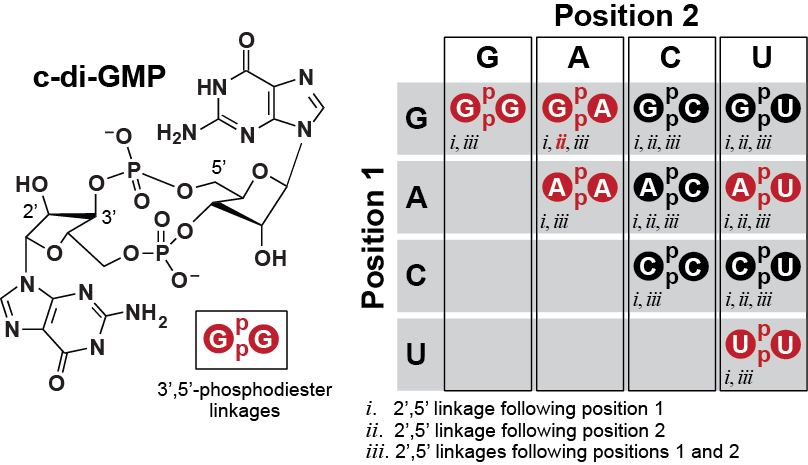
Whiteley et al. @Nature paper on enzymes making new cyclic dinucleotides (https://t.co/ZsEnv3ImcC) forces an update to the possible #RNAWorld language list. Image from (https://t.co/T8kVoVRrdX) shows all possible standard c-di-NMPs; red means strong evidence of bio-relevance.
Can’t wait to read this and learn whether codon optimality is relevant in mammalian cells, and how it differs from zebrafish and yeast! High expectations, I know... https://t.co/JCXmZBJzy4
Ingenious approach for expressing RNA aptamers (and shRNA, gRNA, mRNA, etc.) at high levels in cells! This expression method is a game changer. https://t.co/bbLZmOA46p
@RNApreprints Certain codons are rare in E. coli and their presence is used to signal the presence of a viral invader and its RNA. So I think the RNA toxicity may be part of this defense mechanism.
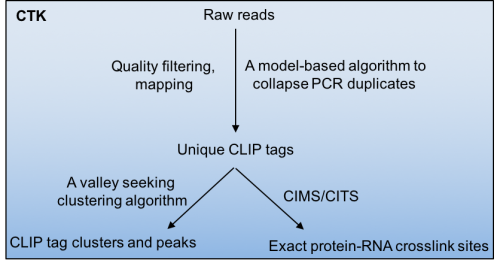
Glad to announce the release of CTK v1.0.8, a major update with various improvement, including improved stability and simplification of pipeline. Also features step-by-step tutorials for several major #CLIP protocols. #proteinrnainteractions, #CLIP, #CTK https://t.co/K5bP9JvswX