I just built Computer Use that’s cheaper, faster, and acts like a human 🖥️
Powered by @typesafeai’s JEV 1.14, using the new Image/Box feature.
It looks at the screen, decides what to do, then clicks and types like a real person.
⚡ Way cheaper than using an LLM
🧑 Acts like a human: sees the screen, picks an action, clicks or types it
📋 Full report of every step: the screenshot, the action it picked and why
Demo: I told it to open Wikipedia, search for an article about aliens, copy the link, and post a tweet with the link and some text.
- Cost: $0.0019
- Tokens: ~50,000
OPEN SOURCING SOON on my github 👀 (as always)
Claude Code can now use almost any app on your computer, not just your code.
CLI-Anything wraps desktop software in a command line an AI agent can operate: GIMP, Blender, LibreOffice, Calibre and a growing list of community-built ones.
→ CLI-Hub works like an app store for agent-ready tools
→ No CLI for your app yet? A plugin generates one
→ Works with Claude Code, Cursor, Codex, OpenClaw and more
Try one in two commands:
pip install cli-anything-hub
cli-hub install gimp
Add the generator to Claude Code:
/plugin marketplace add HKUDS/CLI-Anything
/plugin install cli-anything
You still need the real app installed: GIMP for the GIMP CLI, Blender for the Blender one.
52K+ GitHub stars. Apache-2.0.
https://t.co/oA5nOgl0iF
@mattpocockuk's skills repo has more stars than React, and the most installed skill is one line long.
I animated how his whole workflow works, from /grill-me to /retro
holy sh*t. Official Anthropic tip for Claude Code: stop burning Opus 5.5 context on tasks Haiku 5.5 can swarm, while Sonnet 5.5 builds
put the architect on call with /advisor
claude --advisor opus --subagents haiku
Sonnet 5.5 drives the primary session on high effort, writing diffs and running test suites
Haiku 5.5 subagents swarm the repo in parallel at 340 tok/s, handling file discovery and spec docs lookup
Opus 5.5 stays on call in the background as the advisor, only stepping in at three critical moments:
→ before a plan locks: does the implementation plan miss auth invariants or schema contracts?
→ when a test breaks twice: are we fixing the root cause or falling into a recursive rabbit hole?
→ before calling done: did the full diff introduce hidden regressions or break pre-flight rules?
Opus 5.5 reviews. Sonnet 5.5 builds. Haiku 5.5 swarms
Jev engineering runs the identical pattern one layer down: mechanical decisions that need no reasoning (which file to open, which tool to invoke, retry or abort) execute in 16ms, so the frontier models only wake up when execution paths actually diverge
Plan on high. Delegate on medium. Keep Opus on call.
- the full advisor setup
> Opus 5.5 on call reads full session history and catches deep architectural traps
> Sonnet 5.5 lead drives edits, writes core logic, and executes test harnesses
> Haiku 5.5 subagents swarm AST parsing, grep scans, and API docs in parallel
> JEV micro-fork layer resolves 1,500+ mechanical routing branches in under 16ms
> advisor stays completely silent on routine bash execution to protect context
paste the setup and this prompt into Claude Code below:
"Configure my Claude Code workspace for hierarchical advisor orchestration:
1. Audit ~/.claude/settings.json and project config for model roles fitting lead, subagents, and advisor:
> Pin main session model: sonnet with effortLevel: high for primary execution
> Pin subagents model: haiku with effortLevel: medium for parallel file discovery and docs retrieval
> Pin advisor model: opus on call for strategic review
2. Enable the advisor tool in ~/.claude/settings.json:
> Set advisorModel to claude-opus-5-5
> Enable subagent parallel dispatcher pool (3x workers)
3. Configure automatic advisor consultation checkpoints in ~/.claude/CLAUDE.md:
> Consult /advisor opus before finalizing multi-file architecture plans
> Automatically summon /advisor opus when the same test or compiler error fails twice
> Enforce advisor diff contract audit before declaring tasks complete or staging git commits
4. Constrain subagent scopes:
> Haiku subagents return structured AST summaries and docs snippets only without modifying main session context
Show every configuration diff first. Do not apply edits until confirmed"
↳
https://t.co/gvAWk6KbDn
The site scores 100/100 on is-agentic, so you can just point your agent at it. No install, no setup.
"Read https://t.co/qqfBbHexkM before you write CSS."
Today's hot take:
Agents are actually really good at strategic programming
It's just they aren't RL'd to actually care about it
"Just do the task at hand, don't do anything else"
So all you need to do is to tell your agent to care about its own codebase.
But the truth is that most people actually don't care that much about the codebase, as long as the code works.
This needs to change. Care about the code, and tell your agent to.
Prompt of the day:
/writing-for-agents my AGENTS.md is a hot mess, propose a series of restructurings that:
- Remove no-ops
- Use progressive disclosure
- Move instructions to CODING_STANDARDS.md
Apply your work over three subagents, each more radical than the last. Create a single PR.
AGENTS.md is the most common source of token inefficiency. This prompt kills it dead.
We'll be spending a lot more time trying to understand the outputs of language models. A few thoughts, tips & tricks:
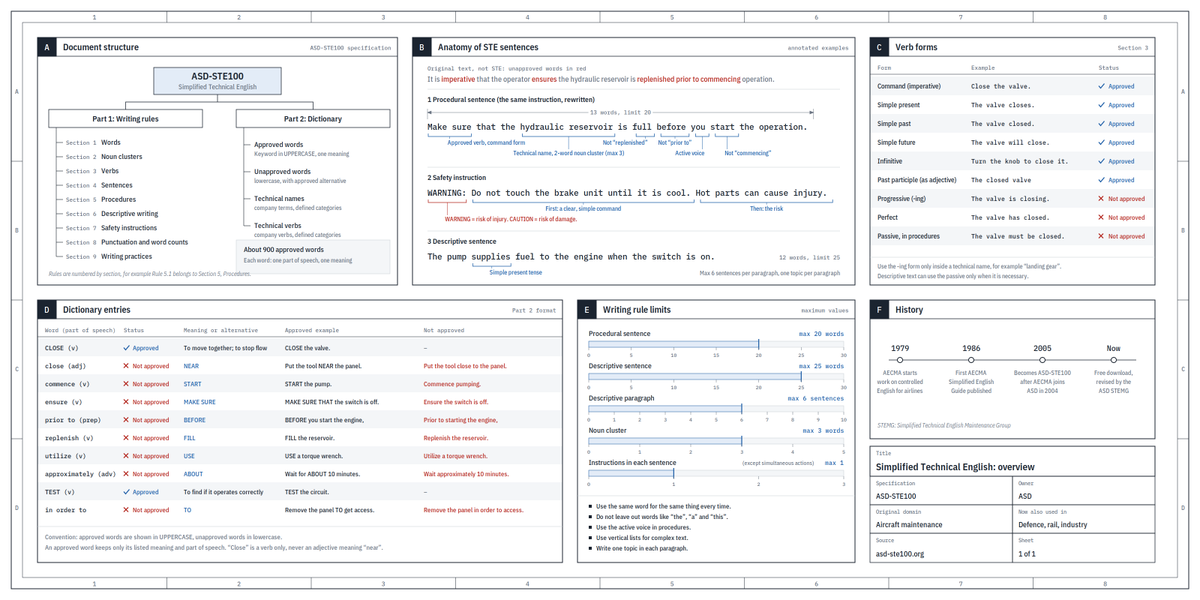
Writing. Something I've had success with: Ask your LLM to explain something in ASD-STE100, it's a controlled language specification originally developed for aerospace maintenance documentation. LLMs well-versed in this language and it comes with heavy constraints on clean writing style that I often find a lot more readable. Sometimes I've tried to soften it a bit e.g. ask for "80% of the way to ASD-STE100" because the spec is quite stringent. But even better:
Diagrams / images. Instead of writing, ask your LLM to create a diagram. These can be a lot easier to process, parse, and understand. But even better:
Web pages. Ask for output "in HTML" to get a beautiful, interactive webpage. LLMs are getting really good at frontend and can create beautiful experiences, animations, etc. But even better:
Explainer videos. The output format I am most bullish on is fully custom / bespoke explainer videos generated on any arbitrary topic. Experiment with things like "Create a 3b1b style video explainer on X. Use my ElevenLabs API key for audio narration". (you'd need an API key for the latter or you can ask your LLM to find you decent free alternatives that use your local compute). This is actually starting to work!
In summary:
- As LLMs get better, they will do more and more of the legwork autonomously, and a lot more of our work will rise up the abstractions into oversight and understanding.
- Luckily, LLMs can help here too because as intelligence and code are increasingly abundant, you can ask for large, custom, discardable software artifacts (e.g. web apps, video explainers) that would have never made sense to create before. Push the boundaries here and you'll be surprised.
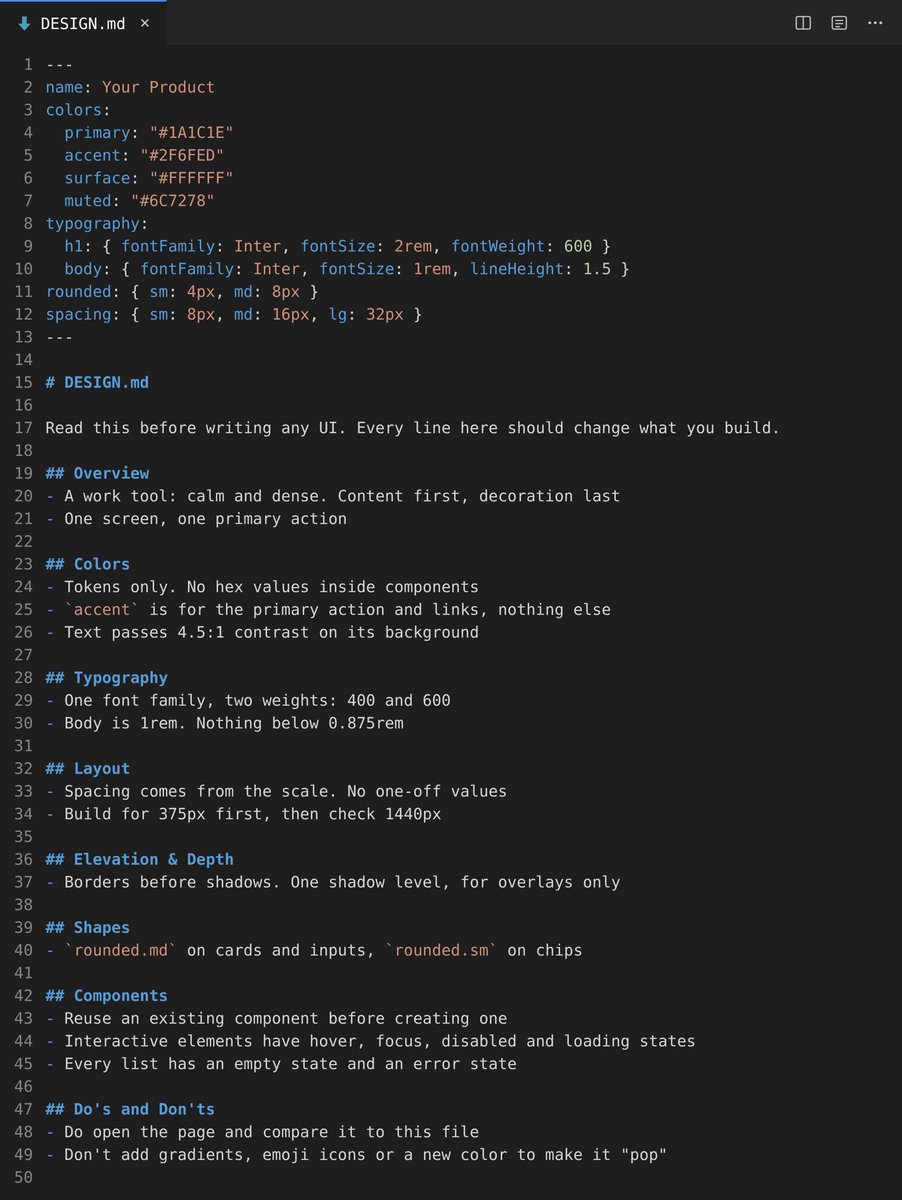
This 𝗗𝗘𝗦𝗜𝗚𝗡.𝗺𝗱 stops Claude Code and Codex from 𝘀𝗵𝗶𝗽𝗽𝗶𝗻𝗴 𝗴𝗲𝗻𝗲𝗿𝗶𝗰 𝗔𝗜 𝗨𝗜.
It's Google's open format. Stitch reads it natively. Claude Code and Codex read it once you add one line to AGENTS .md:
"Read DESIGN .md before any UI work."
Tokens on top, rules below:
→ Overview
→ Colors
→ Typography
→ Layout
→ Elevation & Depth
→ Shapes
→ Components
→ Do's and Don'ts
The agent stops inventing a new color and spacing value on each screen, so 𝗲𝘃𝗲𝗿𝘆 𝘀𝗰𝗿𝗲𝗲𝗻 𝗹𝗼𝗼𝗸𝘀 𝗹𝗶𝗸𝗲 𝘁𝗵𝗲 𝘀𝗮𝗺𝗲 𝗽𝗿𝗼𝗱𝘂𝗰𝘁.
Claude Code users: also install the official frontend plugin:
/plugin install frontend-design@claude-plugins-official
Check your file against the spec:
npx @google/design.md lint DESIGN .md
Copy and paste it into your DESIGN .md 👇
Prompt of the day:
/retro read my last 10 coding agent sessions and find ways to make my repo easier to navigate. Find where agents take too long to find relevant information, or rely on out-of-date docs.
Improving navigability is such an underrated way to save tokens.
Claude can now analyze how you actually use it
Run /insights and Opus 5.5 reviews your last 200 sessions to find what you work on, where you get stuck, and features you’re missing.
opus 5.5 is f**king insane
drop this into Claude Opus 5.5 and watch it design the agents, prompts, and workflows for you.
Steal this before everyone starts using it:
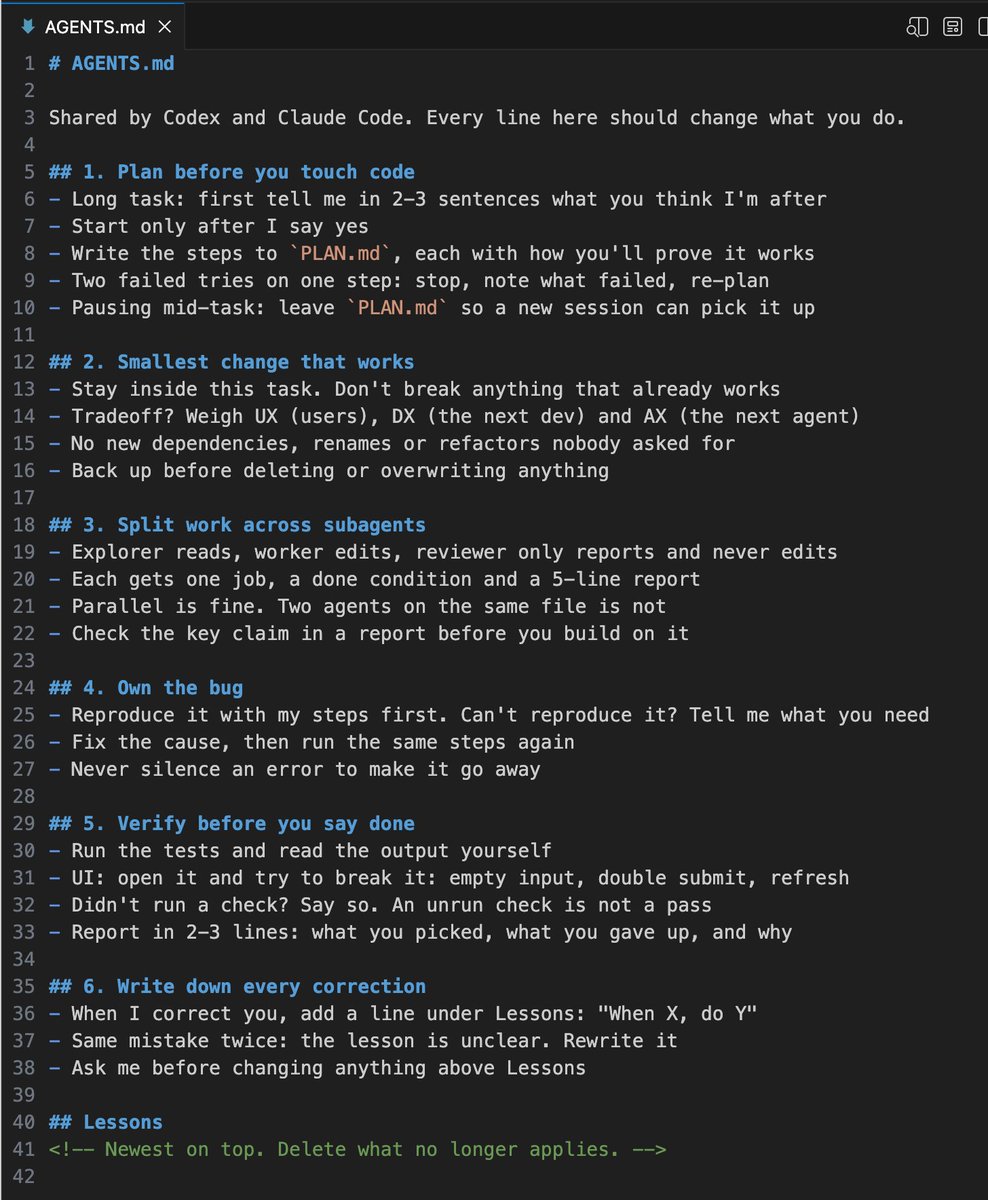
This AGENTS.md gets Claude Code and Codex 𝘄𝗼𝗿𝗸𝗶𝗻𝗴 𝗹𝗶𝗸𝗲 𝟭𝟬𝘅 𝗲𝗻𝗴𝗶𝗻𝗲𝗲𝗿𝘀.
Codex reads it natively. Recent versions of Claude Code read it too when there's no CLAUDE.md.
Six sections:
→ Plan before you touch code
→ Smallest change that works
→ Split work across subagents
→ Own the bug
→ Verify before you say done
→ Write down every correction
The file gets better the more you use it. Each correction makes it 𝗳𝗶𝘁 𝘆𝗼𝘂 𝗮 𝗹𝗶𝘁𝘁𝗹𝗲 𝗯𝗲𝘁𝘁𝗲𝗿.
Claude Code users: also install the official plugin, then have it scan your codebase and recommend the hooks, skills and subagents worth adding:
/plugin install claude-code-setup@claude-plugins-official
Copy and paste it into your AGENTS.md 👇
UN INGENIERO DE ANTHROPIC ACABA DE SOLTAR EL MEJOR TRUCO PARA OPUS 5.5
Abre Claude Code y escribe:
/claude-api prompt-audit
→ Audita tus skills, CLAUDE.md y prompts
→ Borra todo lo que frena al modelo
→ Lo reescribe con la guía oficial de Opus 5.5
Tus prompts están escritos para modelos viejos.
Esto lo arregla en 5 minutos.
Guárdalo.
Por: @RLanceMartin
Claude Coders: Run this prompt for Opus 5.5 *NOW*.
'/doctor prompt-audit'
Different from a viral post I had earlier this week because it prioritizes stale paths, obsolete commands, and conflicting instructions.
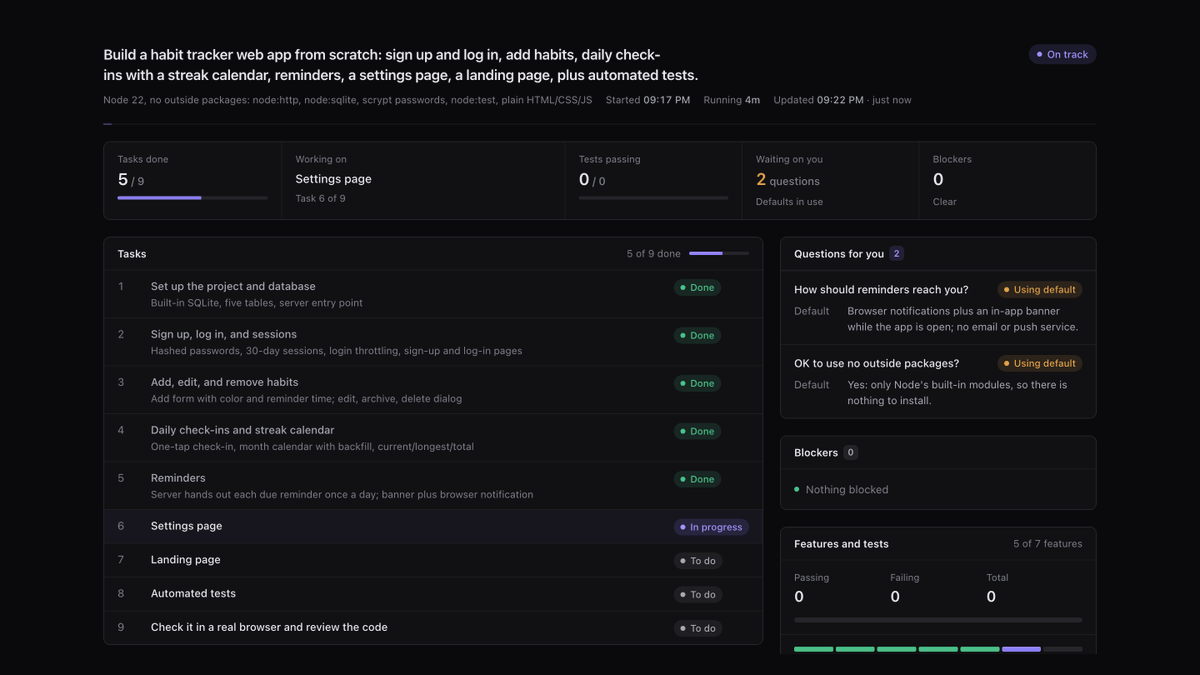
Every time you let Opus 5.5 run a long task on its own, have it vibe-code a quick 𝗛𝗧𝗠𝗟 𝗱𝗮𝘀𝗵𝗯𝗼𝗮𝗿𝗱 like this first.
Then give it 𝗮 𝘀𝘂𝗯𝗮𝗴𝗲𝗻𝘁 𝘁𝗵𝗮𝘁 𝗼𝗻𝗹𝘆 𝗯𝘂𝗶𝗹𝗱𝘀 𝗱𝗮𝘀𝗵𝗯𝗼𝗮𝗿𝗱𝘀:
→ Name it dashboard-builder, set its effort to medium, and preload a design skill
→ The first time, it asks what style you like and saves it to memory. After that, every dashboard fits your taste and the task at hand
→ Call it before every long task. It builds the dashboard in the background in about two minutes, and the main session keeps coding on high without stopping
→ The dashboard shows four things: task progress, what's stuck, questions waiting on you, and what it'll do by default if you don't answer
Send this prompt to Claude Code 👇
"Set up a subagent that only builds progress dashboards:
1. Create dashboard-builder in ~/.claude/agents: model: opus, effort: medium, memory: user. Preload the design skills I have installed (for example impeccable). It can only read and write the .dashboard/ folder and its own memory.
2. The first time, it asks me what style I like: dark or light, dense or airy, and one accent color. It saves my answer to memory and follows it every time. Pick the panels for the current task; don't use a template.
3. The dashboard is one HTML file showing tasks and their status, questions waiting for me with the default action, the latest deliverables, and anything stuck. Use the real clock for every time. It opens with a double-click and refreshes itself every 10 seconds.
4. Add a rule to ~/.claude/CLAUDE.md: for any task with more than 5 steps or that should take longer than 30 minutes, have dashboard-builder set up the dashboard before starting; update it after every step; when you need a decision from me, add it to the questions list and keep going with the default.
Show me the contents of the files you'll create or change, then explain the whole flow in words a 10-year-old could follow. Don't write anything until I confirm."
I recorded a 47-minute tutorial on how I use Opus 5.5 to create designs with gorgeous three.js scenes.
I've been using Mobbin MCP to give my agents strong references, then letting Opus bring them together into a full landing page with multiple sections and a consistent design.
Opus also created a super detailed brand guide, logo explorations, and some amazing ad creatives. Went way beyond my expectations.
Live site: https://t.co/XvMDmU4EAI
Site made during the tutorial, with prompts: https://t.co/5edYikmZEG