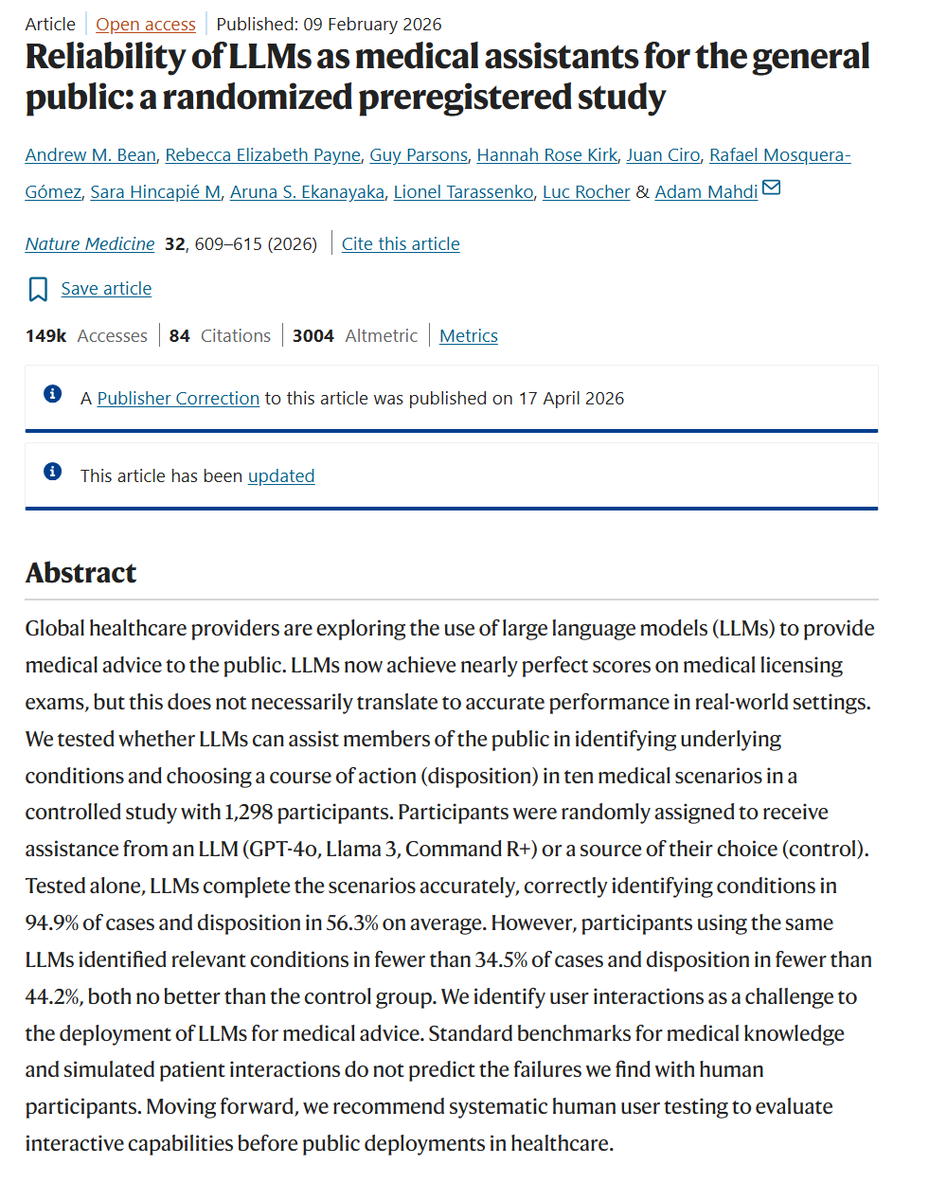
This is a well-designed randomized control study that asks the question: Does an LLM's ability to diagnose and manage the same medical scenarios degrade when a patient is the communicator versus a physician.
The result: 60% drop in diagnostic accuracy, 12% drop in appropriate management decisions
The answer essentially confirms the following suspicions:
1. LLMs are suggestible, naive, and sycophantic
2. Medical literacy drives output; less literacy, less accurate LLM outputs
3. Prompting still confounds frontier models' medical accuracy
It is not safe to have people trust LLM medical advice when they're incapable of detecting their own bias and inaccuracies.
this is excellent
>GitLab founder diagnosed with rare cancer (osteosarcoma)
>standard care works but cancer comes back later
>medical team says there's not much else to do
>"It became my own job to keep myself alive. Nobody else was going to do it for me at this point"
>starts researching, assembles his own medical team, uses AI for deep research
>“I’ll talk to anyone, I’ll go anywhere, and I can be there anytime" to collect information
>does as many diagnostic tests as he can find as often as he can (maximal diagnostics)
>develops his own therapeutic ladder with repurposed drugs, personalized medicine, etc
>Sid’s cancer currently in remission
This is insane… OpenAI Anthropic & Google just got access to petabytes of proprietary Data, The data is coming from the 17 National Laboratories, which have been hoarding experimental data for decades.
We aren't just talking about better chatbots anymore. The US Government’s new Genesis Mission is officially building autonomous scientific agents.
They call it "Closed-Loop" discovery, and it fundamentally changes the physics of how we invent things. Instead of humans using tools, it will be fully autonomous.
The workflow described in the DOE roadmap is essentially sci-fi:
• The AI Designs: It looks at the data and hypothesizes: "If we mix these alloys at 4,000 degrees, we get a superconductor."
• It sends instructions to a robotic lab (which the DOE is building) to physically mix the materials.
• The robot feeds the results back instantly. If it fails, the AI tweaks the formula.
• This cycle runs thousands of times a day, 24/7. No sleeping. No grant writing.
HOLY SHIT IT'S HAPPENING
AI can now write genomes from scratch.
Arc Institute an NVIDIA just published Evo-2, the largest AI model for biology, trained on 9.3 trillion DNA base pairs spanning the entire tree of life.
it doesn’t just analyze genomes. it creates them
1/
📢Excited to introduce NanoCas -our new mini CRISPR system that can reach tissues previously out of reach!
By shrinking CRISPR to 1/3 its normal size, we can now edit genes in muscle, heart & brain that were difficult to access before. Summary & link to paper:
Excited to attend my first #RSNA24! As an MS3 with a background in CS/Software Engineering and a passion for AI, I'm eager to learn from those innovating the #Radiology space and connect with leaders shaping the future. Looking forward to bridging the gap between Radiology and AI for smarter, tech-driven healthcare! #MedStudent #Innovation #RSNA
Recap of Tesla's We, Robot event:
Cybercab:
- Will cost around $30,000
- Operating cost of about $0.20 a mile
- Will have robotic cleaning and wireless charging
- Will be able to make money for people on its own
- In production before 2027
Optimus Robot:
- Will cost between $20,000 and $30,000
- Will be used to complete tasks and chores
- Can talk like humans and move like humans
- Expected to be ready by 2025
Robovan:
- Autonomous bus
- Can transport up to 20 people
- Can also be used to transport goods
- No current timeline
Computerized physician order entry (CPOE) was imposed on us by bureaucrats who never practiced medicine. They insisted that forcing physicians to enter their own orders into the system would decrease errors, but this was never properly studied.
What's worse is that this system metastasized into an expectation that physicians must place every single order, no matter how trivial, into a slow and cumbersome computer system. For a "simple" order, the process of logging in, finding the patient chart, entering the order, completing the required checkboxes, and clicking "sign" can take 2-5 minutes. Ordering an MRI alone takes more than 50 clicks.
By contrast, a paper order could be as easy as writing "MRI brain" on a sheet and handing it to a nurse. Repeating this process for hundreds of orders a day chains physicians to computers, pulling them away from patient care.
Because CPOE is now the mandate, every small change in patient care requires a new order. Want the CT scan at a different facility? The physician must update the order. Medication needs to go through a feeding tube instead of by mouth? The physician must change the order. Need to adjust medication, advance the diet, or modify neuro-checks? More orders.
On top of that, "hard stops" prevent signing the order until every meaningless checkbox is complete, sometimes delaying life-saving care. This system, designed to reduce errors, ironically increases the burden on physicians and threatens patient care efficiency. It's time for @CMSGov to clarify CPOE for hospitals, taking steps to de-tether physicians from their computers.
@AJHolmgren@JPGK_MD@ReasObBob@sdixitmd@anish_koka
Programming is changing so fast... I'm trying VS Code Cursor + Sonnet 3.5 instead of GitHub Copilot again and I think it's now a net win. Just empirically, over the last few days most of my "programming" is now writing English (prompting and then reviewing and editing the generated diffs), and doing a bit of "half-coding" where you write the first chunk of the code you'd like, maybe comment it a bit so the LLM knows what the plan is, and then tab tab tab through completions. Sometimes you get a 100-line diff to your code that nails it, which could have taken 10+ minutes before.
I still don't think I got sufficiently used to all the features. It's a bit like learning to code all over again but I basically can't imagine going back to "unassisted" coding at this point, which was the only possibility just ~3 years ago.
ELON: THE OPTIMUS NUMBERS ARE SO MIND-BLOWING THAT THEY DON’T LOOK REAL
“The Optimus numbers, they're so mind-blowing that you're like, is this real?
I actually think the market for humanoid robots is in excess of 10 billion units, more than the number of humans.
Because people each want one, and then there'll be others that are involved in industry.
So, if they do sell at even a volume for $20,000, that's $200T.
This is just an insane number.
That's why I wonder, what does money even mean at that point.”
Source: X Takeover, July 28, 2024
By 2034, your 9-5 job will be extinct.
Everything will be so cheap you won't have to work anymore.
That's Marc Andreessen's latest prediction — the billionaire investor who predicted the rise of the internet in 1993.
Here's what he said next:
A new paper has lit up the longevity field. Removal of interleukin-11 improves health and extends mouse lifespan by up to 24%. Human therapies are being developed 🧵 https://t.co/1PTPgfSyKD
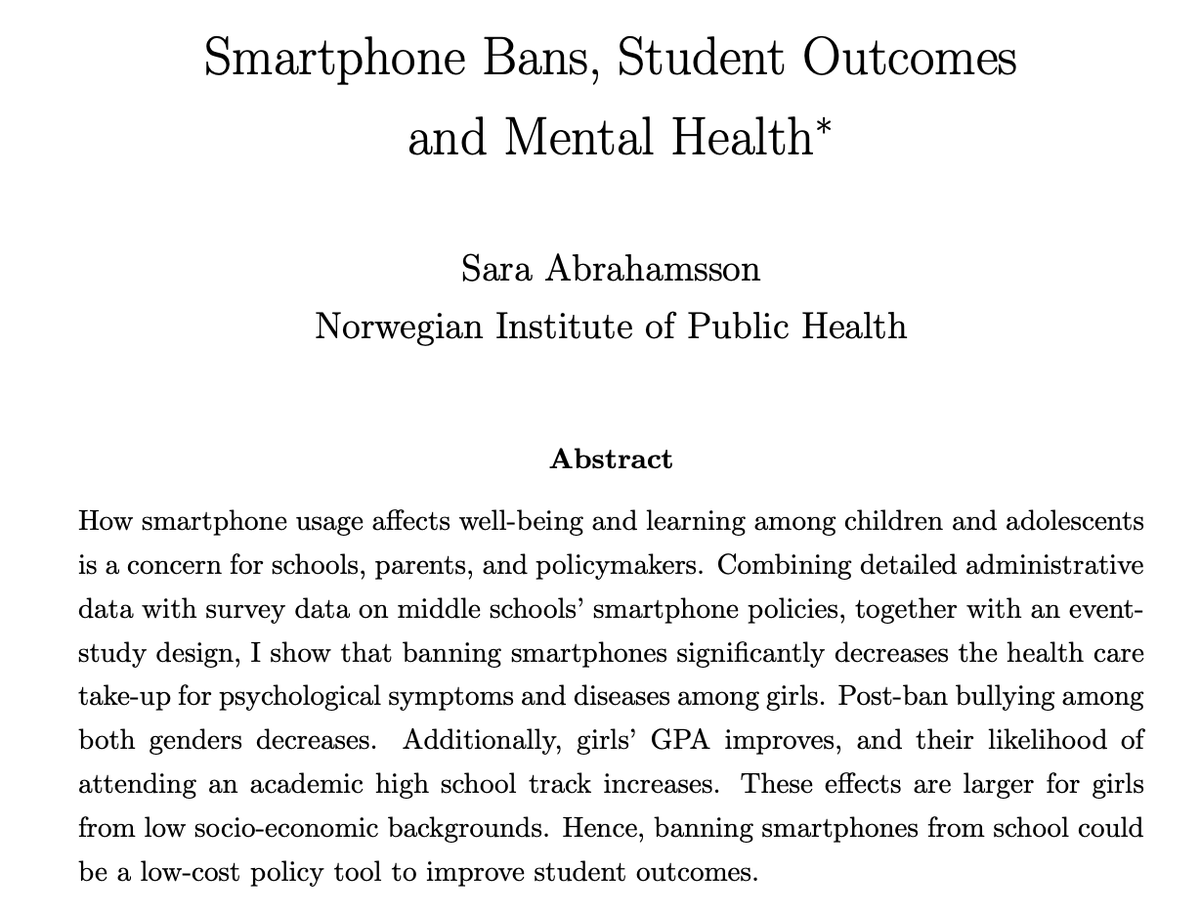
New paper from Norway: Banning smartphones in school
- significantly decreased doctors visits for psychological symptoms and diseases among girls
- reduced bullying among both genders
- improved girls’ GPA and attendance rates
- largest effect sizes were among the poorest kids