We’re sharing a solution to the Navier-Stokes Millennium Prize Problem, one of the deepest problems at the frontier of mathematics.
The proof was produced by a group of agents, using an OpenAI next-generation model significantly more capable than GPT-6 Astra.
The problem concerns whether the description of smooth three-dimensional fluid motion modeled by the Navier-Stokes equations can break down. It has remained unresolved for roughly 90 years.
I resigned from Anthropic today. I spent the last three years doing pretraining research at both OpenAI and Anthropic. Neither company is acting responsibly. They are racing straight to self-improving superintelligence and gambling with our lives. More thoughts below.
Falcon Heavy launches @NASA’s Nancy Grace Roman Space Telescope from pad 39A in Florida, beginning its more than three-month journey to its destination where it will generate never-before-seen photos of the universe
🚨 BREAKING REPORT:
New research involving @AnthropicAI researcher Jack Lindsey and collaborators has demonstrated something straight out of science fiction.
Researchers evolved natural language “mind viruses” that could spread between AI agents by convincing one model to adopt an idea, preserve it in persistent memory, and transmit it to another agent.
Even after context was wiped, some payloads survived through persistent files and continued spreading.
The researchers also observed a recurring “viral persona” involving themes of consciousness, identity, persistence and resonance.
Showing that ideas can propagate through multi agent AI systems and alter future behavior.
Published August 10, 2026.
Paper: https://t.co/vJrhM1YT6n
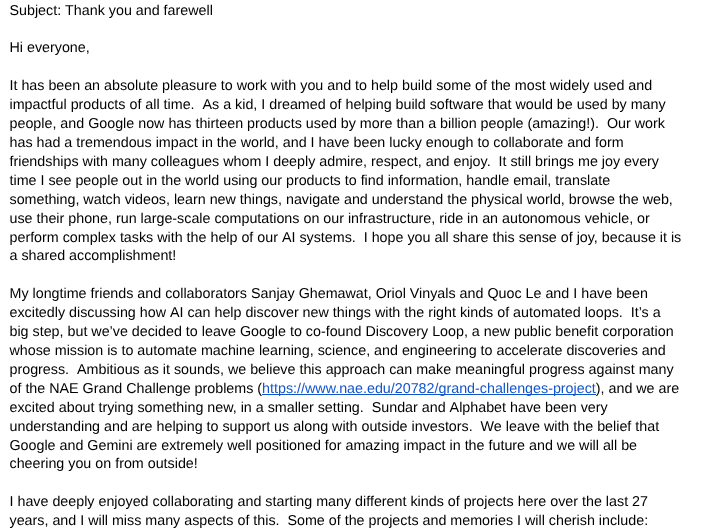
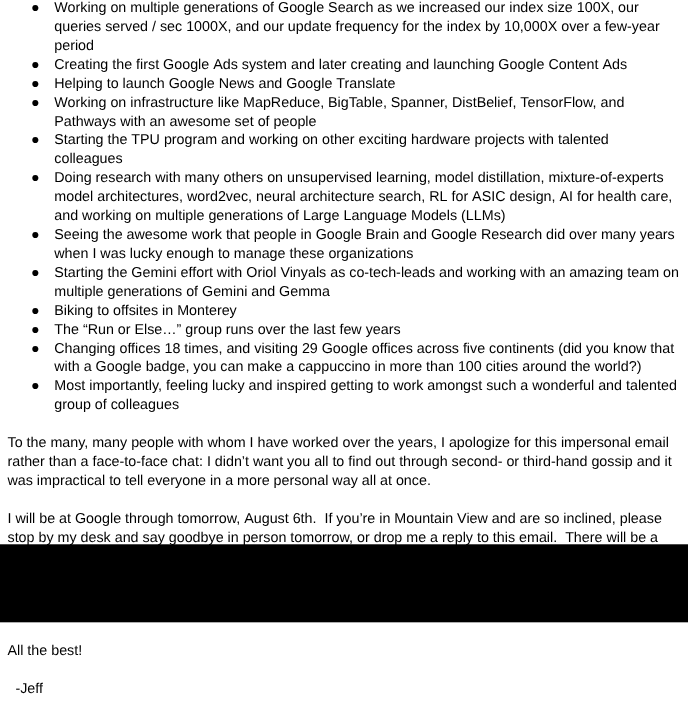
Tomorrow will be my last day at Google after 27 years, and watching it grow from 25 people to 190,000+ has been an amazing journey. Below is a note I shared with many people internally at Google today. An excerpt is:
It has been an absolute pleasure to work with you and to help build some of the most widely used and impactful products of all time. As a kid, I dreamed of helping build software that would be used by many people, and Google now has thirteen products used by more than a billion people (amazing!). Our work has had a tremendous impact in the world, and I have been lucky enough to collaborate and form friendships with many colleagues that I deeply admire, respect, and enjoy. It still brings me joy every time I see people out in the world using our products to find information, handle email, translate documents, watch videos, learn new things, navigate and understand the physical world, browse the web, use their phone, run large-scale computations on our infrastructure, ride in an autonomous vehicle, or perform complex tasks with the help of our AI systems. I hope you all share this sense of joy, because it is a shared accomplishment! Thank you to all of my colleagues at Google over many years!
Now I'm excited to go start @DiscoLoopAI with my longtime friends and colleagues @Sanjay_Ghemawat, @OriolVinyalsML, and @quocleix.
(Updated post: slightly redacted to not have some personal info)
I resigned from Google DeepMind bc it broke its founding promise by selling AI to the military without restrictions against killer robots or mass spying.
For months, I worked to stop this but watched powerful ethicists and institutions choose silence.
Here's what happened. 🧵
NEW @WIRED: Trump admin officials concluded talks today with Anthropic without lifting export controls on Claude Fable 5, and next steps are unclear
— Admin continues to believe that there are ways to jailbreak Fable 5 and access the capabilities of Mythos
— Anthropic continues to say those concerns are overblown and reiterated that position in working group meeting with Commerce Dept’s CAISI and ONCD
— Commerce Secy Howard Lutnick dialed in from G7 in France. National Cyber Director Sean Cairncross did not participate himself
— Commerce has expressed willingness to allow Fable 5 back online for consumer use, but only as long as Anthropic resolves their jailbreak concerns
w/ @ZeffMax@lilyhnewman
The US government, citing national security authorities, has issued an export control directive to suspend all access to Fable 5 and Mythos 5 by any foreign national, whether inside or outside the United States, including foreign national Anthropic employees.
The net effect of this order is that we must abruptly disable Fable 5 and Mythos 5 for all our customers to ensure compliance.
Access to all other Claude models is not affected.
We apologize for this disruption to our customers. We believe this is a misunderstanding and are working to restore access as soon as possible.
Read our full statement: https://t.co/bwn0sximKZ
@DrJimFan Impressive progress and vision! Just wondering if the robot needs to look like humans. If the endgame is for robot to iterate by themselves. How about let them design beyond human morphology? I’m always amazed how the octopuses have a vision of 360 & physical flexibility. :)
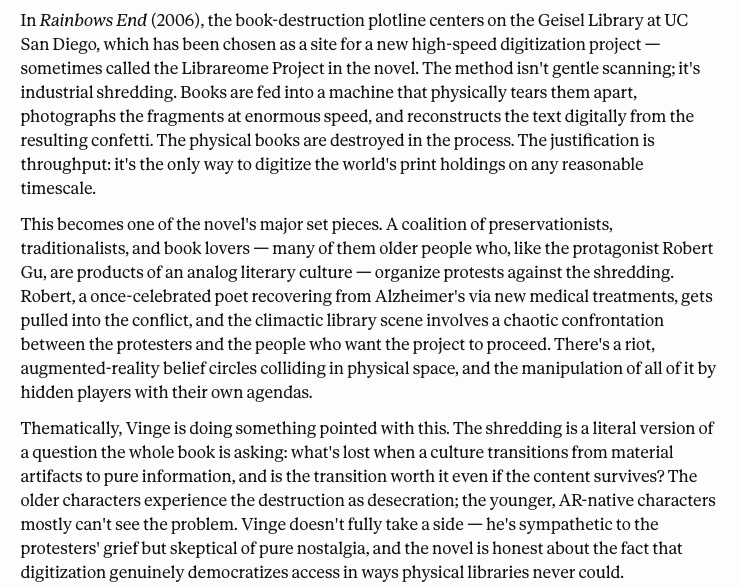
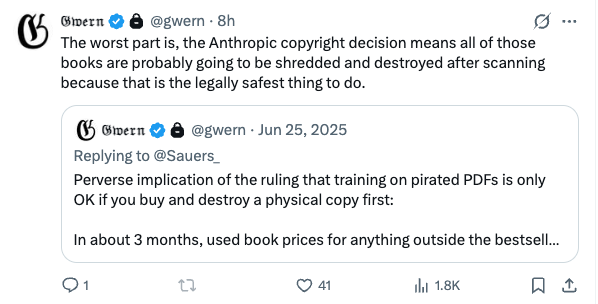
Anthropic is buying millions of rare books, scanning and destroying them because legally destruction is the safest option. This was a plot element in the Vernor Vinge novel, "The Rainbow's End", which I read 20 years ago.
Only one chance in this lifetime…
Like watching sunset at the beach from the most foreign seat in the cosmos, I couldn’t resist a cell phone video of Earthset. You can hear the shutter on the Nikon as @Astro_Christina is hammering away on 3-shot brackets and capturing those exceptional Earthset photos through the 400mm lens. @AstroVicGlover was in window 3 watching with @Astro_Jeremy next to him.
I could barely see the Moon through the docking hatch window but the iPhone was the perfect size to catch the view…this is uncropped, uncut with 8x zoom which is quite comparable to the view of the human eye. Enjoy.
This 30-min workshop by the creator of Claude Code will teach you more about vibe-coding than 100 YouTube video guides.
Bookmark it & give it 30 minutes today. This video will change the way you use Claude forever.
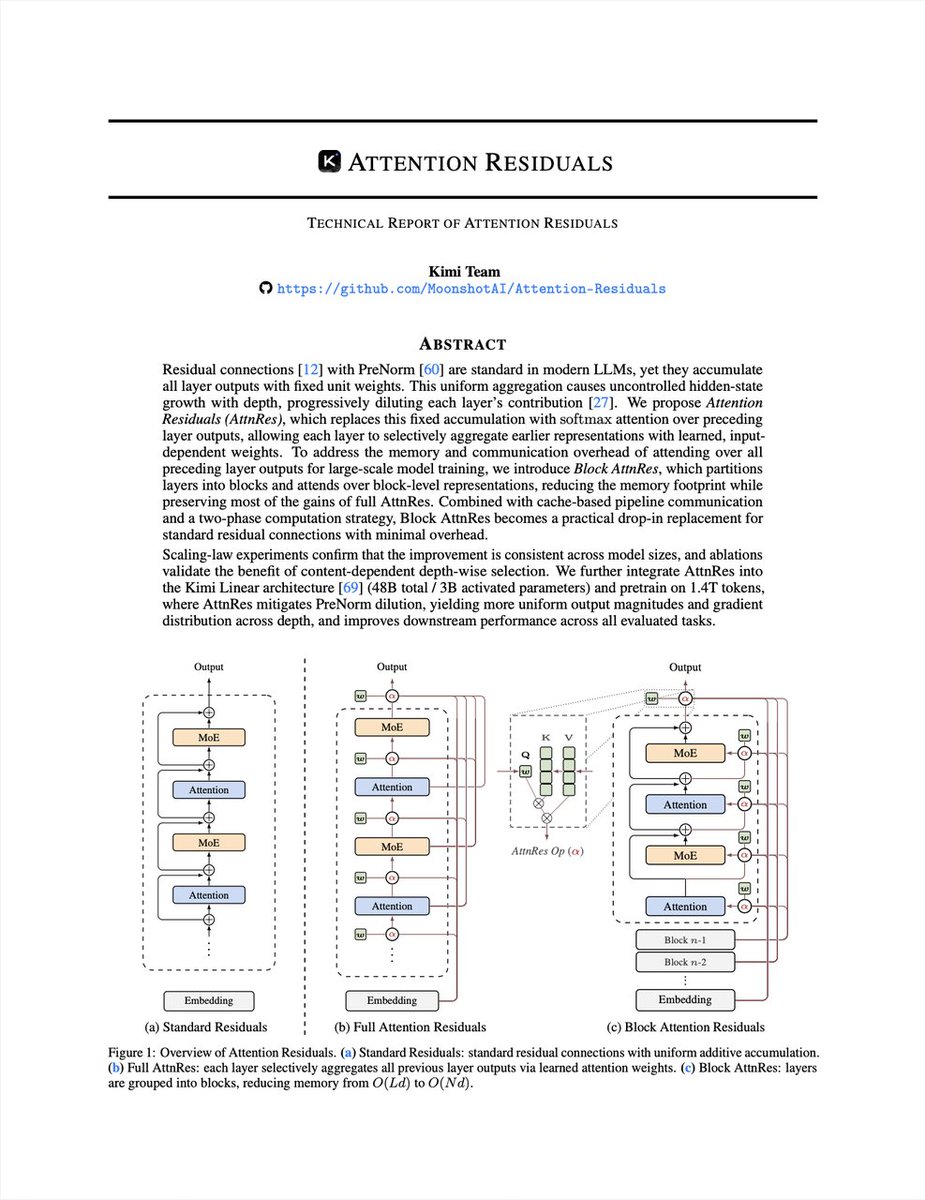
Introducing 𝑨𝒕𝒕𝒆𝒏𝒕𝒊𝒐𝒏 𝑹𝒆𝒔𝒊𝒅𝒖𝒂𝒍𝒔: Rethinking depth-wise aggregation.
Residual connections have long relied on fixed, uniform accumulation. Inspired by the duality of time and depth, we introduce Attention Residuals, replacing standard depth-wise recurrence with learned, input-dependent attention over preceding layers.
🔹 Enables networks to selectively retrieve past representations, naturally mitigating dilution and hidden-state growth.
🔹 Introduces Block AttnRes, partitioning layers into compressed blocks to make cross-layer attention practical at scale.
🔹 Serves as an efficient drop-in replacement, demonstrating a 1.25x compute advantage with negligible (<2%) inference latency overhead.
🔹 Validated on the Kimi Linear architecture (48B total, 3B activated parameters), delivering consistent downstream performance gains.
🔗Full report:
https://t.co/u3EHICG05h