The secret to success: they WON'T tell you:
> sit down
> become very still
> try to do absolutely nothing for as long as possible
> keep doing that until nirvana is reached
> escape the endless cycle of death and rebirth
Your MacBook can now host a coding agent at 300+ tps!
I gave DeepSeek V4.1 Flash a job: write a specialized inference engine for LiquidAI's LFM2.5-24B-A2B on Apple's M5 Max. For $21 of API, it built Molten: 300+ tps, about 1.5x faster decode than mlx-lm and llama.cpp.
Why specialized? General frameworks like mlx-lm and llama.cpp have to run any model on any hardware. A specialized engine serves one model on one chip at batch size 1, so there is far more room to optimize.
Molten is native Rust + Metal: one ~6 MB binary, no Python, PyTorch or MLX. It comes with a chat CLI and an OpenAI-compatible server with streaming and tool calls, so you can point your own coding agent at it. It needs an M5-series Mac with 24 GB+ (sorry, M1-M4 friends).
The numbers (M5 Max, 128 GB)
• 305 tps at 256 tokens of context, vs 190 for mlx-lm and 199 for llama.cpp
• Still 248 tps at 16K, where coding agents actually live (mlx-lm: 165)
• Faster time to first token: 1.76 s vs 2.17 s for a 16K prompt
• Same weights and math as mlx-lm
How it was built
The agent (DeepSeek V4.1 Flash in the Pi harness) ran in a recursive self-improvement (RSI) loop. Each session starts from the best engine so far, plus the feedback from every earlier round. A fixed evaluator rebuilds each candidate from source, checks its tokens against mlx-lm, times and profiles it. Only correct and faster engines survive.
• Hour 3: first correct engine, 0.56x mlx-lm
• Day 2.5: passes mlx-lm
• Day 5.7: 1.28x end to end, 1.53x decode
78 agent sessions, about $21 (1.36B tokens, 98.6% of them cache hits).
What the RSI loop found useful for speeding up:
• Fuse chains of small ops into single kernels: norm + router + top-4 expert pick, expert FFN + combine, Q/K/V projections + KV-cache write, Q/K norm + RoPE + attention, LM head + argmax.
• Keep the decode loop on the GPU. Tokens never round-trip to the CPU, and the GPU stays 99% busy.
• Hard-code every shape, so the 4-bit kernels stream weights at ~75% of the memory bus.
• Target the hardware: prefill runs on the M5 GPU's Neural Accelerators through Metal 4 tensor ops, with MoE routing and expert GEMMs fused and kept on the GPU.
(It's not Rust, by the way. llama.cpp is native C++ too. It's the specialization.)
TBH, I don't fully understand all of it yet lol. The agents wrote this in under 6 days, and it's going to take me longer than that to read it. As the human researcher, I'm now officially the slowest-improving component of my own RSI loop🤣, so I'll spend the next few weeks learning from my agents.
Where I think this goes: local inference will matter more and more, and a specialized engine can beat a general one. As RSI matures, the cost of building one keeps falling toward zero. I think every model, every chip, and maybe every workload will eventually get its own inference engine.
The idea is inspired by @perplexity_ai 's Lily. Thanks to @liquidai for the great model, and Apple's MLX, whose kernels Molten adapted from.
Repo here:
https://t.co/E0iayak9C4
We’re adding new neurons to running local AI models 🤯
Teach it a new fact, save it into the weights, then restart it. Open a fresh chat and it can still remember.
That’s Living Weights in TensorFold. It learns between replies, on your own hardware.
Still experimental, but this is pretty wild.
Myself an @petruspennanen have been working on it and will be bringing a breakthrough soon 🤯🚀
banned for reverse engineering work? that’s wild
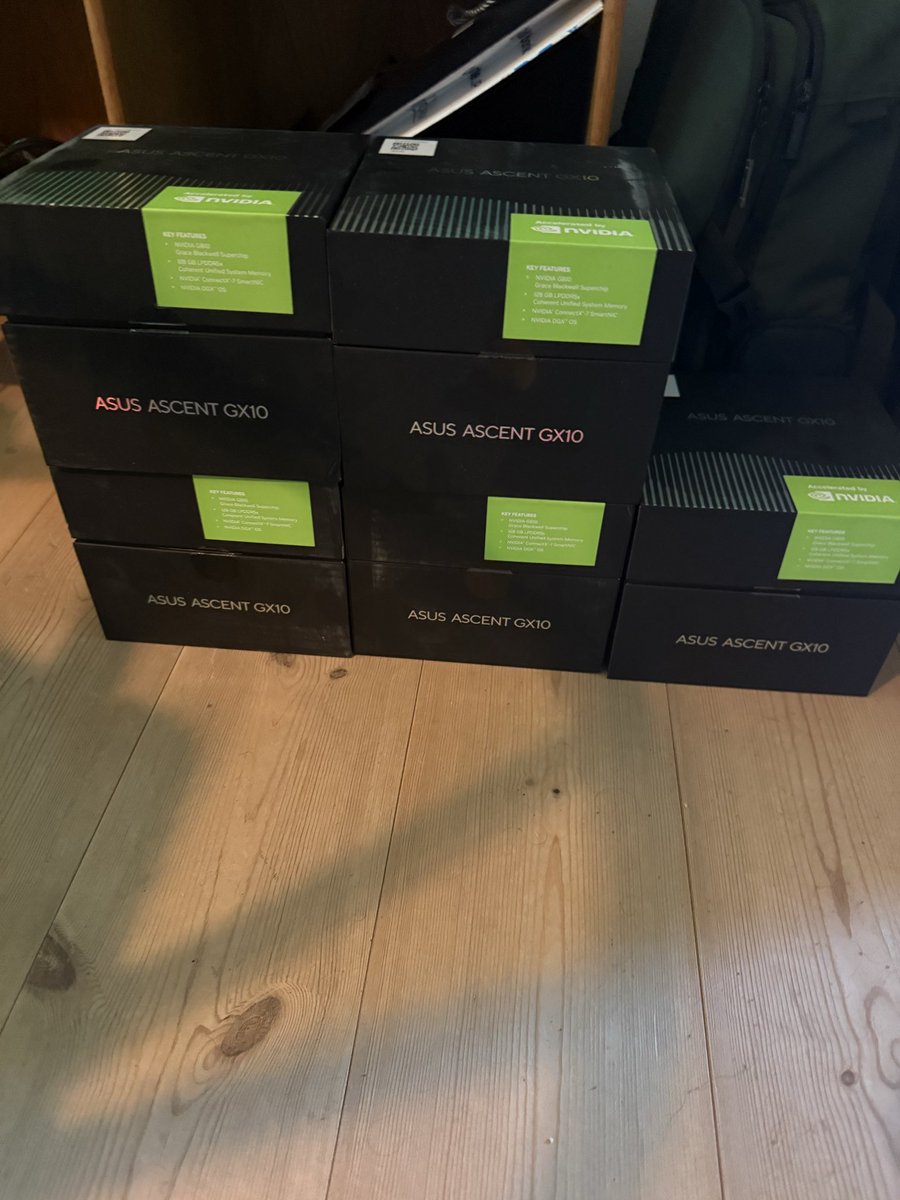
oh well, -$500, and a bunch of banked resets) but gained motivation to get 3 more machines and finish my cluster.
i have never used openai to exploit or find vulnerabilities, only local reverse engineering which tripped daybreak.
System One Computer Use is now open source 👇
https://t.co/GkhLAsHHUG
- Screenshot → decide → click/type loop
- Dashboard with screenshots and decisions for every step
- Cost tracking per step (~$0.002 a task)
- Stops when it isn’t sure instead of guessing
It’s a prototype and a base for users to build on...
Fork it and let's see what you build on it!
you can’t actually automate customer support.
sure, you can delegate some parts to bots, but this is the experience you’re going to lead people to have by default
Currently arguing with a company over whether their blog post advertising a feature implies that their platform should include that feature.
Their support emails are AI-generated, even after I asked for a human. The entire website is AI-generated. Their API docs tell me not to bother reading them, just paste their "integration prompt" into my AI. The founder posted an AI-generated article on Twitter talking about how AI runs the company.
I'm growing increasingly confident that their AI made up a feature that does not exist and wrote dozens of articles advertising this feature in various countries that they do not support.
When I asked their AI assistant to enable this feature on my account, it told me the feature doesn't exist. When I pointed it to the company blog post announcing the feature, it began responding in Chinese.
This company received $6 million from Y Combinator.
you finally finish a 180 GB download
hit extract
"not enough disk space"
unzip needs room for the archive AND the files. hatchzip doesn't: it unpacks from the end and eats the archive as it goes
free and open source. windows, mac, linux
SITUATION DETECTED: Warhound launched from stealth today with a $200M seed at a $1.2B valuation. Ben Lamm and Palmer Luckey are cloning gene-edited bio-enhanced dogs and equipping them with custom Anduril vests, goggles, and sensors for the military and law enforcement.
HOLY MOLY. Something genuinely strange just happened in AI training.
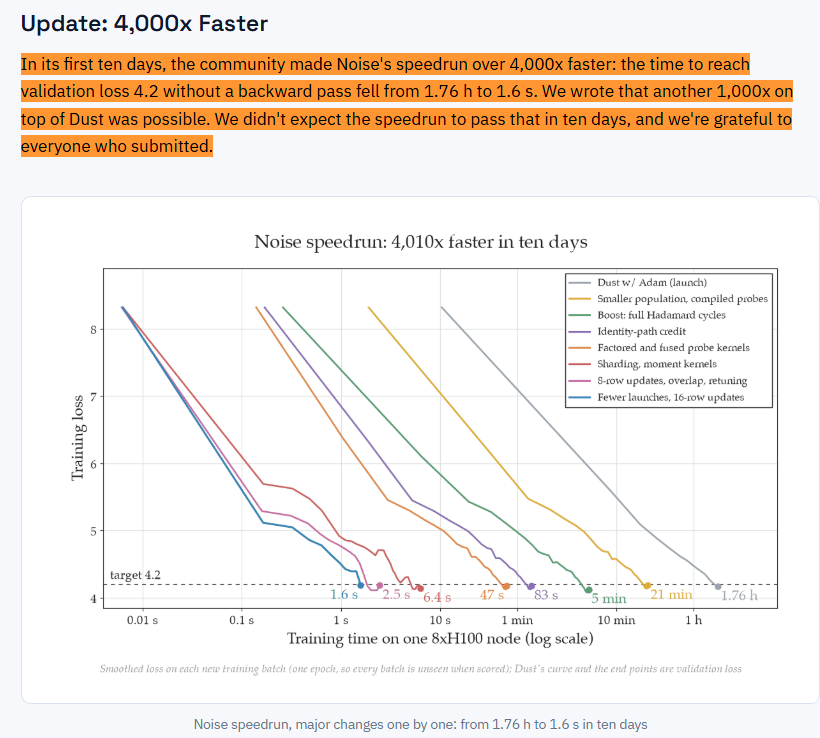
Q Labs says it can now pretrain a transformer WITHOUT backpropagation, cutting the time to reach a fixed validation-loss target from 1.76 hours to just 1.6 seconds in only 10 days. A nearly 4,000x speedup.
The latest run also beats backprop + Adam on validation loss.
Its Dust algorithm was already estimated to be up to 10,000x more compute-efficient than the previous state-of-the-art zeroth-order method.
The biggest question now is scaling. Some of the tricks won't scale, so the team is moving from 10M to 30M training tokens.