Jonbull Stock Guide is a guidebook containing tips inspired by @WarrenBuffett and other investing greats for stock market success. Order a pristine copy now.
TRUMP:
"The Iran Deal is now signed and the Strait of Hormuz is open. I think many great things are going to happen in the Middle East. Oil is plummeting down and the stock market is shooting up like a rocket."
Bitcoin Capitalism — my keynote from @BTCPrague 2026.
Digital Capital is the foundation for Digital Credit, Digital Money, Digital Yield, Digital Equity, and a universe of Bitcoin-backed products and services.
Timestamps:
01:37 - The Four Bitcoin Ideologies and the case for Bitcoin Capitalism
03:29 - Bitcoin as Digital Capital: thousand-year capital with a half-life of infinity
06:12 - Bitcoin network snapshot and ~68% dominance
07:41 - What is money? The Austrian view, the conventional investor view, and “Bitcoin is money, everything else is credit”
09:21 - Digital Money and Digital Credit: bitcoin-backed products for fiat-facing investors
11:28 - Digital Credit: an ~$11–12B asset class that was zero 12 months ago
14:54 - Bitcoin’s opportunity: $1T of bitcoin vs. $1,000T of global capital
15:43 - The 10-dimensional model for reaching stranded capital
16:44 - 1) Asset types: commodities, equities, credit, derivatives, real estate, money, and tokens
18:07 - 2) Capital functions: store of value, appreciation, income, collateral, and payments
19:29 - 3) Custody: self-custody, banks, custodians, broker-dealers, prime brokers, and exchanges
20:34 - 4) Jurisdictions: 664,000 legal and regulatory environments for capital
22:03 - 5) Distribution networks: banks, exchanges, payment networks, and $156T controlled by wealth advisors
23:13 - 6) Account forms: retirement accounts, brokerage accounts, insurance policies, treasuries, and trusts
24:51 - 7) Risk: market, currency, duration, regulatory, credit, technical, security, theft, and counterparty risk
26:03 - 8) Liquidity: transforming $350T of illiquid capital with liquid digital assets
28:02 - 9) Investors: banks control ~$200T and need compliant bitcoin-backed products
30:09 - 10) Product characteristics: fixed rate, floating rate, leverage, callability, fees, and structure
30:45 - The 10x10 matrix for channeling global capital into Bitcoin
31:19 - How $10–20T of capital could expand Bitcoin into a $100T network, moving from $70K to $700K to $7M per bitcoin
32:10 - Bitcoin Capitalism as a Darwinian market: winners, challengers, failures, and 1,400 companies tracked by Strategy
34:53 - Existing bitcoin-backed products: @Trezor, @Unchained, @Fidelity, @Fold_app, @Tando_me, @Relai_app, @CashApp, @HodlHodl, @AnchorWatch, @Meanwhile, $IBIT, $STRC, and $MSTR
40:03 - Digital Capital, Digital Credit, Digital Money, and Digital Yield competing with traditional capital markets
41:03 - Digital Money and Digital Yield: better stablecoins and higher-yield bitcoin-backed products
47:27 - 3 ways to participate: savers, investors, and innovators
49:19 - The aluminum airplane analogy: people buy the product, not the commodity underneath
52:29 - Build a ₿ridge to connect $BTC to the global capital markets
53:42 - 10,000 products, 10,000 needs, and 100,000 corporate efforts to change the world
Jensen Huang told a room of global investors that AI is not one industry. It is five stacked on top of each other. Most people are investing in layer four and ignoring layers one through three entirely.
He called it the five-layer cake.
Layer one is energy. Jensen said this is the single greatest opportunity for the energy industry in a hundred years.
The first time in a century that the grid in most countries can actually attract serious capital. Nuclear, solar, wind, hydrogen, it does not matter what form. If it produces energy, it gets funded. Siemens, GE Vernova, Mitsubishi. That is why they are all doing so well right now.
Layer two is chips, computers, networking, and silicon photonics. Everything that processes the intelligence.
Layer three is infrastructure. Land, power, buildings, data center operations. Every single one in short supply today.
Layer four is the model layer. OpenAI, Anthropic. The layer everyone talks about.
Layer five is applications. Every startup applying AI to financial services, legal, healthcare, logistics, transportation. Last year alone, a hundred billion dollars of venture capital went into this layer. The single largest VC year in the history of humanity.
Then he said the number that stopped me cold.
We are putting one trillion dollars into this five-layer cake this year. That sounds enormous. Jensen thinks the AI industry will eventually run at twenty trillion dollars per year.
We are one trillion in of a twenty trillion dollar per year ecosystem.
Most people watching AI are staring at layer four. Jensen was describing layers one through five as a single compounding system where every layer feeds the one above it.
The people who understand that will invest differently than the people who do not.
Leopold Aschenbrenner’s fund has reached a new milestone, surpassing $20 billion in assets under management.
At just 24 years old, he is already regarded as one of the most talented traders of his generation.
Grant Cardone reveals NOBODY would buy $10,000,000 worth of Gold at market price
“I know a guy who is trying to sell 10,000 pieces of silver and he can’t get a real offer. He’s getting a 30% discount below the market. People see it spiking like this and they’re like, ‘OMG.’ But go try to sell $10M worth of gold and see what happens. You’ll only get offers 20-30% below the market, and you won’t get the money tomorrow or in five minutes. It needs to get authenticated, checked, and validated”
“Bitcoin is a real thing. You can trade it in five minutes, and that’s real. Bitcoin, to me, is not only money, it’s also technology, unlike gold or silver”
🚨 Elon Musk may be building something much bigger than most investors realize!
According to the analysis, Tesla and SpaceX now have 7 major factory projects underway with more than $200 billion in combined CapEx planned or in progress.
These projects span AI chips, AI training clusters, satellite production, Starship manufacturing, Optimus robots, and Megapack energy storage.
The bigger idea isn't just making products. It's building the infrastructure that powers AI, energy, transportation, robotics, and communications at scale.
If even part of this vision succeeds, Tesla and SpaceX could end up reshaping multiple industries at the same time. $TSLA $SPCX
Strategy has acquired 1,587 BTC for $100 million to increase our $BTC Reserve to ₿846,842. We have also increased our USD Reserve by $100 million to $1.1 billion. $MSTR $STRC
https://t.co/WjionpFrva
Digital Credit. Digital Money. Digital Equity. Digital Treasury.
My conversation with @ColeMacro at @BTCPrague on the future of capital markets, followed by Q&A on the nuances of Bitcoin-backed securities and corporate finance.
Elon said SpaceX could hit $1T in revenue by 2030
That's triple what Morgan Stanley's saying ($330B) and double Goldman's ($474B).
Banks still underestimating the space AI compute wave hard. 2030 gonna be crazy if he's right.
@elonmusk@SpaceX / Writers: Lucas
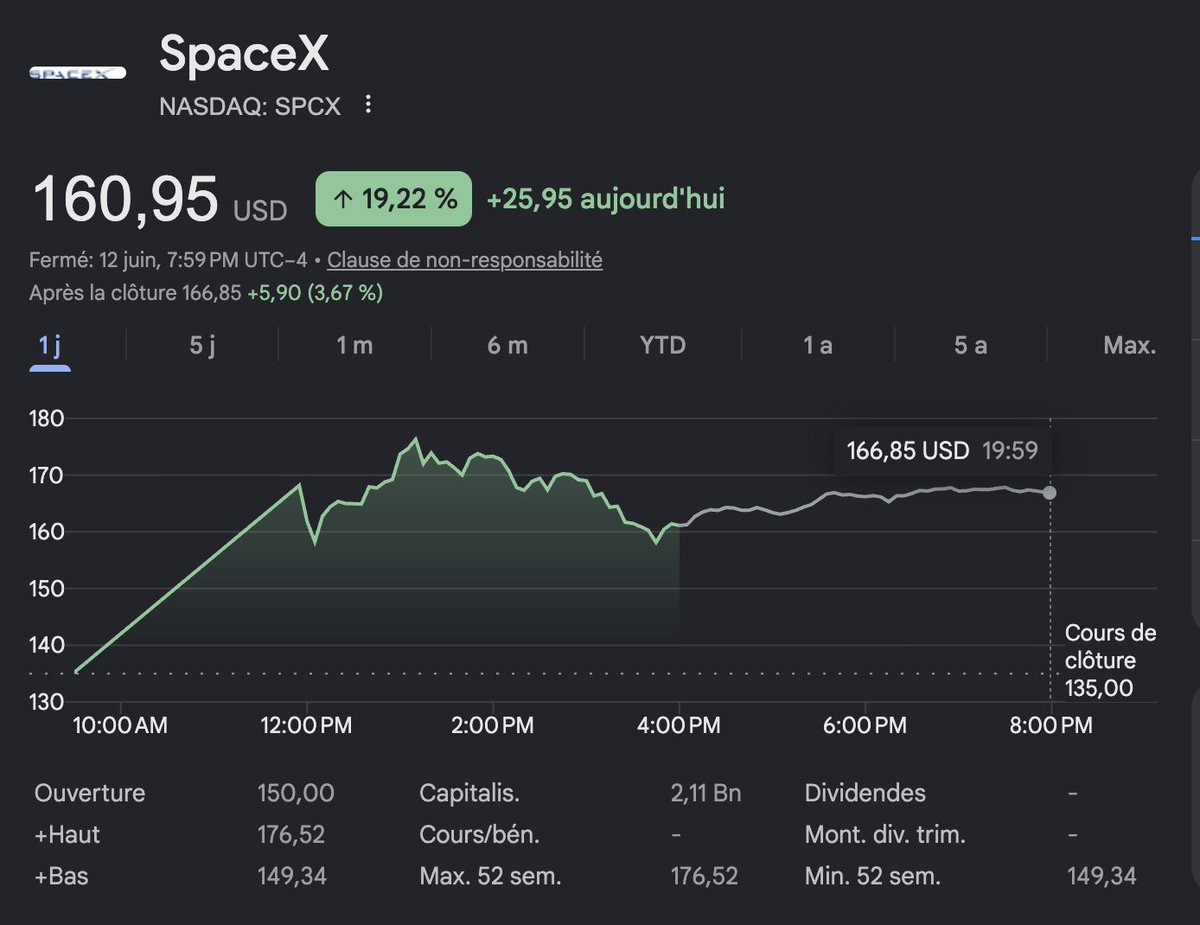
SpaceX a clôturé son premier jour de cotation à 2 100 milliards de dollars, +19%. Tout le monde regarde le chiffre. Personne ne regarde ce qu'il price réellement.
Laissez-moi vous dire ce que le marché vient d'acheter, et pourquoi je pense que cette boîte vaudra 30 à 50 trillions d'ici 5 ans.
D'abord, le symbole. Cette IPO est un référendum. D'un côté, 20 ans de discours sur la décroissance, la sobriété, la redistribution, la fin de l'histoire gérée par des comités. De l'autre, un homme qui a dit "je vais rendre l'humanité multiplanétaire", que tout le monde a traité de clown, et qui vient de créer la plus grosse entreprise cotée de l'histoire en partant d'un entrepôt à El Segundo. Le marché a voté. Le wokisme avait des départements RH, SpaceX avait des fusées. Les fusées ont gagné.
Ensuite, la mécanique économique, parce que c'est là que tout le monde se trompe. Les analystes valorisent SpaceX comme une entreprise de lancement plus Starlink. C'est comme valoriser Internet en 1995 sur le marché du fax. Starship ne réduit pas le coût du kilo en orbite de 20%, il le divise par 100. Et chaque fois dans l'histoire qu'un coût d'infrastructure est divisé par 100, ce n'est pas le marché existant qui grossit, ce sont des industries entières qui naissent. Le coût du calcul divisé par 100 a donné Internet, le smartphone, l'IA. Le coût de l'orbite divisé par 100 va donner une économie spatiale complète.
Faisons la liste de ce qui devient rentable quand le kilo en orbite coûte le prix d'un billet d'avion. Les data centers orbitaux, avec énergie solaire continue et refroidissement gratuit, au moment exact où l'IA fait exploser la demande énergétique terrestre. La fabrication en microgravité de semi-conducteurs, de fibres optiques, d'organes imprimés impossibles à produire sous gravité. Le tourisme orbital de masse, puis les hôtels lunaires, qui passeront du fantasme au business plan exactement comme la croisière de luxe au 20ème siècle. Le transport point à point terrestre, Paris-Tokyo en 40 minutes. L'industrie minière des astéroïdes, dont un seul corps de classe M contient plus de métaux que tout ce que l'humanité a extrait depuis le néolithique. Et Mars en ligne de mire, pas comme destination touristique, mais comme le plus grand projet d'infrastructure jamais entrepris, avec tout ce que ça implique de demande en énergie, matériaux, robotique, IA.
SpaceX ne participera pas à ces marchés. SpaceX possède le péage d'entrée de tous ces marchés. C'est AWS, mais pour la civilisation. Apple vaut 3 500 milliards en vendant des rectangles de verre sur une seule planète. Le premier monopole d'accès à une frontière infinie à 30 ou 50 trillions dans 5 ans, ce n'est pas de l'exubérance, c'est une simple règle de trois sur l'expansion du marché adressable.
Et maintenant, la partie que je préfère. Ce futur n'a pas besoin de bureaucrates. Il n'y a pas de comité consultatif en orbite. Pas de commission Théodule sur Mars. Chaque dollar de cette nouvelle économie sera créé par des ingénieurs, des techniciens, des soudeurs, des pilotes, des entrepreneurs. Les diplômés en gestion de la norme vont devoir apprendre un métier utile, et franchement, c'est une excellente nouvelle pour eux aussi : construire est infiniment plus fun que contrôler.
Parce que c'est ça, le vrai signal d'aujourd'hui. Pendant 50 ans on nous a vendu un futur rétréci : moins d'énergie, moins d'enfants, moins d'ambition, gérer le déclin proprement. Et là, d'un coup, le plus gros actif financier du monde est un pari sur l'abondance, l'expansion et l'aventure. Le pessimisme vient de passer en position vendeuse sur lui-même.
Le futur sera méga fun. Il y aura des hôtels avec vue sur la Terre, des honeymoons en orbite, des gamins qui diront "papa, c'était comment avant les fusées réutilisables" comme on dit "c'était comment avant Internet". Et quelque part dans les années 2030, un humain marchera sur Mars en livestream devant 5 milliards de personnes, et ce jour-là plus personne ne se souviendra du nom d'un seul de ses détracteurs.
Achetez de l'optimisme. C'est encore sous-valorisé.