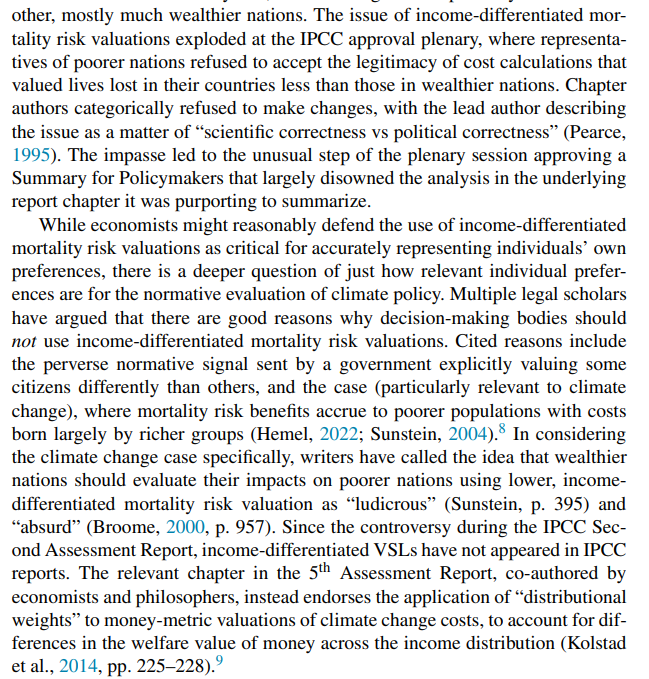
I bet not a lot of people today know this story about the big fight at the IPCC in the 90s between economists and politicians about the economic assumptions underlying climate damage estimates (the economists were wrong)
I have to admit I didn't realize my work was cited this widely... I've never worked for a university and climate is not exactly a fashionable field within economics - so this is quite unexpected.
https://t.co/AR93WL2Wbj
I think this is important work. Many thanks to Migle Petrauskaite for leading and Xinru Lin for providing modelling support. Plus Jose Luis Diaz Sanchez and Andrew Blackman for providing comments on an earlier draft.
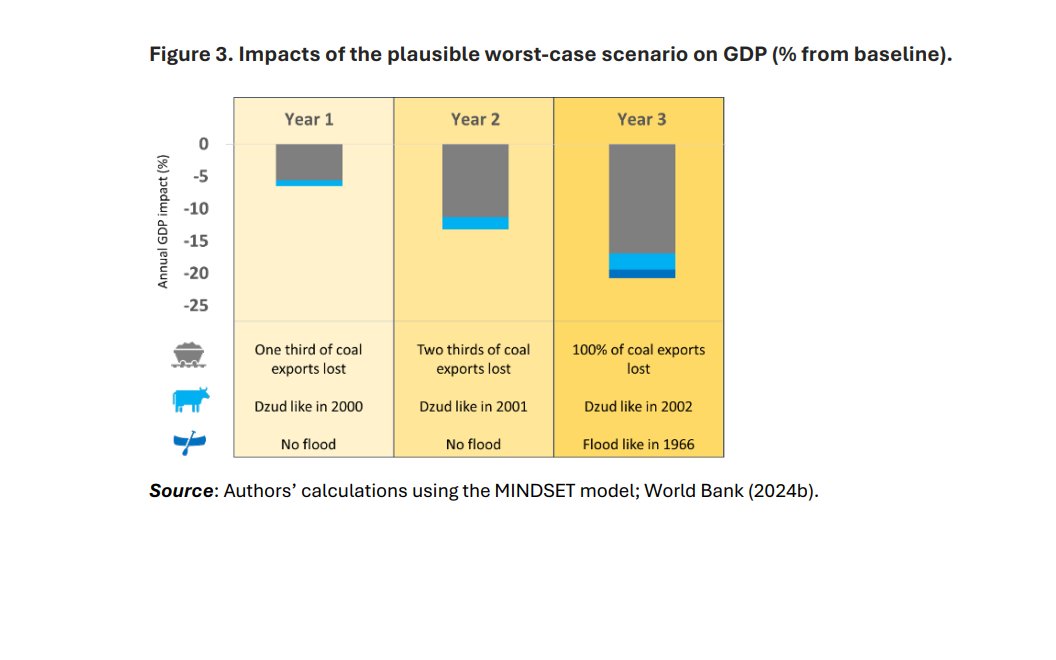
Coal dependence is a big risk on its own. But as disasters become more common the possibility of simultaneous events rises. From this we develop the plausible worst case scenario.
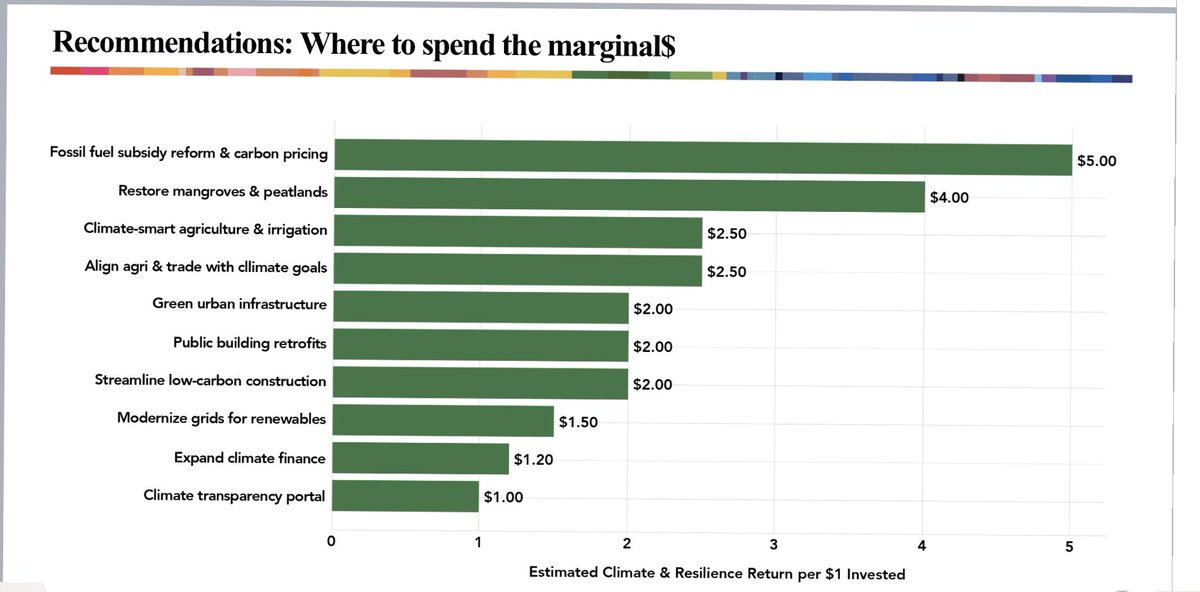
Passionate about building Msia’s climate resilience? But ever wonder what should 🇲🇾 prioritize?
My colleagues crunched the numbers & found:
1. RoN95 reform & carbon pricing, by far, give the max benefit: 5 to 1
2. Mangroves & peatlands: 4 to 1
3. Ag & irrigation: 2.5 to 1
@heiwen@ApurvaSanghi@MuthukumaraMani Thanks! The irrigation point is separate, as an adaptation measure. On agri and trade the full description is "Introduce GHG standards in agricultural exports, support low-carbon certification and align subsidies with climate targets." Hope that clarifies!
Structural economic change as dynamic resource creation – in their OxREP paper, @DimitriZ, @HectorPollitt, Jean-François Mercure, and Frank W. Geels illustrate how innovation, networks and behaviour are adopted in the global economy.
https://t.co/8b6GQVEqUA
The OxREP's newest issue on “Rebuilding Macroeconomic Theory III: The Macroeconomics of Structural Change” has been published! Read all articles online here: https://t.co/O9EZqjas9q
Wrapping Up 2025, I wanted to let you know why I've Been Fighting This Battle for 50 Years.
I was 20 years old when I realized I was being lied to.
It was 1973. I was an undergraduate at the University of Sydney, and the real world was on fire. The oil crisis had hit. Inflation was skyrocketing, and unemployment was rising at the same time - a phenomenon called "stagflation."
According to the textbooks I was forced to read, this was mathematically impossible. The economic models insisted you could have inflation or unemployment, but never both.
I sat in lecture halls watching professors draw elegant curves on chalkboards that described a world of "equilibrium" and "perfect competition." A world where banks didn't exist, debt didn't matter, and crises were just accidental bumps in the road.
I looked at the chalkboard. Then I looked at the newspaper headlines.
The map didn't match the territory.
Most students just memorized the lies to pass the exam. I couldn't do it.
I led a student revolt that year. We demanded to be taught economics that actually engaged with reality - with the messy, chaotic, debt-fueled world we actually lived in.
We won the battle, but we lost the war.
The university establishment crushed us, and Neoclassical economics took over the world.
Fast forward 50 years, and I am seeing the exact same look in your eyes that I had in mine.
You look at the "official" inflation numbers, and then you look at your grocery bill, and you know something is wrong. You hear the Fed Chair talk about a "strong economy," but you see your friends getting laid off and your children giving up on ever owning a home.
That feeling you have? That isn’t confusion. That’s your bullsh*t detector going off.
And you’re right to feel that. Just like I have.
I have spent my entire adult life fighting the "experts" because I know where their bad math leads.
It leads to 2008.
It leads to the housing crisis.
It leads to a world where the rich get bailed out and the rest of us get the bill.
I fought them in 1973 because I was an angry student.
I fight them today because I refuse to let these delusions destroy what is left of our society.
...It cost the rest of the areas of my life to do so. But I know it’s worth it. For the greater good.
I didn't build the Rebel Economist Challenge just for academics and government leaders.
I built it for the people who are tired of being told to ignore their own eyes.
It took me decades to build that map from scratch. You don't have to wait that long.
I am challenging you: Can you learn 50+ years of real economics in the next 7 weeks?
I have condensed half a century of fighting, predicting economic crises, and winning arguments into a 7-week roadmap.
I am handing you the keys to the machine. Handle them with care.
If you try to figure this out alone, you’ll get lost in the noise of 24-hour news cycles and contradictory theories. You will stay paralyzed while the window to prepare for the next crisis slams shut.
Learning alone using YouTube, textbooks, and University courses will waste years of your life. How do I know? Because I did it the hard way. And unfortunately for me, I can’t get those years back.
But I made this system so YOU CAN.
Our new OXREP paper is out. We argue that big shifts—clean energy, AI, biotech—don’t just reallocate resources; they create new ones. We call this “creation economics”: an economy shaped by feedbacks, tipping points and leaps. Models illustrate pathways & risk, not predict future
The return of industrial policy has shifted interest from resource allocation back to creation. The paper shows how economics can catch up, using examples from AI and energy transition.