a friend of mine recently turned me on to this incredible article about the bleak state of the ai tech world and the robin hood-esque escapades of @laserboat999 and now i must share it with all of you because it’s the best reporting i’ve read in a while
https://t.co/2V3wcCxNqs
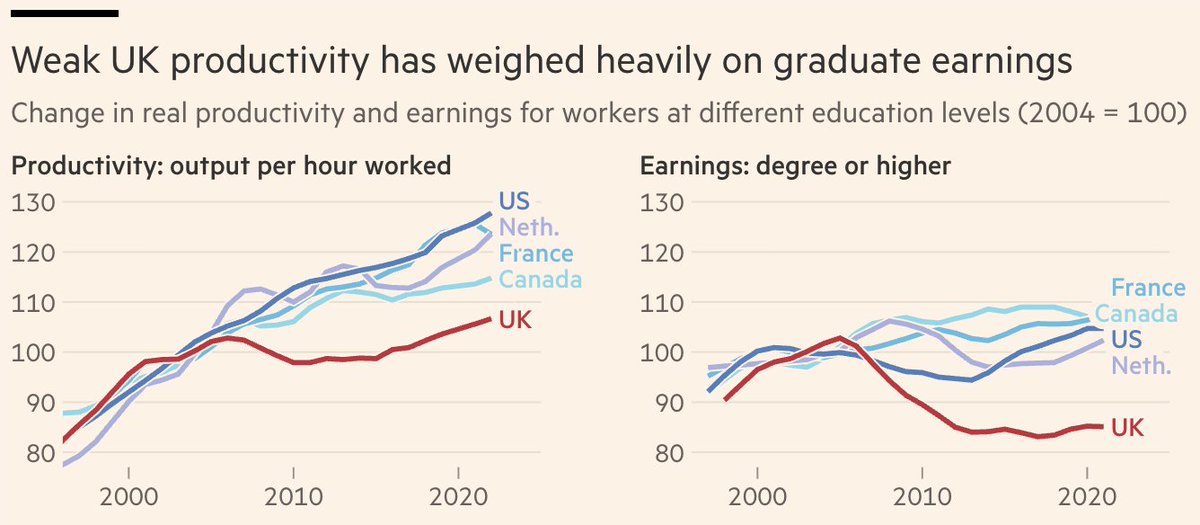
1) The UK economy’s growth and dynamism have never recovered from the financial crisis. This productivity crash has had a scarring effect on earnings at the top of the market — the jobs most graduates work in.
"A self-inflicted wound."
🏭That's how Eliot Whittington @whittso describes the Trump administration's repeal of the US "endangerment finding" for @ClimateHome.
📉As China races ahead on clean tech, the US chooses regulatory chaos and economic isolation.
https://t.co/usiOM2yceO
New paper in the Oxford Review of Economic Policy.
Schumpeter once said "Once you think about economic growth, it becomes impossible to think about anything else”.
But our current macro models don’t really do this.
https://t.co/lsXXhnbk4D
"Against difficult circumstances, Rachel Reeves has delivered a budget that can give the wider economy stability whilst maintaining the direction of travel to a cleaner, greener and more innovative economy," - @whittso in @BusinessGreen on the #UKBudget 🧰
https://t.co/6WcjVbW1tQ
🌍 “Multilateral agreements are difficult but this was a process that really mattered. Over 90 countries went on the record saying they wanted clear direction on how we move away from fossil fuels”
Listen @whittso on the final outcome of #COP30 & why it still matters @Times Radio
Today we launch the Bennett Innovation Lab
@BILCambridge. Its mission comes from a simple imperative: if the UK wants to lead the industries of the future, we must build hardware-intensive technologies at unprecedented speed. #ActionThisDay
Great to see govt recommitting to the Boiler Upgrade Scheme and extending it to “air to air” heat pumps (air con).
As solar on rooftops becomes widespread and our climate warms, summer solar peaks complement AC perfectly. Extra bonus for ditching gas.
https://t.co/ZwCfZyNlOF
Join the Society's Climate Change Research Group (@ClimateGeog) for an online expert panel discussion 🎦👏
'COP 30: what just happened?' will take place on 25 November, featuring contributions from @whittso, @EAMAberg_ and @AngusMcnelly
Register 👉https://t.co/l0YMLkJDG6
We need an urgent conversation about non-wholesale electricity costs and how fast they should be added to household bills - and indeed whether significant proportions of them should be added at all.
Energy bills are set to dip in January, but the bigger story is what comes next.
Cornwall Insight’s final price cap forecast for January - March 2026 shows the cap falling slightly to £1,733 for a typical household from January. A welcome £22 or 1% drop - but our analysis indicates pressures building elsewhere.
While slightly lower wholesale prices are easing the headline figure, new and rising system costs are starting to creep into bills. From policy levies like the Nuclear RAB to higher energy network operation and maintenance charges, these pressures mean our April 2026 forecast currently sits around £75 higher than January.
This marks a major shift in the make-up of bills: wholesale energy is expected to fall to less than 40% of the price cap and remain there for the rest of the decade. Infrastructure, investment and policy decisions will play an increasingly prominent role in what households pay.
Dr Craig Lowrey, Principal Consultant at Cornwall Insight, offered a note of caution on how the transition is communicated to households:
“The shift to renewables will bring long-term stability and energy independence, but it’s not free. The upfront costs are real, and they’re landing on bills now. The challenge will be balancing short-term affordability with long-term resilience, and crucially making sure people understand why that trade-off matters. If the government doesn’t bring the public with them on the energy transition, then it risks undermining the very policies intended to support them.”
Read our full analysis: https://t.co/Gmx1gmvISz
Pope Leo to #COP30 “It is not the Paris Agreement that is failing, we are failing in our response. What is failing is the political will of some. True leadership means service, and support at a scale that will make a difference.”
Germany‘s resistance to the EU‘s phase-out of combustion engines barely matters. The only choice Germany will have long before 2035 is whether to buy Asian or German electric vehicles. In that sense, Germany‘s government is frivolously pretending to be pro-business while it really is anti-growth.
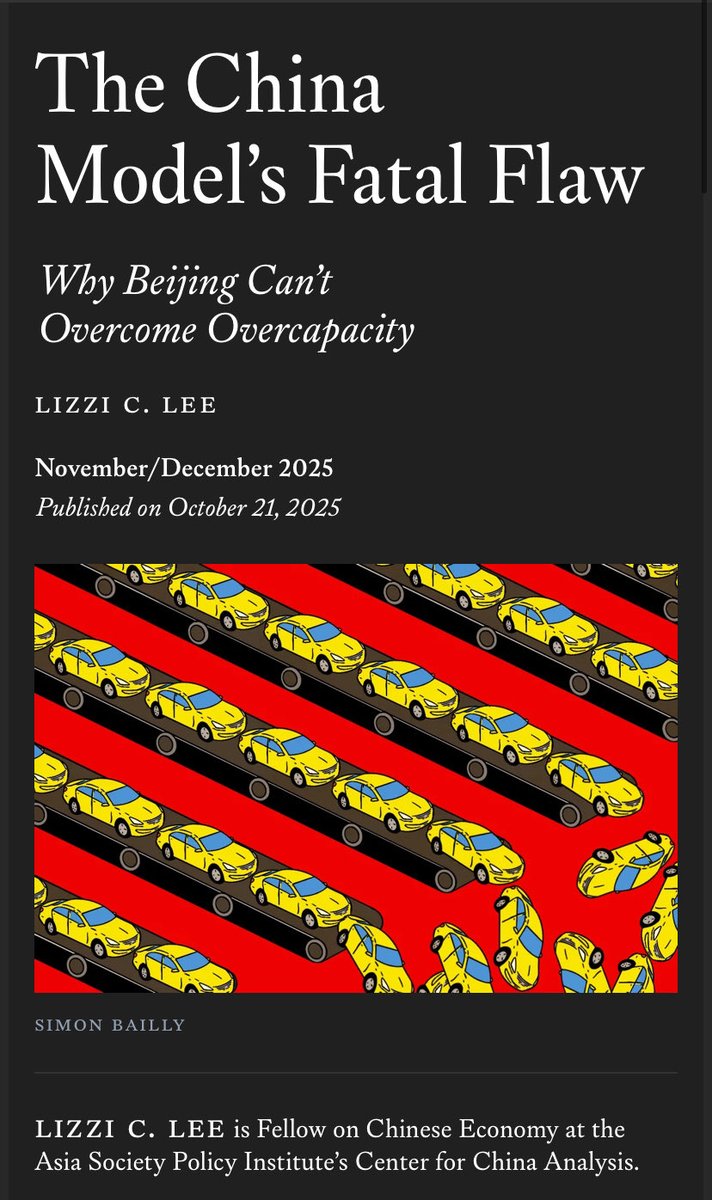
Sharing my piece in @ForeignAffairs where I argue that, unlike the common perception, China’s overcapacity problem is NOT primarily about government subsidies (many of which have been rolled back) or lack of domestic demand (true in general, but not the leading cause in green tech).
Rather, it stems from three interlocking internal dynamics:
The bureaucratic system’s incentives, reinforced by the fiscal–tax model and worsened by the property market drag.
The financial system’s incentives, rooted in the banking sector’s low risk appetite and its preference for visible, short-term results.
A hypercompetitive, extremely innovative private sector, which paradoxically has made the problem worse.
These three forces reinforce one another and are deeply baked into the system. What makes the problem so hard to unwind is precisely that it’s not just about what the government does or doesn’t do; it’s about aligning a vast network of fragmented and often contradictory incentives.
Hence, what’s needed is not merely a correction, but an institutional reckoning.
@wstv_lizzi@ForeignAffairs@AsiaPolicy There are really good threads within the piece and I am trying to re-organize them but like I wrote it is very hard to come up with that "grand unifying model".
I don't think it's around "overcapacity", though. I think we have to find another term.
https://t.co/SRXvYCTOaG