𝗗𝗮𝘃𝗶𝗱 𝗦𝗼𝗹𝗼𝗺𝗼𝗻 𝗶𝘀 𝗿𝗶𝗴𝗵𝘁.
𝗔𝗻𝗱 𝘁𝗵𝗮𝘁 𝗶𝘀 𝗽𝗿𝗲𝗰𝗶𝘀𝗲𝗹𝘆 𝘄𝗵𝘆 𝗵𝗲 𝗶𝘀 𝘄𝗿𝗼𝗻𝗴.
The CEO of Goldman Sachs has just published a New York Times op-ed designed to cool down the AI jobs debate.
His thesis is solid.
Creative destruction is not new.
The economy absorbs ruptures. Productivity gains finance expansion.
Real AI deployment will be slower than markets anticipate.
On the long-term macro, Solomon is right.
On what matters for an executive in 2026, he is looking in the wrong direction.
In October 2025, Goldman announced workforce reductions under OneGS 3.0 to capture AI productivity gains.
A few months later, the same CEO publishes a reassuring op-ed.
This is not a contradiction.
It is a coherent institutional posture.
A systemic CEO never speaks from nowhere.
His role is also to prevent the public narrative from becoming destabilizing.
It is not a neutral demonstration.
It is an act of leadership.
The problem begins when other executives read the message at face value.
The “apocalypse vs adaptation” debate is the wrong question.
The strategic subject of 2026 plays out elsewhere.
𝟭. 𝗧𝗵𝗲 𝘁𝗿𝗮𝗻𝘀𝗶𝘁𝗶𝗼𝗻 𝘄𝗶𝗻𝗱𝗼𝘄. Between 2026 and 2028, agent adoption velocity will outpace most organizations’ adaptation capacity.
The competitive positions of the decade will be won or lost in that gap.
𝟮. 𝗧𝗵𝗲 𝗼𝗿𝗰𝗵𝗲𝘀𝘁𝗿𝗮𝘁𝗶𝗼𝗻 𝗹𝗮𝘆𝗲𝗿.
The relevant question is no longer how many jobs AI will eliminate.
It is: who controls the agents that execute alongside, or in place of, your teams?
𝟯. 𝗢𝗽𝗲𝗿𝗮𝘁𝗶𝗼𝗻𝗮𝗹 𝘀𝗼𝘃𝗲𝗿𝗲𝗶𝗴𝗻𝘁𝘆. Who holds the decision logs?
Which vendor controls the model layer? How do you audit an agent’s decision six months later?
These are no longer theoretical questions. They are architectural constraints and contractual leverage.
OneGS 3.0 is not a productivity program. It is the redesign of the bank’s operating nervous system.
Goldman is not just preparing for AI. Goldman is building the organization that will govern AI.
Companies that take Solomon at face value will arrive in 2028 with no agent architecture, governance, traceability, or sovereignty.
They will discover the real risk was never the job apocalypse.
The real risk was dependency.
The 2026 choice is binary.
Wait for the macro to stabilize.
Or take a position now on the orchestration layer.
The first posture is rational for a systemic bank. The second is rational for every company without that depth.
This is the territory we are building at 𝗛𝗜𝗞𝗔𝗥𝗜 𝗕𝗟𝗨𝗘. Agent governance. Orchestration architecture.
Operational sovereignty.
Not to respond to an apocalypse.
To build the competitive position that plays out within the 2026-28 window while the public debate keeps watching the wrong indicator.
Solomon is right on the long term. That is why the short term is being decided now.
The real question is not: will AI eliminate jobs?
The real question is: who will control the layer that executes the work?
https://t.co/OsSSp7zzLN
The fox in the henhouse paradox
A simple question every executive driving an enterprise AI transformation should be asking.
When you deploy OpenAI, Anthropic, or any other model provider directly at the core of your operations, who captures the value of that usage?
The answer is worth a pause.
Your queries feed the continuous training and improvement of their models.
Your use cases inform their product roadmaps.
Your volumes fund their next generations.
And in parallel, those same providers are launching or funding vertical applications that compete head-on with your own business lines.
This is not a failure on their part.
It is the normal mechanics of a player maximizing its position.
It is a failure on the part of whoever lets that mechanism run without a counterweight.
The layer that separates usage from the provider
The real question is not whether to pick Anthropic, OpenAI, Mistral, or Gemini.
The real question is: who arbitrates token allocation across these providers, based on what criteria, and with what level of traceability?
An organization that owns this arbitration layer keeps three decisive levers.
First, it can route every use case to the most performant and cost-effective model at any given moment, without locking contractual dependencies.
The foundation model market is commoditizing at accelerating speed.
Performance gaps between equivalent models are now measured in weeks, not years.
Without an arbitration layer, you keep paying yesterday's leader's price.
Second, it retains ownership of its usage data, its business prompts, its agentic workflows.
These assets are not peripheral.
They are the codified expression of your operational know-how.
Handing them over in plain text to a third-party provider amounts to outsourcing your competitive edge to the actor best positioned to replicate it.
Third, it can document end to end what is requested, from which model, with which data, for which outcome. Eight months out from full EU AI Act enforcement, this traceability shifts from convenience to regulatory obligation.
Organizations in regulated sectors operating without such a governance layer will find themselves non-compliant by construction.
The shift in value
The thesis deserves to be stated plainly.
Value in enterprise AI no longer concentrates on the models themselves. It is migrating to the integration, alignment, and governance layer that separates business usage from raw capacity providers.
It is this layer that allows a bank, an insurer, an industrial operator, or a pharmaceutical company to:
– Keep control of its technical choices without being subject to its providers' strategic pivots.
– Orchestrate AI agents within an auditable and compliant framework.
– Build a capital of proprietary prompts, workflows, and knowledge that appreciates over time instead of dissolving into third-party models.
The organizations that accept disruption are the ones standing still.
Worse: the ones actively accelerating their own disruption by integrating, without counterweight, the very players whose mission is to replace them.
A governance question, not a technology one
This is not an architect's debate. It is a board decision.
He who controls the tokens controls the spice.
And he who controls the spice controls the table.
At HIKARI BLUE, we work with executive committees at financial institutions, insurers, and regulated industrial groups to build this control layer before the EU AI Act makes it mandatory.
If your board's next agenda includes your exposure to model providers, I am opening a few confidential diagnostic slots this month. 30 minutes, no commitment, to map your position.
DM
Our visions converge towards the same idea:
AI is not a simple technology.
It is a test of individual, entrepreneurial and civilizational sovereignty.
1. It amplifies the intention.
2. It accelerates learning.
3. It rewards the initiative.
4. It penalizes passivity.
5. It transforms the allocation of capital, time and intelligence.
Une IA fiable ne s’intègre jamais par simple adjonction dans une organisation lente ou mal structurée. Elle exige des données robustes, une refonte profonde des workflows, des talents rares, une gouvernance sans faille, ainsi que la capacité financière et managériale d’absorber une courbe en J souvent violente.
Or, précisément, la plupart des entreprises ne disposent ni de cette architecture, ni de cette discipline d’exécution.
Zuckerberg just described exactly what we’ve been building for the past two years.
“OpenAI and Google are building AI. I believe we’ll have many different AI systems.
Every company just like it has a website, a phone number, and an email address will also have an AI that interacts with its customers.”
The real battle is no longer about foundation models.
It’s about the proprietary operational layer: the one that encodes products, policies, customer history, and the way a company works.
Owning a state-of-the-art model is no longer the point.
Owning the integration, alignment, and governance layer that transforms a generic model into a system that thinks like your company that’s where the value is shifting.
That is precisely the founding thesis of HIKARI BLUE.
Intelligence, engineered forward.
Google's new KV-cache optimization broke the DRAM stocks, but how does it work?
Let's take quick a look.
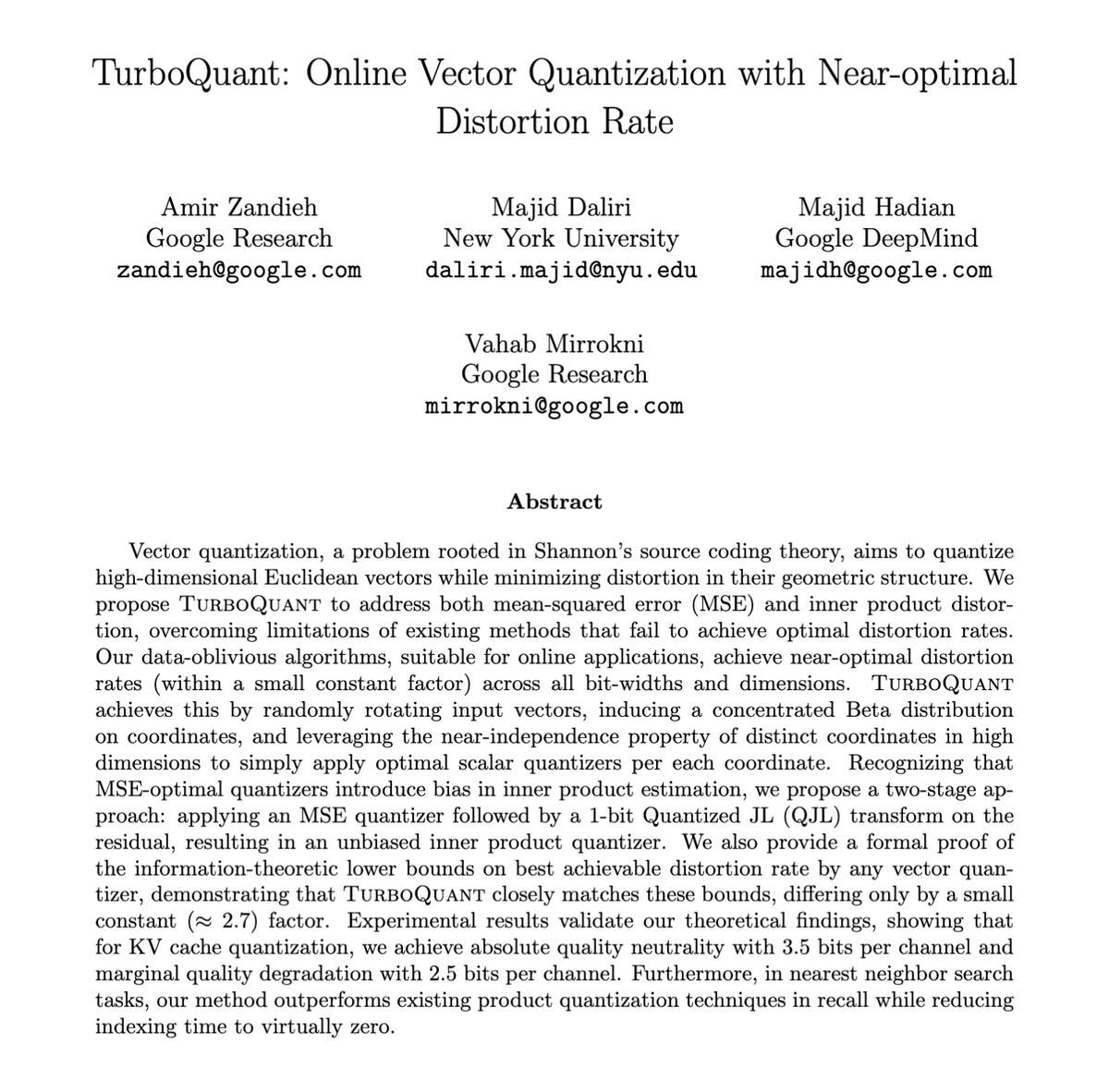
"TurboQuant: Online Vector Quantization with Near-optimal Distortion Rate"
TurboQuant combines 2 ideas from 2 earlier lines of work: PolarQuant and Quantized Johnson-Lindenstrauss(QJL).
PolarQuant shows that switching from Cartesian to polar-style coordinates can kill a lot of the usual quantization overhead, because the transformed variables have a much more structured, concentrated distribution. So you can use fixed scalar quantizers instead of learning lots of extra per-block quantization constants.
In TurboQuant, the same core intuition shows up in a slightly different form, where they instead randomly rotate the vector so it looks like a random point on the sphere. Then each coordinate follows a known Beta distribution and is nearly independent in high dimension, so coordinate-wise scalar quantization becomes nearly optimal.
On the other hand, they used the clever 1-bit trick from QJL. While plain MSE-optimal quantization reconstructs vectors well, it still gives biased inner products, which is bad for KV-cache use cases.
So TurboQuant spends most of the bit budget on the main near-optimal scalar quantizer, then uses the final 1 bit for a QJL sign sketch of the residual to remove inner-product bias. That final 1-bit residual sketch is like a bias-corrector for dot products, which gives an unbiased inner-product estimator while keeping variance low.
And these are what got TurboQuant to reduce LLM key-value cache memory by 6x and 8x speedup.
Yes!!
The example is all the more striking as so many mediocre people spend their time attacking @elonmusk. Whether we appreciate him or not: he is part of this very rare category of men capable of thinking at the scale of the century and executing at the scale of industry. Where many comment, he builds. Where many theorize, he deploys. Where many dream small, he transforms extraordinary visions into technological, industrial and operational realities.
Introducing TurboQuant: Our new compression algorithm that reduces LLM key-value cache memory by at least 6x and delivers up to 8x speedup, all with zero accuracy loss, redefining AI efficiency. Read the blog to learn how it achieves these results: https://t.co/CDSQ8HpZoc