This is me and my wife's early retirement tax strategy.
A taxable brokerage *can* act as a Roth IRA (tax-free withdrawals) that you can tap early if you're savvy with managing your taxable income (salary + portfolio withdrawals).
Ideal to retire first and zero out a salary.
Charles Darwin only worked about 4 hours a day. He worked for two 90-minute periods each morning & then one 60-minute period later in the day. Before the latter, he would take an hour nap & go on 2 walks. On this schedule he wrote 19 books including The Descent of Man & On the Origin of Species.
My life improved dramatically when I learned to pause before reacting. Space creates perspective. Perspective creates better decisions. And better decisions compound into a better life.
Underrated life skill: Listening without waiting to respond. Most people treat conversation like a competition. If you can truly listen, you'll compress your learning cycles. You'll learn faster, connect more deeply, and adapt more effectively. You stand out without trying.
If you only workout when you feel like it, you’re going to get fat.
If you only go to work when you feel like it, you’ll be broke.
If you only have sex when you feel like it, you’re going to deprive your spouse.
Master your emotions,
irrespective of how you feel.
I'm still utterly baffled by folks who want to get in shape but refuse to track anything
Not their diet (cals/macros)
Their training (exercises/sets/reps)
Their weight or measurements
How in the hell do you expect to reach your goal without any data?
Makes zero sense.
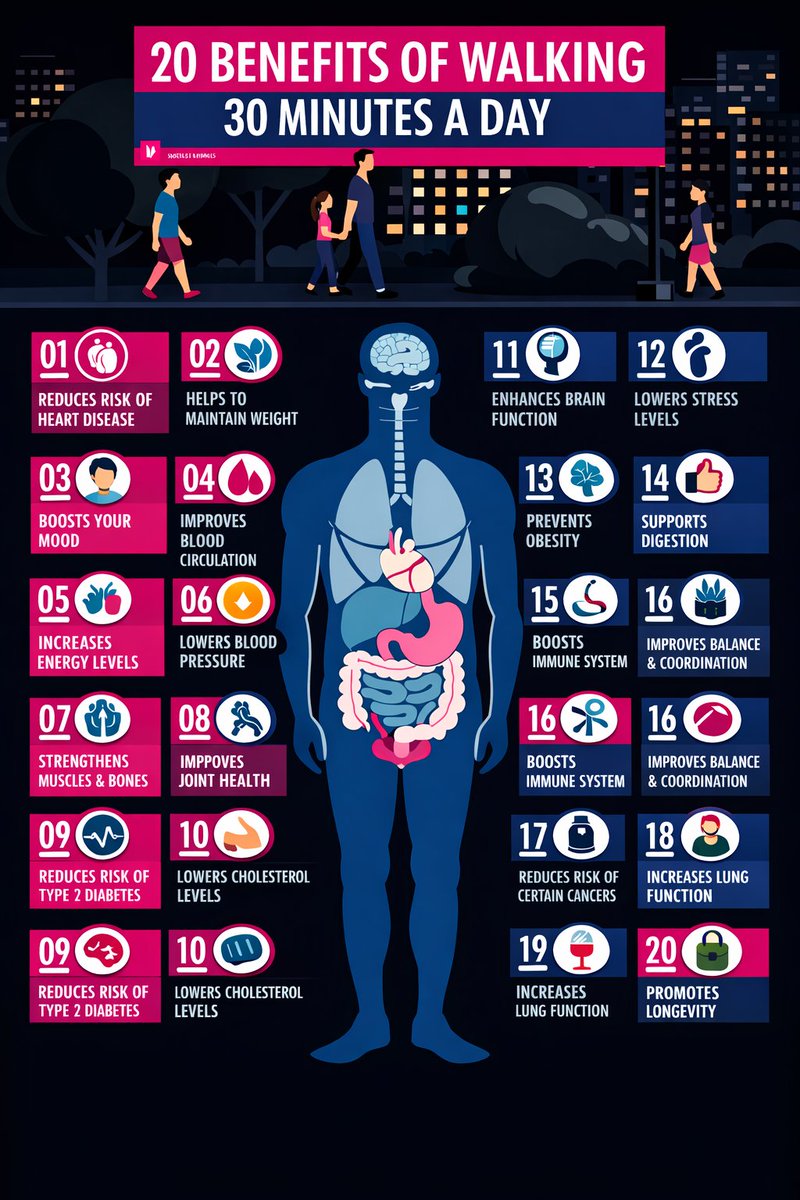
Humans used to walk 16,000–17,000 steps a day.
The average American now walks 3,000–4,000.
Here's what actually happens to your body when you start walking more:
I wish I could tell my younger self how much better life gets when you stop living for the approval of others. You realize you were living at 10% of full power and suddenly unlocked that other 90%. The gray dullness of constantly editing who you are is replaced by full color.
The 2x Training Method
1) 2 sets per exercise
2) Hit each muscle 2x per week
3) Take sets as close to failure as possible
4) Each session try to do more weight or reps
Do this for a full year and you'll spend less time in the gym while making more gains.
The mindset you should have in the gym:
"Every workout is a 'brick' to build muscle. If I beat the training log, I'll gain a small 'brick'. If I do this every session, over time, the house will be built."
Every workout counts, don't take sets off.
A mentor once told me this: Confidence is less about knowing you’ll win and more about knowing you’ll bounce back even if you don’t. Real confidence is built on resilience. Adaptability. Tolerance for uncertainty. Fear loses when you embrace that failure is never final.
You're not afraid of failure.
You're afraid of being seen failing.
There's a difference.
One is about outcome. The other is about ego.
Let the ego die. Start building.
The most underrated flex is being easy to reach for the people who matter and hard to reach for the people who don’t. Guard your attention with your life. It’s the only resource you can’t create more of.
Feeling worse is a sign you're getting better. You have to feel weak before you're strong. You have to feel stupid before you're wise. It's not supposed to be easy, it's supposed to be hard. So keep showing up. One day you'll look back and realize it was worth it.
I can’t help but think (and feel) that the world is generally very sad right now. Injured really.
Yesterday I was in Utah with family. Three generations. We played sports, enjoyed good food, saw friends, and just messed around all day. One of the best days in recent memory for all of us. This is where I grew up. It took me back to my childhood. Allowing me to embody those psychological states and feel the comparative difference between then and now.
The hollowing and sadness of the modern world seems to stem in part from our phones, social media, and the ferocious need to be seen and relevant in every moment. We have mistakenly idolized a specific kind of dysfunction: a manic, sleepless hyper-vigilance that needs to be omnipresent.
Everyone I know who’s unplugged for a week, returns reporting life-changing levels of improved life satisfaction. I’ve never met anyone who didn’t return feeling spry and vibrant and clear-eyed about the corrosive nature of current social culture. The science supports them feeling that way. They were in a dopamine deficit from the hyper-stimulated state of the world so everything felt gray.
So why don’t we unplug more and more often? We’re all kind of trapped in a prisoner's dilemma. Most want to move to the mountains and be relieved of it all but are terrified that if they unplug, they’ll be invisible. Real life consequences of reduced power and status. So we stay plugged in and drink the poison. This hypervigilant state keeps us in chronic fight or flight (anxiety). Simultaneously, our addiction creates a dopamine deficit (the emptiness/grayness feeling) and a background hum of anxiety.
Mammals are biologically hardwired to co-regulate: physical touch, eye contact, proximity and in-person vibes. Things which release oxytocin and activate the vagal nerve's parasympathetic system. Screens eliminate all of this goodness.
There are small wins to be had here. More in-person time. A day off technology per week. A block of 4 hours. One hour before bedtime. I hope that there’s a collective awakening that we’re all being mined for engagement. Then we get trapped. And then trap each other.