😎 Je veux l'amour, l'amusement, la bonne humeur et meurs d'une main dans le coeur... 😉
Laissez tout vous arriver, beauté et terreur, continuez. Aucun sentiment n'est définitif... 🕉️
Magnificent: The Cone Nebula, found some 2,500 light-years away.
Its pillar-like structure epitomizes the fascinating shapes that can emerge within immense clouds of cold molecular gas and dust, where stars are formed.
(Credit: ESO)
ESPECTACULAR!
Atardecer en llamas, esta noche sobre la ciudad de Nueva York tras la fuerte tormenta 🇺🇸
También se está registrando una tormenta geomagnética solar moderada.
#NYC#NewYork#NewYorkCity#sunset
Créditos 🎥
Vía @isardasorensen
🔴 El 21 de septiembre de 2012, el transbordador espacial Endeavour llegó a Los Ángeles montado sobre un Boeing 747 de la NASA.
¡Una de las imágenes más icónicas de la aviación y la era espacial! 🇺🇸✨
There will be more than just fireworks to see in the night sky this month!
You can look forward to these celestial sights in July:
- A lunar-planetary alignment
- A visiting comet
- A good look at Saturn and the Milky Way
Happy skywatching! https://t.co/6EP5GpvAQw
It's a Hot Moon Summer 💅
In the early morning tomorrow, June 29, this month's full Moon will peak, also known as the Hot Moon or Strawberry Moon since it aligns with the beginning of the summer season.
Learn more about our Moon here: https://t.co/Vm9Iq3ZQpd
This image of Messier 64 is a combined view from @NASAHubble and @NASAWebb.
The gas in the outer regions is rotating in the opposite direction from the gas and stars in its inner regions. This strange behavior may be due to a merger between M64 and a satellite galaxy.
Los tardígrados son animales invertebrados microscópicos. Miden en promedio medio milímetro y son famosos por su capacidad de sobrevivir en condiciones ambientales extremas. En este video, se observa a uno caminando bajo el microscopio
Two close-up views of Ganymede, the largest moon in our solar system, taken 25 years apart!
30 years ago on June 27, NASA's Galileo spacecraft performed humanity's first-ever flyby of Jupiter's icy moon Ganymede—revealing that it had a magnetic field. Galileo flew within 519 miles (835 km) of Ganymede.
Nearly 25 years later, in June 2021, Juno made the next closest approach to the surface of this fascinating moon reaching a distance of 645 miles (1,038 km), detecting salts and organic compounds in its icy crust.
⬇️ Galileo's view, June 1996 ↘️ Juno's view, June 2021
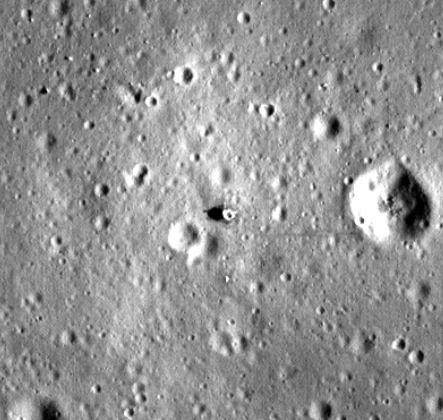
Today marks 17 years since NASA's Lunar Reconnaissance Orbiter (LRO) began orbiting the Moon and collecting detailed data about its surface.
Here's one of our favorite spots as seen by LRO: the Apollo 11 landing site featuring the descent stage of the lunar module at center!
A Black Hole Can Be Dragged Through Spacetime
A Black Hole does not have to sit still.
Einstein’s equations allow a stranger possibility... a Black Hole that accelerates.
This is the C-metric, an exact solution of General Relativity describing an accelerating Black Hole.
The Black Hole accelerates because the geometry of Spacetime says it must.
The C-metric is one of those exact solutions that reminds us how wild General Relativity really is. Gravity is not just attraction, and Spacetime is not just a stage.
Sometimes the stage itself contains the force.
#Astrophysics #GeneralRelativity #Einstein #CMetric #BlackHole #CosmicStrings #Spacetime #Cosmology #Mathematics #Physics
19 years ago today: Space Shuttle Atlantis' main landing gear touches down at Edwards Air Force Base in California concluding a two-week assembly mission to the International @Space_Station.
Sunita Williams, a flight engineer on the Expedition 15 crew, returned to Earth on STS-117 completing 194 days in space, the longest single spaceflight ever by a female astronaut or cosmonaut to that date. This record is now held by @astro_Christina for her 2019–2020 spaceflight (328 days).
El 12 de agosto de 2026 un #eclipse solar total recorrerá Europa y Norteamérica, dejando fuera a #México.
Sin embargo, 15 días después, los mexicanos podrán mirar al cielo para observar un eclipse parcial de #Luna que pintará al satélite de una tonalidad rojiza.
https://t.co/pB2lu6KPp0
IMPRESIONANTE!!
Un hombre fotografió el Sol diariamente durante tres años desde el mismo lugar y a la misma hora.
Luego combinó todas las imágenes para revelar el movimiento del Sol en el cielo a lo largo del año.
This photo from the @Space_Station shows the aurora australis arcing over Earth during an active solar event.
When energetic particles from space collide with atoms and molecules in the atmosphere, they can cause the colorful glow that we call auroras: https://t.co/hTLLxD0WTP
🚨 NASA’nın Voyager 1 uzay aracı, Güneş Sistemi’nin en uç noktasında beklenmedik bir “duvar”la karşılaştı.
Yaklaşık 50 yıl önce fırlatılan Voyager 1, Plüton’un çok ötesine geçerek karanlık ve sessiz uzaya doğru ilerlerken, bir anda alışılmadık bir bölgeye girdi. Cihazları ani bir sıcaklık artışı ve yoğun enerji dalgası tespit etti.
Bilim insanları bu bölgeyi “Wall of Fire” (Ateş Duvarı) olarak adlandırıyor. Burası, Güneş’in manyetik etkisinin ve güneş rüzgarlarının bittiği, yıldızlararası uzayın başladığı kritik bir sınır.
Voyager 1, insan yapımı bir nesne olarak milyarlarca kilometre uzakta, hiç kimsenin daha önce görmediği bu sınırı dokunarak geçti. Hâlâ sinyal gönderiyor ve bize yeni veriler aktarmaya devam ediyor.
Bu keşif, Güneş Sistemi’nin gerçekten nerede bittiği ve ötesinde ne olduğu sorularını yeniden gündeme taşıdı.
Smile! Tomorrow is the Northern Hemisphere’s summer solstice! 😎☀️
This “sunny smile” is made of coronal holes — darker, cooler regions on the Sun where solar material escapes to space at incredible speeds. 🕳️
More on coronal holes in this episode of NASA’s Illuminate.👇