Excited to announce I'm joining @PanteraCapital as a Junior Partner!
I'll be backing founders building stablecoin payments, fintech x DeFi, and new markets for compute, energy, and more.
Thank you to @dan_pantera, @veradittakit, @FranklinBi, @stutireal, Cosmo and the rest of the Pantera team for the trust and the opportunity. It's an honor to join a team that has backed the foundations of onchain finance for over a decade.
Huge thank you to @nascent and @delitzer. Nacscent sharpened how I think about DeFi, market structure, and what it takes to build at the edge of finance. I'm grateful for the mentorship and the friendships.
More on why I joined Pantera: [https://t.co/PDtcFozxbm]
Following Black October I’m convinced that Cybersecurity has to become a market that is as big, if not bigger than AI. Every dollar of the AI buildout passes must pass through cybersecurity infrastructure, which has become mission critical, to reach an enterprise.
I @PanteraCapital sat down with the two people best to discuss this: @P3b7_ , CTO of @Ledger whose devices hold half a trillion dollars and have never been compromised, and Michael, Director of Security at @Payward, the company behind @krakenfx where his team defends over $40B and has helped the Secret Service claw back hundreds of millions from attackers.
What we got into:
→ @OpenAI’s 700-paper math drop, and half the field is calling it the slop drop. Not one paper was about cryptography, what does that silence mean?
→ Quantum versus AI, the race to break encryption. Quantum goes after the math itself, on a timeline no one will commit to. AI’s already here, stripping out everything built around the math.
→ @binance. Over $6B gone, and the way in was a fake job interview
→ The Donjon, Ledger’s attack team, found more vulnerabilities with AI this year than in the previous 8 years combined.
What surprised me is that two people closest to the damage are also the most optimistic.
Links in the thread
💲 @Coinflowlabs is proudly partnering with @Bastion to power U.S. payouts for Samsung Wallet.
Our Network of Networks, in a new use case. https://t.co/eeKWVnSxkq
Today we're announcing Atomarine's $19M seed round!
We are supported by great investors including @ycombinator, @PanteraCapital, @Soma_Capital , @sevensevensix, @Liquid2V, @AudaciousHQ, @e14fund, and many others.
@Atomarine_co is solving the main constraint to AI today: physical buildout. Our floating data centers powered by nuclear, are designed to be built on a single production line, and anchored offshore.
By moving offshore, we do not compete with communities for water, power or land, and we do not drive up their electricity bills or rent. This allows America to stay competitive in the AI race without putting the burden on local communities, while fighting climate change by scaling AI on nuclear instead of fossil fuels.
We have already built a functional proof of concept and we are now racing towards our next big milestone.
If you are a very talented engineer in naval architecture, nuclear or data center design, or just love to work at world-changing, fast-paced companies, reach out. We are hiring!
Florida elected a Republican governor who backed a U.S. Bitcoin reserve. Texas elected a Democratic senator who voted to create one for his state. The case for holding Bitcoin crosses party lines.
Every parent wants a happy child. So we built MDD-PGT, the first genetic predictor of depression for embryo screening.
Kids with a lower MDD-PGT tend to sleep better, fight less and enjoy jokes more. With 10 embryos, picking the lowest-risk one cuts depression risk by over 40%.
We’ve been investing in the entrepreneurs building the future since 2003.
We look for founders who are resilient, and we’ve learned that founders look for investors who are too.
Embracing volatility and standing alongside our founders through every market is what draws the best ones to work with us.
It goes beyond capital. They’re trusting us to be their partner for the life cycle of their company.
Money, markets, and machines.
That’s where Pantera is investing, and our October Portfolio Spotlight shows two companies building at that intersection:
→ @FissionXYZ makes tokenized funds easier to sell. Rather than waiting on redemption windows that can stretch to ~200 days, eligible investors can access their capital in 90 seconds or less.
→ @verantaxyz (Lumena Labs) brings crypto, stocks, currencies, metals, and more into a single wallet. Its new developer tools let AI agents connect to the same markets as human traders.
Read the full Spotlight: https://t.co/i5WHp7TU1B
the world is doomed in real time with all these massive hacks and people telling me we all gonna die so soon
thought running thru my brain: darn i just bought an ikon pass yesterday
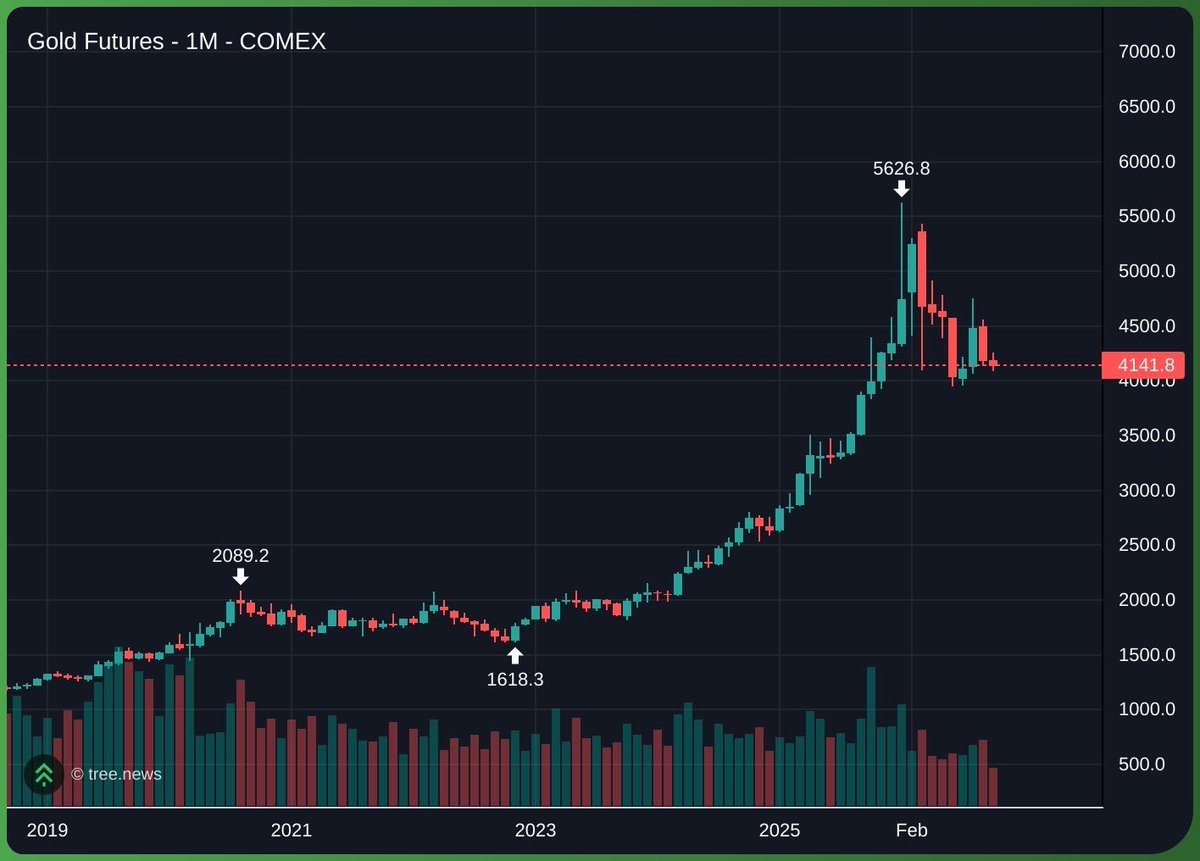
If you’re selling gold because of fusion alchemy, you’re front-running a reactor that doesn’t exist, fed with mercury that costs 100,000x more than the gold it makes, to produce bars you couldn’t legally sell for 15 years.
Marathon Fusion’s idea is real physics, since fusion neutrons can turn mercury-198 into gold.
1. Even optimistic models give 2–5 tonnes per gigawatt plant per year, against roughly 3,500–4,000 tonnes of annual mine supply
2. Enriched mercury-198 sells for about $15,000 per milligram today, while gold trades near $135 per gram
3. The gold would need 14–18 years of storage before it can be sold, so a plant’s first sellable bar arrives well over a decade after it switches on
Scientists in Germany have managed to reverse aging in human cells, turning blood cells from an 80 year-old into brain stem cells with a molecular age of 20.
They haven't quite found the key to immortality, but this is a big step toward extending human life.
In an AI compute short squeeze, everyone in the stack looks smart. That doesn’t tell you who earns durable long-term returns.
You can be right on demand and still own the wrong businesses.
Today we estimate that every incremental GW of data center capacity currently generates $40-50bn of revenue across the stack.
Data centers are under-earning (~$2.2mn/MW) relative to the value they unlock at the token factory layer (~$40mn+/MW).
Frontier models face real pricing pressure from open-source and the hyperscalers. A 40% token-price cut can push standalone inference near breakeven — while hyperscalers still make money on the hardware.
The picture will look very different in 6–12 months. Energy capacity, tokens per watt, model-layer competition, and financing are all in motion.
We built a dynamic tool to track how it plays out.
This map will look different in 6-12 months. Four forces to watch:
- Energy, the most acute bottleneck today
- More tokens per watt from better hardware and software
- Rising competition at the model layer
- Financing all this capex
So we open-sourced our model. Input your assumptions and watch how value shifts across the stack.
so i have been in the sf tech scene for a couple of months now, and i learned the games that ppl play
1. land a $3M lab order in 2 weeks, *26 = ~$80m as the annual revenue
2. schedule all orders to be signed in the same month, and multiply the best month by 12
3. sign $5M LOIs with friend's companies and batchmates. they sign one back (also happens at scale with large labs/compute)
4. buy github stars at 6 cents each
the last company that swapped invoices with a partner reported $220M - and it's bankrupt now
sad that it's a whole gresham's law game right now and if you dont play you just get downvoted
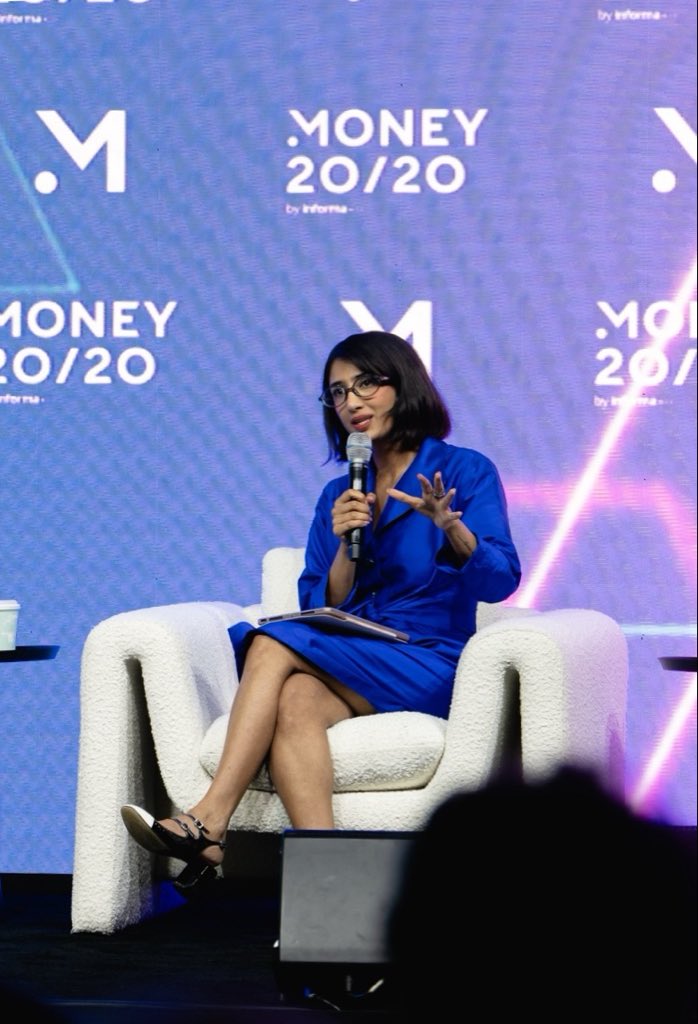
Just wrapped Money20/20. My biggest takeaway as a VC: the two forces reshaping fintech right now are AI agents and stablecoins.
@SirDigitalDan from @CoinflowLabs and I dug into both in our fireside.
Some takeaways:
* Where will value accrue?
AI is collapsing the cost of cognition, and stablecoins the cost of settlement. This changes value accrual, when those inputs aren’t scarce. I’m expecting value to migrate to regulated trust, proprietary data, distribution, underlying physical assets, networks.
* What does stablecoins as programmable money unlock?
Funds and spending rules can execute together, letting a product enforce agent budgets or trigger conditional payouts with less coordination across banks, processors and operational teams.
* Where is agent demand emerging?
Dan pointed to compute, inference and data APIs, which agents need to complete tasks. I’m looking for infra on fraud, KYA, chargebacks, and merchant side ops to help proliferate agentic commerce usage.
* Who carries agent liability?
A purchase can comply with the spending rules and still be a mistake. Before delegating larger budgets, businesses will want audit trails, a way to dispute purchases and an agreement on who absorbs losses.
* Where’s the distribution advantage?
Local integrations and merchant relationships give providers access to existing payment volume. Stablecoins can improve settlement without changing how customers pay. (Coinflow connects cards, ACH and PIX this way.)
* How do existing PSPs participate?
A provider can earn a processing fee when a developer funds an agent by card, even if subsequent payments settle in stablecoins. (Coinflow powers card funding for Tempo’s MPP Credits.)
Thanks for the week @money2020! Curious what others took away too!
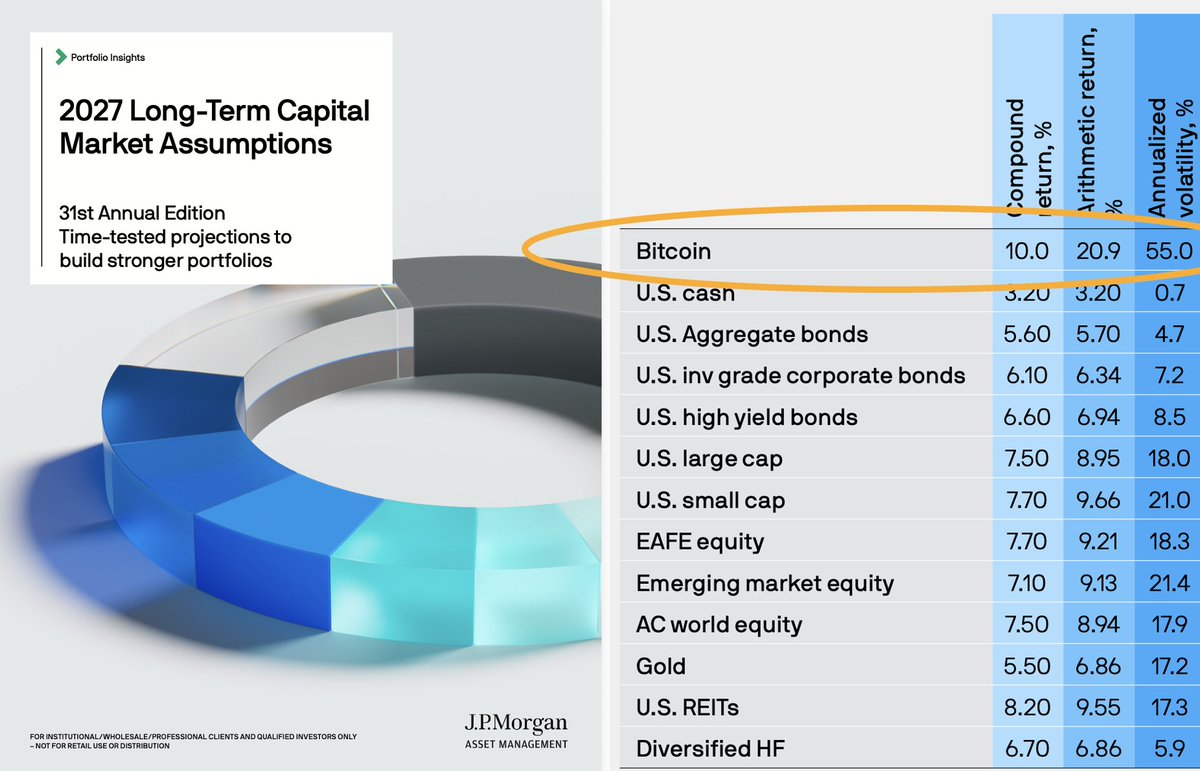
First they ignore you, then they laugh at you, then they fight at you, then they add you to their Long-Term Capital Markets Assumptions paper and predict you'll be the best-performing asset of the next decade.
this California wealth tax thing is just incredible.
so in October 2025, a California healthcare union proposed a "one time" 5% tax on any billionaire's wealth. the ballot measure will be voted on next month. In early December 2025, California announced that it would be a retroactive tax if passed, applying to anyone with CA residency as of Jan 1, 2026. The objective is to pay for Medi-Cal, California's incredibly dysfunctional healthcare system. (which also functions as a glorified welfare apparatus, but that's a discussion for another time).
polls reveal that the CA electorate is split around 50/50 on the tax, but prediction markets only give Prop 40 a ~23% chance of passing (there are competing measures on the ballet that would nullify it).
there are 200 billionaires in CA, worth collectively somewhere between $2.3 and $2.6 trillion. 5% of that is around $100b, accounting for a small amount of attrition. proponents of the tax forecasted a significant windfall, assuming only a 10% departure rate.
supporters thought they were being clever with the retroactive concept. no billionares would leave CA in the few short months between the tax being proposed and the residency cutoff date, without the tax even having passed yet, right?
well as it turns out, they did.
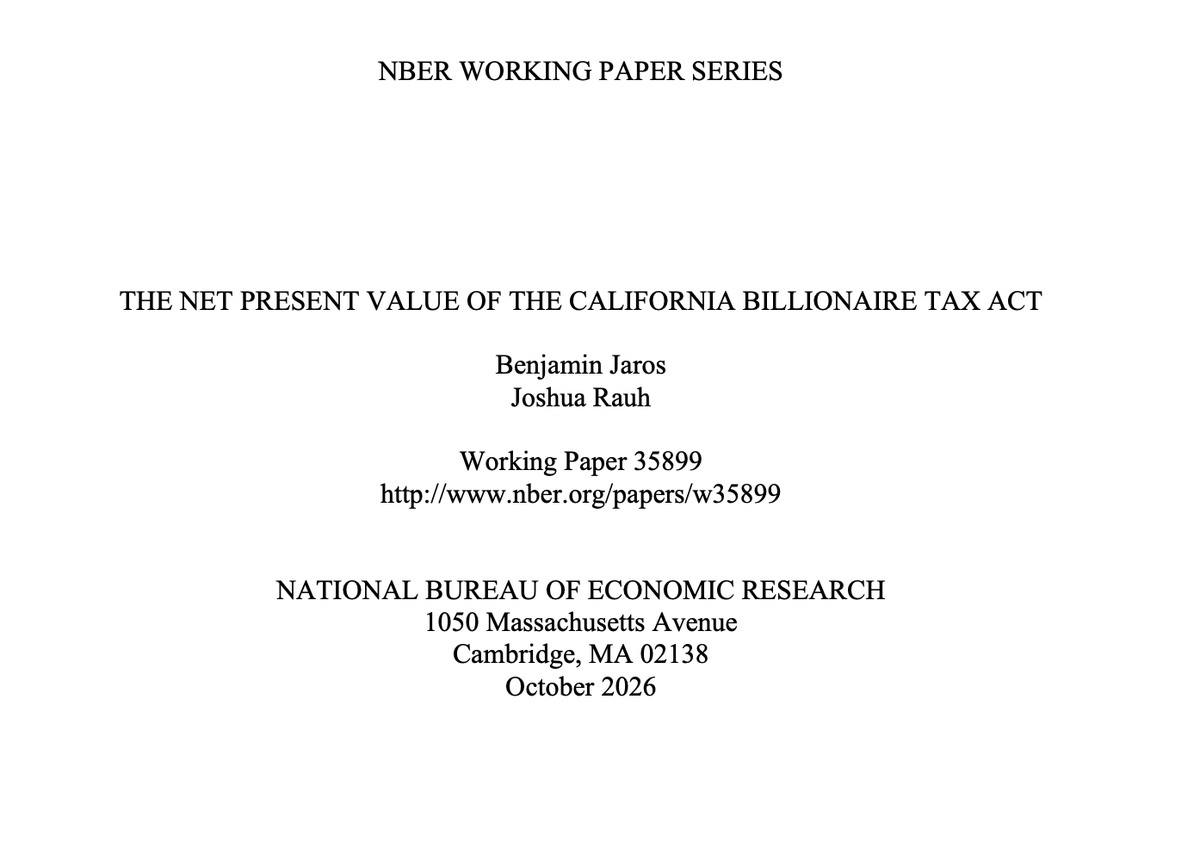
a new paper [1] from two academics at Stanford called "The Net Present Value of the California Billionaire Tax Act", argues that not only did more billionaires leave due to the proposed tax than its proponents expected, but that the value of the tax, if it does pass, is actually negative.
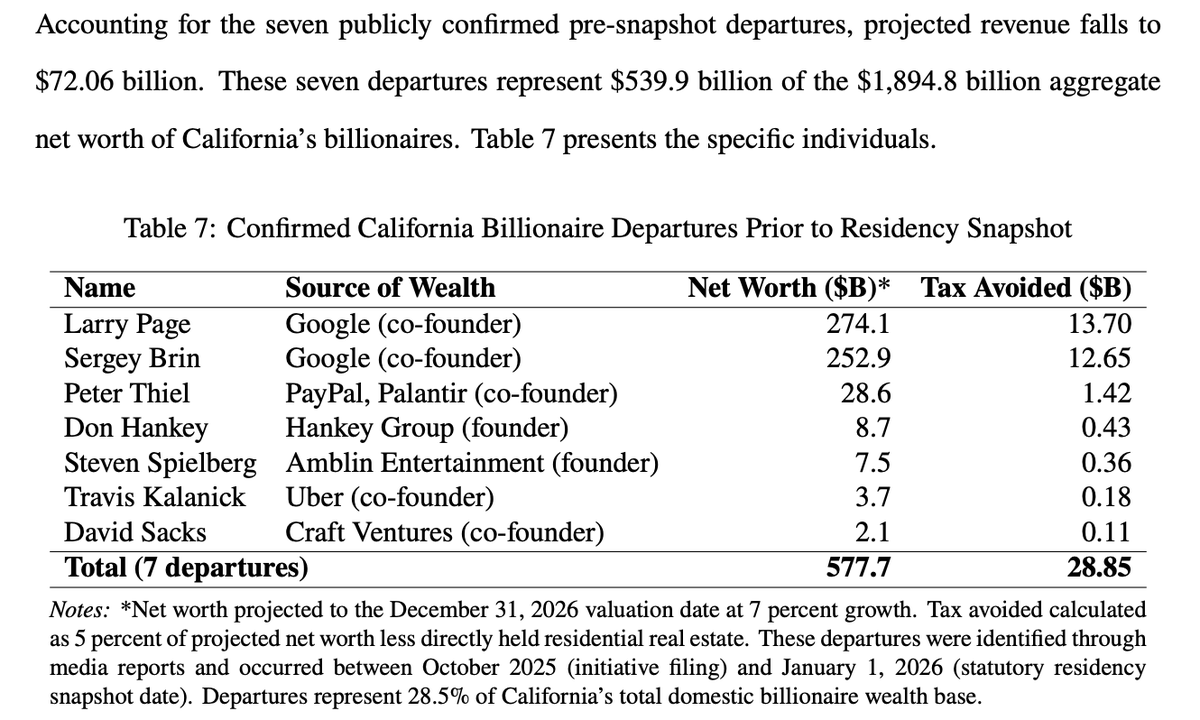
proponents of the tax only assumed 10% avoidance, that is, only 10% of the taxable base of targeted billionaires would leave CA within the very short Oct-Dec 2025 window. Jaros and Rauh, the Stanford academics, find that a lower bound of 28.6% of the taxable base managed to leave.
just based on known departures, those departures total $577b in net worth, or $28.8b in potential tax lost. this of course does not capture everyone (many left without announcing their departure), so the authors normalize to departure rates estimated from other wealth tax events, and apply other discounts for litigation, arriving arrive at a figure of only $28-$36b in forecasted tax revenues.
but this isn't all! all of the income taxes paid by the departed billionaires are also forsaken. the authors estimate that CA billionaires pay $3.3- 5.8b in annual income taxes. they assume a midpoint of $2b lost in annual collections from departed billionaires. the net present value of that lost income stream is -$68.9 billion.
so when you add it all up you get:
+ $30b one-time tax windfall (estimated)
- $69b in present value of lost future income taxes
= - 38.9b overall net present value of the tax
of course, this analysis is highly estimate driven. the authors simulate the parameters 100k times and find a negative NPV of the implemented tax 85 percent of the time.
and if the tax doesn't pass, which it's not looking like it will, California still ended up losing at least $577b in departed net worth, and they have permanently poisoned the well with entrepreneurs who will now worry about future wealth taxes.
[1]: https://t.co/1lbZgnMTG9