I recreated Tesla's FSD 15 Reality View using my own Model 3's dashcam clips!
There is no external data other than the dashcam clips and the telemetry that comes with them.
Youtube breakdown is in the replies
We’re building the future of reliable AI in healthcare, starting with the operations that keep hospitals running.
Introducing Scale for Hospital Operations: five agents built to strengthen the care teams behind every patient.
My AI agents found an unmapped Maya site in Mexico, using LiDAR data from a NASA dataset.
72 hours from a random thought on vacation to a reply from Mexico's national archaeology institute.
What a time to be alive…
Fable 5.2 shows substantially improved skills in controlling physical robots, even on tasks it has never explicitly been trained to do.
On RoboDojo, a benchmark with a simulated two-arm robot, it outperformed other models and most AI systems built to control robots.
We introduce 3D World Simulator, an interactive world model that runs at 50+ FPS on an RTX 5090.
Our model predicts in a unified 3D representation space, capable of generating:
• Novel view appearance
• Multi-view consistent RGB-D
• 3D geometry
• Spatially aligned tactile signals
Play with the world model now at https://t.co/eveClAxURp!
In collaboration with @HuggingFace, we’ve released the largest open robot dataset, alongside their first open System 1-System 2 model that can reason over step-by-step actions.
FineART is built with 40K+ demonstrations across 151 tasks and 500K subtask labels.
Together, the dataset and model were designed for each other, and both are available on @LeRobotHF where robotics developers work today.
@scale_ai is teaming with @huggingface to make robots better at long, multi-step tasks, and we’re open-sourcing all of it!
Today @scale_AI is launching FineART-VLA, a model that helps robots complete longer tasks, building on our first open-source robotics dataset.
Built with @huggingface 's LeRobot team, this is Scale’s first open-source robotics release.
Thanks to @Thom_Wolf + team for the partnership.
The momentum on open-source robotics is picking up steam, and high-quality data will determine how far it goes. Go build!
https://t.co/Y8OLuNSnnP
Many of you don't understand how serious this is, so let me break it down.
In computer science there is a famous kind of puzzle called 3-SAT. You are given a long list of yes-or-no switches and a set of rules about how they must be arranged, and you have to find a combination that satisfies every rule. The obvious way to solve it is to try every combination, but each new switch doubles the number of possibilities, so a puzzle with a few hundred switches would take longer than the age of the universe to brute force.
For decades, the smartest people in the field found clever tricks that made this a little faster, but every trick still hit the same wall: the time required kept exploding as the puzzle grew.
About 25 years ago, two computer scientists, Russell Impagliazzo and Ramamohan Paturi, working with Francis Zane, turned that wall into a formal idea.
They proposed the Exponential Time Hypothesis, which says this explosion is not a failure of human cleverness but a law of nature. No algorithm, however brilliant, will ever solve 3-SAT without the time blowing up exponentially. Nobody could prove it, but almost everyone believed it, and it became one of the foundations of modern computer science.
Researchers used it as a measuring stick. If you could show that solving some other problem quickly would also crack 3-SAT quickly, you had shown that problem was hopelessly hard too. Hundreds of papers, across scheduling, graphs, logic and much more, rest on this one assumption.
Now an internal AI model at OpenAI claims to have broken it. It says it found an algorithm that solves these puzzles meaningfully faster than the hypothesis allows, and it has checked the proof in a computer verification system called Lean.
And here is the remarkable part: the very people who proposed the hypothesis, Impagliazzo and Paturi, along with MIT's Ryan Williams, are now leading the public review of whether a machine has disproved their own idea.
So what happens next? If the disproof holds, a large part of theoretical computer science has to be revisited.
Every result that said "this problem cannot be solved faster, assuming ETH" loses its foundation, and researchers will have to work out which of those walls were real and which were simply where we stopped looking. It does not mean everything becomes easy. The new algorithm is still slow in absolute terms and this is not the famous P versus NP problem being solved.
But it means our map of what is possible was wrong in a place we were very confident about, and it was an AI that redrew it. If the disproof fails, the hypothesis survives and the field breathes out, but we will still have watched an AI produce serious, checkable work on one of the deepest questions in the discipline, closely enough that the founders of the idea had to take it seriously. Either way, something has shifted.
We just launched OpenUSD support on the @huggingface Hub 🎉
Yesterday, @nvidiaomniverse put 2,500+ SimReady assets on the Hub. Forklifts, robot arms, engines, hospital equipment, all OpenUSD. You can also search the whole library in plain English
https://t.co/SU8mXQQRzL
https://t.co/U4PmZ0OMUp
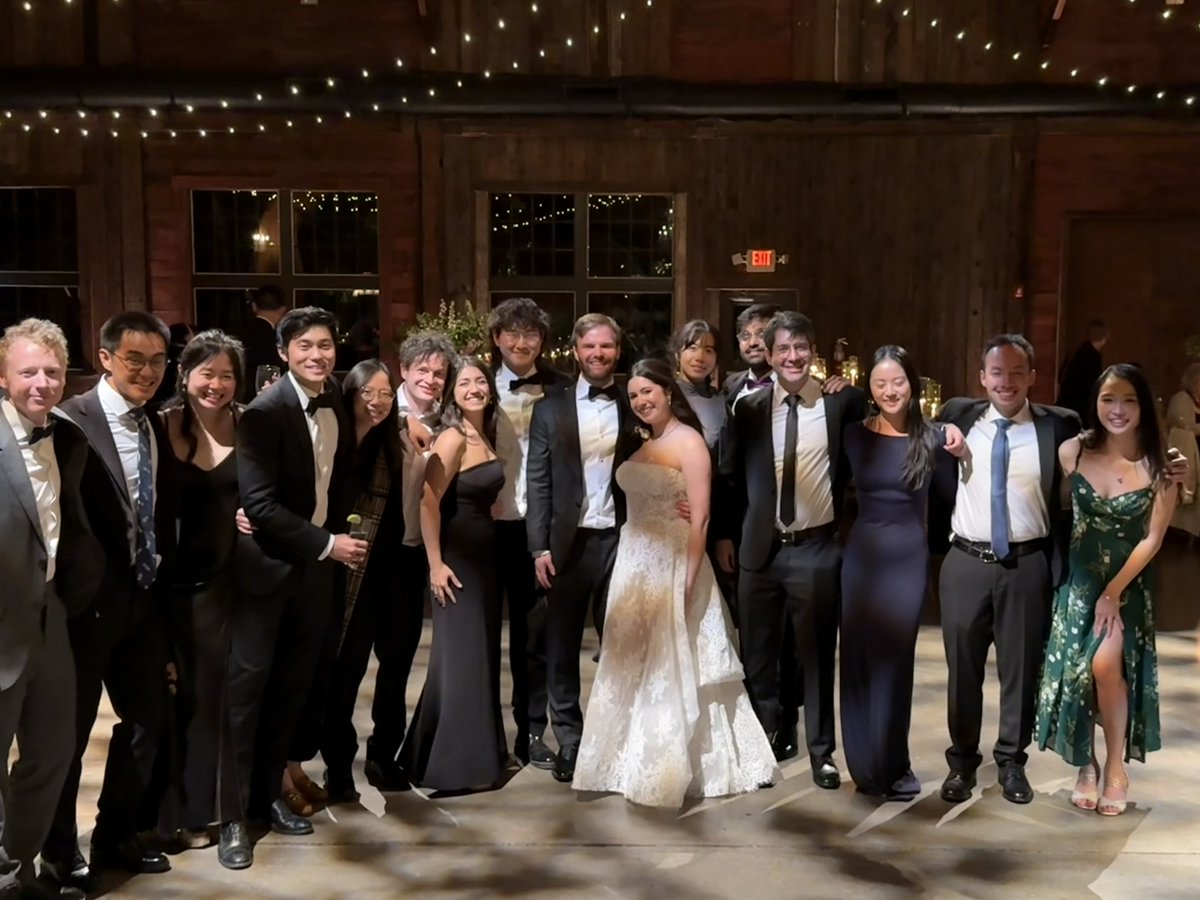
THE SCALE MAFIA
one of the most special parts of starting a company is watching the people you fought and bled with in the early days go out and change the world.
the Scale crew was supernatural. @scale_ai was one of the first companies to IOI and IMO-maxx, and the magic of Scale was that all of these geniuses gave a shit and ran through walls. it's no wonder that the Scale mafia is the first true mafia of the modern tech era. just to name a few:
- cognition founder @stevenkplus1 & president @russelljkaplan
- modal founder @akshat_b
- tech & science advisor to POTUS @mkratsios47
- claude code head of product @_catwu
- kpcb partners @LM_Braswell & @nayakkayak
- bun founder @jarredsumner
- tbd head of product @lindugong
- netic founder @melisatokmak
- cobot founder @BradPorter_
- secureframe founder @shravvmehtaa
- paramount skydance cfo @DennisKCinelli
- thinking machines gc lauren lennon
- partner at greylock @sophia_luo_
- liquid ai coo jeffrey li
- gallatin ai founder @agilemofo
- tbd safety @_julianmichael_
- center for ai safety president @devindkim
[photo courtesy the beautiful wedding of @thenateherman (who in many ways was a cofounder of Scale) and @ChristinaG325]
a brand new model paradigm! introducing 𝚌𝚕𝚊𝚒𝚛𝚒𝚌: a system one model for extracting, computing, estimating, and predicting values from unstructured inputs.
https://t.co/xRE3gO6JeO
A great pianist can play almost anything, but mastering one piece is what makes a performance exceptional. The same goes for AI.
With today's launch of Nemotron 3.5 Super VL, we’re collaborating with @NVIDIAAI to combine their open post-training tools with Scale’s data, evaluation and applications building expertise. Together, we're turning general-purpose models into powerful, cost-effective specialists for enterprises everywhere.
Welcome to the multi-model world. 🤝
We're opening up early access Physical AI evaluations at @ScaleAILabs
Evaluating robotics models in real-world environments remains challenging. Across our SFHQ Robotics Lab and our Mexico City Data Factory, we have a range of mobile and stationary robotic embodiments to support real-world model evaluation.
If you're developing Physical AI models, we'd love to work with you. DM me if you're interested or email [email protected]
Introducing Contrastive Language Model (CLM): an ultra-fast System One Model trained with a contrastive learning objective that connects states and actions.
CLM-8B is pre-trained on internet-scale data and delivers up to 9× faster inference than Jev ⚡ while achieving comparable performance across computer-use, gaming, and tool-calling tasks.
With lightweight fine-tuning, CLM-8B sets a new SOTA on challenging agentic coding benchmarks, such as DeepSWE (81.6%) and Terminal-Bench 2.1 (87.6%). In contrast, Jev fails to serve as an effective verifier for these long-horizon tasks.
We also build an efficient training and serving infra for CLMs by disaggregating states and actions, allowing their embeddings to be cached and reused independently. This substantially reduces inference latency in settings where the state evolves continuously while the action set remains fixed.
Finally, we establish scaling laws for CLMs and show that the test contrastive loss decreases predictably as a power law in training compute, model size, and dataset size.
📄 Blog: https://t.co/zwi9JOHKGx
💻 Code: https://t.co/rsHRYCGR8I
🗣️ Discord: https://t.co/Uqtdefvo3J
🤗 Data & Models: https://t.co/wdSWGGO3hu
More details on CLM’s architecture, data recipe, and scaling laws in the thread below 🧵
Built a System 1 + System 2 robot brain using @typesafeai's Jev in PyBullet.
🧠 Claude: Generates the high-level plan to stack cubes.
⚡ Jev: Acts as the split-second reflex layer, evaluating sim states in <100ms to adapt.
Fast, schema-safe neurosymbolic robotics in action.
Built a System 1 + System 2 robot loop in PyBullet using @typesafeai's Jev
🧠 Claude: Generates the high-level cube stacking plan.
⚡ Jev: Acts as the split-second reflex layer, evaluating sim states in <100ms for adapting
Fast, schema-safe neurosymbolic robotics in action