PN Certified Master Coach & Behavioural Health Specialist | Health Strategies for the Demands of Leadership | Private 1-1 Coaching Online, Team Cohorts/Workshop
Sometimes you just need someone to sit down with you, listen, and help you figure out what to do next.
A new diagnosis. A recent injury. Or simply wanting to feel better and enjoy your daily life.
These all require a framework.
And a great healthcare plan means nothing if it doesn't fit into your actual life.
As a PN Certified Master Coach and Behavioural Health Specialist — that's exactly what I help with.
Book a complimentary online consultation and we'll:
→ Walk through your current health challenges
→ Identify the small habit shifts that could make the biggest difference
→ Map out the next 90 days around your goals and routines
If it makes sense to work together, I'll offer that option.
If not, I'll point you toward trusted resources - because knowing where to turn matters.
هاکنی تا ۸۸ سالگی عمر کرد و تا آخرین لحظه با دستهای لرزون و لاغر از نقاشی کشیدن دست نکشید. حالا به جای اینکه از رفتنش غوصه بخوریم، تا هنوز بهاره به شکوفهها و درختها و سبزیها نگاه کنیم شاید دنیا رو به رنگ اون دیدیم.
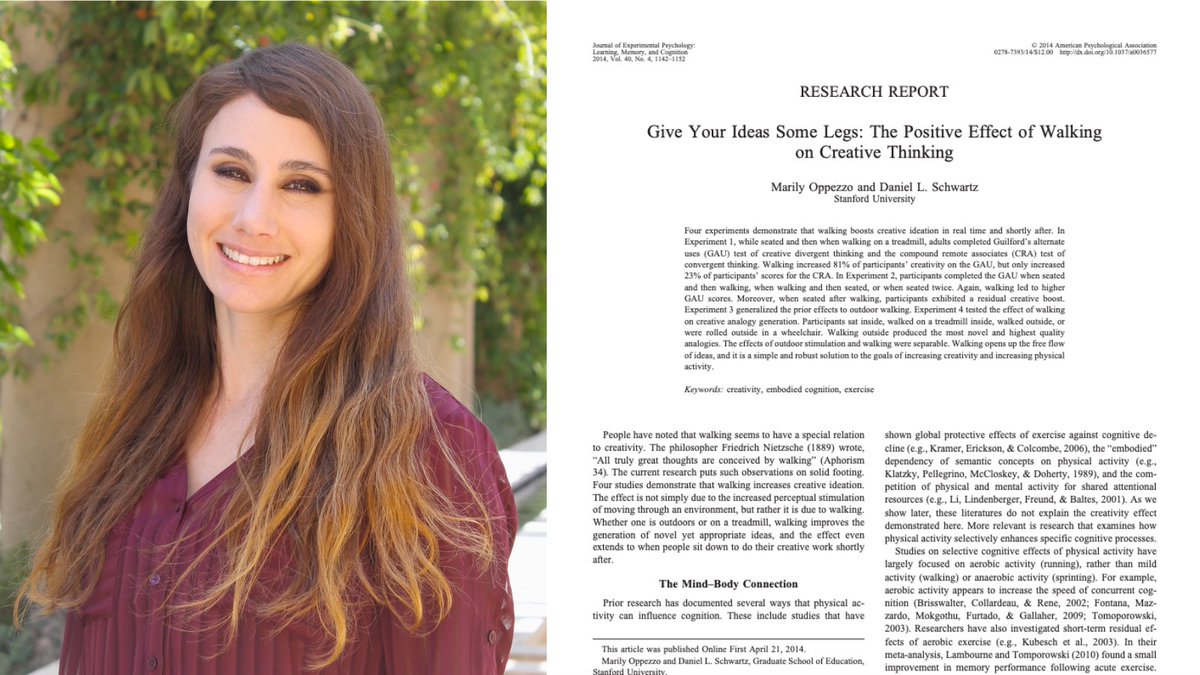
A Stanford psychologist spent 4 years proving that the simple act of walking generates 60% more creative ideas than sitting, and the experiment she designed to kill every alternative explanation is one of the most decisive findings in modern psychology.
Her name is Marily Oppezzo.
She got the idea for the study while walking with her advisor at Stanford to discuss her thesis topic, and the paper she eventually published in the Journal of Experimental Psychology in 2014 is sharp enough that it should have ended the seated meeting on the day it came out.
She ran 4 experiments on 176 people. Same person tested twice. Once sitting, once walking. The creativity tasks were the standard ones psychologists have used for decades to measure how good a brain is at generating novel useful ideas.
The result was almost too clean to publish.
81% of participants in the first experiment produced more creative ideas while walking than while sitting. In the second experiment, 88%. In the third, 100%. Every single person walked into a more creative version of themselves.
On average, people generated 60% more novel useful ideas the moment their legs started moving.
The skeptical question is the obvious one. Maybe it was the fresh air. Maybe it was the scenery passing by. Maybe it was the change of environment doing the work, not the walking itself.
Oppezzo killed every one of those explanations with one experimental decision.
She put people on a treadmill facing a blank wall. No scenery. No fresh air. No environmental change. Just legs moving in place while staring at white drywall. The 60% boost held.
Then she ran the experiment that closed the case completely. She took participants outside in two conditions. Half of them walked through a Stanford courtyard. The other half were pushed through the exact same courtyard in a wheelchair. Same outdoor stimulation. Same scenery passing at the same speed. The only difference was whether the legs were moving.
The walkers produced dramatically more novel high-quality ideas than the wheelchair group. The outdoors did almost nothing on its own. The walking did everything.
This is the part of the study that hit hardest when I read it the first time.
She also tested the opposite kind of thinking. Convergent thinking. The kind where there is one right answer and you have to narrow down to it.
Word puzzles where 3 words share a hidden fourth word that connects them. The seated participants did slightly better on these. Walkers got slightly worse.
Walking is not a general intelligence enhancer. It does one specific thing. It opens up the divergent search inside your brain. The part that generates options. The part that produces unexpected connections. The part that takes a problem and finds five ways into it instead of one.
When you need to converge on the single right answer, sit down. When you need to find the answer in the first place, get up.
The mechanism is now well understood. Walking selectively activates what neuroscientists call the default mode network, the system inside your brain that runs when you are not consciously focused on anything. The DMN is where mind-wandering happens. Where memories cross-reference each other. Where ideas that have been sitting in separate folders inside your head finally bump into each other.
When you sit at a desk and force yourself to concentrate, you suppress the DMN. When you walk at a natural pace, the executive part of your brain gets just busy enough handling the walking that the DMN comes online and starts doing the work that focus was blocking.
The most useful finding in the entire paper is the one almost nobody quotes.
The boost did not turn off the moment people stopped walking. Participants who walked first and then sat back down stayed elevated. Their next round of seated creativity work was still significantly better than people who had been sitting the whole time. The rest lingered for at least several minutes after the legs stopped moving.
You do not need to do creative work while walking. You need to walk before the creative work. The brain holds the state.
The history of this is the part that should haunt anyone who still does meetings in chairs.
Charles Darwin built a gravel loop behind his house in Kent called the Sandwalk and walked it 3 times a day for the rest of his life. The theory of evolution was developed one lap at a time on that path.
Nietzsche walked up to 10 hours a day during the years he wrote his most important books and openly said the work was conceived on his feet.
Beethoven composed for the morning and walked for 5 hours every afternoon with a pencil in his pocket for when something landed.
Kahneman said the best thinking of his Nobel Prize-winning career happened on leisurely walks with Amos Tversky. Steve Jobs refused to take important conversations sitting down. He held them on foot.
Every one of them was using the system Oppezzo would not measure until 2014. They just did not know what to call it.
The question worth sitting with is the one almost nobody asks.
Every meeting you have ever attended sitting around a table was a meeting held at a fraction of the brain power that was actually available to the people in the room. Every brainstorm that got stuck inside a conference room. Every problem you tried to solve at a desk and gave up on. Every idea you could not quite get to.
The intervention is the easiest one in modern science. No supplement. No app. No subscription. No training program. Just a pair of legs and 15 minutes.
The Stanford lab proved it. The philosophers knew it. The neuroscience explains it.
And almost everyone reading this is still trying to think their way out of problems sitting completely still.
Aujourd’hui, j’étais à la banque, dans la file d’attente devant un distributeur.
Devant moi, un monsieur très âgé. Plus de quatre-vingts ans, sûrement.
Il tenait une enveloppe dans la main, un peu tremblante.
Quand ce fut son tour, je l’ai observé discrètement.
Il touchait l’écran, hésitait, revenait en arrière…
Je voyais bien qu’il ne comprenait pas.
L’écran, les boutons, les étapes… tout semblait trop rapide pour lui.
La file derrière commençait à s’impatienter.
Lui, il s’est retourné vers moi, avec un regard gêné mais digne,
et il m’a demandé, tout doucement :
« Vous pourriez m’aider… s’il vous plaît ? »
Je me suis avancée tout de suite.
Je lui ai expliqué calmement, étape par étape.
Sans jamais toucher son argent.
Par respect. Par pudeur. Par délicatesse.
Il voulait faire un dépôt.
Il a réussi, lentement, en se concentrant.
Quand l’opération s’est terminée, il avait l’air soulagé.
Comme un enfant fier d’avoir réussi.
Il m’a remerciée avec un sourire incroyable.
Et juste avant de partir, il a sorti un billet de 10 euros de sa poche
et a voulu me le donner.
J’ai refusé.
Il a insisté. Il m’a dit que c’était « pour le petit-déjeuner ».
Pour me remercier à sa manière.
J’ai décliné encore, doucement.
Et là, je suis repartie avec un nœud dans la gorge.
Parce que ce monsieur…
ce n’est pas un cas isolé.
Ils sont nombreux, nos parents, nos grands-parents,
perdus face à un monde devenu trop numérique, trop rapide, trop froid.
Perdus devant les écrans, les bornes, les applications, les mots de passe.
Ces gens ont construit le pays dans lequel on vit.
Ils ont travaillé toute leur vie.
Ils ont payé, cotisé, élevé des enfants, tenu des familles.
Et aujourd’hui, on les laisse seuls
face à des machines qui ne parlent pas,
dans des banques sans guichet,
dans des hôpitaux sans accueil,
dans des administrations sans humain.
On parle d’innovation, de progrès, de modernité…
Mais on oublie l’essentiel : l’humain.
S’arrêter cinq minutes pour aider quelqu’un,
ça ne coûte rien.
Mais pour eux, ça change tout.
Parfois je me demande :
est-ce qu’on avance vraiment…
ou est-ce qu’on devient juste plus rapides à oublier les autres ?
Generated with @grok (not bad, room for improvement)
As a PN Master Coach, I focus on Deep Health for sleep, stress and recovery management for professionals in leadership roles who need the energy to lead well without sacrificing themselves.
Health coach hits #5 on @CoachDanGo’s list!
When you “know what to do” but have a hard time implementing a strategy that works, it makes a big difference in time, energy and outcomes.
Best investments I've made in my health
· Air fryer
· Lab work
· Pedometer
· DEXA scans
· Health coach
· Standing desk
· Under desk treadmill
· Bluelight blockers
· Blackout shades
· Ninja Creami
· Home gym
· Meal prep
What about you?
Sometimes you just need someone to sit down with you, listen, and help you figure out what to do next.
A new diagnosis. A recent injury. Or simply wanting to feel better and enjoy your daily life.
These all require a framework.
And a great healthcare plan means nothing if it doesn't fit into your actual life.
As a PN Certified Master Coach and Behavioural Health Specialist — that's exactly what I help with.
Book a complimentary online consultation and we'll:
→ Walk through your current health challenges
→ Identify the small habit shifts that could make the biggest difference
→ Map out the next 90 days around your goals and routines
If it makes sense to work together, I'll offer that option.
If not, I'll point you toward trusted resources - because knowing where to turn matters.
When I was teaching at a high school in Alaska, we read Dostoyevsky's "Notes from Underground" together. Paragraph by paragraph. We spent six weeks on that one story.
Here's what paragraph-by-paragraph close reading actually looks like: I'd read a passage aloud. Then I'd ask, "What is the Underground Man really saying here?" Silence at first. Then someone would venture an interpretation. Someone else would push back. Within ten minutes, they'd be arguing about human nature, about pride and spite and self-deception.
People hear this and assume I was working with exceptional kids. I wasn't. I was working with kids who had never been asked to grapple with genuinely profound ideas before. In my experience, when you treat young people as capable of serious intellectual work, and take the time to train them how to read difficult texts, they learn how to do so.
I'll never pressure my son (4yo) to be a poet, or to be anything except what he wants to be, but today he woke up and held my face and said, "Before I was made I wanted to see you."
And it healed something in me forever.
The most attractive trait isn’t looks, wealth, or status. It’s energy. When you walk into rooms with genuine enthusiasm, interest, and curiosity, you become a magnet for the highest quality people. Energy is contagious. Spread the kind you’d want to catch.
5️⃣ It's hard to believe but Rocky has now been here for five days and I think today is the most incredible he has ever looked
💤 I had a lot of messages and suggestions that maybe it would be better to put Rocky asleep when I first found him on Saturday
🐕 I think you can see from his whole body language, his wagging tail, and how hungry he is that this is a dog that very much wants to live
🍣 Every day we have a little routine where I change his bandana and bring him some smoked salmon and poached chicken. It's a little boy's picnic and it's the most magical time, sitting in the sun, you could ever imagine.
👀 We're slowly getting towards a stage where we might be able to do more for him with his eyes but there's no rush on that because he has so many ailments. What I am noticing is that he's fantastic at navigating around using my voice, the smell of food, and by learning the different types of grass and trees in his small area
There's a lot of bad news in the world and doom and gloom. Rocky might just be one little individual street dog in Thailand but I really think he's helping put a smile not just on my face but on people around the world. A truly special little creature is Mr. Rocky ❤️