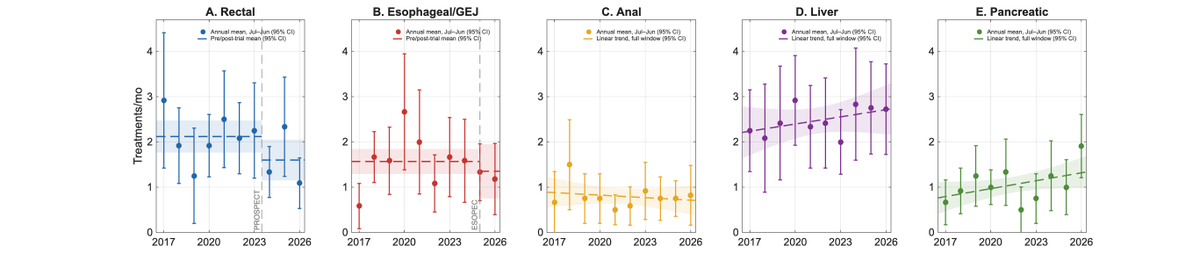
1/8 🧵Have PROSPECT & ESOPEC changed GI radiation referrals. If so, what does that mean for resident training?
@danalynnecasey and I teamed up to examine a decade of experience at @UNC_Lineberger.
https://t.co/h14XhU84az
@Advances_ASTRO
📢 Our practical guide to EBRT for HCC is out in PRO
Less of a lit review, more of a how-to for #radonc: pt selection, techniques, treatment delivery, special scenarios
Many thanks to all coauthors!
@ldawsonmd@AndrewMMoon@hmaxi_MD@MichaelYanMD
🔗 https://t.co/NIVDmjyOok
Thank you ASTRO Speed of Light for highlighting our research and this inspiring patient’s story. This was a lot of fun to make and important to spread the word about the work @SpeedofLightFdn and @ASTRO_org are doing to advance #radonc!
@ASTRO_org is in great, and I would argue better, hands with this passing of the gavel.
Good luck @NehaVapiwala ! You will do great and we are all in your corner.
Thank you to #ROCR Act champion Rep. Paul Tonko (D-NY) for giving remarks on the Radiation Oncology Case Rate Act during today's House Energy and Commerce Committee hearing and advocating for ROCR to be considered as part of the Patients First Act.
We appreciate his continued leadership and commitment to advancing policies that improve access to high-quality cancer care for patients.
Learn more about the #ROCR Act: https://t.co/W1FvXVurA3
@RepPaulTonko@HouseCommerce
Congratulations to the winners of the 2026 Publication Excellence Awards!
Join Speed of Light – The ASTRO Foundation in recognizing these emerging leaders in radiation oncology during the Research Honors presentation at 9:00 a.m. on Mon., Sep. 28, before the keynote address at #ASTRO26 in Boston.
Learn more about the winners: https://t.co/0gCgEFSW6J
@karamarieruicci@ZihangChenMD@Jalal_Ahmed
@GoodUrol@LondonProstate1@5_utr Please see here for detailed analysis of 0-5 year patient QOL in PACE B https://t.co/1rokREZI7e I am trying to stay out of this unbecoming exchange which demeans both urology and oncology imo, but please try to quote the best data you can find.
From our paper https://t.co/PdY7obp42Q, RE vertebral body compression fracture (VCF) after spine SBRT —
tl;dr: The risk of VCF requiring intervention (kypho or stabilization) at 2y post spine SBRT was 11% for 24x1, 3.1% for 10x3, and 2% for 9x3.
⚡️Just published: NEW STUDY ON MULTI-COURSE RT IN DIPG ⚡️
What happens when #DIPG progresses after re-irradiation?
💊 Systemic therapy?
🧪 Clinical trial?
🕊️ Hospice?
☢️ Or… can we irradiate the brainstem a third time, and could it actually help?
A few years ago, a family of a DIPG patient asked me exactly that. My immediate reaction was: "No, that would be too risky. Too dangerous. She’s already had radiation twice". But I kept thinking about it. 🤔 I spoke with several colleagues, reviewed the very limited literature, and eventually started asking a different question:
Do we actually know that a third course is too dangerous, or have we simply assumed it is?
We ultimately treated this patient with a carefully selected, low-dose third course of RT.
✨ She experienced significant improvement in symptoms.
⏳ She lived for nearly 9 months after that treatment.
That experience prompted us to look more systematically at this question.
📄 Our phenomenal resident Dr. Lauren Jacobs @laurenjacobs_md led this newly published study in #practicalRO, combining
🌎 2 patients treated at our institution + 10 previously published cases we identified in the literature = 12 patients total.
To our knowledge, this represents the entire published global experience with ≥3 courses of RT for DIPG.
📊 What did we find?
➡️ Median survival from diagnosis: 27 months
➡️ Symptomatic improvement after reRT was frequently reported
➡️ Despite substantial cumulative radiation doses, the limited available experience did not identify a clear signal of prohibitive toxicity
⚠️ Of course, this is only 12 highly selected patients. These retrospective observations cannot establish a survival benefit - or definitively tell us how safe a third course of RT is.
But they do suggest that perhaps the answer shouldn't automatically be “No.”
For carefully selected patients with progressive DIPG and few remaining options, low-dose multi-course reRT may provide meaningful palliation and deserves prospective study.
🔬 What’s next? We’re hoping to develop a prospective study at @MountSinaiRO to better define patient selection, dose, timing, benefit, and toxicity.
Sometimes patients and families ask questions we simply don't have good answers to.
💡 Those questions are often worth studying
@BecherOren@sindhu_kunal@QuadShotNews@TischCancer@MountSinaiRO@sgilheeney@ASTRO_org
Updated SFRO dose constraints for organs at risk in adult patients.
#Radonc
New recommendations from the French Society of Radiation Oncology cover #normofractionation , #hypofractionation , #SBRT and #reirradiation.
They offer a unified, practical framework adapted to modern techniques (IMRT/SBRT), while noting that many limits still derive from 3D-CRT data — clinical judgment remains essential in complex cases.
A useful tool to help minimize normal-tissue toxicity in daily practice.
https://t.co/Br0dLHeddn
Is age prognostic for lower grade IDH mutant glioma?
NO, according to this pooled analysis
In molecular era age alone should not influence decision-making adjuvant treatment
Age is surrogate for IDH status https://t.co/fPQG2RR7rW