“Yesterday I was clever, so I wanted to change the world. Today I am wise, so I am changing myself.” - Rumi
You can’t change the world until you change yourself.
Start inward, expand outward.
- @SahilBloom
@MackayIM@RickABright Could it have started in Burundi in March and the Zaire Ebola tests were run? What presence does WHO or others have in Burundi?
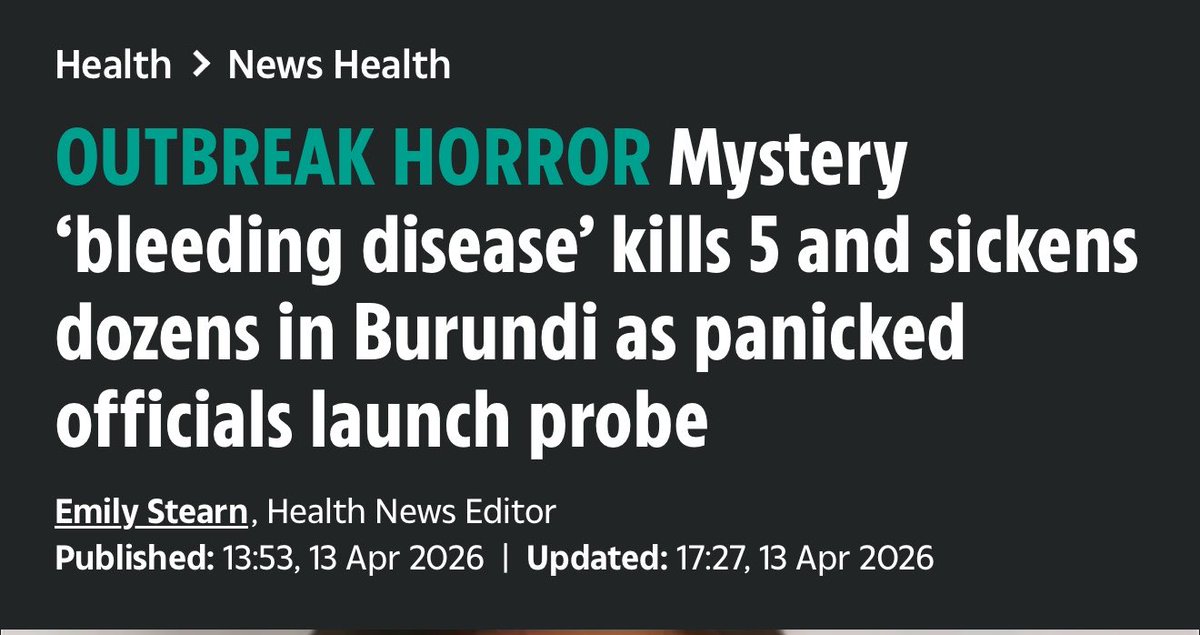
Mystery Illness Hits Burundi With 35 Cases And 5 Deaths So Far As Authorities Rule Out Ebola And Yellow Fever
https://t.co/MQ1bcTTvHo
#ebola
[Much to think on here. McNeill does bring the receipts.]
⚠️
➡️ Opinion: The U.S. needs a tough Ebola policy — before the virus gets here
- Covid proved that home quarantine fails. Ebola demands a harder lesson be learned faster.
By Donald G. McNeil Jr.
- Donald G. McNeil Jr., a former global health reporter for the New York Times, is the author of “The Wisdom of Plagues: Lessons From 25 Years of Covering Pandemics.”
- Covid, mpox, bird flu, hantavirus — and now Ebola again. The threats just keep jabbing at America’s borders. The United States needs to rethink its quarantine policies, and it may not be able to avoid being brutal. Brutal should be the new norm, because it often works. But it should stop being guided by xenophobia, racism and foolishness and instead follow data and experience.
- All signs suggest that the current Ebola outbreak will grow for months. By the time a response started gathering steam, there were 500 suspected cases — 10 times as many as there were when the world started fighting the 2014-2016 West Africa epidemic, which ultimately infected more than 28,000 people. And this strain, Bundibugyo, is concentrated in an even more remote and war-torn part of Africa. There is no vaccine or cure.
- Over the coming year, the virus is highly likely to reach the United States repeatedly. The 2014 outbreak arrived in Dallas with a traveler who infected two nurses before he died. At least 177 people who had contact with them in households, hospitals, airplanes and ambulances had to be found and monitored. It also reached New York via a doctor who fell ill after returning from heroic work in Guinea; he roamed the city for seven days before being hospitalized but infected no one else. Seven other American medical workers who fell ill in Africa were brought home for treatment. They didn’t infect anyone else either.
- This time, America may not be as lucky. The U.S. health system has not been as weakened by Trump administration cutbacks as the international surveillance system has. But it’s been hurt. The Centers for Disease Control and Prevention lost 3,000 employees, and many of its top experts are gone and either unreplaced or replaced by political appointees.
- On May 18, the Trump administration made the same mistake it made with covid-19 in early 2020: It barred U.S. entry only to noncitizenscoming from affected areas. Those reactions were xenophobic and silly — both the coronavirus and Ebola infect anyone regardless of passport. The names of the first U.S. covid-19 cases have never been revealed, but they were almost certainly citizens or legal residents. The first confirmed U.S. case was a Seattle resident who had visited Wuhan, where the virus was first discovered in China; New York’s first was in a Manhattan resident who visited Iran; most other early New York cases were of the “European strain,” which may have been brought back by wealthy American skiers, since there was a severe early outbreak in the Alps and Western U.S. ski towns were hard hit soon after.
- Since then, U.S. Ebola policy has been sensibly refined: Now, any American or legal resident who has visited the Democratic Republic of Congo, Uganda or South Sudan in the past 21 days must fly home viaWashington, Atlanta or Houston and be screened. That, said Thomas Frieden, who headed the Centers for Disease Control and Prevention during the 2014 outbreak, echoes a policy he imposed then: All travelers from West Africa were routed through five airports. Their temperatures and travel histories were taken, each was given a thermometer and a cheap phone (since many lacked cellphones that worked here), and they were told to check in with a local health department daily for three weeks.
- The Trump administration also has just announced tentative plans to open a treatment center in Kenya for Americans exposed to the virus. Although keeping patients overseas will be criticized as coldhearted, it makes some medical sense as long as the center can deliver state-of-the-art supportive care. Long medevac flights can be risky for both patients and caregivers. Family members who want to see their loved ones can be flown to Kenya.
- Intrusive and inconvenient as that sounds, however, it might not be enough. First, all initial screening should take place overseas, so a sick traveler who hasn’t been identified yet does not infect others during a flight. Second, an important lesson that covid taught was that voluntary quarantine, especially at home with one’s family, is almost guaranteed to fail.
- Asia and Australia proved that in 2020. To recall: After cases exploded in Wuhan in January, China locked down the city and several others until it had zero cases by late April. Japan, Taiwan, South Korea, Singapore and Australia barred flights from any region with cases. Their returning nationals and rare permitted visitors were either locked in hotel rooms for 14 days with mandatory testing or required to carry a device or phone app that dialed the police if they left their homes.
- The United States, meanwhile, waved in Americans who promised to be careful — even though a famous study of China’s first 72,000 cases, released in February 2020, had shown that 64 percent of all clusters occurred within families.
- Home quarantine even failed on television. In April 2020, CNN anchor Chris Cuomo home-quarantined in his basement, eating meals left atop the cellar stairs. Nonetheless, he infected both his wife and 14-year-old son.
- During the pandemic, the failure of home quarantine quickly became blindingly obvious. By May 24, 2020, when the New York Times devoted its front page to the names of the first 100,000 Americans to die, there were fewer than 5,000 deaths in China. Japan then had only 857 dead, South Korea had 269 and Australia had 104.
- Ebola isn’t covid-19. It’s spread by fluids, not breath. Transmission is thought to rarely, if ever, take place before someone is obviously sick. But its high death rate makes the consequences of any transmission — whether, for example, on a plane, at home, in a grocery store, to a food deliverer or neighbor or in a crowded doctor’s office — very high. Because victims spew vomit and diarrhea, it demands high-level protection: not just masks but goggles, rubber aprons, bleach and isolation. But mostly it requires awareness. Victims don’t usually seek care thinking: “I have Ebola.” Contrary to myth, massive bleeding is rare. They arrive complaining of fever, nausea, diarrhea and aches — symptoms that could be many things. By the time a test detects Ebola, their families, doctors and nurses could be infected.
- Policymakers need to consider how far we must go to prevent that from happening. They will need to assess risk levels and types of quarantine. The biocontainment units in Omaha and Atlanta, where hantavirus-exposed cruise passengers were isolated recently, would be overkill for most. But it may be necessary to take over hotels or military barracks where new arrivals can be monitored and tested. It would be smart to be clear and firm about this before the situation gets out of control, not once there’s a crisis.
- The World Cup poses special risks; Congo’s team is set to play in Houston and Atlanta in June, and if it makes it to the final round, it will be just across the Hudson River from New York on July 19. The team has already relocated to Belgium, and the Trump administration has ordered it to create a 21-day “bubble” around all players and staff before they come here.
- Congo is a poor country, but it has its share of wealthy fans who very much want to be in the stands for its team’s World Cup matches. And by June, the disease may have spread far from eastern Congo. This could turn into a nasty scramble with anti-African overtones. Rather than succumbing to that, the U.S. government should find a way to admit fans who can prove they have lived risk-free for three weeks.
- Because many Americans still resent masks, school closures and other covid-era restrictions, they may resist tough quarantine measures — especially if imposed by people like Jay Bhattacharya, the acting director of the Centers for Disease Control, who six years ago protested covid-19 lockdowns and wanted the virus to circulate freely among healthy Americans, or by his boss, Health Secretary Robert F. Kennedy Jr., who preaches “medical freedom.”
- But every disease is different. And when onetime outsiders find themselves in charge of the nation’s health during an emergency, one hopes they will realize how badly a poor but populist decision could come back to bite them — and choose a different path.
https://t.co/Y4QgyIYM10
@mrmickme2 It also seems to be a higher rate of females infected… I think it’s fairly common for women to “push through” and ignore symptoms too long in general.
Le Burundi enquête sur une maladie ayant causé 5 décès et touché 35 personnes à Mpanda (nord).
Les résultats des analyses préliminaires excluent Ebola, Marburg et autres fièvres hémorragiques.
#ebola
⚠️
➡️ Transmission of Ebola Viruses: What We Know and What We Do Not Know
Authors: Osterholm MT, Moore KA, Kelley NS, et al.
ABSTRACT
- Available evidence demonstrates that direct patient contact and contact with infectious body fluids are the primary modes for Ebola virus transmission, but this is based on a limited number of studies.
- Key areas requiring further study include (i) the role of aerosol transmission (either via large droplets or small particles in the vicinity of source patients), (ii) the role of environmental contamination and fomite transmission, (iii) the degree to which minimally or mildly ill persons transmit infection, (iv) how long clinically relevant infectiousness persists, (v) the role that “superspreading events” may play in driving transmission dynamics, (vi) whether strain differences or repeated serial passage in outbreak settings can impact virus transmission, and (vii) what role sylvatic or domestic animals could play in outbreak propagation, particularly during major epidemics such as the 2013–2015 West Africa situation.
- In this review, we address what we know and what we do not know about Ebola virus transmission. We also hypothesize that Ebola viruses have the potential to be respiratory pathogens with primary respiratory spread.
https://t.co/5RvOuFGaKX
@WhoBurundi@WhoBurundi have you made any new findings? In light of the current outbreak I am curious if the Ebola testing done in Burundi might not have picked up the BDBV strain?
@RVAwonk If you watch this area you will see it perfectly aligned with his mouth movement. I think it’s a reflection of his lips somehow. No idea how that happens technically but it’s definitely mirroring his mouth.
So, I’m curious about this. There was an outbreak of a “mystery illness” in Burundi (which borders the Democratic Republic of Congo, where the Ebola outbreak is) in March, with symptoms that mirror Ebola. Somewhere around 35 people were infected, and a number of them died.🧵
@RVAwonk@Nucleocapsoid@JPWeiland Oh boy, me too. I fell in to this hole with you as soon as I read your post. Did they ever test for BDBV?? I’m behind on work deadlines but now I just want to research bat patterns in DRC because of Mr Arnott’s reply 😆 I’ll keep you posted.
@Nucleocapsoid@JPWeiland Would love to hear your thoughts on this ⬇️ She makes an interesting point I think. And Burundi isn’t all that far away... I can’t find anything reporting that they’ve figured out what this was.
So, I’m curious about this. There was an outbreak of a “mystery illness” in Burundi (which borders the Democratic Republic of Congo, where the Ebola outbreak is) in March, with symptoms that mirror Ebola. Somewhere around 35 people were infected, and a number of them died.🧵