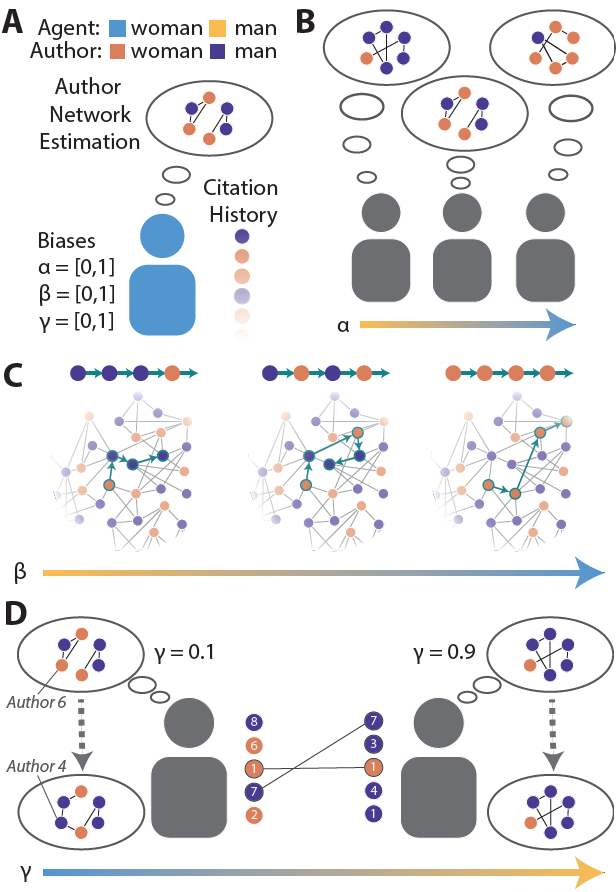
“Modeling observed gender imbalances in academic citation practices” https://t.co/zE4RMsvlOs
We model how homophily - the tendency to engage with the work of authors who are similar to you - can give rise to gender bias in citations and best to mitigate this bias. (1/9)
We’ve got a new preprint out! 👏🥳
Have you ever wanted to model and ⚡️control⚡️neural dynamics on your connectome data? 🤔
Well, you’re in luck because our team has put together a protocol paper and a Python package to help you do just that! 😎
https://t.co/6fJm9Waopu
Among the most difficult things to understand about AI's impact in the real world is the mechanics of integration - ie. how the AI system is introduced & used within an ecosystem of decision-makers.
Finally, a thorough study on this, led by @DukeInnovate:https://t.co/YN3RP9XqnM
Huge congrats to DR!!! @neuro_dz, who had a brilliant thesis defense. I have been just so lucky to co-mentor Dale alongside primary mentor @DaniSBassett -- learned SO much, always SO fun. His work on efficient coding a in brain networks - blows my mind. CONGRATS DR. DALE!!!!
‼️🚨Postdoc opportunity‼️🚨Please RT 🙏
Are you interested in:
* Neuroimaging
* Network neuroscience
* Multi-omic analysis in large datasets
* Machine learning
* Psychiatry research
Come work with me at @RutgersU! Apply here: https://t.co/ybRqpb5spF
Check out our new preprint on learning from @khanacademy videos (by @paxt0n4, @andyheusser, and @jeremyRmanning)! We use text embeddings to model and map what people know and how knowledge changes over time.
Preprint: https://t.co/nEqDzxc3pA
Code/data: https://t.co/ICI6Ew5RJB
Randomized clinical trial shows machine learning mortality predictions & behavioral nudges to cancer clinicians led to significant increase in rate of serious illness conversations & altered outcomes of end-of-life care for pts w/cancer. https://t.co/E4btlWKusi #HPM#EOL
Why are some brain regions specialists versus generalists? For efficiency, regions might compress activity but forfeit functional flexibility. We find support for this idea in brains networks and RNNs.
Oral presentation at InfoCog @ NeurIPS 2022 workshop
https://t.co/IRvsYq83Sl
Had a blast using diffusion models for a new art exhibit Dyslexia Dictionary, an invitation to explore and redefine how minds experience language, with artist Rebecca Kamen. Also ft. Gov. @GavinNewsom, @GershoniAgency, Adeniyi Akingbade @neyo902 & others https://t.co/xQYYBUjt6g
1/n I'm excited to announce that v1.5.0 of {paletteer} got on CRAN today, adding 188 palettes, and 7 new packages for a total of 2569 palettes 🤯
https://t.co/XKUNqwdvOZ
#rstats#dataviz
Just accepted at @SfNJournals JNeuro – our paper entitled “The age of reason: Functional brain network development during childhood.”
Talking about it at #Flux2022 today at 3:30, virtually. Ask me questions on Twitter, 🧵 details below!
@anne_churchland @j6m8 @neuro_dz@DaniSBassett Yeah exactly! If you launch the binder, upload the bib file, and clean it as the instructions say, it should output what your looking for.
Also I'm happy to help trouble shoot if it doesn't work as expected
@faroit Yeah I think it makes sense to try and diversify reviewers. I can't think of specific research at the moment, but my intuition is that engaging people from different parts of the scientific community in reviews might help counter balance some of the trends towards homophily
“Modeling observed gender imbalances in academic citation practices” https://t.co/zE4RMsvlOs
We model how homophily - the tendency to engage with the work of authors who are similar to you - can give rise to gender bias in citations and best to mitigate this bias. (1/9)
I am excited to share that I'm joining Rutgers (@Rutgers_CAHBIR@BHI_Rutgers@RutgersU) as an Assistant Professor of Psychiatry in 2023! My group will work at the intersection of psychiatry, network neuroscience, and machine learning to study the neurobiology of mental disorders.
New preprint on statistical and network learning🎉
When exposed to a sound stream, adults compute biased transitional probabilities between the items and extract the structure from the underlying network. They even generalize to missing data!
-> https://t.co/gWjkkL5IV3
Researchers at Oklahoma State University are conducting a study on sizeism in academia with the goal of documenting the unique challenges faced by fat/ larger-bodied students and faculty. Please consider participating if you are eligible!
https://t.co/pIgJ1X1jnh
“Asymmetric Signaling Across the Hierarchy of Cytoarchitecture within the Human Connectome” — new preprint with @DaniSBassett, @sattertt and the team at @Penn@pennbioeng@PennMedicine! 🥳
https://t.co/XtKGXu3C44