UBC computer scientists have developed a new machine learning method to help researchers identify different cell types. ProtoCloud automates the process of annotating cell types in single-cell genomics. Learn more about the new paper in @CellGenomics : https://t.co/DOAEF5B6VP
UBC Computer Science researchers developed a deep generative model to disentangle biological processes in cells. CellUntangler extracts key representations of data points in single-cell RNA sequencing data to capture cell signals. Read more: https://t.co/eXNr9vWxOK
Excited to see this paper is out in @CellRepMethods! We think the preferred way to generate artificial single-cell multiomics data is to pair unimodality data. @ubcscience
In a new paper, UBC Computer Science researchers present a deep learning model to help scientists integrate and generate new multiomics data. Read more: https://t.co/Qrd9rCgBUL
UBC Computer Science invites applications for up to two full-time tenure-track positions with the following priority areas: visualization, robotics, reinforcement learning, data management, and data mining. Applications are due Wed Dec 10, 2025. https://t.co/ARgHUbnGny
Nice study and interesting! We also identified a similar subset of dendritic cells, which we called CDC2C (PRDM16+), in the human esophagus (https://t.co/IEsjMQjLtf). From analyzing public data, we found these cells in the brain, colon, and two cross-tissue scRNA-seq datasets.
Check out this incredible study from the #LittmanLab@nyulangone@nyugrossman dissecting the origin of peripherally induced Tregs in the gut, with broad implications for therapies for autoimmune diseases! Co-led by Rabi Upadhyay, no biases here
@AlanMackworth and I just got the printed version of our new AI textbook published by @CambridgeUP (freely available online at https://t.co/wwwaFSf19F).
Artificial Intelligence: Foundations of Computational Agents, 3rd edition.
#AI#AIFCA@CAIDA_UBC@UBC_CS@UBC
Excited to be a part of the interdisciplinary team working on “Untangling Neuroimmune Communications in Food Allergy” through an award from FARE @FoodAllergy (https://t.co/lkRtOYrLyx)
@travishughes@marc_wadsworth@shaleklab Congratulations! Beautiful work with increased sensitivity, making it even better to detect some 'fragile' cell types!
Seq-Well S3 is now live! https://t.co/txQPkFWpty
An enormously collaborative project with @marc_wadsworth , Todd Gierahn, Chris Love, @shaleklab, Robert Modlin and Johann Gudjonsson.
A brief tweetorial 1/n:
Bert Vogelstein's work has shaped our understanding of the molecular basis of cancer. Now his team at Ludwig Johns Hopkins is racing to test a treatment to prevent #COVID19 deaths, even as it advances a powerful new technology for early cancer detection. https://t.co/dSD6hxOFNP
Very excited to share our preprint introducing PHAGE-ATAC, a multiomic assay for combined protein and accessible chromatin readout using engineered bacteriophages via @10xGenomics droplet-based single-cell ATACseq. #PHAGEATAC https://t.co/3ShKuqxxVD
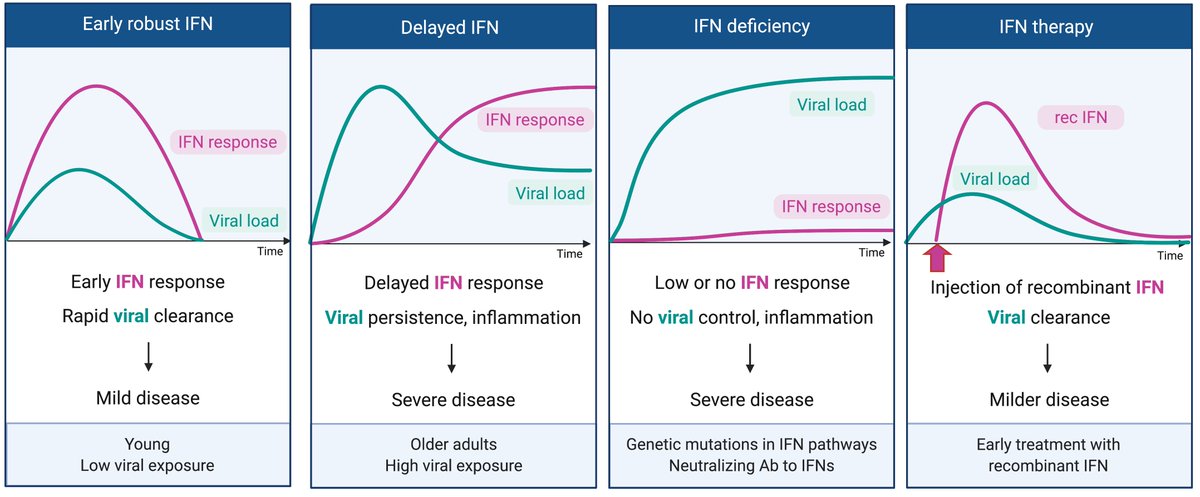
Are you confused about the role of type I interferons (IFN) in #SARS_CoV_2 infection?
Here is my speculation on what makes IFN-I helpful vs. harmful in #COVID19 patients - it comes down to timing and dose. A short thread.
All figures made by @BioRender & @annsea_park (1/n)