I am really excited to share the first chapter of my PhD, where we characterise a genetically linked NLR/MLKL pair underpinning the Rwt3 resistance locus in wheat! With yet another KFP involved in monocot immunity 🌾https://t.co/rYcd3FjXqB
Some rhizobia transform legume nodules via native T-DNA transfer systems.
This reframes how bacteria-to-plant DNA transfer evolved, and opens a route to legume engineering.
w/ @ShanChiHsieh1@erhminlai
https://t.co/SIoP4pC0tl
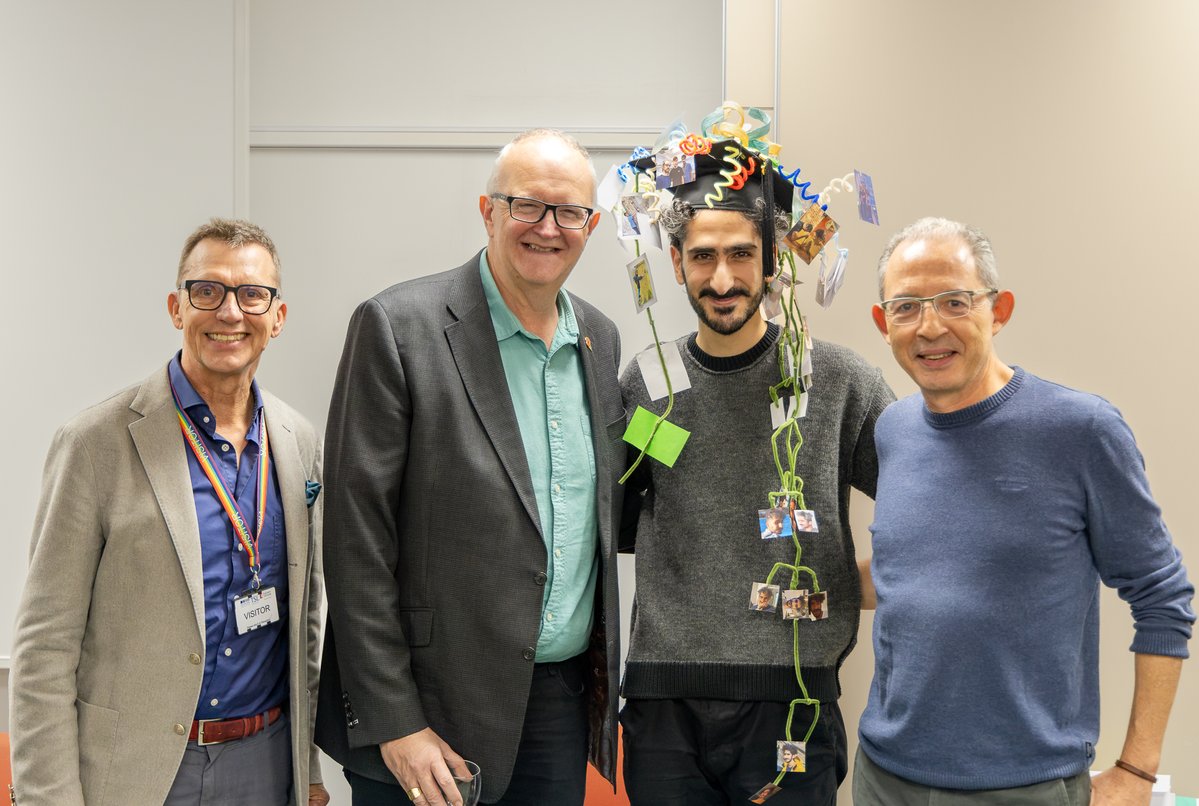
Huge congratulations to @amiralito_ on the successful defence of his PhD thesis. Thanks to the examiners Detlef Weigel and @talbotlabTSL . Another graduate from the @KamounLab
A warm welcome to Mario Herrera-Degracia, our new lab Technician! He’s already doing great work caring for our plants, with microscopy projects coming soon. Welcome Mario!
I just published... a picture book! 😳
Have a browse through “The Parcel’s Secret Journey” and discover the hidden world of logistics that brings online orders to your doorstep!
More sneak peeks here: https://t.co/jZohAom3X1
Keep an eye out!
52nd New Phytologist Symposium: "Structural biology at the plant–microbe interface"
Tübingen, 21–25 Mar 2028
Crystallography, cryo-EM, cryo-ET, structure prediction & protein design
Applications open late spring 2027
https://t.co/4Hi4IYTwni
Excited to share our latest @biorxivpreprint, led by Dr. Chelsea Fries @assemblingfries 🥳
Here, we establish multistate interface design as a strategy for engineering protein assemblies that break symmetry and switch between distinct geometries.
https://t.co/TEjb7MpGow
Happy to share our preprint with @Chaocheng_Guo! “Single-molecule nascent RNA profiling reveals multiple layers of co-transcriptional splicing and their reprogramming by cold in Arabidopsis”
Thanks to all co-authors!
@YiliangDing@CarolineDeanLab
https://t.co/3ArbSYEMyh
📣 Apply to the John Innes Foundation Rotation PhD Programme
This 4-year #PhD programme trains graduate students in Plant & Microbial Sciences @JohnInnesCentre@TheSainsburyLab & @EarlhamInst
🗓️ Apply before 12 Nov '26 ➡️ https://t.co/KhLHJijixf
Postdoc opening in my lab! Looking for someone excited about genomes, symbionts and plant–insect interactions to join our team at @TheSainsburyLab 🧬🍄🌿🦟
Applications reviewed from 16 Nov.
https://t.co/ECezWOJE5T
Avengers assemble: 1 year BakerLab + NVIDIA GenAIR = 🔥 https://t.co/Cd2qiugCJo
Presenting RFD4-Proteina, our latest protein design model, significantly better and faster than everything we compared against, both in silico and in the lab! 1/30
Thrilled to share my freshly "baked" Baker lab paper. We took a bottom-up approach to designing transcriptional regulators. Instead of relying on natural activation domains, we designed compact proteins that recruit specific cofactors. Activators for now, repressors to come!
@ParkerLab_MPIPZ@nobolly Now @dianagdlc presenting her beautiful story on effector recognition via molecular mimicry in a barley NLR. Their findings enabled engineering of multiple pathogen recognition in one receptor!
https://t.co/isk6O5cqJN
Our transient expression system for diverse crops is now published in PLOS Biology! Check it out and see if we tested your favourite species... 🌱
https://t.co/Nzsjf4kX5h
Excited to share this bioRxiv where we characterise the interaction between the Magnaporthe Zinc finger fold effector (Tie1) to a family of rice transcription factors called the Tubby-like F-box proteins (TLPs)! https://t.co/8CJ05heX4b
We found that Tie1 specifically binds to TLPs, after identifying the interaction using an IP/MS approach. This interaction underpins relocalistion of the host protein and manipulates its transcriptional activity!
Beetles secrete jelly to embed & sustain symbionts with impossibly tiny genomes🪲
But what is this jelly made of? And how does it help maintain a partnership that has lasted over 62 million years?
Thrilled to share our latest, out in @NatureComms!
https://t.co/Q22iF4P859