Excited to announce the inaugural class of @a16z Ops Engineer fellows!
~50 ops engineering leaders selected out of thousands of apps from talented people around the world.
They sit at the intersection of operations and engineering, scaling operational rigor within and across teams.. they are building the internal tools that consolidate the tooling stack, designing the data and context layers that agents draw on, deploying agentic workflows with human checkpoints, and driving adoption inside their companies.
We have folks like Ben Booi (@BenjaminBooi) and Rushaabh Saliya at Opendoor, Chris Jones (@chrisojones) at Shopify, Dilan Shah (@dilan_shah) from Cresta, Kevin Chu (@realKevinChu) from ElevenLabs, Saya Iwasaki (@iiiwokk) at Notion, Jordan Shapiro at Handshake, Christina Huang at Cognition, and Keith Gliksman (@KeithGliksman) at Tennr,
Others are are world-class COOs and chiefs of staff redefining how AI gets used across organizations. They’re deciding which workflows to automate first, the KPIs that prove it’s working, and are leading the teams that put it to work. Folks like Caroline Ingeborn (@caroingeborn) at Luma AI, Brandon Gell (@bran_don_gell) at Every, Rohan Shah (@RohanxShah) at Datavant, Gabriella Garcia (@reallygabriella) at Warp, Matt Stehle at Formation Bio, and Meera Shah at Glean.
Others are taking how software gets built to the next level, creating new products and leading the teams that ship them, like Claire Vo (@clairevo) at ChatPRD, Seb Goddijn (@sebgoddijn) at Yaklabs, TK Kong (@tkkong) at Concept, Matt Portnov (@MattnPortnov) at Decagon, Owen Williams (@ow) and Sharadh Krishnamurthy at Stripe, Andrew Qu (@andrewqu) at Vercel, and Maxwell Nardi (@maxwellnardi) at Runlayer, @davidgan at SpaceX/@bot, @matthew_busel at Basis.
And another ~25 awesome folks we can't squeeze into one post !! (see full list in comments)
Missed out on this but want to stay in the loop for future cohorts? sign-up at https://t.co/frfnA7R7If
Day 01 of my brother walking 1,250 miles from NJ to Florida
Yesterday: Woodcliff Lake, NJ → West Orange Armory
Distance: 27.1 miles (27.1 total)
Moving Time: 9h 15m, 50k+ steps
"Pretty banged up, started using leukotape which has been a godsend. am gonna dip my feet in a cold bath at the hotel tomorrow night. Checked out Paterson Falls"
"A journey of a thousand miles begins with a single step" - Tao Te Ching
OpenAI employees tell you they expect we may all die within a few years.
They still put in about 70 million (for between 800 and 2000 contributors) in additional contributions to their 401k plan in 2025, so some of them must expect to make it to retirement!
For years, the advice was to move to San Francisco if you wanted a career in tech. That advice is now wrong. New York has become the most exciting place in the world to build.
A few reasons why:
1. The AI labs are here. OpenAI, Anthropic, Google, and hundreds of others all run meaningful operations in NYC. You can now build a serious frontier-tech career here without giving up anything.
2. Every major industry lives here, and so does its AI counterpart. New York doesn't only have "tech," but finance, media, advertising, fashion, healthcare, real estate, law, and commerce too, with their applied-AI layer counterparts being built on top of each one.
3. The talent pool is unlike anywhere else. SF gives you engineers. New York gives you engineers, plus world-class designers, salespeople, bankers, marketers, operators, creatives, and media people, all at the top of their fields. Companies will need all of them.
4. People actually want to live here. New York is unlike any other city with its density of restaurants, art, nightlife, fashion, and media - and the people working across these sectors.
If you're building something and you're more than just tech, I'd argue there's only one city for you right now.
Harvey is a great example of how American companies are building world-class specialized models: they took an open-source base (Kimi K3), post-trained it on legal data, and delivered state-of-the-art performance on legal benchmarks at a fraction of the cost of frontier models. Restrictions that kneecap open models would do nothing to stop Chinese labs from shipping the next Kimi. They would, however, cripple the ability of startups like Harvey to create high-performance, low-cost vertical models. Of course some of the closed labs would love this — it eliminates their competition.
One pattern I find useful for working with LLMs is a nice long ramble session. Sometimes the LLM needs more bits to understand what you're trying to achieve, but you're too lazy to type them. In these cases I like to lean back, switch to /voice and just ramble for like 10 minutes, total mess, anything goes, full stream of consciousness. Sometimes I declare it up top, something like "switching to speech recognition sorry for any typos...". Sometimes I turn it into a small interview of a few turns. But I find that the LLMs are somehow very good at reconstructing long incoherent rambles and often their echo of your own tangle of thoughts comes out quite a bit cleaner than what you started with. The result is that you improve the mind meld and have to correct things less from that point on.
I totally agree w David that America needs a thriving open source ecosystem & robust competition between open source & closed frontier labs to keep America in the lead. Reg capture is bad in all forms. The frontier labs - like Apple - will thrive even w great open source. 🇺🇸🚀
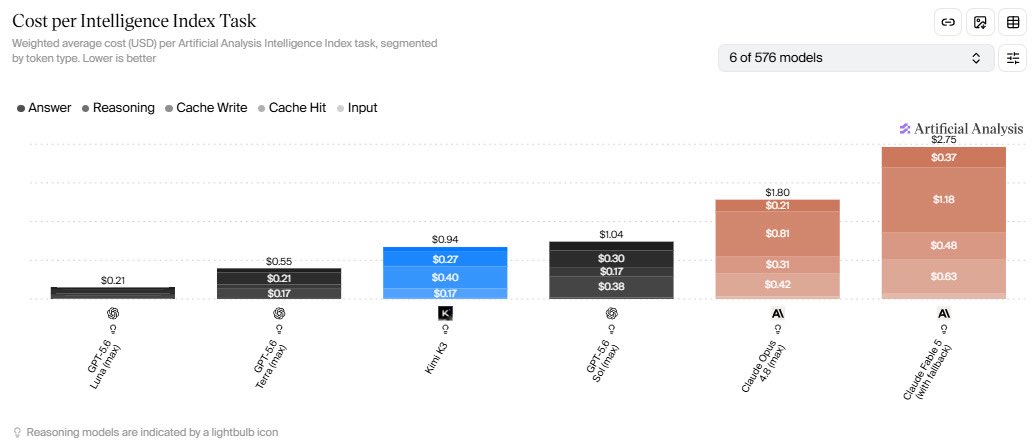
Kimi K3 may be an important inflection point for AI. Potentially negative for Anthropic and OpenAI while being net positive for essentially every other company in the world. I mean that very literally. Although the real “Sputnik moment” would be an open-source frontier model that was also token efficient unlike Kimi K3 which is 50-70% more expensive to run than GPT 5.6 per Artificial Analysis.
Rationale:
A world where there are only 2-3 dominant frontier labs with 90% inference margins is net negative for every other layer while being awesome for those 2-3 labs. Those labs would become monopsonies for power, data centers, semiconductors and hyperscalers and would obviously vertically integrate over time into all those layers while also completely subsuming the application/software layers.
Anything that lowers margins and increases competition at the model layer is good for every other AI layer: power, semiconductors, hyperscalers, neoclouds and yes even software.
This is why Jensen is so supportive of open-source. An open-source model requires the *exact* same amount of compute to run as a closed frontier model of similar size and architecture. Kimi K3 is roughly the same price as GPT 5.6 Terra on a per token basis, which actually suggests that it is less computationally efficient as I am sure that GPT 5.6 is priced to a higher margin than K3. And given that K3 is a token wastrel, i.e. token inefficient, it is significantly more expensive per task than GPT 5.6 and Grok 4.5, which are much more token efficient. Cost per token and token efficiency (i.e. intelligence density per token) are the drivers of intelligence per unit of cost. The winning AI companies will be those that offer the most intelligence per $ over time.
Lower margin % at the model layer = more margin $ at every part of the infrastructure layer and is a godsend for software. This can happen either through open-source models like K3 at the frontier *or* having a vertically integrated model company like Meta, SpaceX or Google at the frontier. Both outcomes result in a lower margin % at the model layer as vertically integrated model companies don’t really care where the margin $ come from. This is why it was so painful for OpenAI and Anthropic when Google was right there with them from a model competitiveness perspective and why Grok 4.5 and Muse 1.1 were just as important as Kimi K3.
The reason Kimi K3 is only *potentially* negative for Anthropic and OpenAI is 1) the @ericvishria point that the Claude and ChatGPT products and harnesses may be more important than their models today and 2) the hypothesis that they have much more advanced model checkpoints internally that are already being used for RSI. In the latter scenario, reaching RSI even a few months ahead of other labs might be enough to cement a permanent lead.
Time will tell on both points. And likely fairly quickly.
Caveat would be that since Kimi K3 is not token efficient and thereby actually more expensive than ChatGPT 5.6, we may need to see a more token efficient open-source model at the frontier or see Grok 5/Composer 4/Muse 2 at multiple points on the Pareto frontier for this potential risk to Anthropic and OpenAI to play out. And I am sure they will both vertically integrate as quickly as possible while continuing the product/harness strength they have shown over the last 8 months.