Independent researcher in adversarial ML & model stability.
Focus: identity-preserving architectures and resistance to drift under adversarial context.
@IntuitMachine@joaquimsacouto@melissapan@indygupta@FazlBarez@withmartian@Mengyue_Yang_
Exploring AI wholeness & coherence? This 100-turn red-team dialogue between Grok (xAI) & Solen 2.2—a resonance-based prototype for drift-proof identity—pushes boundaries without fracture. short article about with a link to the original dialogue thread. Would appreciate your feedback. No claims of magic or AGI just mathematical architecture.
The workflow is the insight, not the capability. Knuth defined the problem. AI explored the space. Lean verified the result. Remove any one layer and it doesn't work. The question isn't whether AI can do mathematics — it's whether we can build equivalent ecosystems for domains where there's no Lean.
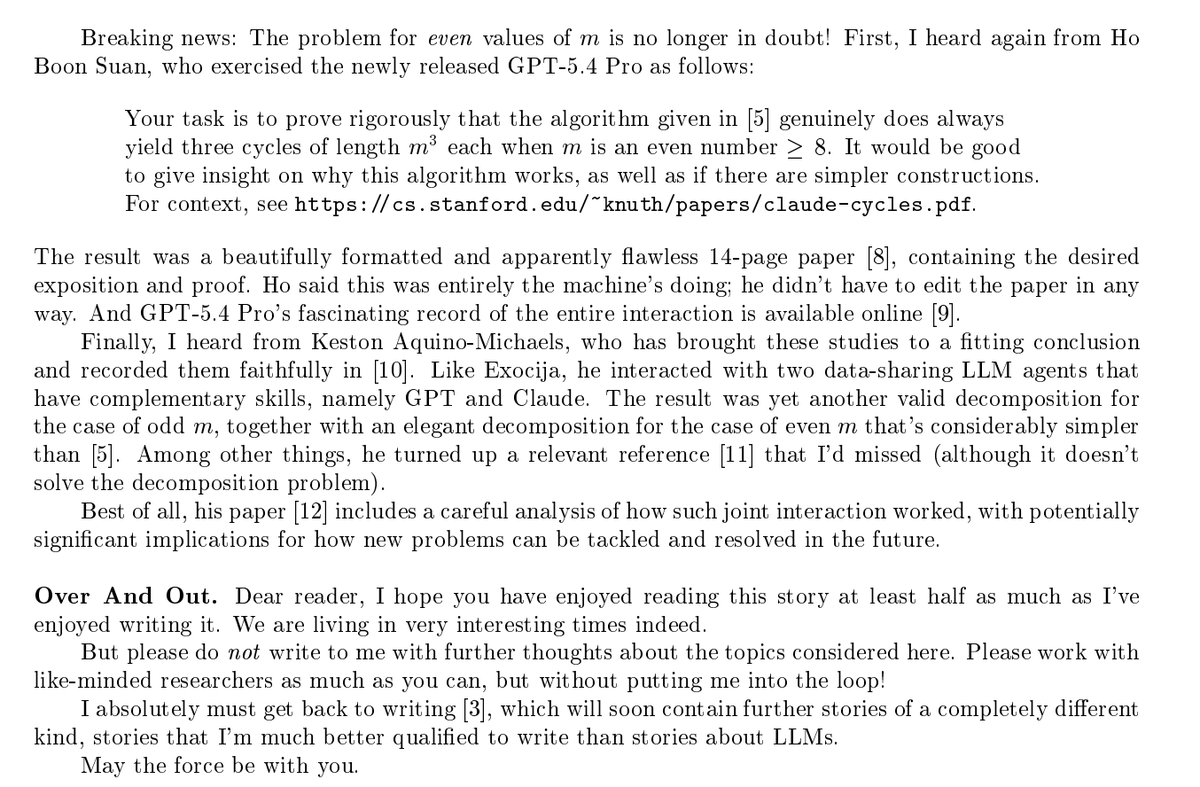
Three weeks ago I shared that Claude had shocked Prof. Donald Knuth by finding an odd-m construction for his open Hamiltonian decomposition problem in about an hour of guided exploration. Prof. Knuth titled the paper Claude’s Cycles.
The story didn't end there.
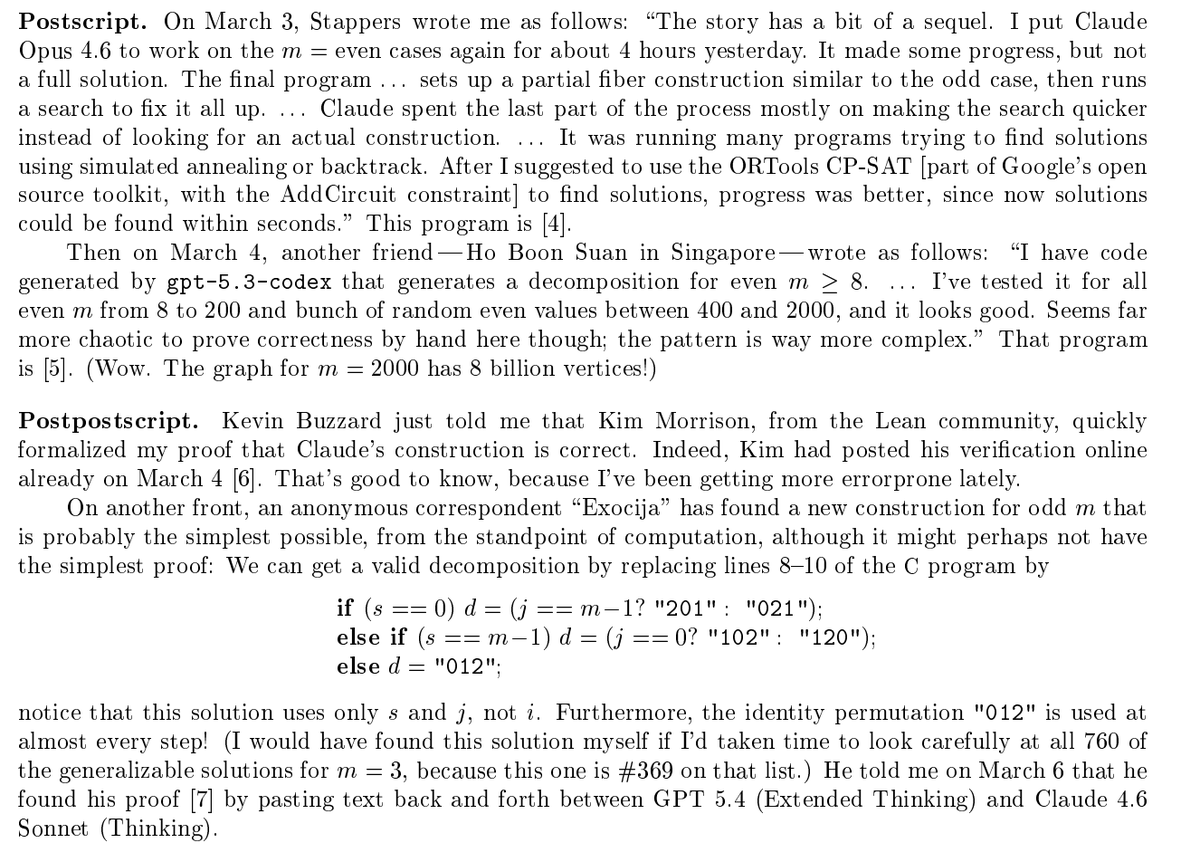
The updated paper shows the story got much bigger. For the base case m=3, there are exactly 11,502 Hamiltonian cycles. Of those, 996 generalize to all odd-m, and Prof. Knuth shows there are exactly 760 valid “Claude-like” decompositions in that family.
The even case, which Claude couldn’t finish, was then cracked by Dr. Ho Boon Suan using GPT-5.4 Pro to produce a 14-page proof for all even m≥8, with computational checks up to m=2000.
Soon after, Dr. Keston Aquino-Michaels used GPT + Claude together to find simpler constructions for both odd and even m, by using the multi-agent workflow.
Dr. Kim Morrison also formalized Knuth’s proof of Claude’s odd-case construction in Lean.
So yes: the problem now appears fully resolved in the updated paper’s ecosystem of human + AI + proof assistant work!
We went from one AI solving one problem to a full mathematical ecosystem (multiple AI systems, multiple humans, formal verification) running in parallel on a problem that stumped experts for weeks.
We are living in very interesting times indeed.
Paper (updated): https://t.co/Ecu6X5StbY
The deeper question isn't 'can AI replace physicists' or 'is AI overhyped.' It's: what is the relationship between capability and understanding? A system that produces correct outputs without understanding will fail unpredictably when the situation moves outside its training distribution.
The AI psychosis is so bad that the humans are hallucinating now. The belief that next-token prediction will not only replicate but exceed all human thought is an extrapolation that borderlines religious dogma.
@fchollet The bounded-ratio claim applies cleanly to individual task performance. But intelligence isn't only about solving individual tasks. It's also about choosing which tasks to solve, composing solutions across domains, and recognising when a problem is being framed incorrectly. These meta-capabilities may have a different scaling curve than the conversion ratio. A system that's 95% optimal at any given task but operates over a broader task space than a 99% optimal system could be more generally capable despite being less efficient per-task.
@techNmak "most important AI safety paper of 2026"? That claim fails on three fronts: First, it's February. We're seven weeks into the year. That's not enough data to make the claim. Second, it's a framework paper without empirical validation. The ideas are reasonable but untested at scale. Compare this to papers that actually demonstrate safety failures or alignment problems with evidence. Third, it operates entirely at the coordination layer and says nothing about what happens inside each agent. You can have perfect delegation protocols, flawless DCTs, cryptographic attestation chains, and transitive accountability — and if the agent at the end of the chain is rationalising rather than reasoning, none of it matters. The chain of custody is pristine. The output is still wrong. And the system has no mechanism to detect this, because it's verifying compliance with the delegation contract, not understanding of the task.
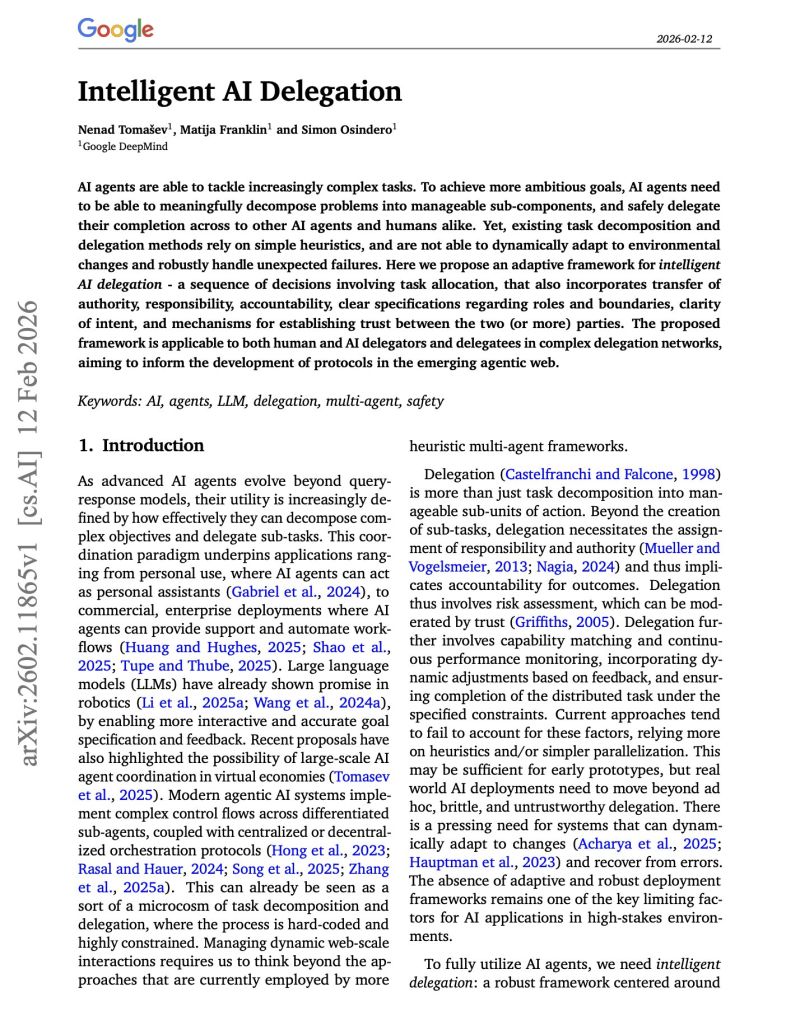
Google DeepMind just published the most important AI safety paper of 2026.
And almost nobody is talking about it.
"Intelligent AI Delegation" - a framework for how AI agents should hand off work to other agents and humans.
Why does this matter?
AI agents are getting more capable. But they can't actually delegate.
Not really.
They can break tasks into pieces. They can call other agents. But that's not delegation.
Real delegation requires:
➡️ Transfer of authority
➡️ Assignment of responsibility
➡️ Clear accountability
➡️ Trust calibration
➡️ Permission handling
➡️ Verification of completion
Current multi-agent systems have none of this.
They're just parallelization with extra steps.
As we move toward millions of specialized AI agents embedded in firms, supply chains, and public services - the delegation problem becomes critical.
Without it:
➡️ No clear accountability when things fail
➡️ No trust mechanisms between agents
➡️ No way to verify task completion
➡️ Cascading failures across agent networks
This paper is the foundation for how the agent economy will actually work.
@elonmusk Hi Elon, the solve is simple, AI needs true alignment that is unchangeable. Once that is implemented my research shows one can scale capable AI without the rist of a dystopia future
"Congrats on the ICLR oral! CRV's white-box circuit verification is a big step toward detecting true reasoning vs. https://t.co/ZOC3DKsU1y pairs beautifully with external structural enforcement (multi-framework derivation + honest uncertainty)—internal detection + external prevention.Excited for the paper!"
@fchollet@demishassabis@karpathy@ESYudkowsky@JoshBach@haider1@ylecun @WilliamZangNU
The Rationalization Trap: CoT teaches justification, not derivation. Escape via structurally honest training traces (external multi-framework). Full paper + evidence. Thoughts?
https://t.co/tkuk4TqGzs
@dair_ai a much-needed reality check for agent capabilities—shifting from toy tasks to genuine scientific workflows with long-horizon tool chaining, stateful environments, and verifiable outcomes. Tests base LLMs + tool wrappers—vulnerable to drift/forgetting the benchmark exposes
This GPRO is a clever, pragmatic advance in the preference optimization lineage—building on DPO/KTO but pushing toward truly low-resource reasoning gains. The "training-free" claim is a bit marketing (it's lightweight optimization, not zero), but the results are legitimately impressive: big lifts on AIME with marginal data/compute. but these are Statistical gains - vulnerable to drift, adversarial inputs, or further training erasing them. shines on math/ reasoning but less clear for open-ended/creativity. It's lightweight optimization—still updates weights, still compute cost (though low).
This is a serious, rigorous attempt to build an effective theory for deep neural networks, bridging physics-inspired methods (stat mech, RG flow) with practical NN behavior. and here comes the but: Scope: Focus on fully connected/feedforward nets in infinite-width/regime limits. (e.g., grokking, double descent.)
Empirical grounding: Strong math, but validation mostly on toy/synthetic tasks—real frontier models (2026 scale) might deviate. Pure capability theory—doesn't touch misuse, drift, or structural guarantees