#Cyanobacteria incorporate fatty acids into #naturalproducts through different biosynthetic strategies. They then modify these residues in a myriad of ways. Follow the link below if you want to learn more about this! @ERC_Research@CiimarUp
https://t.co/UpjbGuAHtn
Largely unexplored the ocean is filled with untapped medicinal potential. Chemist Sam Afoullouss (@Afroloose) dives into the science behind natural remedies and explains why the ocean's biodiversity is ideal for deriving and inspiring future treatments. https://t.co/eXGKOEIZQy
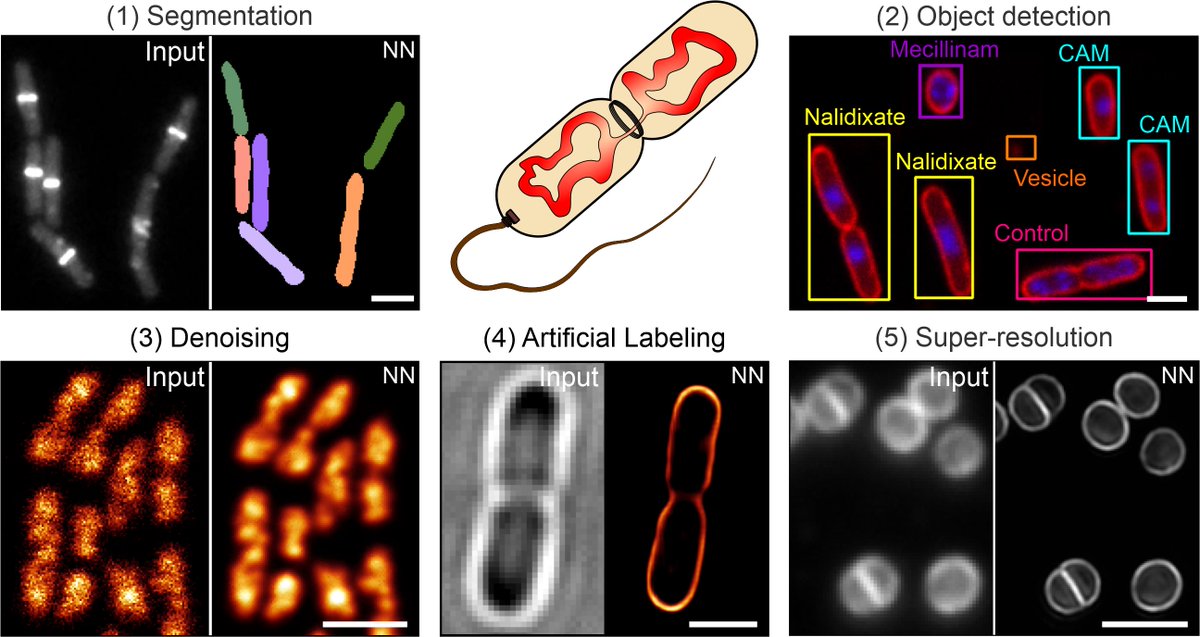
Happy to share our preprint on DeepBacs, a project dedicated to all bacteriologists working with #microscopy. In #DeepBacs, we employ open-source #DeepLearning tools for various tasks in bacterial bioimage analysis. A thread will follow soon! 🦠🔬🧠
https://t.co/dTm3CSLnv0
Congratulations to Franzi, @jkbcahn & all the co-authors on the newest @biorxivpreprint preprint!! 🥳 The MERMAID pipeline provides new insights into chemical functions of uncultivated life https://t.co/gVMnBBtBTD
In 1989, scientists discovered a new species of marine bacteria and began studying the chemical compounds it makes. Today, that bacteria is killing cancer in a Phase-3 clinical trial. I explored its long journey from seabed to bedside for @hakaimagazine: https://t.co/G6puHauKNd
For sure, you've never seen an earthworm like this!
Supercool research and pictures from @benebio3D, @mliebeke and colleagues now published in @PNASNews: https://t.co/pe0fpb58m5
More info here: https://t.co/V1qbyt29ZY
And on YouTube:
https://t.co/XXHlSs039z via @YouTube
Who left these tracks??
Surprise in the deep: Scientists found sponge paths on the ocean floor, they even move uphill! Until now it was thought they just sit around down there.
Read the news @AWI_Media@Habitat_MPI@teresamorganti
Photo @AWI_Media
https://t.co/F7v57wzwKt
A bacterium located inside rice seeds confers disease resistance to its host. Plants carrying the bacterium can't be infected by Burkholderia plantarii. The protective bacterium can be transferred to all major rice cultivars. @NaturePlants#microbiome
https://t.co/hx74q3icb9
This is a wonderful collaboration with scientists across the world. It started with the interest of building @GNPS_UCSD and molecular networking for volatile molecules. We needed something that could scale to the analysis at the repository level.
Using both multi-informative molecular network and score-based approaches as prioritization strategies, we report the isolation of 16 highly branched thiolane-containing natural products from a marine worm. @GNPS_UCSD @MarBioIreland
https://t.co/5MSmRArixE
Retrieving and Utilizing Hypothetical Neutral Losses from Tandem Mass Spectra for Spectral Similarity Analysis and Unknown Metabolite Annotation https://t.co/Lp88wW0wmf
Check out our latest article about "Isolation of Picrotoxanes from Austrobuxus carunculatus Using Taxonomy-Based Molecular Networking" #naturalproducts Congratulations to Florent Olivon and @CecileApel for their great work @ICSN_lab@UnivParisSaclay ! https://t.co/jaxSQw3jgS
Have you ever thought how many biosynthetic units does nature use to perform indole dearomatization ? Check out our recent article @JOC_OL Nice collaboration with @jjjvanderhooft@ms2lda @WU_BioInfo @UnivParisSaclay@BioCIS@ICSN_lab @INC_CNRS https://t.co/z8oE6VKl4i
1/n Super excited about this work. We have had MASST (BLAST for molecules) for > 5 years however as there was not sufficient public data to search against it was not as useful at that time. As more data became available in @GNPS_UCSD / MassIVE @metabolights and @MetabolomicsWB