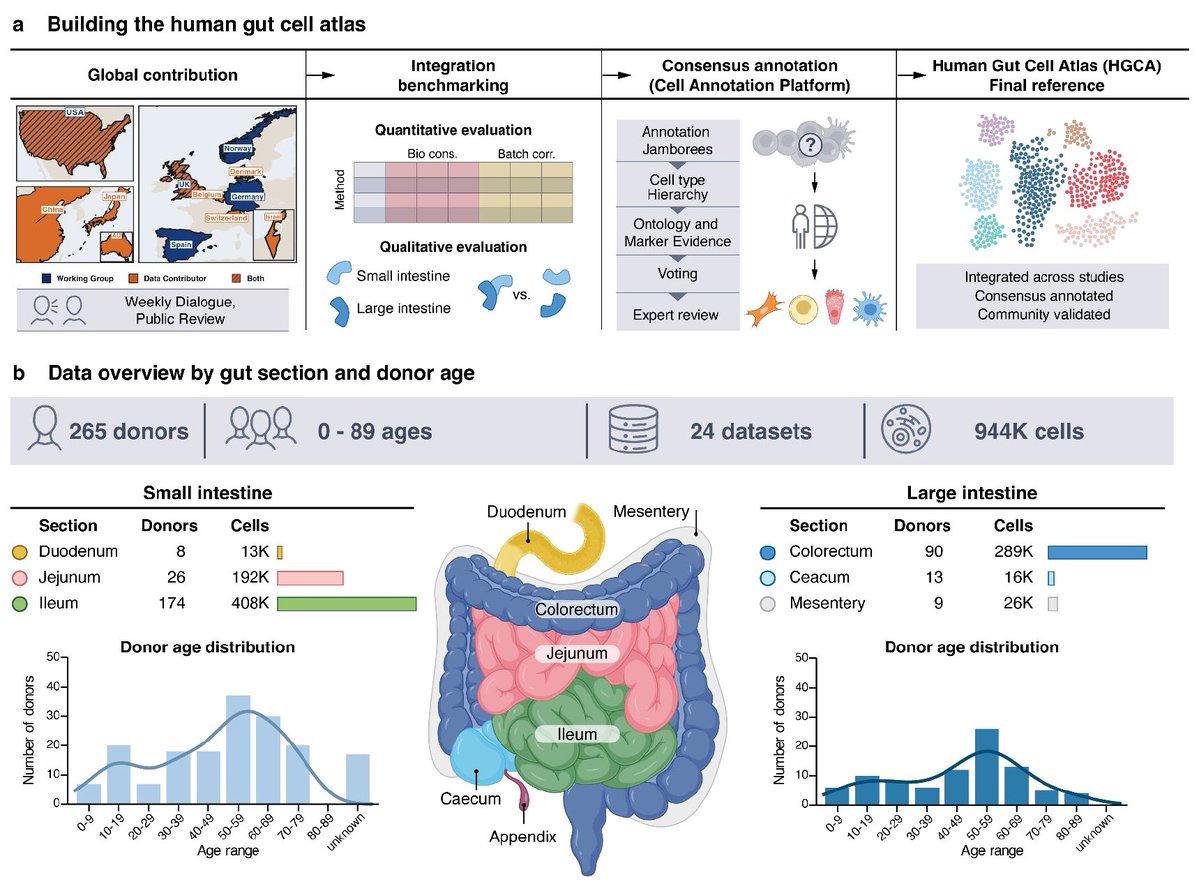
1/8 The Human Gut Cell Atlas (HGCA) v1.0 is out on bioRxiv! https://t.co/VW1XOkr9SI
Built by the gut community, for the gut community. For this HCA resource, we aimed for high-resolution healthy cell subtypes and robustness for downstream tasks like label transfer.
8/8 HGCA v1 will grow through community use, critique, and contributions. Explore the data, map your cells and help fill gaps in populations, ages and tissues. Thank you to everyone who built this! Want to build the next versions with us? Reach out! https://t.co/a3wq5Uxdnc
1/8 The Human Gut Cell Atlas (HGCA) v1.0 is out on bioRxiv! https://t.co/VW1XOkr9SI
Built by the gut community, for the gut community. For this HCA resource, we aimed for high-resolution healthy cell subtypes and robustness for downstream tasks like label transfer.
7/8 Do organoid cells made from ileal biopsies resemble ileum cells? Some types retain regional identity, others don't. Longer cultures often approach in vivo states, but the effect varies by cell type. HGCA lets us quantify both regional fidelity and maturation.
The integrated HCA v1 Human Gut Cell Atlas is now available on the HCA Data Portal! Integrating nearly 1 million single cells from 265 donors, the #Gut Atlas is a reference map to understand gut health and diseases like Crohn’s.
Explore here https://t.co/oCiO8sPlHO
#Genomics
What can we learn from all cytokines in the human genome? For most, we have limited info on what they do and when to target them
Meet TAPAS & EPICURE: tools to synthesize all human cytokines➡️scRNA data of primary human immune responses➡️🖥️methods to use them in your work (1/n)
Our new publication from the @ordovas_phd and von Andrian lab in this month's issue of @ImmunityCP sniffs out what there is to know about nasal immunity and memory to viral infections https://t.co/kJVDdp0pez 1/8
What a pleasure collaborating with the Craneo team on this podcast (en Español!) on the digestive system (el sistema digestivo)! Such amazing questions from young kids. Stay curious! https://t.co/lXm7nVehGP #Science#podcast
The peer-reviewed version of our study on the evolution of tissue-specific expression across vertebrates and insects is finally published in @NatureEcoEvo ! @FedeMantica@CRGenomica@UPFbiomed
https://t.co/PyaO9RBLhC
Translating scRNAseq results to the clinic is difficult... could comparing to clinical trials data be key to bridging the gap? @teichlab shows scRNAseq data supports many successful drug targets by bringing in ct data!
https://t.co/vAg5YBlGpa
Multicellular Factor Analysis is now fully available in @eLife's website, including the editor's evaluation and our updated revision.
Estimate multicellular programs and perform unsupervised analysis of samples from cross-condition single cell atlases
https://t.co/K4BI3OFZ03
AI is catalyzing scientific discovery into health and disease.
To accelerate progress, we’re building one of the world’s largest computing systems dedicated to non-profit life science research that we’ll leverage to create predictive models of whole cells