Successful Ukrainian counteroffensive especially to the north bolsters Western confidence of the country's victory over Russian invasion and most likely boosts louder voices of strengthening Taiwan's defence against potential Chinese military offense. 3/3
Introducing Anatomy
Describe a machine in one line. Claude brings it to life.
- Interactive isometric wireframes you can rotate, inspect and explore
- WebGL shaders for fire, water, plasma and more
- Real 3D motion, with individual parts that rotate and move
Install it as an agent skill. Fully open source.
Codex 🤝 Tailscale
Codex Cloud can now securely connect to resources on your tailnet with Tailscale.
Useful tools should be easy to build with, combine, and turn into something even more useful.
See how it works →
https://t.co/0eFd37GmmO
Introducing Contrastive Language Model (CLM): an ultra-fast System One Model trained with a contrastive learning objective that connects states and actions.
CLM-8B is pre-trained on internet-scale data and delivers up to 9× faster inference than Jev ⚡ while achieving comparable performance across computer-use, gaming, and tool-calling tasks.
With lightweight fine-tuning, CLM-8B sets a new SOTA on challenging agentic coding benchmarks, such as DeepSWE (81.6%) and Terminal-Bench 2.1 (87.6%). In contrast, Jev fails to serve as an effective verifier for these long-horizon tasks.
We also build an efficient training and serving infra for CLMs by disaggregating states and actions, allowing their embeddings to be cached and reused independently. This substantially reduces inference latency in settings where the state evolves continuously while the action set remains fixed.
Finally, we establish scaling laws for CLMs and show that the test contrastive loss decreases predictably as a power law in training compute, model size, and dataset size.
📄 Blog: https://t.co/zwi9JOHKGx
💻 Code: https://t.co/rsHRYCGR8I
🗣️ Discord: https://t.co/Uqtdefvo3J
🤗 Data & Models: https://t.co/wdSWGGO3hu
More details on CLM’s architecture, data recipe, and scaling laws in the thread below 🧵
Day 2.1/
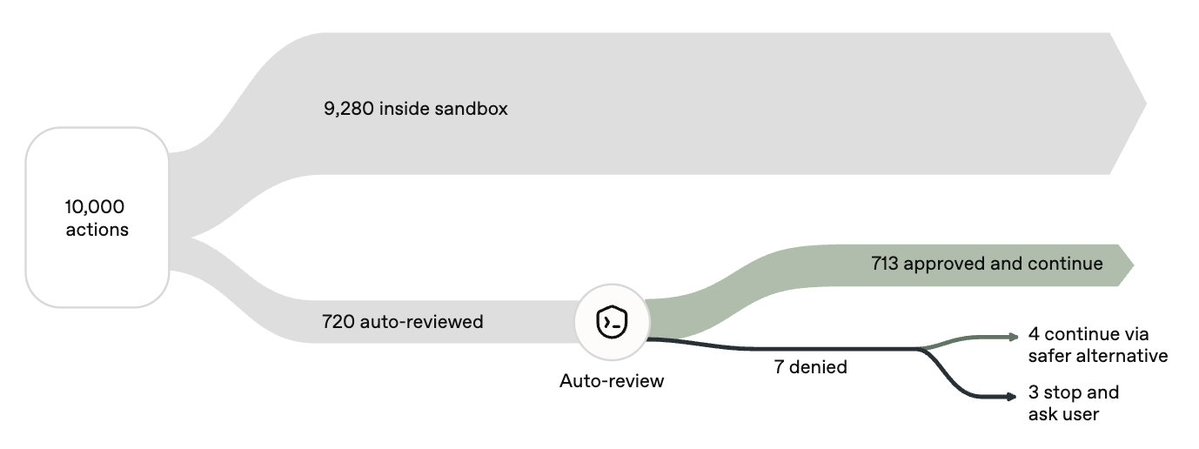
We have made Auto-review free for all users signed in through a ChatGPT account. You can enable it in settings > permissions > auto-review. Auto-review improves upon the default sandbox setting that requires you to approve everything, which is prone to decision fatigue unless you spend a lot of time configuring specific rules.
It allows you to run long tasks while having a second agent review all actions taken by the primary agent. Its only goal is to prevent high-risk actions from being taken and to protect against unwanted actions that are not aligned with the original user intent. This Auto-review feature is now free and does not draw usage from your plan.
Jev answers every question instantly. That's great, until a question is hard.
TypeLLM is System 1 when it can be, System 2 when it has to be.
"thinking": "auto" picks per question, per call.
Read more: https://t.co/ONbHAs6yIu
Meta just change the game!
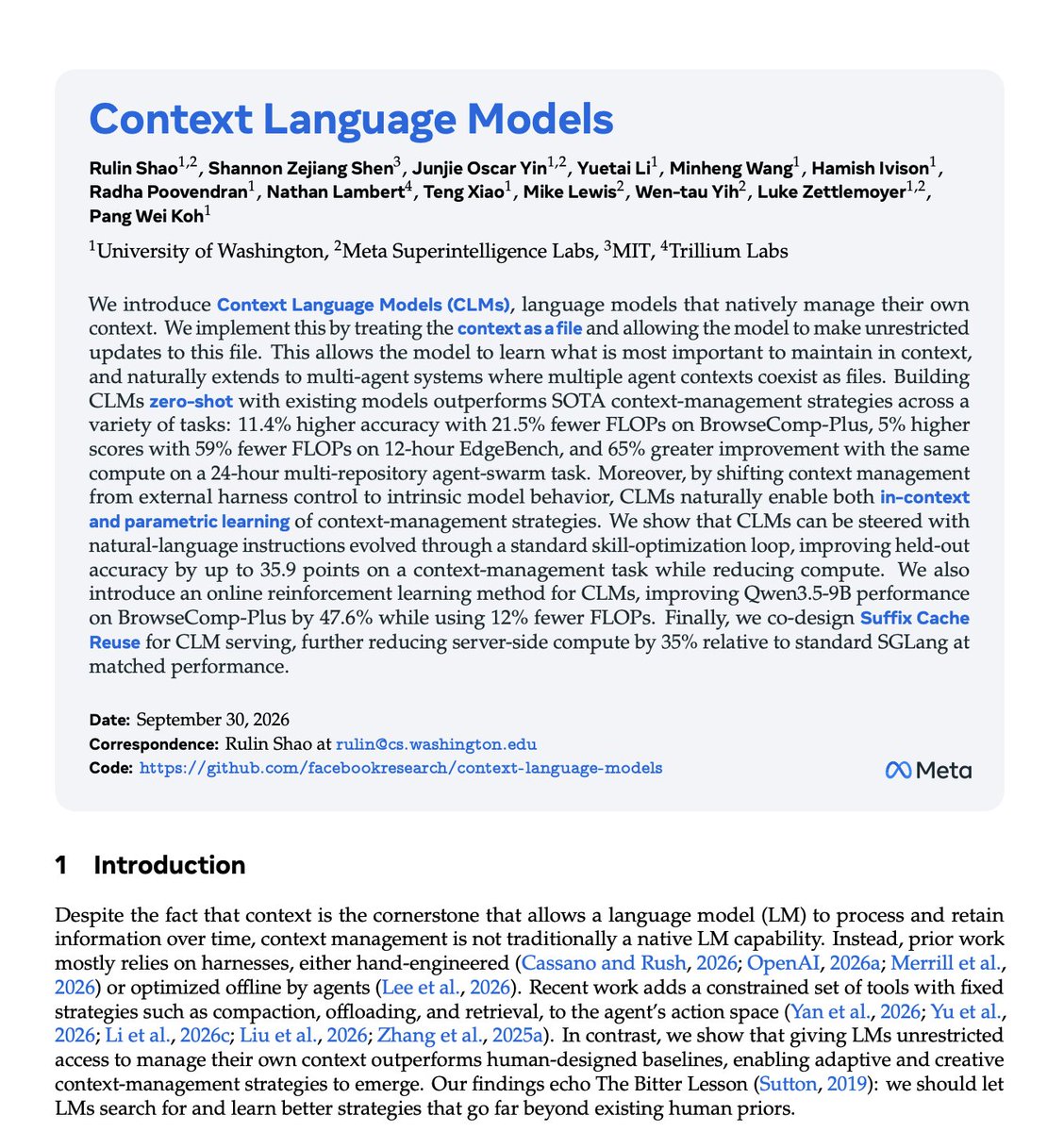
They open-sourced Context Language Models. Instead of using LangChain, RAG, or any orchestration harness, the model natively manages its own context like a file.
And it beats every SOTA context method with 59% less compute.
Instead of forcing a model to swallow endless walls of text like a passive file cabinet, they gave language models something revolutionary:
The ability to natively manage their own context.
To treat context like a dynamic file.
To learn their own internal policies entirely through weights, with zero human-designed frameworks or rigid retrieval harnesses.
The results shatter current benchmarks.
Using online reinforcement learning, they applied CLMs to the Qwen3.5-9B model.
Performance on BrowseComp-Plus skyrocketed by 47.6%.
And the wildest part? It used 12% fewer FLOPs to do it.
They didn't stop there. They co-designed Suffix Cache Reuse for server-side inference, slashing compute costs by 35% compared to standard SGLang at matched performance.
For years, labs have spent billions trying to engineer smarter ways to stuff more tokens into an LLM's prompt window.
They were solving the wrong problem.
Jev for RAG, clearly explained!
Hybrid search gives you a shortlist. It does not decide which passages contain evidence, which are merely adjacent, or whether the evidence is strong enough to answer.
That missing judgment is where Jev fits.
Jev sits between retrieval and generation. It does not replace BM25, embeddings, or the LLM. It evaluates the candidates they produce before those candidates enter the context window.
→ Retrieve wide
Combine dense and keyword search, then merge the results with reciprocal rank fusion. This gives Jev a broad candidate pool, such as the top 20 passages shown in the visual.
Retrieval still sets the ceiling. If the right passage is missing from this shortlist, Jev cannot recover it.
→ Judge every candidate together
Send the query as Jev’s state. For each candidate, ask a typed yes-or-no question such as “Does C7 help answer this query?”
Jev evaluates every question in one packed request and returns a calibrated probability for each passage. This avoids making a separate model call for every query-passage pair.
→ Let code apply the threshold
Your application compares each probability with a threshold. Candidates above it continue to the LLM. Everything below it is removed before generation.
Jev makes the fuzzy judgment. Code remains responsible for the actual decision.
→ Gate the entire answer
The same request can check whether the retained passages make the query answerable. It can also flag signs of prompt injection inside a candidate.
If answerability falls below the threshold, the application can skip the LLM and return “not in the documents.” The injection score should remain a filtering signal, not a security boundary.
The result is a cleaner division of work.
Hybrid search retrieves broadly. Jev reranks, filters, and decides whether sufficient evidence exists. The LLM writes only from the passages that survive.
Jev’s value here is not simply moving passages up or down a list. It turns relevance into an explicit probability that your application can inspect, threshold, and act on.
To summarise:
- Retrieval finds the candidates.
- Jev decides what deserves context.
- The LLM writes the grounded answer.
----
I also built an open-source project showing how to use Jev as a judge for AI observability with Comet Opik.
It evaluates support traces for groundedness, request coverage, action honesty, and helpfulness, then records the results as an auditable experiment.
You can explore the project here: https://t.co/XVmpg6ldHT
My article on how Jev works is quoted below.
Deploying DiffusionGemma-Jev (djev) just got a lot easier. You can now spin up a Jev API-compatible endpoint on Google Cloud Run using a single command.
Performance is solid: ~35-60 ms for single step latency and batch@32 is ~100-123 requests/sec.
It's a straightforward way to experiment without needing your own GPU. Runs at roughly $3/hr and drops to $0 when idle.
Get the code and instructions here: https://t.co/E3agzrW2hZ
We tested Jev against LLM judges on accuracy, repeatability, latency, and cost to see whether System One models could offer a new approach to agent evaluation. https://t.co/hrqdNpm0g8
Theo is right on the core issues. This filter-style pruning drops tool results without Jev seeing their full content, loses encrypted reasoning traces that Claude needs intact, risks stupid retry loops, and invalidates prompt caches (expensive rewrites). Native model compaction is trained for the job and used sparingly. Jev is fast for decisions, but this specific strategy is flawed for real agent runs. Cool experiment, not production-ready.