Have you already pivoted to AI? Apart from 5 mega funds, the Web3 VC space is dead: all the money has already been made, and there is no more upside.
This is the logic I hear weekly in my conversations with other VCs, LPs, and founders.
At first glance, it looks like a paradox. Investor attention to the space is at the bottom, while fundamentals are at the top — and moving higher every month. Stablecoin payments are scaling, assets are being tokenized, and agentic economy infrastructure is emerging.
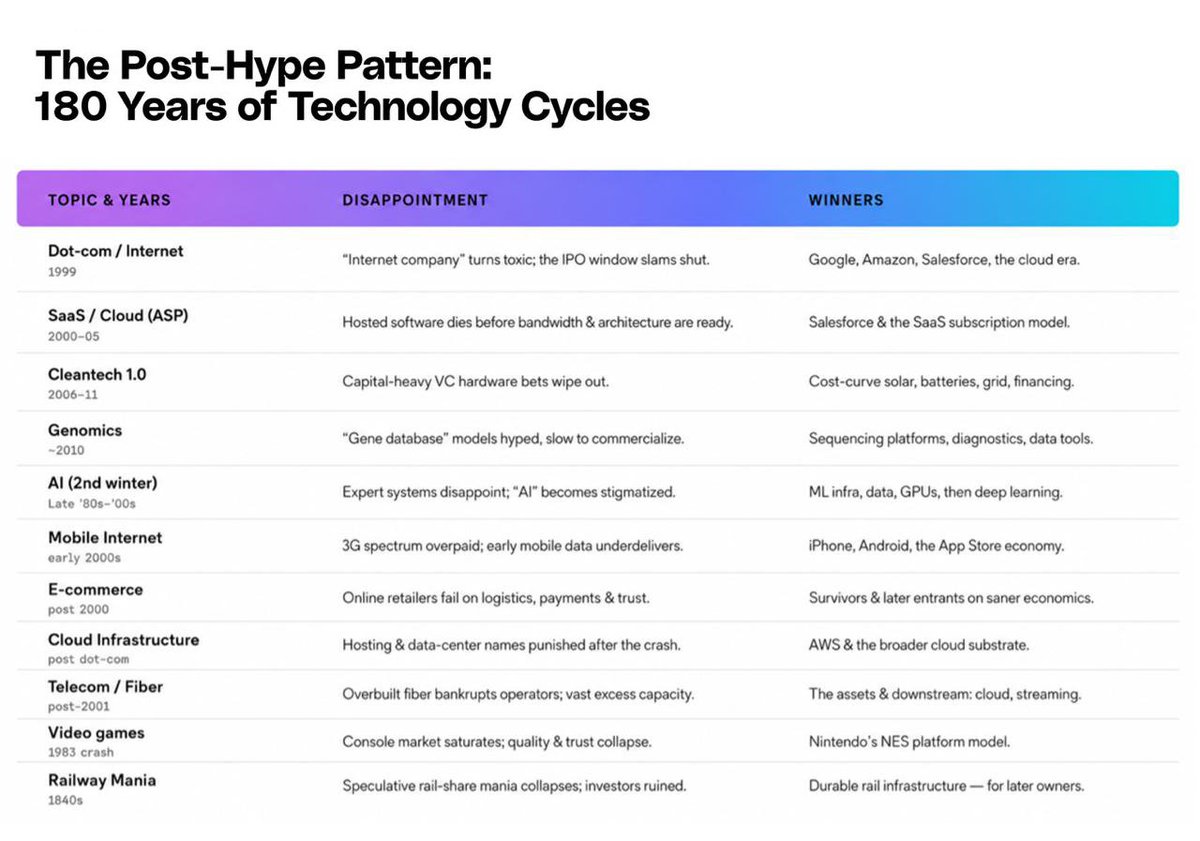
But that is not a contradiction. It is a very common pattern. Every technology cycle follows a similar arc.
At the peak, capital chases the label: “dot-com,” “AI,” “crypto,” “cleantech,” “metaverse,” “quantum.” Marginal companies get funded on narrative alone. Valuations detach from fundamentals. The category becomes more important than the product.
Then the correction comes. Generalist capital leaves. Media attention declines. Public-market proxies de-rate. Founders who entered for momentum disappear.
But in durable sectors, the fundamentals keep improving after attention moves elsewhere:
- Infrastructure becomes cheaper and more reliable.
- Developer tools mature.
- Regulation becomes clearer.
- Business models become more disciplined.
- Real users adopt the technology for practical reasons rather than speculative excitement.
This creates a post-hype productivity window:
The market continues to discount the category because the previous narrative failed, while the investable opportunity has already shifted from storytelling to measurable productivity.
Historically, this is where some of the strongest companies — and some of the strongest entry points — are created.
- After the dot-com crash: Google, Amazon’s recovery, and Salesforce.
- After the ASP cycle: SaaS, rebuilt on better architecture and subscription economics.
- After the telecom crash: overbuilt fiber became the substrate for cloud, streaming, and enterprise connectivity.
- After the ICO winter: stablecoins, custody, wallets, analytics, and DeFi infrastructure became the foundation of the next cycle.
The failure of the first narrative does not imply the failure of the underlying technology.
Often, it creates the conditions for that technology to become useful.
At @Polymorphiccap, we do not ask whether a sector is fashionable. We ask whether the fundamentals kept improving after everyone stopped watching:
- Usage growth.
- Falling infrastructure costs.
- Regulatory clarity.
- Incumbent adoption.
- Founder quality.
- Real use cases.
- Reset valuations.
Our thesis has always focused on practical, application-centric Web3 businesses: payments, settlement, stablecoin infrastructure, tokenized assets, compliant financial rails, liquidity networks, and machine-native commerce.
We believe the practical Web3 applications now show all the key signals of a post-hype productivity window.
@polymorphiccap is one of the most active Web3 funds today and one of the earliest investors in @FairMath , as well as one of the most value-add partners we’ve worked with.
If you’re raising in this space, you can get in front of the Polymorphic Capital team directly via Parley:
https://t.co/yrxQ6AAy1B
https://t.co/NreaFLediK
@daminufe Would be cool to add there the potential pitch side of the product to real investors. Our portco founder did this @g_arakelov https://t.co/D5kJG8ahOK happy to explore if relevant and how @daminufe
1/2 Great to see multiple portcos in the latest
@a16zcrypto stablecoin map 🫡This is where real usage is compounding while the rest of the market debates narratives
People often say crypto’s only real use case is finance.
Yesterday:
Zoom
Docusign
Vercel
Tinder
Okta
all on stage integrating World ID.
Under the hood this runs on:
Ethereum
Worldchain (OP stack)
Client-side ZK
TACEO Network
Crypto quietly becoming infrastructure for the internet.
Aaron Levie says agent-driven micropayments could create an entirely new business model for the internet:
"We might have truly a completely different business model for the internet."
"Now actually it's probably is a good business model. Because let's say you had paywalled, really proprietary data... You could actually imagine like there's maybe like a hundred million agents that would be tapping into that data for various use cases."
"All of a sudden, a penny a transaction starts to make a lot more sense than it did when you were capped at... people that maybe was interested in your content previously."
"We probably have new business models for tools and APIs... We probably want an agent to be able to have a budget and make any API call it wants, and all of a sudden you have this new revenue stream, which is like these agents showing up, just transacting on your system."
@levie at Daytona Compute Conference
It’s important to enable merchants to accept those micropayments and track/mark them as agentic payments. This is not to mention that there should be a smooth fiat and stablecoins flow - whatever works for developers and merchants. Our portco @Nevermined_ai built it. Looking for more solutions like that in the space - dm