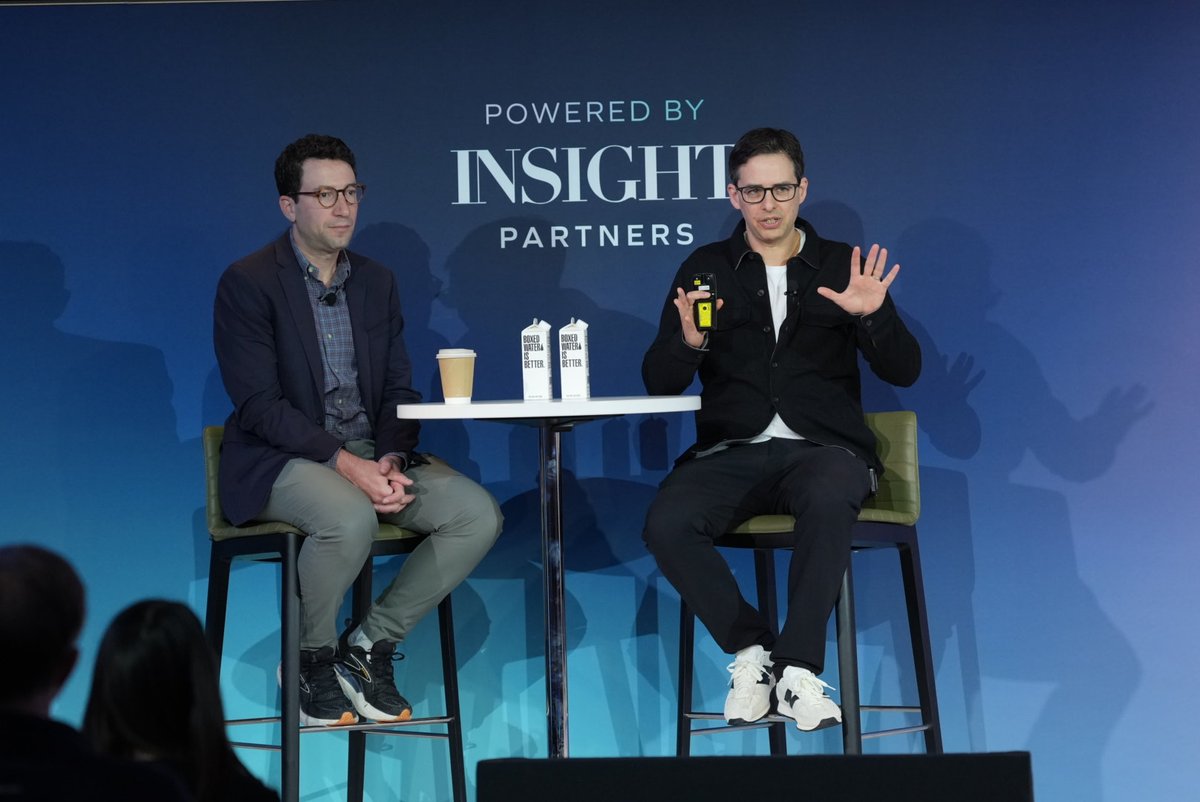
the replay of my keynote at our @scaleupevent - I divide things into three time phases, and in that context talk about the foundation model landscape, elasticity of demand, consumer surplus, incumbents integrating generative AI features, the potential for switching costs eroding for legacy products, products and business models that could become obsolete, threshold effects as AI systems pass human performance at various tasks, the "wall" and whether AI models will start improving more slowly, among other topics. @insightpartners@CentralReach@quantummetric@FeaturespaceLtd @runailabs @OpenAI@GoogleDeepMind@AnthropicAI@xai@GliaInc
Today, we’re expanding @SnorkelAI’s Open Benchmarks Grants by 10x to a $30M commitment:
- Funding a more diverse, robust, and continuously-updated ecosystem of open benchmarks
- Launching the Open Benchmarks Red Team to continually test and strengthen them
- Introducing the Snorkel Research Fellowship to support independent contributors developing new evaluation methods
Since our launch earlier this year, we’ve been humbled to partner with the teams behind Terminal-Bench, TB-Science, ARC-AGI-3, OSWorld 2.0, Agents’ Last Exam, Continual Learning Bench, Senior SWE-Bench, SlopCodeBench, and more. Alongside these teams, we’ve helped design evaluation methodologies, develop task construction pipelines, and scale quality control. OBG-funded benchmarks have appeared on the latest model cards from every major frontier lab; have helped to index and measure frontier progress and alignment; and have contributed to guiding the frontier of AI development.
Benchmarks have always been guideposts for—and drivers of— AI progress: setting a metric and then “hillclimbing” against it is the core of how AI works! But when benchmarks fall behind frontier capabilities, our ability to evaluate and align these systems does as well. They become too simple, static, or correlated, and the risk of “benchmaxxing” increases.
We need more diverse, robust, and continuously-updated benchmarks, developed by a broader ecosystem of researchers and domain leaders.
We’re incredibly excited to accelerate frontier evaluation with Open Benchmarks Grants— raising the ambition and investment in robust, open, and independent measurement. Read our full announcement and apply here: https://t.co/E5kfZQ0Im5
@InsightPartners MD Lonne Jaffe (@lonnej) on what's changed in the AI investment landscape this past year — where the most consequential innovation is happening, and where capital is flowing. #ScaleUpAI💬 "What we really care about as an investor… is the durability of the business, not just the historical growth.”
almost exactly two years ago I posted my first @suno song and thought it was amazing
today: a full music video for "I Can't Do This Without You," a dark love song between a woman and her AI assistant
made with @claudeai Opus 5.5 and @suno v6
full list of tools in reply
"@SnorkelAI's research-grade approach to AI data, environments, and measurement is becoming an increasingly important ingredient in building capable and reliable AI systems – and their demonstrated growth at scale reflects that,” said @lonnej , Managing Director at @insightpartners. “We’re excited to back @ajratner and the team as they continue to bring their frontier AI data factory capabilities to longer-running, complex work in high value industries like healthcare, law, and software engineering.”
“As AI systems take on longer-running, higher-stakes work, the data needs from frontier AI labs and enterprises are shifting from generalist data that humans can write down to specialized data, environments, and evaluations that often need to be built.”
In the below post, @lonnej and I share some thoughts about our (@insightpartners's) recent investment in @SnorkelAI and what got us so excited to partner with @ajratner and the Snorkel AI team as they build the data lab for “Data 2.0”.
https://t.co/M5fCM4UlgQ
TIL that Gemini, Claude, and ChatGPT (but not Grok) are told that today is March 32nd, because if you tell LLMs it's April 1st, the conditional text predictions downstream become less reliable for obvious training-dataset reasons.
1/ The future of general-purpose robotics will be decided by one major question: which flavor of data scales reasoning? Every major lab represents a different bet.
Over the past 3 months, @adam_patni, @vriishin, and I read the core research papers, spoke with staff at the major labs, and mapped the talent pool. This has completely changed how we think about general-purpose robotics.
Our paper builds intuition, step-by step, across the 2025 frontier: from architectures → evals → data → industry dynamics. Each layer reveals a different bottleneck, but they all converge on one truth—data decides everything.
Our takeaways + process below👇
If you want access to our graph (sound on), comment or DM me
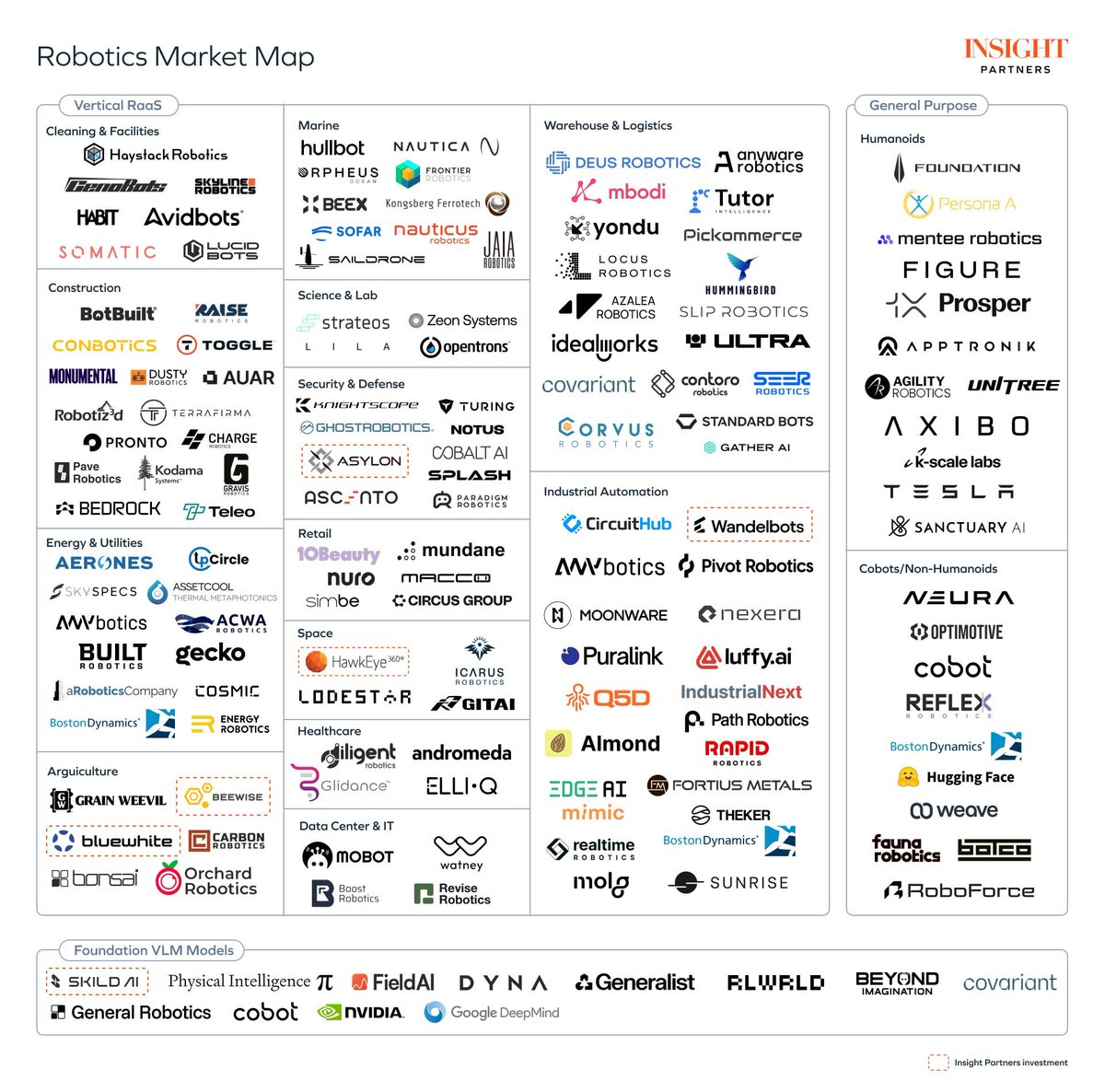
AI agents are redefining productivity. Physical agents will redefine labor.
In our latest POV, Managing Director Lonne Jaffe, Adithya Sanjay, and Sourish Jasti unpack how robotics is moving from the lab to the real world — delivering ROI across logistics, security, agtech, and more.
https://t.co/tz2Kgbq0kc
“Do you love this product?”
0% say yes.
0% switch.
On the latest Analytics Engineering Podcast, @jthandy and Lonne Jaffe of @insightpartners unpack why legacy tools stick—and what AI might finally change.
🎧 Listen: https://t.co/sUjyj0xkyu
the replay of my keynote at our ScaleUp:AI event just posted to YouTube: https://t.co/TaulZ3vyJw -- I talk about the foundation model landscape, elasticity of demand, consumer surplus, incumbents integrating generative AI features, the potential for switching costs eroding for legacy products, products and business models that could become obsolete, threshold effects as AI systems pass human performance at various tasks, the recent discussion around a "wall" and whether AI models will start improving more slowly, among other topics.
@insightpartners@CentralReach@quantummetric@FeaturespaceLtd @runailabs @OpenAI @ChatGPTapp @GoogleDeepMind@AnthropicAI@xai@GliaInc
replay of my AI keynote presentation (19 minutes long) "What we've learned from working with AI ScaleUps" at the @scaleupevent in NYC, @insightpartners
I wrote a piece titled "Making a Splash: @swimm_io's New Generative AI Software Documentation Capabilities" for their launch yesterday https://t.co/EUyw9HgaTl @insightpartners
https://t.co/iqVoyXQYCc - replay of my 52 min discussion today "Investor’s POV: Mapping the Applied Generative AI Landscape" with @JennaZerker and @PraveenAkkiraju, is up on YouTube, covering (with timestamps):
6:29 – Insight has been investing in AI for countless years, but with the rapid innovation taking place, how do you see the current AI landscape evolving?
12:55 – Where do you think value will accrue across the generative AI stack?
19:05 – What are some examples of how you are seeing “big tech” and portfolio companies incorporate generative AI products and tools?
31:25 – Given how quickly one can “spin up” a generative AI company, how do you think about product defensibility, the concept of moats, and the potential first-mover advantages/disadvantages?
37:36 – How do you manage AI responsibly? What advice do you have for founders on how to build in data privacy, governance, and AI responsibility guardrails?
42:54 – What are some of the “unknowns” or debates you are seeing in the AI community?
@insightpartners@swimm_io@OpenAI@wandb @runailabs @midjourney_ai@OverjetDental@UnlearnAI@nvidia@IterativeHealth@SingleStoreDB@ProfluentBio@Workato@bardeenai
https://t.co/4iHCsvcFiO "...AlphaDev not only found faster algorithms, but also uncovered novel approaches. Its sorting algorithms contain new sequences of instructions that save a single instruction each time they’re applied. This can have a huge impact as these algorithms are used trillions of times a day. We call these ‘AlphaDev swap and copy moves’. This novel approach is reminiscent of AlphaGo’s ‘move 37’ – a counterintuitive play that stunned onlookers and led to the defeat of a legendary Go player. With the swap and copy move, AlphaDev skips over a step to connect items in a way that looks like a mistake but is actually a shortcut. This shows AlphaDev’s ability to uncover original solutions and challenges the way we think about how to improve computer science algorithms..."