This paper has been available for 4 weeks, but I joined Twitter 3 days ago, hence this belated, by now redundant, thread. Very pleased that https://t.co/aSaFQ1HJ8Z (with radical approach towards data access and research transparency) got published by @RIPEJournal
🔬🤝 Jeszcze lepsza współpraca na rzecz nauki!
💡Dyrektor NAWA, dr @karczewski01, spotkał się z prezesem-elektem @FNP_org_pl, prof. dr. hab. @k_pyrc. Rozmowy dotyczyły przyszłych inicjatyw i możliwości współpracy na rzecz wzmocnienia pozycji polskiej nauki na arenie międzynarodowej. 🌍
Z niecierpliwością czekamy na wspólne działania! 🔜
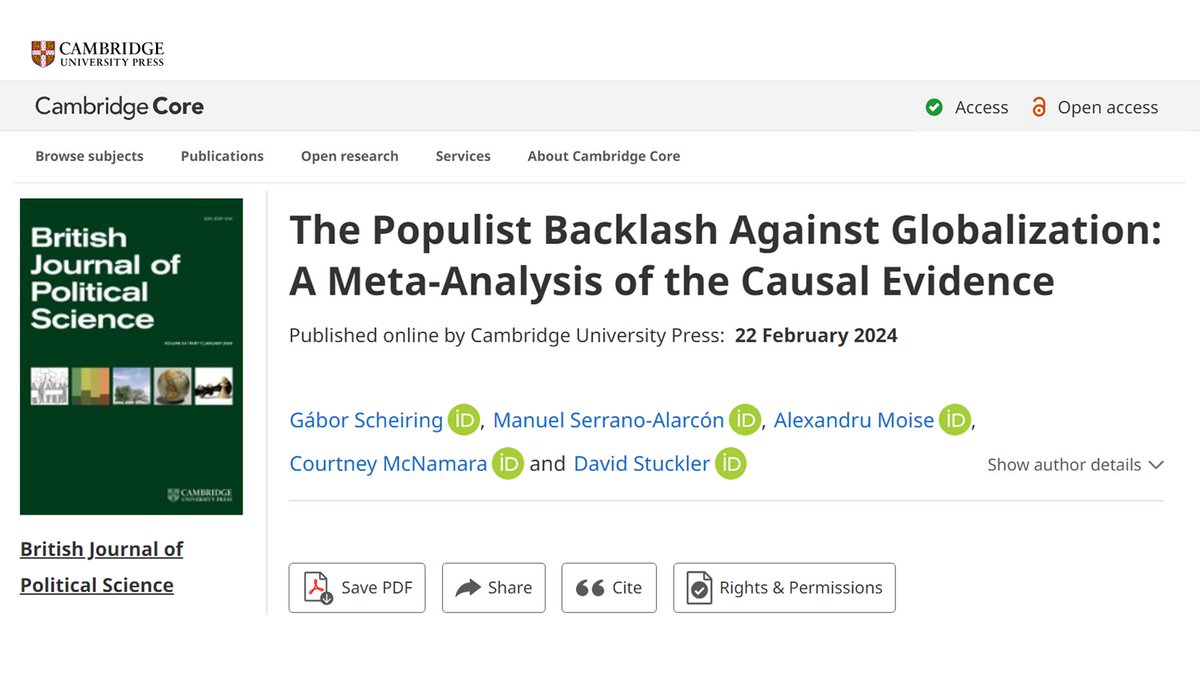
Excited to share our article just out in @BJPolS#OpenAccess. The first meta-analysis of the evidence of a causal association between economic #insecurity and #populism provides a definite answer confirming that economic insecurity is a robust cause. @ManuSeral @alexdmoise@DrMcNamara@davidstuckler@GUQatar
https://t.co/yt6qVDBwGs
The literature on populism is divided on the causes. Several recent narrative reviews report weak association at best. Although we found significant heterogeneity in several dimensions, all studies reported a significant causal association. A recurrent magnitude was that economic insecurity explained around one-third of recent surges in populism.
We statistically tested for publication bias and found significant evidence of it. However, the causal association between economic insecurity and populism remains significant after controlling for it. Economic insecurity seems particularly relevant for explaining right-wing populism, while the results for left-wing populism appear more ambiguous.
Altogether, the existing scholarship presents enough evidence to conclusively disperse any doubts about the causal role of economic insecurity in the populist backlash against globalization. Denying the role of economic insecurity is a position that cannot be defended. Of course, this does not mean that cultural factors are not important. Culture can mediate the role of economic shocks or might even be an independent primary cause. But juxtaposing economy and culture is less productive than exploring their interactions.
The literature search took place early/mid 2022, which means we could not cover some new studies. We do cover, though, everything we found in the three biggest academic databases and on Google Scholar.
Feedback, comments, or questions are welcome!
Might be of interest to @LeoBaccini@mcopelov@SteWalter@VenturiniMiri@CharlotteCavai1@matthewpurdy123@thmskrr@RachelNavarre@fetzert @SattlersThomas @hvm1@PStanig@SJWeymouth@martinmckee@cmicmeissner@AlganYann@davidautor @timvlandas @halikiopoulou@CihanTugal@MSnegovaya @CasMudde @Jacob_S_Hacker@NoamGidron@ILLSP_GWU
https://t.co/yt6qVDBwGs
Tomorrow, I am presenting my ongoing work on gender and intra-party politics at @EuropeAtHarvard! If you're interested in women within political parties, come and join us!
📢 The countdown is on - one week until our next seminar with @g_picot ⬇️
‘The politics of regulating low wages’
📅 4pm, 8 February
📍 Online & in-person
More information: https://t.co/dk6tSUp036
Meet @MNaczyk, one of our Visiting Scholars from @UniofOxford. Join him tomorrow for a seminar on “Varieties of Pension Financialization: The Politics of Defined-Contribution Plans in America and Western Europe.”
⏰ 2:00 - 3:15pm
🔗 https://t.co/xJkK2fUslU
Interesting new study by Kenneth Nelson and colleagues on how welfare states can blunt how environmental taxes might otherwise be regressive. Cool new approach to incorporate comparative social policy, taxation/public finance, and environmental issues.
https://t.co/KjThH1Em6s
📢Very happy to share that our paper "Bounded #solidarity? Experimental evidence on cross-national bonding in the EU during the #COVID crisis" together with @ZTruchlewski is now published Open Access🔓in @EJPRjournal. Here are a few of our findings🧵👇https://t.co/s2fyZhVhz2
@BJMbraun@LSEEI Big loss for German academia (shame they never offered you that permanent position)... And I look forward to being able to meet and chat more often with you in the UK! Congrats, Ben!
Come join my team at @UniofOxford !
We're looking for a Research & Policy Coordinator to join the newly created research & policy engagement programme on green economic transformation & industrial policy in Latin America.
Deadline: 9th Jan
Apply here: https://t.co/vJ2kLHxSPl
1/ 🧵 Our new special issue @EJIR_News explores the intersection of industrial relations and comparative political economy, focusing on public sector wage setting (PSWS) across European growth regimes.
w/ @OscarMolinaRom1 & @LyhneIbsen
Open Access👇
https://t.co/e2aYlHjpH6
*24 postdocs on #democracy and #development!* 6 each in Bogota, Budapest, Cape Town, & Colombo. I'll be a resident senior adviser for part of the '24-25 fellowship period in S Africa and Sri Lanka. Please apply and/or encourage others to apply! Details ⬇️
https://t.co/Q4ncAHU8vE
@rlequiniou Un échec politique sur l'Ukraine devait, bien entendu, être évité. Nous sommes d'accord là-dessus. Cependant, "j'en sais rien" (sic) si la "meilleure nouvelle de ces derniers mois" c'est cet isolement de Budapest qui paraît être en trompe-l'oeil.