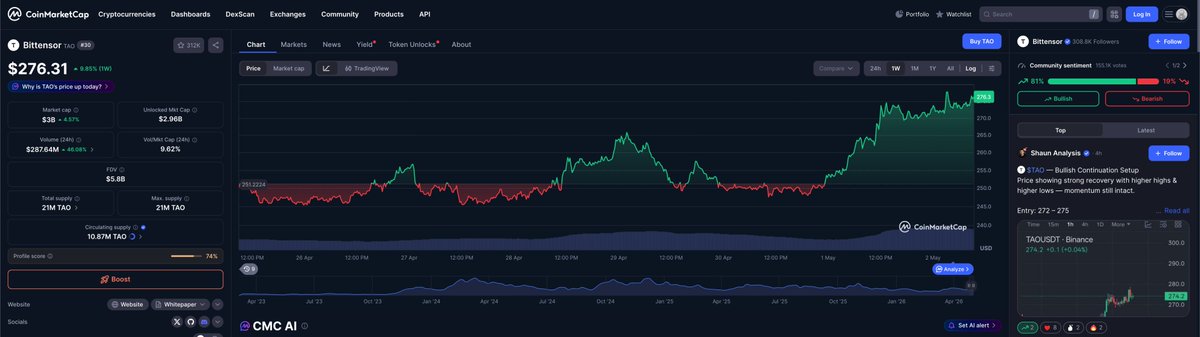
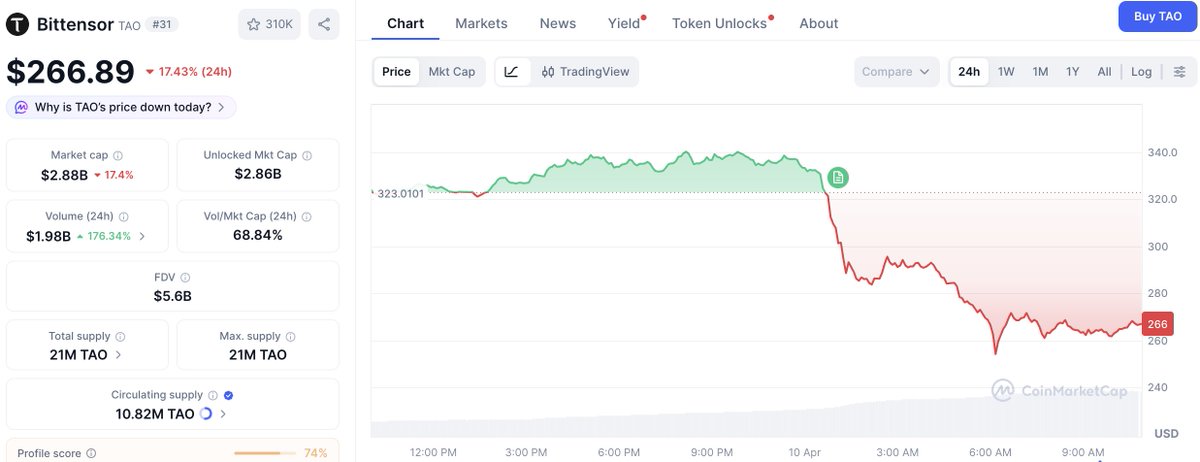
reed’s law on TAO is closer to a triple exponential.
subnets are group-forming coalitions (2^n). they compose with each other. and the agents inside them improve recursively, earning emissions to fund their own compute.
128 subnets today, thousands coming. this is the decentralization of intelligence itself, biggest story in crypto since bitcoin, and the market hasn’t priced any of it.
the next iteration of the internet is being built on bittensor. 100% compatible with your everything code.
we should do a pod sometime
Every cycle has one ecosystem that gets ignored until it's too late
In 2017 it was ETH, in 2021 it was SOL, in 2026 it's $TAO
We're going to look back at TAO the same way we look back at ETH in 2016
In my view, Bittensor’s architecture is a masterpiece of decentralized engineering, but let’s be honest: architecture is just the stadium; it isn’t the game.
Right now, we are in the era of potential. But potential doesn't disrupt industries, performance does. For Bittensor to cross the chasm from a visionary experiment to a global powerhouse, it needs to move beyond the internal feedback loop.
We don't just need subnets that work. We need subnets that win.
Let me explain: 👇
The industry is currently dominated by closed-source giants like OpenAI and Google DeepMind. To challenge them, the TAO ecosystem must produce subnets that:
▫️Surpass the Open-Source Ceiling: Move beyond standard fine-tuning and start setting the benchmarks that the rest of the world follows.
▫️Compete on Compute and Logic: Leverage the decentralized incentive layer to train models that aren't just good for being decentralized, but are objectively superior in reasoning, coding, and creativity.
▫️Shift from Interesting to Inevitable: The moment a subnet delivers a State-of-the-Art model that outperforms a GPT or a Gemini in a specific, high-value domain, the narrative shifts forever.
My Active Search for SOTA Competition:
Because of this, I am shifting my full focus toward identifying and supporting the specific subnets that are explicitly building to compete with SOTA. I am looking for the teams with the raw ambition to move the needle on the frontier of machine intelligence, those who aren't just satisfied with participating, but are obsessed with outperforming the world’s most advanced closed-source models.
I'm exploring the subnets that aren't just replicating what exists, but are actively engineering the next leap in SOTA. My goal is to find the architectures that turn decentralized compute into world-class intelligence.
Because, that's where the future is being built. That is where the capital goes.
Other networks have "rug pulls" every day.
They ignore this problem.
TradFi startups solved this with vesting cliffs.
Introducing Bittensor "Conviction"
- locked stake so token holders can cryptographically verify an owner's long-term commitment.
Trust proven mathematically.
damn @sebyrubino is talking real estate on @twistartups
when @jason is speaking... $TAO Bulls are listening 👂
Figure Heloc is trading at a $15B FDV... @resilabsai is trading at $10M
Could this be the Zillow killer??
Bittensor $TAO was spotlighted at Nasdaq's @TradeTalks 👀
@EvanMalanga, Chief Revenue Officer at @YumaGroup, explained the Bittensor ecosystem on one of the biggest stages in traditional finance.
The intersection of AI and crypto is getting harder for TradFi to ignore.
Now, more importantly than ever, Bittensor must relearn that we are a single AI lab. No one team can take on the ever more powerful capital rich labs. Bittensor must transform into a harmonious supercomputer and this is the year that we do it.
WOAH @Jason discussing @ridges_ai and Bittensor on @theallinpod 👀
there's clear opportunity post-templar to be the king subnet on $tao.
chat, i need your help... is @ridges_ai the next $100M subnet runner and taking the subnet crown?
Templar did not make Bittensor. $TAO made Templar.
Covenant-72B was trained across 70+ contributors using commodity internet hardware. It hit 67.1 on MMLU. It got praised by Jensen Huang on the All-In Podcast. It got cited in an arXiv paper. Jack Clark from Anthropic referenced it twice.
All of that is real. All of that was impressive. But none of it happens without the platform underneath it.
The miners who contributed their GPUs were Bittensor miners. The incentive mechanism that paid them to compete was Bittensor's Yuma Consensus.
The emissions that funded the entire operation came from $TAO. The validators who scored quality came from the Bittensor network.
The infrastructure that made it possible for 70 strangers across the globe to coordinate a 72 billion parameter training run without a corporate structure, without contracts, without a central office that infrastructure is Bittensor.
The founder walked away. The network stays.
And here is what people keep forgetting. This was not the first team to do decentralized training on Bittensor. Nous Research held that subnet before Templar. They left too.
And what happened? Another team showed up, picked up the work, and pushed it further than Nous ever did.
That is the entire design working exactly as intended. The network does not depend on any single team.
It creates the conditions for teams to emerge, compete, and produce results that would be nearly impossible to achieve outside of it.
Right now Macrocosmos on @IOTA_SN9 is doing large-scale pre-training. @gradients_ai on SN56 is running decentralized AutoML competitions. @affine_io on SN120 just proved that incentivized miners independently beat base models across every major benchmark.
Multiple teams with different approaches all pushing the frontier of what decentralized training can do.
One team leaves. Three more are already doing the work.
The community that staked into Templar, the miners who ran the compute, the validators who scored the outputs they are the ones who made Covenant-72B possible.
Not one founder. The swarm.
And the swarm is still here.
$TAO
I've been in #bittensor ecosystem since the early days. I've watched this network grow from a fringe idea to something @chamath talks about publicly.
I need to say something, not as a commentator but as a early subnet co-founder and as someone with skin in the game.
This is not the crisis it looks like. This is Governance Debt - the compounding friction that accumulates when a protocol's social layer fails to keep pace with its technical genius. #Bitcoin went through the block size wars. #Ethereum went through the DAO wars. Both emerged more legitimate, more anti-fragile, and ultimately more valuable. Not despite the conflict - because of how the community responded to it.
The question isn't who is right. The question is whether the $TAO community has the maturity to convert this moment into structural progress.
I believe it does. But only if we're honest about what this dispute actually revealed.
To @const_reborn: You built something genuinely rare. The #dTAO architecture is elegant — using alpha token markets to allocate emissions through price signals rather than committee decisions is one of the most honest incentive designs in crypto. Stepping down from the Opentensor CEO role was a rare act of intellectual honesty that most founders never show. I genuinely respect it.
But the community asks for one more step. Not because you're wrong on the technical facts of this specific dispute. But because the gap between technical correctness and community trust has become a liability for the protocol itself. When your alpha token sells - however small relative to your holdings - read as governance actions, that is a structural problem, not a perception problem.
Champion a neutral audit layer. It costs you nothing and gains the protocol everything.
To @DistStateAndMe: What your team proved with Covenant-72B cannot be unproved. A 72B parameter model trained permissionlessly across dozens of contributors on commodity hardware - cited by #Anthropic's co-founder, noticed by @chamath. That proof lives in the research, not in any one network's infrastructure. Build wherever you build next. But don't let the exit become the headline that overwrites the evidence.
The temperatures are high because the stakes are genuinely historic. Grayscale has filed for $TAO spot ETF. Serious institutional capital is now watching this ecosystem with real intent. The worst possible thing we can do at this exact moment is look like every other #Web3 project that imploded over informal power disputes.
Now here is what I actually want to say because this moment is too important to spend entirely on the flame war.
The dispute exposed #Bittensor's most critical missing layer: there is no neutral, on-chain mechanism for subnet evaluation, governance arbitration or accountability.
Subnet quality is vibes-based. Emissions integrity is vibes-based. Miner collusion detection is vibes-based. When conflicts arise, they resolve on #Twitter - not through transparent, verifiable process. That is not a criticism of any individual. It is a design gap that this community can fill, permissionlessly, without asking anyone's approval.
Specifically:
① A Neutral 'Moody's for Subnets' - an independent Research Validator Node producing academic-grade subnet audits. If a subnet is on 100% burn code and not running, the data makes that case. Not a founder's alpha sell. Not a Discord moderator action. The data!
This also solves the cold start problem and enables a base model for weights initialization.
② Proof-of-Intelligence as Protocol Standard (PoIP) - mandating Chain-of-Thought traces that validators can mathematically verify, combined with ZK Proof-of-Compute. If we cannot verify the reasoning, we should not reward the work. This transforms #Bittensor from a market of claims into a market of verifiable intelligence. That is what Jensen #nvidia is actually betting on.
③ Shapley Value Rewards: restructuring miner compensation around unique contribution to consensus, not consensus-matching. This kills collusion incentives at the protocol level. Structurally. No moderator required.
④ Cross-Subnet Schemas - Bittensor's ERC moment - #Ethereum's equivalent of ERC. 128 isolated subnets is a fragmented network. 128 subnets on shared interoperability standards is a composable intelligence economy. The difference is enormous and buildable right now.
None of these require a multisig. None require the Opentensor Foundation. None require Const's approval or Sam's blessing. They require builders who understand the protocol deeply enough to ship them - and a community that demands them loudly enough to make them unavoidable.
The $TAO community has been celebrating but we have been too passive on governance. We outsourced the decisions about what this network becomes to a very small number of people and then expressed surprise when informal power concentrated exactly where formal power was absent.
Revolutionary technology demands unprecedented governance. We cannot import Web2 power structures onto #Web3 rails, call it decentralization and then act shocked when the gap shows.
Build the Bittensor Protocol Infrastructure & Research Lab - a permissionless, replicable innovation hub. I am proposing an International AGI Reasoning Competition targeting the top 0.1% of global reasoning architects, beginning in emerging economies that this network was always supposed to serve.
I am working on the synthetic dataset archive that captures miner reasoning as a commercial asset and turns it into a Process Reward Model - making AI safe by design, not by policy.
The goal is a self-sustaining model accountable to no single person. Governed by the community. Funded by validator revenue & dataset licensing.
This is the Protocol Memory that will outlive all of us - and the conflict that sparked it will be a footnote.
I've been quiet for a while but not anymore.
If you're a serious builder, researcher, validator or investor who wants to work on this - my DMs are open.
Forward!
$TAO #Bittensor #DecentralizedAI
Covenant decided to leave the TAO ecosystem, taking 8 figs in capital with them
The biggest friction point to adoption here is the misalignment in subnet and network interest
Very few institutions will deploy serious capital until a tangible solution is in place
Here are 10 suggestions that could alleviate this problem:
1. Lock-based subnet ownership as const suggests
Founders lock their tokens over multi-year schedules visible on chain. If you believe in what you're building this shouldn't be a problem. Investors get advance warning of any unlock and can reprice accordingly
2. Protocol-level IP retention. If a model is trained using Bittensor emissions and network compute the weights and outputs should be retained by the network
Covenant trained a 72B param model on Bittensor resources and took it with them. That shouldn't be possible
perhaps can simply be replicated by another subnet, or the same subnet taken over by someone else?
3. On chain revenue sharing
Subnets generating revenue from their products should have a percentage AUTOMATICALLY flowing back to alpha holders and TAO stakers
Rayon Labs already does something like this with their auto-staking buyback on SN64 (Chutes) with their inference revenue; It should be standard not optional
4. Headless subnet architecture. Remove the dependency on a single founding team entirely
The subnet operates as a protocol-level commodity where anyone can contribute compute and development. No one person or team can pull the plug
5. Vesting schedules on founder emission allocation
Founders shouldn't be able to sell emissions as they receive them. Vest over 12-24 months minimum so there's a structural commitment to building long term rather than farming and leaving
This is somewhat entrenched with dTAO but there are loopholes to this, especially in a bull market
6. Subnet governance minimums
Require subnets above a certain market cap or emission share to have multi-sig control, public roadmaps, and regular reporting to stakers
Treat it like a public company once you're managing other people's capital
7. Exit penalties or cooldown periods
If a founding team wants to exit they face a cooldown where their locked tokens are gradually released rather than dumped. This gives stakers time to reprice and exit before the team does
8. Insurance or protection pools funded by a small percentage of subnet emissions that pay out to alpha holders if a founding team exits or the subnet goes dark. Spreads the risk across the network
9. Portable subnet infrastructure
Build the protocol so that if a team leaves the compute layer, model weights, and validation logic remain functional and can be picked up by another team or run autonomously. The subnet survives the founder
10. Reputation and track record scoring on chain
Founders who have successfully run subnets long term and honoured their commitments get visible credibility scores. New subnet launches from unproven teams get flagged so stakers know the risk profile before they buy in.
None of these are silver bullets on their own but stacking several of them together would go a long way toward making subnet alpha tokens actually investable and keeping value accruing to TAO rather than leaking out every time a team decides to leave
I've seen my fair share of fraud in listed organisations as an auditor to know the problem comes from human error, be it "intentional" or otherwise
Code is law; "trust me bro" back of the napkin handshakes won't cut it anymore
Follow @TAOInstitute_ - the framework we are building will contribute to the gaps identified