I'm starting a new series: 30 Days of Biology History
Day #1: Penicillin manufacturing during WWII was only made possible because of a moldy cantaloupe in Illinois.
In 1928, Alexander Fleming returned from a holiday to discover a mold on his bacterial plates. The mold made penicillin and killed the bacteria. Fleming published the discovery in 1929.
He claimed that — being somewhat "absent-minded" — he had left his laboratory window open, allowing mold to drift in. This is the story taught in schools, but it's likely false:
1. His lab window was rarely, if ever, left open. The window story also wasn't mentioned until a decade-plus after the event.
2. Fleming claimed to find the plate on September 3rd, but his first notebook entry is dated October 30th. That entry doesn't describe a "chance" contamination, but a deliberate experiment where Fleming grew mold on a plate FIRST, then added bacteria.
3. Penicillin only kills bacteria while they're actively growing; it cannot kill mature colonies. Every attempt to recreate Fleming's experiment as described has failed. It only works if you grow mold first and add bacteria afterward.
Chemists who initially tried to purify penicillin failed repeatedly. In the late 1930s, Ernst Chain and Howard Florey figured out how to purify the molecule and showed it could cure mice of infections.
By 1941, penicillin was given to the first human patient, a policeman named Albert Alexander, whose symptoms abated but who died when supplies ran out. Scientists still couldn't isolate penicillin in large amounts, so they tried extracting it from patients' urine. (In 1942, a single patient consumed half of the United States' entire experimental supply. That's how little was available.)
Around this time, Florey went to Peoria, Illinois to visit an agriculture laboratory and try to scale manufacturing. Fleming's mold only grew as a thin mat on the surface of a liquid, so scaling up meant thousands of shallow vessels stacked on shelves. It took about 2,000 liters of culture fluid to treat a single patient!
The Peoria scientists solved this. They swapped the growth medium for corn steep liquor, a corn starch byproduct, and put the mold into 300-gallon tanks while blowing in air from the bottom. The mold circulated throughout the whole tank, growing in a larger volume. This boosted yields 500-fold.
Still, Fleming's original mold was bad at making penicillin! So the Peoria team put out a public call for mold samples. Surprisingly, the best strain was discovered by Mary Hunt, a research assistant in the laboratory, on a rotting cantaloupe at a local market. It made about six-times more penicillin than Fleming's.
This combination (better fermentation + a better strain) meant that, by D-Day in 1944, US companies scaled penicillin manufacturing to 2.3 million doses. The cantaloupe strain, dubbed Penicillium rubens NRRL 1951, is still the ancestor to all the mold strains used to make penicillin today.
Why are there no child prodigies in biology?
This question seems to me to reveal something important about the nature of biological knowledge
It has new relevance as try to distinguish questions that can be answered with pure intelligence from those that require large datasets
More grad students/post-docs should start deep tech companies by applying for grants.
1. you are good at writing grants -- a motivated undergrad is not good so you have an advantage vs people running on pure startup hustle.
2. it's non-correlated to what VCs are into at the moment so in case your niche of deep tech isn't in vogue (almost always the case!!) you can still get started building.
3. it's non-dilutive - you'll own more of your company
4. you are used to living on not much money (grad school!) so can get a lot done w/ it.
First $3-5M into @ginkgo when we started out of grad school before we did @ycombinator came from grants. you just make a C-corp, get a bench somewhere, and you can apply! Founders of Ginkgo were co-PI on a DARPA grant with David Baker like a year out of grad school. Even if we'd ended up going into academia it would have been better than doing a post-doc over the first couple of year of ginkgo. Do it!
Congrats @cheyava_falls and @deleon_omics!
I'm a second-generation bookseller. My family runs Houston's largest used & rare bookstore and I'm building an AI tool for used bookstores. We got hit by exactly these orders, including a single order for 70 obscure books that made us pause online sales entirely. So I dug in. I don't think this connects the way people want it to.
Every ingredient of the viral story is true. ISBNdb really does advertise sourcing books for AI companies. Anthropic really did destructively scan millions of books though they were mostly acquired through things like library deaccessions, not bookstore inventory. And booksellers really are getting bizarre bulk orders. But "rare" here isn't what you're picturing. It's The Insider's Guide to Metro Denver (1995) and how-to-use-WordPerfect 1991 manuals. Obscure, but often not precious.
When we combed through our orders, nearly every book bought from us was either unavailable on Amazon or listed there at 5, 10, 20x our price on the platform they were purchased on. And the shipments are going to FBA prep companies: which is what you do with a book you're about to resell, not one you're about to cut apart. There is more than circumstantial evidence that this is a well-funded company running algorithmic arbitrage, buying underpriced or out-of-stock books to relist on Amazon at markup. This evidence includes an official denial that they are selling to train AI but I don't want to mention them for several reasons. You can Google it.
That's more mundane than the shredder story. The actual risk is worse, though, because it's quieter: books that don't sell via FBA eventually get liquidated. If we really hold the last copies of some of these (and comparing platforms, it looks like we might) we're feeding them into a portal they may not come back from. No AI company required.
Everyone assumes the internet preserved everything. It didn't. Many of these books have almost no metadata anywhere, just a scattered listings across proprietary databases then nothing. That's what my project is for: building better bibliographic records for these books than exist anywhere else, so we at least have a map of what we stand to lose. So the Library of Alexandria is still burning, just more slowly, and kore from “who cares” than from some cinematic villain.
(I am open to being corrected.)
Full writeup: https://t.co/tHXMH0L3us
"A lot of writers are now writing 26-episode scripts with the help of AI. And you can tell it’s with AI, because these writers don’t even try to change the dialogue to fit our culture," says Syed Mohammed Ahmed.
https://t.co/NatqFHlUoU
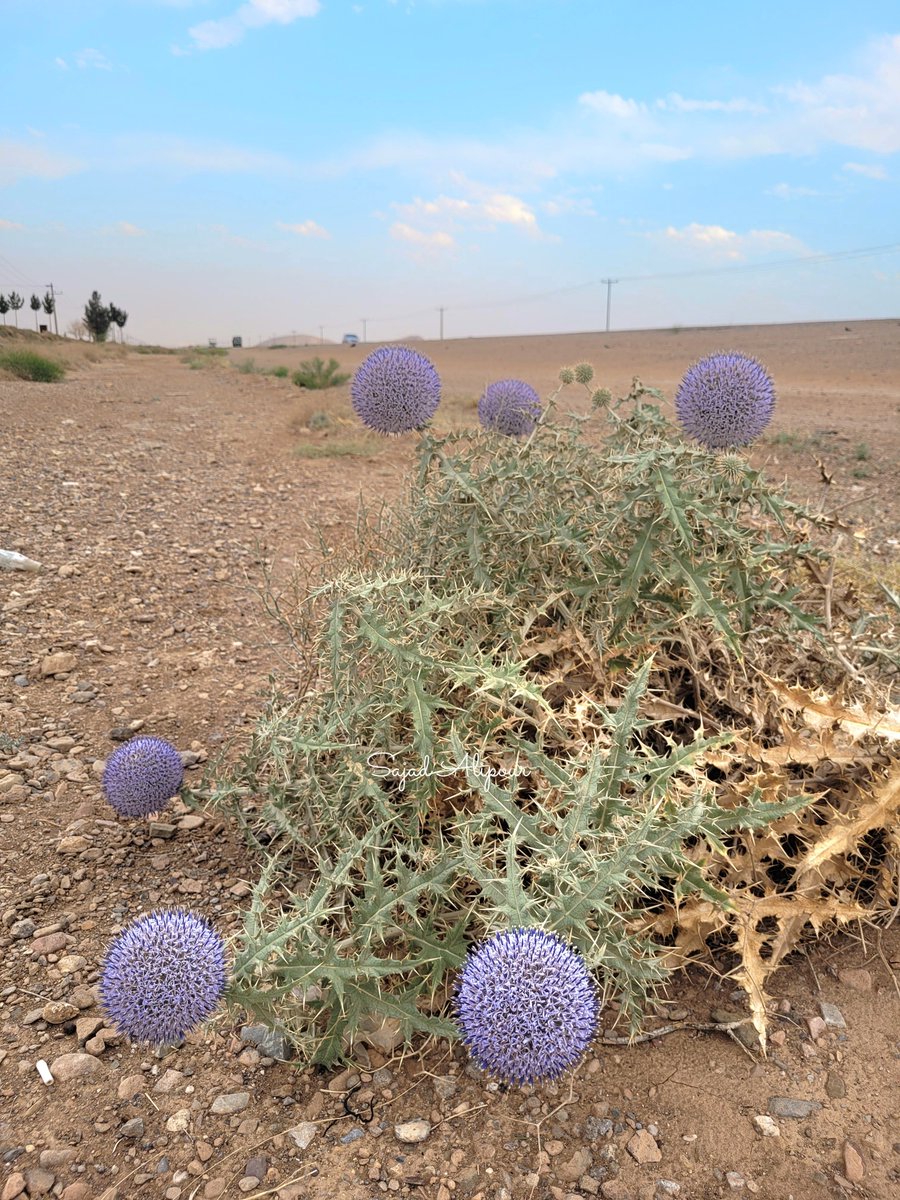
Echinops cephalotes
Asteraceae
Iran Esfahan Shahreza
June 2026
Elevation 1700m
Iran is a major center of diversity for the genus Echinops, with 72 species recorded in the Flora of Iran, including 57 endemic species.
#Echinops#Asteraceae#wildflowers#botany
For biologists using Claude Science, here is Motif, an AI-native molecular biology workbench plugin. Now, you don't need to leave Claude Science to view and operate on your sequences.
Motif gives the full power of Claude to your upstream mol bio workflows, such as asking Claude to: 1) fetch the genes in a target pathway and annotate them, 2) perform and view multiple sequence alignments using your preferred alignment tool, 3) design and label CRISPR-Cas guide sequences, and much more.
Motif was built as part of the "Built with Claude: Life Sciences" hackathon, and is an MIT-licensed, open source plugin.
Also, Claude made this demo video using HeyGen's Hyperframes and Elevenlabs TTS.
The greatness of any idea—grant, project, or paper—is capped by the imagination, expertise, and biases of the panel evaluating it. So don’t destroy yourself when it is rejected. And don’t become too arrogant when it succeeds. 🧵 (Too much coffee, forgive the GIFfiness..)
There seems to be this implicit assumption that biologists don't really make foundational discoveries anymore. We've plucked all the low-hanging fruits from the proverbial tree, so to speak.
This is probably true in a quantitative sense. I'm sure that truly foundational discoveries are, in fact, getting harder to make. Many discoveries today are 'variations on a theme,' or fill in some exception to the rule. We are probably not going to discover something today as important as the structure of DNA, or how genes are expressed, and so on.
But as our tools get better, and as they resolve more and more details across space and time, it's clear that many fundamental things about how cells work remain unsolved. There are many examples of this just from the past few months!
In April, for example, researchers found that astrocytes (a type of glial cell in the brain) form their own networks that stretch across the brain and even run through the corpus callosum. The researchers discovered this after engineering mice to fuse a biotinylating enzyme to the connexin proteins that build astrocyte gap junctions. Any time a molecule crossed between two astrocytes, this enzyme tagged it with biotin, thus 'staining' the cell. The researchers then killed the mice, stained their brains, and found these large astrocyte networks across the entire brain.
In May, researchers found that human cells pass DNA to each other through nanotubes, and that this DNA persists in the recipient cell, integrates, and switches on genes there. These researchers labeled two populations of cells with different colors of fluorescent proteins and then watched them under a microscope; nothing fancy.
It's curious that a new tool enabled the first of these discoveries. The researchers had to genetically engineer mice so that astrocyte junctions in their brains would make these signals. No new technology was required for the second paper, though. It was just people who questioned dogma, and who were sufficiently careful and patient with their experiments.
I don't know what to make of this. But I feel like you should never finish a textbook in biology and think you understand it all. There are layers and layers and layers, and it goes deeper and deeper, and we are still figuring out important things all the time.
People often ask me what they should work on. They are in medical school, or work as a software engineer, and they want to know what they ought to do in biology.
This is an impossible question for me to answer! I don't know you; I'm not in anybody's head except my own. So I can throw out a bunch of ideas that I find interesting, but most of them won't be interesting to you.
The best advice I can give is just to write. I don't mean writing a blog, or writing for others, but writing purely to think through ideas.
Set yourself a challenge: Say "I will explore one idea per week — something that I think is interesting — and write a short piece about it." Then set aside 1-2 hours per day to explore that idea and write down what you find. Limit your energy on that idea to just one week; no more.
I typically start by writing down a list of questions that I have about the idea. If I was keen to explore, say, bottlenecks in AI for antibody design, then I would start by writing out: "What is an antibody? How do people make them today? Who is using AI to design new antibodies?" Etc. Usually I write down 20-30 questions like this.
Then, I spend time researching each question, one at a time. I answer them, write down my responses, and merge everything together into a single article at the very end.
The benefit of this daily ritual is that you'll figure out (very fast) whether the idea holds your interest, and whether you want to dig deeper after the one-week "trial."
I'd also recommend, while writing, that you reach out to people working on the idea. Send them a focused question, ask to meet, and use writing as a "forcing function" to meet other people. I try to email one new person every day.
At the end of the one week, you don't need to publish the article. Most ideas will not feel that exciting to you, and so you can just quietly scrap them. (About 90% of ideas I explore are never published.) But for ideas that hold your attention, consider sending the article to people via email. Say, "Hey, I wrote about this idea. I'm interested in it, and wanted you to read it." Every job I've had in my life has been downstream of writing about an idea and sending it to other people.
(I had a mentor at MIT who did a similar thing. Every Saturday, he wrote down three ideas and sent them to influential people. After a few months, he received donations from philanthropists to help grow his new lab.)
If you write a little bit every day, you'll quickly find an idea that holds your interest. You will also have used writing as a starting point to talk to people who are working on that idea. How much further is it to now fundraise for the idea? To start a company around it? You've already done a lot of the early work, and are well on your way to figuring out what you ought to be doing.
Richard Murray, a professor at Caltech, made this beautiful chart showing how the complexity of gene circuits (as measured by their number of "parts," or components) has scaled over time. (I'm sharing it below with permission.)
We can learn many things from this chart.
First, academic laboratories have been able to make some *really* complicated gene circuits. My friend, Jai Padmakumar, made the largest gene-circuit ever reported; it was described in a 2024 paper. Jai assembled 1.1 million bases of synthetic DNA into 110 distinct logic gates, and then partitioned that DNA across 66 strains of E. coli. Together, these engineered cells could compute the MD5 hashing algorithm.
The problem is that the larger you make your gene circuit, the less "robust" or reliable the engineered cell becomes. Living organisms did not evolve to carry human-made gene circuits! Therefore, many synthetic biology efforts fail to scale into the real-world. The more complex a gene circuit, or the more genes it has, the less likely that it will be robust over time. More genes have more opportunities to break.
(Note that this is not always the case in natural organisms. Many cells have evolved overlapping ways to regulate genes, such that if one breaks, others can fill in the gap. We're not good at emulating this synthetically, though.)
The chart below shows this trend via the red, dotted line. Engineered cells that have been *commercialized* tend to have only a small number of engineered components; usually less than 10 synthetic genes in total. There is a drop-off in number of components as we move from the laboratory to the real-world.
How can synthetic biologists solve this, and begin to build large gene circuits that are robust over time?
Perhaps we should make it standard to grow engineered cells in a small bioreactor, perturb them with various stressors, and see how well the engineered cells hold up over time. We could record the number of generations that pass before a cell's functions break, and then report that value in the paper. (This is sometimes done, but not often.)
Another option is to "merge" human-made designs, or AI-generated DNA, with continuous evolution.
If we wanted to engineer a cell to break down plastic and recycle the atoms into a medicine, for example, then we could first build dozens of different gene circuit architectures (using high-throughput DNA assembly methods), put each gene circuit into a cell, and then do continuous evolution on each of them to see which one holds up best over time, with various stressors. We could sequence the populations over time, see which sequences hold up well, and use the data to train predictive models of "cellular robustness."
"No matter how isolated you are and how lonely you feel, if you do your work truly and conscientiously, unknown allies will come and seek you."
- Carl Jung
It’s a mystery that stumped Darwin and many researchers since: what exactly drives the snap shut of a Venus flytrap?
Now, researchers in Science have the answer: a rapid, one-second softening of the cell walls on the outer epidermis of the trap.
📄: https://t.co/mw3V6mzgcW
#SciencePerspective: https://t.co/Q7rWJljY6o
This is how I have always felt about science. I always knew I was never a top tier researcher or educator. But I seek the sense of wonder science has *always* gifted me. Always.
If writing feels hard, try doing nothing. No phone, no music, no laundry—nothing. Sit in front of a blank page doing absolutely nothing for long enough, and filling it will feel easy.