Associate Professor of Medicine & Cell Biology, Washington University in St Louis. We study the cell cytoskeleton, centrosomes, cilia, kidney and lung diseases.
Our latest study is now published @JCI_insight and OMG WE GOT THE COVER! 😱😱😱
Congrats to my amazing postdoc @ChengTao_PKD for this herculean effort (~5 yrs), and to @LangnerEP for the beautiful image that made the cover 😍
Lemme tell you about our study real quick👇
In a new article, our Vice President of Research Programs, Dr. Chris Chen, Ph.D., explores the growing pipeline of potential ADPKD therapies and why there is reason to be hopeful about the future of treatment.
Read more ⬇️
https://t.co/AY46N3ajBB
Dear Canada, I felt compelled to make something. To stick up for, and to honour. To show our strength, beauty, genius, empathy, light & heart. It's made with deep gratitude for the people and places of this beautiful land. Vive le Canada 🇨🇦❤️✌️💪 https://t.co/UNXJ0UusP1
So grateful for this funding from KidneyCure 🙏
For those of us who got good, fundable scores at NIDDK but didn’t get funded (because of the various shenanigans 🙄), this is a lifeline to keep these projects alive.
Congratulations to the 2026 KidneyCure Grant Recipients! 34 new investigators join 22 continuing grantees in a cohort of 56 researchers. More than $4 million in research funding supports their work advancing kidney research and improving patient care. Meet the recipients: https://t.co/0o3j9I7q3q
This is really cool (and wild):
Scientists simulated a complete living cell for the first time. Every molecule, every reaction, from DNA replication to cell division.
The paper (Luthey-Schulten et al., Cell 2026, https://t.co/PXxXWKC8yp), just out today, used JCVI-Syn3A — a synthetic minimal bacterium with fewer than 500 genes. A 3D+time simulation of the full 105-minute cell cycle: DNA replication, protein translation, metabolism, division. Every gene, protein, RNA, and chemical reaction tracked through physical space.
It took years to build. Multiple GPUs. Six days of compute time per run.
And this is the simplest possible cell.
A human cell has ~20,000 genes. It lives in tissue. It interacts with neighbors. It differentiates. It responds to drugs in ways that depend on context we haven't fully measured.
Mechanistic simulation of the minimal cell costs 6 GPU-days for 105 minutes of biology. You cannot scale that to human cells. The complexity isn't 40x harder. It's exponentially harder.
This is why the field pivoted to data-driven models. You can't hand-encode the regulatory wiring of a human hepatocyte. But you can learn it — if you have the right perturbation data collected across enough diverse biological contexts.
The two approaches aren't competing. Papers like this generate the ground truth that future ML models need for validation. But the path to a clinically useful virtual cell runs through foundation models, not through scaling up mechanistic simulation.
Amazing work!
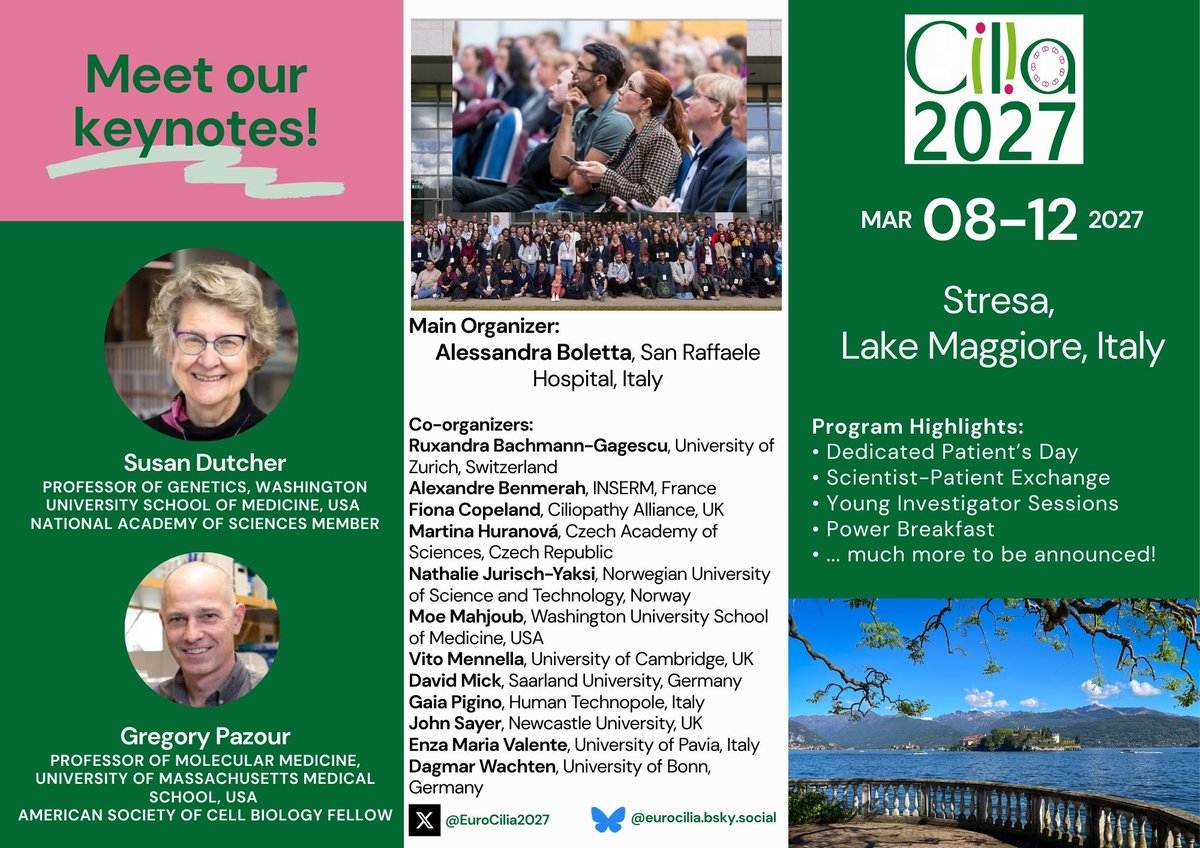
𝗠𝗲𝗲𝘁 𝗼𝘂𝗿 𝗸𝗲𝘆𝗻𝗼𝘁𝗲 𝘀𝗽𝗲𝗮𝗸𝗲𝗿𝘀 𝗳𝗼𝗿 #𝗖𝗶𝗹𝗶𝗮𝟮𝟬𝟮𝟳!
We are grateful for their participation and look forward to welcoming the cilia community on 8-12, March 2027.
Wishing you all a happy and inspiring 2026.
#Cilia#Milan
Proud moment for WashU Nephrology! Dr. Moe Mahjoub @MahjoubLab, with Drs. Susan Dutcher and Steven Brody, are advancing lung disease research with two #NIH R01 awards, one renewal and one newly funded project! #LungResearch#NIH#WashU See More:
https://t.co/q1Wd5uibKA
Flashback #FluorescenceFriday to some of the first light-sheet imaging we were doing. Video shows the collecting duct system of the developing kidney labeled with a pan-cytokeratin antibody. Courtesy of former talented technician Deanna Hardesty.
🔊New preprint from our lab!
Zygotene cilia regulates meiosis, germ cell development, and fertility in zebrafish, mice, and humans
https://t.co/qg1v5Mjku5