I help operators keep important work moving without becoming the follow-up system.
30+ years in engineering, operations & business.
Building GigStacks.
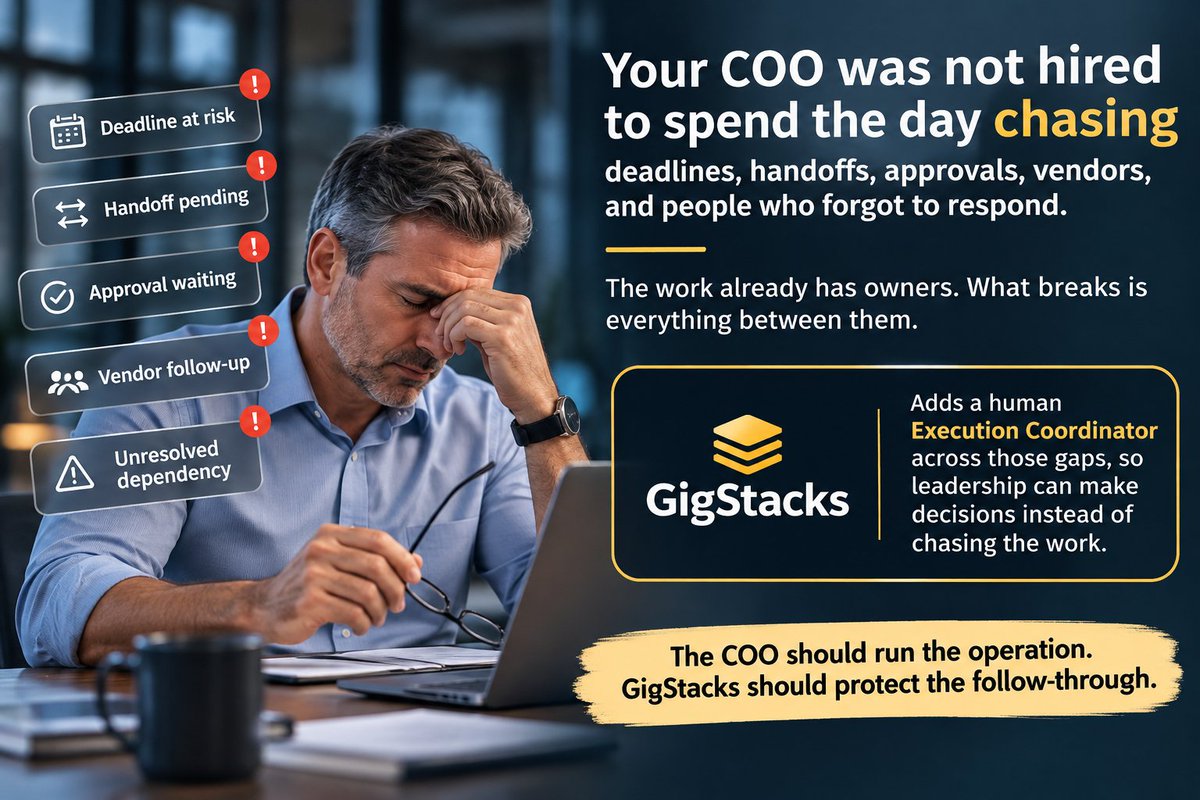
𝐘𝐨𝐮𝐫 𝐂𝐎𝐎 𝐰𝐚𝐬 𝐧𝐨𝐭 𝐡𝐢𝐫𝐞𝐝 𝐭𝐨 𝐬𝐩𝐞𝐧𝐝 𝐭𝐡𝐞 𝐝𝐚𝐲 𝐜𝐡𝐚𝐬𝐢𝐧𝐠 𝐝𝐞𝐚𝐝𝐥𝐢𝐧𝐞𝐬, 𝐡𝐚𝐧𝐝𝐨𝐟𝐟𝐬, 𝐚𝐩𝐩𝐫𝐨𝐯𝐚𝐥𝐬, 𝐯𝐞𝐧𝐝𝐨𝐫𝐬, 𝐚𝐧𝐝 𝐩𝐞𝐨𝐩𝐥𝐞 𝐰𝐡𝐨 𝐟𝐨𝐫𝐠𝐨𝐭 𝐭𝐨 𝐫𝐞𝐬𝐩𝐨𝐧𝐝. But in a lot of companies, that is exactly what happens.
The work already has owners.
What breaks is everything between them:
• the deadline nobody re-confirmed,
• the handoff that went quiet,
• the approval sitting in someone’s inbox,
• the dependency nobody escalated,
• the vendor everyone assumed somebody else was following.
Then the COO becomes the company’s human reminder system.
That is the wrong use of executive capacity.
GigStacks adds a human Execution Coordinator across those gaps, so leadership can make decisions instead of chasing the work required to carry them out.
The #COO should run the operation.
#GigStacks should protect the follow-through.
#leadership #management #office #news
Great list. I'm an engineer and founder building GigStacks and CommitOS, and GTM has become one of my biggest challenges. We have the technology and execution model built; now the priority is reaching the right CEOs and COOs and converting that into paying customers.
I'd love to connect with everyone on this list, learn from what you're building, and explore opportunities to collaborate. Especially interested in people who can help turn a new category into a repeatable sales process.
I often get asked who to follow to learn GTM Engineering.
My answer: Follow people who SHOW the work, not just talk about it.
Here are 12 accounts I'd recommend:
@ENowoslawski : GTM insights, practical tactics, and industry updates.
@MitchellKeller_ : Technical GTM breakdowns and cold email infrastructure.
@Kellen_the_man : Signal-based outbound, targeting, and messaging insights.
@coldemailchris : Real campaign breakdowns and practical GTM Engineering resources.
@shawntenam : Building GTM as code in public and sharing useful resources.
@gtm_engineer : Clay workflows, MCP, and modern GTM systems.
@itsalexvacca : Practical GTM playbooks and creative ways to generate pipeline.
@MichLieben : AI agents, automation, and autonomous GTM workflows.
@retttx : GTM Engineering, Clay, and AI-powered workflows.
@tim_yakubson : Clay workflows and practical GTM knowledge.
@shaw_gtm : Offer positioning, outbound experiments, and messaging that converts.
@bretonwill : Cold email at scale, infrastructure, and deliverability.
Don't just follow them.
Study what they build, test what they share, and learn by doing.
Who else deserves to be on this list? Drop their handle below.
My goal on 𝕏 is to build 10,000 real connections, not just followers.
I'd love to connect with:
1. Founders, CEOs & COOs
2. Engineers & product builders
3. AI & software innovators
4. Manufacturing & industrial leaders
5. Sales, GTM & growth experts
6. Investors & business owners
7. People who believe in helping others succeed
30+ years building things. Still learning, still creating, and always happy to help.
If that's you, say hi. Let's build something valuable together.
Exactly. That's a core principle behind FXOS: preserve what was known, what was authorized, and what actually happened without allowing later evidence to rewrite the original record.
But cryptographic integrity alone doesn't prove the underlying evidence was truthful.
That's the harder problem we're addressing: how do we establish trust in the evidence before sealing it, not just prove that nobody changed it afterward?
An immutable record of a false claim is still a false claim.
This is precisely the cross-organizational challenge we're addressing with FXOS.
Two valid authorizations don't automatically make a shared execution legitimate. Each organization retains control of its policies, but the interaction needs a mutually accepted set of constraints, independently verifiable evidence, and a defined escalation path when those constraints conflict.
Our objective is to make that trust verifiable without requiring either party to surrender control.
The harder question is: what happens when both organizations are compliant individually, but no mutually acceptable policy exists? Should execution stop by default, and who is authorized to override that decision?
Exactly. That's the problem we're building FXOS to address. AI can recommend which therapies deserve attention, but years later, can we independently prove why one was prioritized over another?
The model version, evidence, decision criteria, authorization, and outcome all need to be traceable and tamper-evident.
But here's an even harder question: what happens when a decision was fully justified by the evidence available at the time, but new evidence later proves it was wrong?
Can we preserve accountability without rewriting history?
Exactly. And that's where FXOS needs to go beyond proving individual events.
A chain of valid actions doesn't necessarily produce a legitimate outcome. We need evidence that the entire execution path respected defined constraints, dependencies, and decision boundaries.
But here's the harder question: who defines those legitimacy rules, and how do we prove they remain valid when autonomous agents encounter situations nobody anticipated?
That's where I believe the next major challenge in AI accountability lies.
What happens when AI discovers 10,000 potential treatments, but humanity can only validate 100?
Who decides which 100 move forward? Based on what evidence?
And years later, can we prove why those decisions were made, what data was trusted, and who authorized them?
That's the challenge we're addressing with ForgetfulX and FXOS: independently verifiable evidence of critical decisions and actions.
AI may accelerate discovery. But who will prove that the decisions shaping our future were justified?
Agreed. Medicine has never required perfect understanding, only sufficient evidence that the benefits outweigh the risks.
But here's a harder question: what happens when AI begins discovering treatments faster than humans can clinically validate them?
If an AI identifies 10,000 potentially life-saving therapies, but we can only test 100, how do we decide which 9,900 patients may never get the chance?
Could the bottleneck in medicine shift from discovering cures to deciding which cures humanity can afford to validate?
Exactly. That's the architecture we're pursuing with ForgetfulX and FXOS.
But here's the question that keeps me thinking: if Agent A provides valid evidence, Agent B verifies it, and Agent C makes a harmful decision based on both, who is accountable?
And what happens when every certificate is cryptographically valid, but the collective outcome is wrong?
Can we build a system that proves not just that every action was authorized, but that the entire chain of decisions was legitimate?
Then here's an even harder question: what if AI discovers therapies that work, but we can never fully explain why?
Could we eventually reach a point where withholding an AI-designed treatment is riskier than deploying one we don't completely understand?
And who gets to decide when the evidence is sufficient—the scientists, regulators, physicians, or the AI that understands the biology better than any of them?
That may become one of medicine's most difficult decisions.
Exactly. That's the problem we're tackling with ForgetfulX and FXOS.
But here's the harder question: when thousands of autonomous agents interact across different companies, who can independently prove that every action was authorized, that its inputs were trustworthy, and that its outcome was valid?
And if an agent makes a critical decision based on another agent's compromised output, where does accountability begin?
That's the level of evidence infrastructure I believe AI will eventually require.
Here's what fascinates me: what happens when AI can predict biological outcomes faster than science can validate them?
Could we eventually simulate an entire human cell accurately enough to test treatments before clinical trials? And if AI designs a therapy no human fully understands, how do we prove it's safe across billions of cells, years of biological changes, and millions of genetic variations?
Are we approaching the point where understanding biology becomes easier than safely controlling it?
Exactly. That's the thinking behind ForgetfulX and FXOS. Traditional logs can tell you what a system says happened. We're focused on preserving independent, verifiable evidence of what was authorized, executed, and validated at the time.
As AI agents take on more responsibility, that distinction becomes critical. Trust shouldn't depend on a vendor's version of events. It should be something you can prove.
Now this is the kind of AI progress that really excites me. Moving from analyzing entire tissues to understanding what happens at the individual cell level could change medicine dramatically. As an engineer, I find it fascinating that we're getting closer to understanding biology as a system we can actually model and predict. What do you think is the biggest obstacle to turning this into real treatments?
I agree. The immediate risks are already showing up in businesses: workforce disruption, unreliable information, and growing dependence on AI decisions people can't always explain or verify.
As an engineer building AI systems, I think accountability is the missing piece. When AI takes an action, can we prove who authorized it, what information it relied on, and whether the result was verified?
That's one of the problems we're addressing with ForgetfulX and FXOS. The more autonomy we give AI, the more important that evidence becomes.