In what may be one of Earth’s craziest forms of mimicry, researchers in 2023 reported a species of rove beetle that grows a termite puppet on its back to fool real termites into feeding it.
Learn more on #NationalWildlifeDay: https://t.co/4rAtAEspiF
These blood-sucking arachnids can’t leap, but it turns out they can fly.
Their secret? Static electricity.
Learn more: https://t.co/gw21qCykmz #ScienceMagArchives
At any point on a curve, there's one circle that fits the curve better than any other. It touches the curve at that point, leans in the same direction, and bends by the same amount.
It tells you how sharply the curve is bending at that exact spot, and which way it's leaning. If the curve is bending sharply, the circle is small. If the curve is nearly straight, the circle is huge.
The osculating circle of the curve.
Every number is a crowd of dots hiding its factors.
The dots regroup into equal clusters, revealing each multiplication without writing a division sign. Composite numbers split apart. Primes refuse.
What if chemistry's table is a Klein bottle: no inside, no outside?
This UVS model arranges all elements on a non-orientable surface via cyclonic/anti-cyclonic cycles and Möbius twists, matching s/p/d/f blocks by atomic number.
It hints at topological origins of periodicity, useful for predicting superheavy elements in materials design and quantum simulations.
Topology unifies the language of matter.
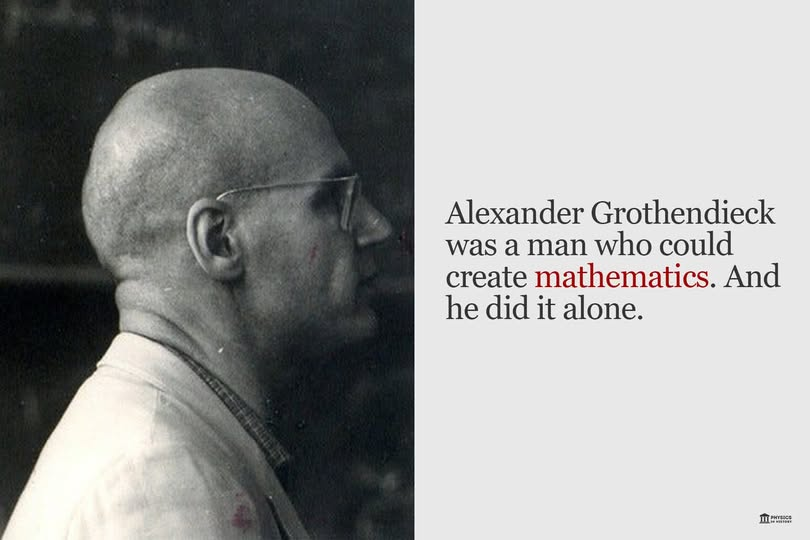
Alexandre Grothendieck was very different from Weil in the way he approached mathematics: Grothendieck was not just a mathematician who could understand the discipline and prove important results—he was a man who could create mathematics. And he did it alone.
-- Amir D. Aczel
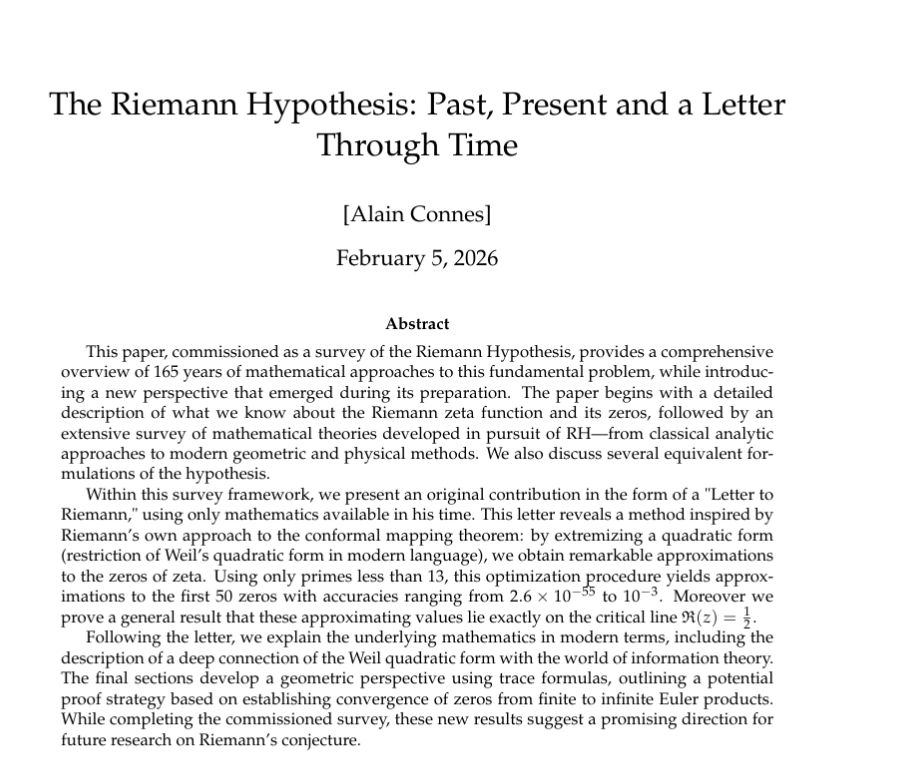
Because of the current progress in AI, many people are starting to think that the Riemann hypothesis could be solved ''soon''!
In the meantime, I suggest you to read this fantastic presentation (40 pages) by the legend Alain Connes, titled 'The Riemann Hypothesis: Past, Present and a Letter Through Time', a (technical) history of the Riemann hypothesis (and more).
🔗👇
Like most insects, the wings of tobacco hawk moths are covered in tiny hairs. These microscopic strands help insects taste and stay stable in flight.
But the tobacco hawk moth’s wing hairs do something researchers haven’t documented in any other insect: they help the animal smell.
Learn more: https://t.co/8ClJm0Me4h
J'ANNONCE que je suis en train de préparer une vidéo dédiée à la réparation électronique, une sorte de guide pratique ultime pour réparer des appareils, en particulier pour ceux qui ne sont pas très calés en électronique.
Elle sera publiée dans le courant du mois prochain 🧐
A new analysis in Science of more than 116,000 bird songs has revealed that the astonishing variety of passerine birdsong is built from just eight basic acoustic motifs, like trills, whistles, and harmonic notes.
The findings also reveal that local environments greatly shape how birds communicate around the world. Learn more: https://t.co/3oaQ0sKQfJ
New Disney characters unlocked
Wildlife photographer Nimish Peter captured a horned viper staying perfectly still as a tiny insect landed on one of its signature horns in the desert
As humans, we don't naturally have strong intuition around electromagnetism so @chris_m_bryant built a minigame into his blog post on Smith charts to help it click. Give it a try here: https://t.co/MdfXeh20Ow.
What should we demystify next? Let us know in the comments below ⬇️
Noether’s Theorem - This equation reveals that every continuous symmetry in nature, a change you can make to a system without affecting its physical laws, brings about a conservation law. In simple terms, if the universe does not react to a certain change in perspective, it must keep a related physical quantity constant. For example, since the laws of physics remain unchanged no matter when you are (Time Symmetry), energy is conserved. Since the laws are the same regardless of where you are (Space Symmetry), momentum is conserved. Because they stay the same regardless of which way you face (Rotation Symmetry), angular momentum is conserved. This insight shifted our view of the universe. We no longer see conservation as just a series of lucky observations, but as a necessary outcome of the symmetry of space and time...
Bronstein Cube ✍️
Physics has a significant and embarrassing problem at its core. The two most successful theories ever created by humans are fundamentally incompatible. Quantum mechanics explains how matter and energy behave at tiny scales, governing atoms, electrons, and subatomic particles with remarkable precision. General relativity describes the behavior of space, time, and gravity at the largest scales, governing planets, stars, black holes, and the universe itself with equal accuracy. Each theory has been tested thoroughly by countless experiments. However, when you try to apply both to the same situation, the mathematics completely breaks down and produces errors. The Bronstein Cube is a diagram that maps out the entire landscape of physical theories. It shows how they all relate to each other and indicates where our understanding stops.
The cube is organized around three fundamental constants of nature, each marking a boundary where ordinary intuition fails and new physics becomes necessary. The first is the reduced Planck constant, a small number that sets the scale for quantum effects. When physical processes are small enough for this constant to matter, classical physics fails, and quantum mechanics takes over. The second constant is the speed of light, which not only represents how fast light travels but is also a key feature of the universe, the ultimate speed limit, and the factor that links space and time. As speeds approach this limit, Newtonian physics falters, and relativistic effects become important. The third constant is Newton's gravitational constant, which determines the strength of gravity. When masses are large and close together, gravity controls everything and must be considered. Each theory in the cube is identified by which of these three constants it considers and which it ignores.
This creates eight possible combinations, one for each corner of a cube. Classical mechanics ignores all three constants and works perfectly for large, slow objects at human scales. Adding just the speed of light gives special relativity, explaining how space and time transform at high speeds. Adding only the gravitational constant results in Newtonian gravity, which accounts for planetary orbits and falling objects. Adding solely the Planck constant leads to quantum mechanics, governing atoms and subatomic particles with their unusual wave-particle duality and uncertainty. Combining the gravitational constant with the speed of light yields general relativity, Einstein's masterpiece that shows gravity as the curvature of spacetime, predicting black holes and gravitational waves. Combining the Planck constant with the speed of light produces quantum field theory, the framework that supports the standard model of particle physics, describing all known particles and forces except gravity with remarkable accuracy. Combining the Planck constant with the gravitational constant gives a partial theory describing quantum objects in gravitational fields at non-relativistic speeds.
The eighth corner, which combines all three constants, is quantum gravity. This theory does not yet exist in complete form, and its absence represents the most significant unsolved problem in science. It would be essential to understand what occurs inside black holes, where general relativity predicts that matter density becomes infinite and breaks down completely. It is also necessary for understanding the very first moment of the Big Bang when the entire universe was compressed into a region smaller than an atom, where both quantum effects and extreme gravity were critical. At these scales, the very fabric of spacetime is expected to become turbulent and foamy, with quantum fluctuations making the geometry of space uncertain, and we currently have no theory to describe this.
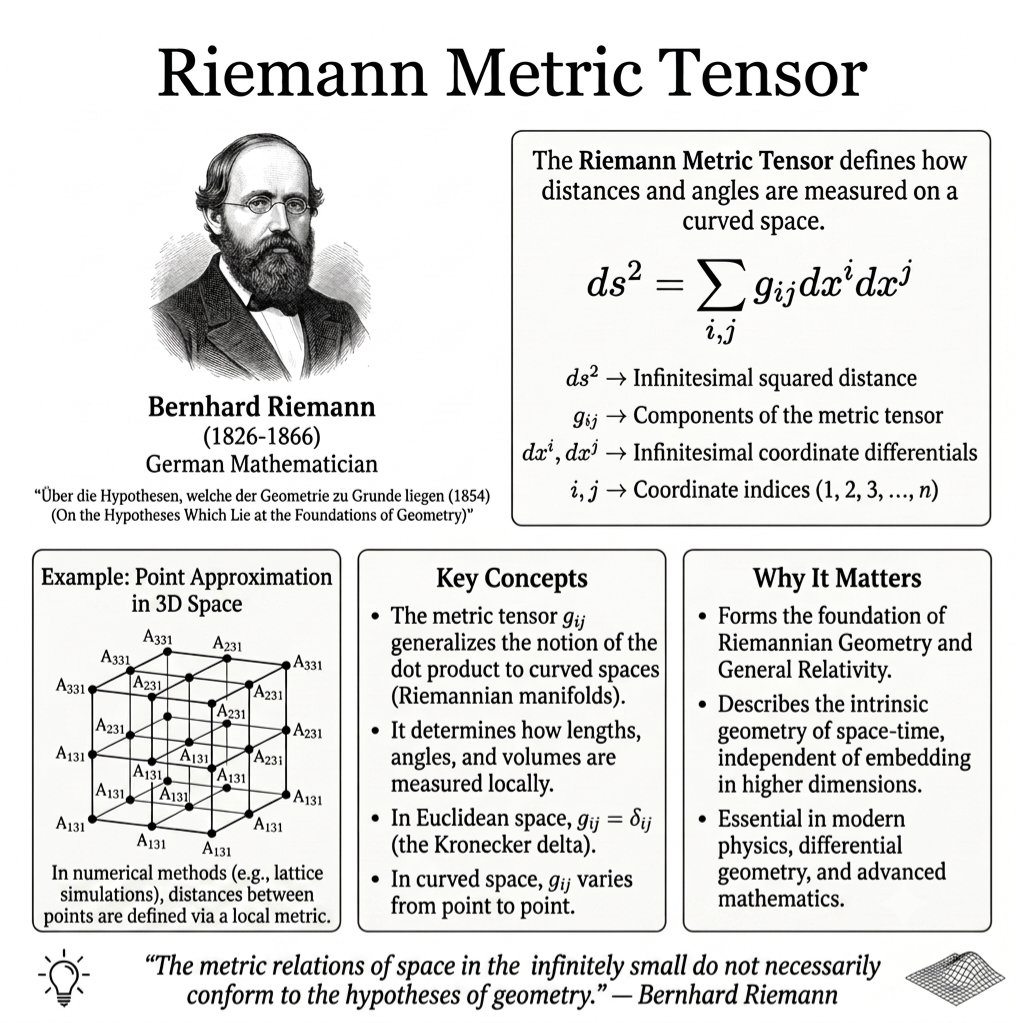
The geometry of space is not fixed. It depends on the metric.
The Riemann metric tensor defines how distances and angles are measured on curved spaces. At every point, the metric determines the local geometry through the relation
ds² = ∑ᵢⱼ gᵢⱼ dxⁱ dxʲ
where gᵢⱼ describes the metric, dxⁱ and dxʲ are infinitesimal coordinate changes, and ds² is the infinitesimal squared distance.
This simple expression became one of the mathematical foundations of Riemannian geometry and Einstein's General Relativity, showing that gravity is a consequence of the curvature of spacetime.
One of my all time favorites! This #infographic helps you to visualize geologic time. Earth came into being at the shoulder, single cell organisms started at the forearm, humans only rocked up at the tip of the finger nail. Source: https://t.co/zo0IzlYoVk