A DeFi carry trade can go from a 4% gross spread to a 2% loss even when the strategy’s yield stays the same. All it takes is a jump in borrowing costs.
@kamino’s $85M+ in fixed-rate loan originations points to growing demand for a way to lock in those costs.
Two models are emerging to meet that demand. @iris_credit uses solvers to turn existing lending liquidity into fixed-rate loans. @avon_xyz uses an order book to match borrowers and lenders directly.
—
● Why DeFi Needs Fixed-Rate Borrowing
Most DeFi lending markets, including @aave use variable rates tied to how much of the available liquidity is borrowed. As utilization rises, so does the cost of borrowing. That makes longer-duration strategies harder to price upfront.
Take a carry trade earning 9%. At a 5% borrowing rate, the gross spread is +4 percentage points. If the borrowing rate rises to 11%, the spread falls to −2 percentage points.
A fixed-rate loan locks the financing cost for a defined term. The strategy’s yield can still move, but the borrower knows what the debt will cost.
The question is how to deliver that fixed rate. IRIS and Avon differ in where they source capital, how they discover rates, and who takes the interest-rate risk.
—
● @iris_credit + @sparkfinance (Fixed Rates Through Solvers)
@iris_credit adds fixed-rate borrowing to @sparkfinance by sourcing capital from SparkLend’s existing pools.
1. The borrower sets the terms
A borrower puts up $ETH as collateral and requests 100,000 $USDC for 180 days at a maximum fixed APY of 7%.
2. Solvers compete to fill the loan
Through a request for quote (RFQ), Solver A offers 6.2%, Solver B offers 6.5%, and Solver C offers 6.8%. Each quote is backed by a bond, and the borrower can accept any offer within the 7% cap.
3. The loan settles on SparkLend
The borrower receives the USDC in a single transaction and pays the agreed fixed rate. The solver pays SparkLend’s floating rate and takes the difference.
At a 7% fixed rate, the solver earns a 2-percentage-point spread when SparkLend charges 5%. If the floating rate rises to 12%, the solver faces a 5-percentage-point loss, with its bond backing settlement.
This gives IRIS access to SparkLend’s existing liquidity, with $4.7B in TVL and loan terms ranging from one day to two years.
—
● @avon_xyz + @aave (Fixed Rates Through an Order Book )
@avon_xyz uses an onchain central limit order book (CLOB). Borrowers submit the amount they need and the maximum rate they’ll pay. Lenders specify how much capital they’ll offer and the minimum rate they’ll accept. The order book matches compatible orders, and rates emerge from that competition.
Each market can set its own interest-rate curve, loan-to-value limits, liquidation rules and other risk parameters. An aggregated order book lets borrowers access the best available terms across markets while each market maintains its own risk settings.
@aave acquired Avon’s technology and team to bring order-book-based credit into its ecosystem. Combined with Aave V4’s hub-and-spoke architecture, it could support specialized markets for tokenized Treasuries, private credit and tokenized equities, each with separate risk parameters.
—
● Who Takes the Risk When Borrowers Lock Their Rate?
In variable-rate markets, borrowers absorb changes in financing costs, while lenders generally have more flexibility to withdraw when liquidity is available.
Fixed-rate credit shifts that exposure. In @iris_credit , solvers absorb the difference between fixed and floating rates. In fixed-term lending markets, lenders commit capital for a defined period and take on duration risk.
For vault curators, APY and collateral quality are only part of the decision. They also have to assess capital efficiency, maturity exposure, secondary-market liquidity, early exit options, and how rates are priced and losses allocated.
Managing duration becomes as important as managing collateral risk.
—
● @kamino Shows Where Demand Is Emerging
@kamino has originated $85M+ in fixed-rate loans on 30-day terms, with $35M+ renewed through Auto Rollover, which renews loans when capital is available.
Its RWA markets show where borrowers are using that financing.
• AUTO : ~$67M in originations at 5.30–6.25%
• OnRe : ~$17.8M at 7–8%
• Huma : ~$1M at 6.25%
The renewals point to demand for financing that extends beyond a single 30-day term. Borrowers are using fixed-rate loans to finance positions backed by tokenized real-world assets and rolling those loans forward when liquidity is available.
—
● The Fixed-Rate Credit Landscape Is Expanding
Beyond IRIS’s solver model and Avon’s order book, several protocols are exploring fixed-rate and fixed-term credit.
• @Morpho’s Midnight has $167M in cited TVL.
• @flexmeow is a fixed-rate credit initiative under @yearnfi.
• @lista_dao’s activity is primarily tied to slisBNB looping.
• @term_labs , @TermMaxFi and @Loopscale offer fixed-term credit markets.
• @LiquityProtocol V2 lets borrowers select their interest rate.
Liquidity remains thin across most markets, limiting how much borrowers can raise and how competitive rates can get.
—
● Why Predictable Financing Matters for Institutions
Institutions, fintechs and RWA issuers need to know what financing will cost over the life of a position so they can price loans and estimate returns.
• Fintechs can lock in borrowing costs when financing consumer loans.
• Tokenized Treasury holders can borrow USDC while keeping their assets.
• Private-credit funds can borrow against yield-generating collateral and estimate the spread they’ll retain after financing costs.
Variable-rate markets gave DeFi deep pools of liquidity. Fixed rates, defined maturities and competitive pricing could make that liquidity usable for businesses and institutions that need to plan around their cost of capital.
The next phase of DeFi lending may be measured by how much credit borrowers can reliably access on terms that fit their businesses.
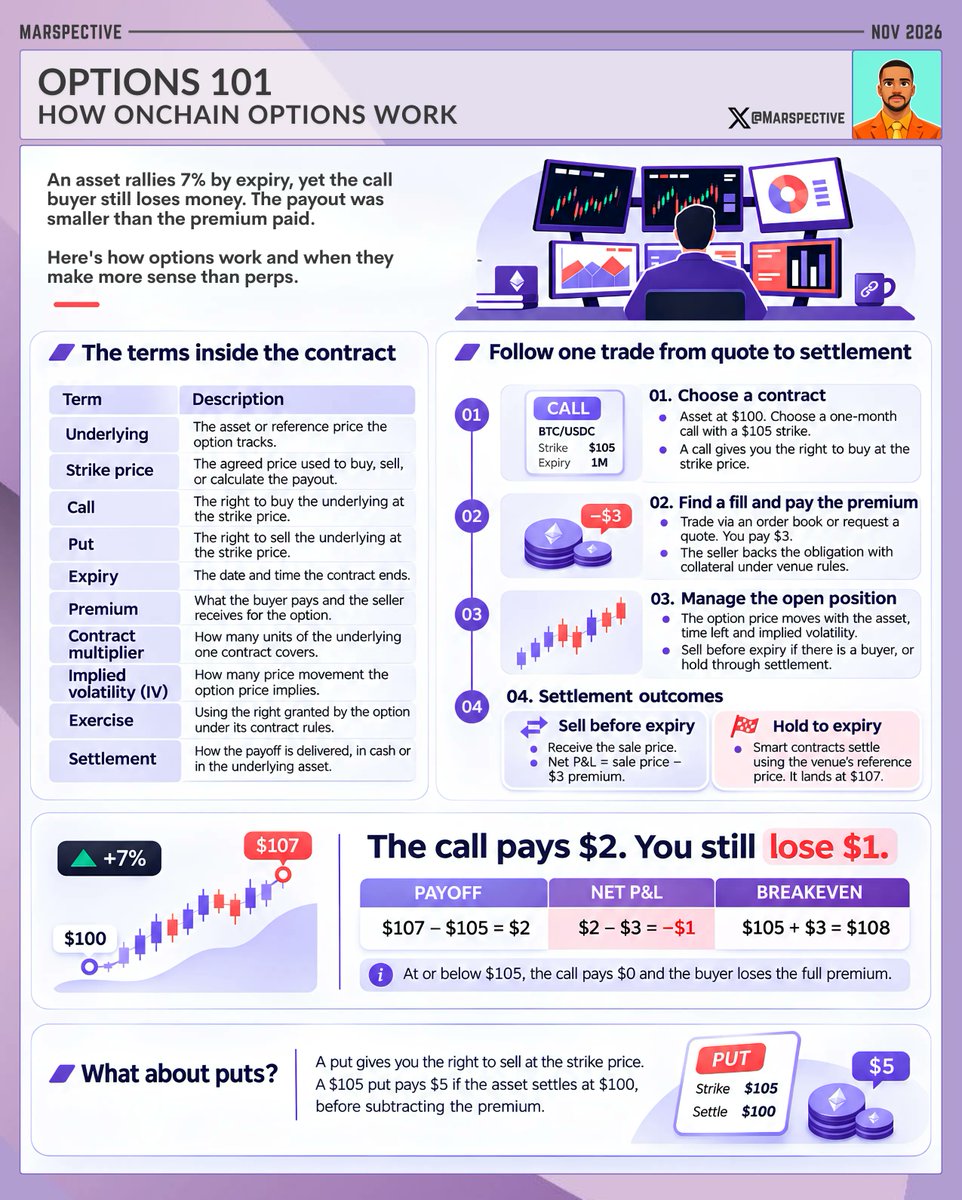
You buy a call expecting the asset to rise. It rallies 7% by expiry, and you still lose money.
Sounds strange, right? The call paid out, but the payout was smaller than what you paid for it.
If you’re new to options, here’s Options 101. I’ll break down what you’re buying, how the trade works from start to finish, and when options make more sense than perps.
—
● Options 101: What are you actually buying?
An option gives you the right to buy or sell an asset at an agreed price. You can use that right if it benefits you or let it expire. The seller gets paid upfront for taking on the other side of that agreement.
Here are the terms you’ll see on an options platform.
• Underlying : The asset or reference price the option tracks.
• Call : The right to buy at the agreed price. A call pays at expiry if the asset settles above that price.
• Put : The right to sell at the agreed price. A put pays at expiry if the asset settles below that price.
• Strike : The agreed price. It determines where the option starts to pay at expiry.
• Expiry : The date and time the contract ends. The contract rules determine when you can use your right, which is called exercising the option.
• Premium : The price you pay for the option. The seller receives it.
• Contract multiplier : How many units one contract covers. A $3 premium per unit costs $300 if the contract covers 100 units.
• Implied volatility (IV) : How much future price movement is priced into the option. All else equal, higher IV generally makes options more expensive.
• Settlement : How the contract delivers what’s owed. Cash settlement pays the difference in a specified currency. Physical settlement involves exchanging the underlying asset at the strike.
The strike tells you when the option starts paying. The premium tells you how much of that payout you need just to get your money back. That’s the difference behind the 7% rally in the opening.
—
● How an onchain options trade works
• Choose the contract
An asset trades at $100 and you think it will rise over the next month. You open the option chain, a list of calls and puts grouped by strike and expiry.
You choose a one-month call with a $105 strike. For this example, it covers one unit.
• Find a price and open the trade
You can trade against an offer on an order book or use a request for quote (RFQ) to ask market makers for a price.
An RFQ can also price several options together, which helps if you want the whole trade filled at once. Some venues also draw liquidity from automated market makers or vaults.
Your trade fills at $3. You pay the premium and the seller backs their obligation with collateral under the venue’s rules. Depending on the platform, matching can happen offchain while smart contracts manage collateral and settle the trade onchain.
• Sell early or hold to expiry
You can sell the call before expiry if there’s a buyer. Its resale price depends on where the asset trades, how much time is left, and implied volatility. Even if the asset rises, the call can lose value if the effect of time passing or falling IV is bigger than the effect of the rally.
• Calculate what you get at expiry
You hold the call and the asset settles at $107.
- Payout : $107 settlement price − $105 strike = $2
- Net result : $2 payout − $3 premium = −$1
- Breakeven : $105 strike + $3 premium = $108 before fees
The call was in the money because the asset settled above $105. But you needed $108 to recover the full premium. If the asset had settled at or below $105, the call would have paid zero.
—
● Why use options when perps already exist?
The call shows how the strike can limit what you earn from a rally. A put shows why choosing a strike can be useful when you already own the asset.
Say you hold the asset at $100 and want protection below $90 for one month. You buy a one-month $90 put. If the asset settles at $75, the put pays $15. That offsets the drop from $90 to $75. You still absorb the first $10 of the decline and the premium you paid for protection.
A short perp can also offset a decline while it’s open. It has no expiry, funding can add to or reduce the cost of holding it, and a leveraged position can be liquidated if margin falls too low.
The put gives you a specific level where protection starts and a date when it ends. That ability to choose the payoff is also what lets traders build spreads or trade a view on volatility.
—
● What makes onchain options harder to trade?
• Liquidity is spread across contracts.
A perp can concentrate trading in one market. Options divide it across calls, puts, strikes and expiries. One contract can trade easily while the one next to it barely has a bid. Asking for a quote can help, but market makers can decline.
• Timing matters.
A rally can come after expiry or fall short of breakeven. If you plan to sell early, time decay and changes in IV affect what someone will pay for your option.
• Margin depends on the account.
A fully paid standalone long option limits the position’s loss to the premium before fees. Under portfolio margin, the venue evaluates the whole account and can liquidate long options as part of that process. Sellers can also face liquidation.
• Settlement follows the contract’s rules.
The venue may use a reference index or average prices over a window. That can give you a different settlement price from the last price you see on the chart.
—
● Why use options when perps already exist?
The call example showed how the strike affects your payout. A put shows how you can use that same feature to protect an asset you already own.
Say you hold an asset at $100 and want protection below $90 for the next month. You buy a one-month $90 put. If the asset settles at $75, the put pays $15. You still take the first $10 of the drop and pay the premium, but the put covers the rest of the decline.
A short perp can also offset a drop while it’s open. It has no expiry, funding can add to or reduce your costs, and the position can be liquidated if your margin falls too low.
The put gives you a hedge with a specific price level, an end date and an upfront cost. Those same choices let traders combine options into spreads or trade a view on how much an asset might move.
—
● What makes onchain options harder to trade?
• The flexibility comes with a trade-off.
A perp can concentrate trading in one market. Options spread it across calls, puts, strikes and expiries. One contract might be easy to trade while the next barely has a bid. You can ask market makers for a quote, but they may decline.
• The trade also depends on how far the asset moves and when.
A rally can come too late or fall short of breakeven. If you want to sell early, the time left and changes in implied volatility affect what someone will pay for your option.
• A fully paid standalone option can lose up to the premium before fees.
Under portfolio margin, the platform looks at the whole account and may liquidate positions, including options you bought. Option sellers can also face liquidation.
• And if you hold to expiry, the payout depends on the platform’s settlement price.
That could be an index price or an average over a set period, so it may differ from the last price on your chart.
—
I am hoping this explains how the projects highlighted in this landscape operate.
Crypto derivatives have scaled around perpetual futures, but onchain options remain one of the market's most underdeveloped segments.
Despite reaching $1.77B in notional open interest, options liquidity and execution remain concentrated across a handful of venues.
As new protocols compete to close this gap, the next phase of growth will depend on how effectively they solve liquidity, execution and capital efficiency.
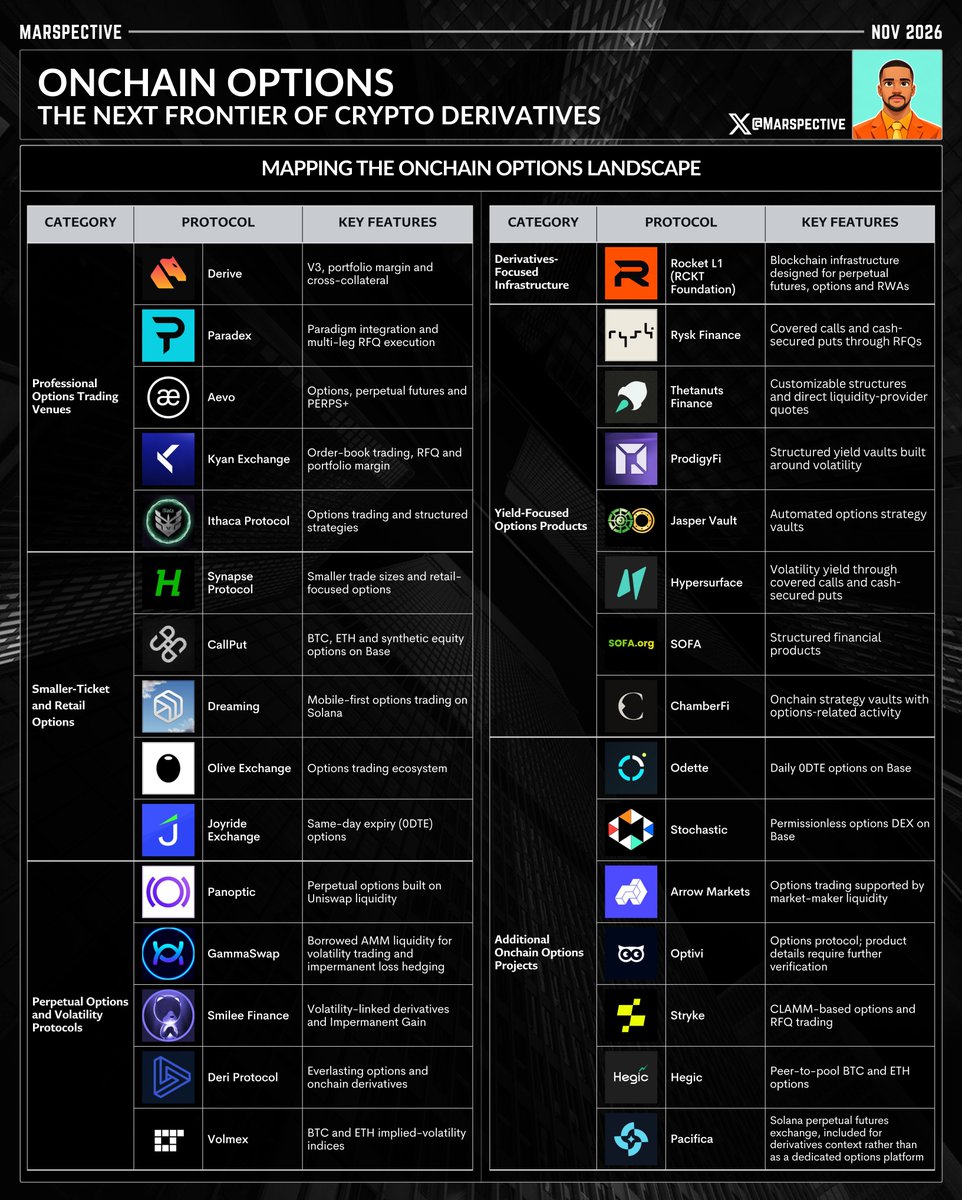
Here's a look at the emerging onchain options landscape.
—
● The Liquidity Gap Between Perpetuals and Options
Perpetual futures have become crypto's dominant derivatives product, while options remain comparatively underdeveloped despite their widespread adoption in traditional finance.
The contrast is significant:
• Traditional finance: Options reportedly trade 3x more contracts than futures.
• Crypto: Perpetual futures reportedly generate 238x more volume than options.
Crypto perpetual futures have recorded $18T in all-time volume, compared with just $75.5B for options.
This gap highlights the potential for options to capture a larger share of derivatives activity. However, unlike perpetuals, options require liquidity across multiple strikes, expiries and contract types.
That fragmentation makes execution and market-making considerably more difficult.
—
● RFQ: Bringing Institutional Liquidity Onchain
One approach to overcoming fragmented options liquidity is Request for Quote (RFQ), which allows traders to source prices directly from professional market makers rather than relying entirely on resting order-book liquidity.
The process:
• A trader requests a quote for a specific options contract.
• Multiple market makers assess the risk and submit competing prices.
• The trader compares available quotes and accepts the preferred execution.
Trader request -> Market makers compete -> Quote accepted -> Trade executed
RFQ is particularly valuable for options because it can aggregate liquidity across market makers without requiring deep order books for every strike and expiry.
Alongside portfolio margin and structured execution, this model is becoming an important component of the emerging onchain options market.
—
● Mapping the Onchain Options Landscape
The ecosystem is developing across several segments, with protocols addressing different aspects of trading, liquidity provision, volatility exposure and structured yield.
● Professional Options Trading Venues
These platforms focus on building the execution infrastructure required for sophisticated options trading.
• @DeriveXYZ: V3, portfolio margin and cross-collateral.
• @paradex: Paradigm integration and multi-leg RFQ execution.
• @aevoxyz: Options and perpetual futures, with PERPS+ linking options strategies to perp positions.
• @KyanExchange: Order-book trading, RFQ and portfolio margin.
• @IthacaProtocol: Options trading and structured strategies.
● Smaller-Ticket and Retail Options
While professional venues prioritize advanced execution, another group of platforms aims to make options accessible to a broader audience through smaller contracts and simplified trading interfaces.
• @SynapseProtocol: Smaller trade sizes and retail-focused options trading.
• @CallPutApp: BTC, ETH and synthetic equity options on Base.
• @dreaming: Mobile-first options trading on Solana.
• @Olive_Exchange: Options trading ecosystem.
• @JoyrideExchange: Same-day expiry options (0DTE).
These products address accessibility, but broader retail adoption will still depend on pricing, liquidity and manageable trading costs.
● Yield-Focused Options Products
Beyond active trading, options can also support structured yield strategies.
These protocols package options exposure into vaults and financial products, allowing users to participate without continuously managing individual positions.
• @ryskfinance: Covered calls and cash-secured puts through RFQs.
• @ThetanutsFi: Customizable options structures and direct liquidity-provider quotes.
• @ProdigyFi: Structured yield vaults built around market volatility.
• @jaspervault: Automated options strategy vaults.
• @hypersurfaceX: Volatility yield through covered calls and cash-secured puts.
• @SOFAorgDAO: Structured financial products.
• @chamberfi: Onchain strategy vaults with options-related activity.
This segment expands the use of options beyond speculation into income generation and automated risk management.
● Perpetual Options and Volatility Protocols
Other protocols are experimenting with alternative derivatives designs that reduce reliance on traditional expiry-based contracts or provide more direct exposure to volatility.
• @Panoptic_xyz: Perpetual options built on Uniswap liquidity.
• @GammaSwapLabs: Perpetual options using borrowed AMM liquidity to trade volatility and hedge impermanent loss.
• @SmileeFinance: Volatility-linked derivatives and Impermanent Gain products.
• @DeriProtocol: Everlasting options and other onchain derivatives.
• @volmexfinance: BTC and ETH implied-volatility indices.
These models introduce new ways to trade volatility, manage risk and access options-like exposure without relying exclusively on conventional options markets.
● Derivatives-Focused Infrastructure
Alongside trading protocols, blockchain infrastructure is also being developed to support more specialized derivatives activity.
• @RCKTFoundation: Rocket L1, designed for onchain perpetual futures, options and RWAs.
● Additional Onchain Options Projects
Several other projects provide, or have previously provided, options-related products through different trading models and blockchain ecosystems.
• @odetteonchain: Daily 0DTE options on Base.
• @stochastic_fin: Permissionless options DEX on Base.
• @ArrowMarkets: Options trading supported by market-maker liquidity.
• @optivixyz: Options protocol, with specific product details requiring further verification.
• @stryke_xyz: CLAMM-based options and RFQ trading.
• @HegicOptions: Peer-to-pool BTC and ETH options.
• @pacifica_fi: Solana-based perpetual futures exchange, included for derivatives ecosystem context rather than as a dedicated options platform.
Together, these projects show how the market is expanding beyond traditional options exchanges into retail trading, structured products, perpetual options and specialized infrastructure.
However, a growing number of platforms does not necessarily translate into deeper or more efficient liquidity.
—
● The Core Challenges Facing Onchain Options
Despite growing experimentation, four structural challenges continue to limit adoption.
• Liquidity fragmentation: Liquidity is distributed across strikes, expiries and contract types, making competitive pricing difficult.
• Multi-leg execution: Executing individual legs separately introduces execution risk and increases transaction costs.
• Capital inefficiency: Isolated margin requirements fail to account for portfolio-level hedging, increasing collateral demands.
• Trading costs: Fees, spreads and slippage make sophisticated options strategies expensive to execute.
RFQ systems, portfolio margin and smaller contracts address different parts of these challenges, but solving them collectively remains essential for sustainable market growth.
—
Perpetual futures established crypto's derivatives market, but options represent a largely underdeveloped layer with significant room for expansion.
Fractional contracts can lower entry barriers, while structured payoffs allow traders to access risk profiles that perpetual futures cannot easily replicate.
The opportunity extends beyond speculation into hedging, volatility trading and structured yield.
However, the next generation of onchain options will not be defined simply by the number of protocols entering the market.
The platforms that win will be those capable of combining competitive liquidity, reliable execution, capital efficiency and accessible risk management.
Ultimately, making options easier to trade and more useful will matter far more than simply making them available onchain.
You buy a call expecting the asset to rise. It rallies 7% by expiry, and you still lose money.
Sounds strange, right? The call paid out, but the payout was smaller than what you paid for it.
If you’re new to options, here’s Options 101. I’ll break down what you’re buying, how the trade works from start to finish, and when options make more sense than perps.
—
● Options 101: What are you actually buying?
An option gives you the right to buy or sell an asset at an agreed price. You can use that right if it benefits you or let it expire. The seller gets paid upfront for taking on the other side of that agreement.
Here are the terms you’ll see on an options platform.
• Underlying : The asset or reference price the option tracks.
• Call : The right to buy at the agreed price. A call pays at expiry if the asset settles above that price.
• Put : The right to sell at the agreed price. A put pays at expiry if the asset settles below that price.
• Strike : The agreed price. It determines where the option starts to pay at expiry.
• Expiry : The date and time the contract ends. The contract rules determine when you can use your right, which is called exercising the option.
• Premium : The price you pay for the option. The seller receives it.
• Contract multiplier : How many units one contract covers. A $3 premium per unit costs $300 if the contract covers 100 units.
• Implied volatility (IV) : How much future price movement is priced into the option. All else equal, higher IV generally makes options more expensive.
• Settlement : How the contract delivers what’s owed. Cash settlement pays the difference in a specified currency. Physical settlement involves exchanging the underlying asset at the strike.
The strike tells you when the option starts paying. The premium tells you how much of that payout you need just to get your money back. That’s the difference behind the 7% rally in the opening.
—
● How an onchain options trade works
• Choose the contract
An asset trades at $100 and you think it will rise over the next month. You open the option chain, a list of calls and puts grouped by strike and expiry.
You choose a one-month call with a $105 strike. For this example, it covers one unit.
• Find a price and open the trade
You can trade against an offer on an order book or use a request for quote (RFQ) to ask market makers for a price.
An RFQ can also price several options together, which helps if you want the whole trade filled at once. Some venues also draw liquidity from automated market makers or vaults.
Your trade fills at $3. You pay the premium and the seller backs their obligation with collateral under the venue’s rules. Depending on the platform, matching can happen offchain while smart contracts manage collateral and settle the trade onchain.
• Sell early or hold to expiry
You can sell the call before expiry if there’s a buyer. Its resale price depends on where the asset trades, how much time is left, and implied volatility. Even if the asset rises, the call can lose value if the effect of time passing or falling IV is bigger than the effect of the rally.
• Calculate what you get at expiry
You hold the call and the asset settles at $107.
- Payout : $107 settlement price − $105 strike = $2
- Net result : $2 payout − $3 premium = −$1
- Breakeven : $105 strike + $3 premium = $108 before fees
The call was in the money because the asset settled above $105. But you needed $108 to recover the full premium. If the asset had settled at or below $105, the call would have paid zero.
—
● Why use options when perps already exist?
The call shows how the strike can limit what you earn from a rally. A put shows why choosing a strike can be useful when you already own the asset.
Say you hold the asset at $100 and want protection below $90 for one month. You buy a one-month $90 put. If the asset settles at $75, the put pays $15. That offsets the drop from $90 to $75. You still absorb the first $10 of the decline and the premium you paid for protection.
A short perp can also offset a decline while it’s open. It has no expiry, funding can add to or reduce the cost of holding it, and a leveraged position can be liquidated if margin falls too low.
The put gives you a specific level where protection starts and a date when it ends. That ability to choose the payoff is also what lets traders build spreads or trade a view on volatility.
—
● What makes onchain options harder to trade?
• Liquidity is spread across contracts.
A perp can concentrate trading in one market. Options divide it across calls, puts, strikes and expiries. One contract can trade easily while the one next to it barely has a bid. Asking for a quote can help, but market makers can decline.
• Timing matters.
A rally can come after expiry or fall short of breakeven. If you plan to sell early, time decay and changes in IV affect what someone will pay for your option.
• Margin depends on the account.
A fully paid standalone long option limits the position’s loss to the premium before fees. Under portfolio margin, the venue evaluates the whole account and can liquidate long options as part of that process. Sellers can also face liquidation.
• Settlement follows the contract’s rules.
The venue may use a reference index or average prices over a window. That can give you a different settlement price from the last price you see on the chart.
—
● Why use options when perps already exist?
The call example showed how the strike affects your payout. A put shows how you can use that same feature to protect an asset you already own.
Say you hold an asset at $100 and want protection below $90 for the next month. You buy a one-month $90 put. If the asset settles at $75, the put pays $15. You still take the first $10 of the drop and pay the premium, but the put covers the rest of the decline.
A short perp can also offset a drop while it’s open. It has no expiry, funding can add to or reduce your costs, and the position can be liquidated if your margin falls too low.
The put gives you a hedge with a specific price level, an end date and an upfront cost. Those same choices let traders combine options into spreads or trade a view on how much an asset might move.
—
● What makes onchain options harder to trade?
• The flexibility comes with a trade-off.
A perp can concentrate trading in one market. Options spread it across calls, puts, strikes and expiries. One contract might be easy to trade while the next barely has a bid. You can ask market makers for a quote, but they may decline.
• The trade also depends on how far the asset moves and when.
A rally can come too late or fall short of breakeven. If you want to sell early, the time left and changes in implied volatility affect what someone will pay for your option.
• A fully paid standalone option can lose up to the premium before fees.
Under portfolio margin, the platform looks at the whole account and may liquidate positions, including options you bought. Option sellers can also face liquidation.
• And if you hold to expiry, the payout depends on the platform’s settlement price.
That could be an index price or an average over a set period, so it may differ from the last price on your chart.
—
I am hoping this explains how the projects highlighted in this landscape operate.
Crypto derivatives have scaled around perpetual futures, but onchain options remain one of the market's most underdeveloped segments.
Despite reaching $1.77B in notional open interest, options liquidity and execution remain concentrated across a handful of venues.
As new protocols compete to close this gap, the next phase of growth will depend on how effectively they solve liquidity, execution and capital efficiency.
Here's a look at the emerging onchain options landscape.
—
● The Liquidity Gap Between Perpetuals and Options
Perpetual futures have become crypto's dominant derivatives product, while options remain comparatively underdeveloped despite their widespread adoption in traditional finance.
The contrast is significant:
• Traditional finance: Options reportedly trade 3x more contracts than futures.
• Crypto: Perpetual futures reportedly generate 238x more volume than options.
Crypto perpetual futures have recorded $18T in all-time volume, compared with just $75.5B for options.
This gap highlights the potential for options to capture a larger share of derivatives activity. However, unlike perpetuals, options require liquidity across multiple strikes, expiries and contract types.
That fragmentation makes execution and market-making considerably more difficult.
—
● RFQ: Bringing Institutional Liquidity Onchain
One approach to overcoming fragmented options liquidity is Request for Quote (RFQ), which allows traders to source prices directly from professional market makers rather than relying entirely on resting order-book liquidity.
The process:
• A trader requests a quote for a specific options contract.
• Multiple market makers assess the risk and submit competing prices.
• The trader compares available quotes and accepts the preferred execution.
Trader request -> Market makers compete -> Quote accepted -> Trade executed
RFQ is particularly valuable for options because it can aggregate liquidity across market makers without requiring deep order books for every strike and expiry.
Alongside portfolio margin and structured execution, this model is becoming an important component of the emerging onchain options market.
—
● Mapping the Onchain Options Landscape
The ecosystem is developing across several segments, with protocols addressing different aspects of trading, liquidity provision, volatility exposure and structured yield.
● Professional Options Trading Venues
These platforms focus on building the execution infrastructure required for sophisticated options trading.
• @DeriveXYZ: V3, portfolio margin and cross-collateral.
• @paradex: Paradigm integration and multi-leg RFQ execution.
• @aevoxyz: Options and perpetual futures, with PERPS+ linking options strategies to perp positions.
• @KyanExchange: Order-book trading, RFQ and portfolio margin.
• @IthacaProtocol: Options trading and structured strategies.
● Smaller-Ticket and Retail Options
While professional venues prioritize advanced execution, another group of platforms aims to make options accessible to a broader audience through smaller contracts and simplified trading interfaces.
• @SynapseProtocol: Smaller trade sizes and retail-focused options trading.
• @CallPutApp: BTC, ETH and synthetic equity options on Base.
• @dreaming: Mobile-first options trading on Solana.
• @Olive_Exchange: Options trading ecosystem.
• @JoyrideExchange: Same-day expiry options (0DTE).
These products address accessibility, but broader retail adoption will still depend on pricing, liquidity and manageable trading costs.
● Yield-Focused Options Products
Beyond active trading, options can also support structured yield strategies.
These protocols package options exposure into vaults and financial products, allowing users to participate without continuously managing individual positions.
• @ryskfinance: Covered calls and cash-secured puts through RFQs.
• @ThetanutsFi: Customizable options structures and direct liquidity-provider quotes.
• @ProdigyFi: Structured yield vaults built around market volatility.
• @jaspervault: Automated options strategy vaults.
• @hypersurfaceX: Volatility yield through covered calls and cash-secured puts.
• @SOFAorgDAO: Structured financial products.
• @chamberfi: Onchain strategy vaults with options-related activity.
This segment expands the use of options beyond speculation into income generation and automated risk management.
● Perpetual Options and Volatility Protocols
Other protocols are experimenting with alternative derivatives designs that reduce reliance on traditional expiry-based contracts or provide more direct exposure to volatility.
• @Panoptic_xyz: Perpetual options built on Uniswap liquidity.
• @GammaSwapLabs: Perpetual options using borrowed AMM liquidity to trade volatility and hedge impermanent loss.
• @SmileeFinance: Volatility-linked derivatives and Impermanent Gain products.
• @DeriProtocol: Everlasting options and other onchain derivatives.
• @volmexfinance: BTC and ETH implied-volatility indices.
These models introduce new ways to trade volatility, manage risk and access options-like exposure without relying exclusively on conventional options markets.
● Derivatives-Focused Infrastructure
Alongside trading protocols, blockchain infrastructure is also being developed to support more specialized derivatives activity.
• @RCKTFoundation: Rocket L1, designed for onchain perpetual futures, options and RWAs.
● Additional Onchain Options Projects
Several other projects provide, or have previously provided, options-related products through different trading models and blockchain ecosystems.
• @odetteonchain: Daily 0DTE options on Base.
• @stochastic_fin: Permissionless options DEX on Base.
• @ArrowMarkets: Options trading supported by market-maker liquidity.
• @optivixyz: Options protocol, with specific product details requiring further verification.
• @stryke_xyz: CLAMM-based options and RFQ trading.
• @HegicOptions: Peer-to-pool BTC and ETH options.
• @pacifica_fi: Solana-based perpetual futures exchange, included for derivatives ecosystem context rather than as a dedicated options platform.
Together, these projects show how the market is expanding beyond traditional options exchanges into retail trading, structured products, perpetual options and specialized infrastructure.
However, a growing number of platforms does not necessarily translate into deeper or more efficient liquidity.
—
● The Core Challenges Facing Onchain Options
Despite growing experimentation, four structural challenges continue to limit adoption.
• Liquidity fragmentation: Liquidity is distributed across strikes, expiries and contract types, making competitive pricing difficult.
• Multi-leg execution: Executing individual legs separately introduces execution risk and increases transaction costs.
• Capital inefficiency: Isolated margin requirements fail to account for portfolio-level hedging, increasing collateral demands.
• Trading costs: Fees, spreads and slippage make sophisticated options strategies expensive to execute.
RFQ systems, portfolio margin and smaller contracts address different parts of these challenges, but solving them collectively remains essential for sustainable market growth.
—
Perpetual futures established crypto's derivatives market, but options represent a largely underdeveloped layer with significant room for expansion.
Fractional contracts can lower entry barriers, while structured payoffs allow traders to access risk profiles that perpetual futures cannot easily replicate.
The opportunity extends beyond speculation into hedging, volatility trading and structured yield.
However, the next generation of onchain options will not be defined simply by the number of protocols entering the market.
The platforms that win will be those capable of combining competitive liquidity, reliable execution, capital efficiency and accessible risk management.
Ultimately, making options easier to trade and more useful will matter far more than simply making them available onchain.
@TweetByGerald I agree that more venues could spread already limited liquidity even thinner. The priority should be aggregating liquidity, improving market-maker efficiency, and reducing execution costs rather than simply launching more options platforms.
The real challenge for options right now is liquidity depth across strikes and expiries.
However, a combination of RFQ systems, portfolio margin, and more efficient execution has shown that market makers can now quote competitively, bringing onchain options closer to CEX-level liquidity.
@catqpx This is just it. With more efficient options markets, trading would grow beyond leveraged directional bets giving traders better tools to hedge risk, generate structured yield, and manage volatility without relying entirely on perpetual futures.
@0Oxdead To be honest, it is any that enables options platforms to aggregate liquidity, execute multi-leg strategies efficiently, and share collateral across different markets.
Demand for onchain equity exposure grew faster than the infrastructure for owning, trading and borrowing against stocks onchain.
That gap explains much of what happened this year. Issuers put more equities onchain, exchanges and wallets brought them to users, AMMs and memecoin pools gave stock tokens new roles.
But once those tokens started moving into lending markets, the questions got harder. Who holds the underlying shares? Who can redeem? And what happens when liquidity disappears?
Dive into this detailed 2026 tokenized stocks report to understand how stocks went mainstream this year and where they go from here.
—
● From the Tokenization Landscape to the Stock Token
The broader RWA landscape showed how much infrastructure sits behind an asset onchain. Issuers structure it, custodians hold the backing, trading venues provide liquidity, and data and lending protocols determine how it can be used across DeFi.
https://t.co/oodHGB8ZTO
Stocks made those dependencies easier to see. Two tokens can track the same company while offering different rights. One can represent the share itself. Another can provide price exposure through a third-party instrument.
Both can trade under a recognizable ticker, but the structure behind each token determines what holders own and how they can use it.
https://t.co/zMkAlELQpv
—
● More Issuers, More Venues, More Fragmented Liquidity
As several issuers began offering exposure to the same stocks, liquidity split across wrappers, chains and venues. A familiar ticker could appear in multiple pools without those pools sharing depth.
Aggregators can help traders find the best available route, but different legal claims and redemption terms make it harder to treat every version of a stock as interchangeable.
https://t.co/VwDE3JwRUF
That fragmentation made the design of individual markets more important. On Robinhood Chain, stock tokens paired directly with SPY showed where AMMs could have an edge.
Traders could move between correlated assets without routing every trade through dollars, while LPs could supply two assets they already wanted to hold.
Those pools recorded $33M in volume in 12 days, offering an early example of how tokenization can change the way equities trade.
https://t.co/tKIAJntmOd
Once those markets existed, distribution became a bigger source of advantage. Exchanges had users, wallets had direct access to them, and aggregators could route orders across venues.
As more issuers offered similar exposure, those channels increasingly shaped which stock tokens users encountered and where their trades landed.
https://t.co/OLKfDu8v2g
—
● Trading Proved Demand but Lending Exposed the Gaps.
One snapshot put weekly tokenized-equity spot volume near $3B, while only around 5% of the market was deployed in DeFi. The two figures capture different things. Trading volume shows how much activity passes through a market.
DeFi deployment shows how much equity capital is being put to work in applications such as lending.
Accepting a stock token as collateral raises the bar. A lending protocol needs a reliable price, enough liquidity to liquidate a position, and a clear understanding of what can happen when the underlying stock market is closed or redemption is restricted.
https://t.co/lfPytGRI2z
The SEC framework covered in the series brought the legal side of that distinction into focus. The permissioned AMM pathway applied to qualifying securities that preserve shareholder rights.
Meanwhile, much of the onchain activity was already happening in wrappers built primarily for price exposure. The products drawing trading activity and the products built around shareholder rights were developing along different paths.
https://t.co/cruYeRz6lM
Memecoin pools showed how far those paths could diverge. By pairing memecoins with stock tokens, they gave traders a reason to use equity wrappers even when they came to trade something else.
Across 19 liquid wrappers in the sample, meme-quoted pools held roughly 17.2% of the onchain float. The question is how much of that liquidity can stay once speculative activity fades.
https://t.co/8FiSGbEJWe
—
● Exposure Scaled Faster Than Ownership
Equity perps surpassed $590B in 2026 year-to-date trading volume by the time of the October analysis. That figure measures turnover in derivatives, but it shows how quickly crypto markets can distribute exposure to stocks.
Direct onchain ownership has more pieces to coordinate. Transfer agents and shareholder registers still matter, alongside voting rights, dividends, corporate actions and rules around who can hold or transfer the shares.
https://t.co/thhs0OuV0J
Custody and redemption bring that distinction down to what a holder can actually do. A token can be backed 1:1 while offering limited redemption access or no direct shareholder rights.
Selling on a DEX depends on available liquidity and redeeming through an issuer depends on eligibility, the product’s terms and what the holder can legally claim.
Those two exits can produce very different outcomes when markets are under stress.
https://t.co/0IeFqUW0jF
—
● Where the Market Goes From Here
The first phase of tokenized stocks proved there was demand for equity exposure onchain. It also showed that issuance, distribution, liquidity and ownership can develop at very different speeds.
The next phase depends on whether those pieces can work together. A stock token becomes more useful when it can trade in a deep market, serve as credible collateral and give holders a clear claim they can enforce.
The strongest signal of progress will be how well those markets hold up when the underlying exchange is closed, liquidity is thin and holders need a reliable way out.
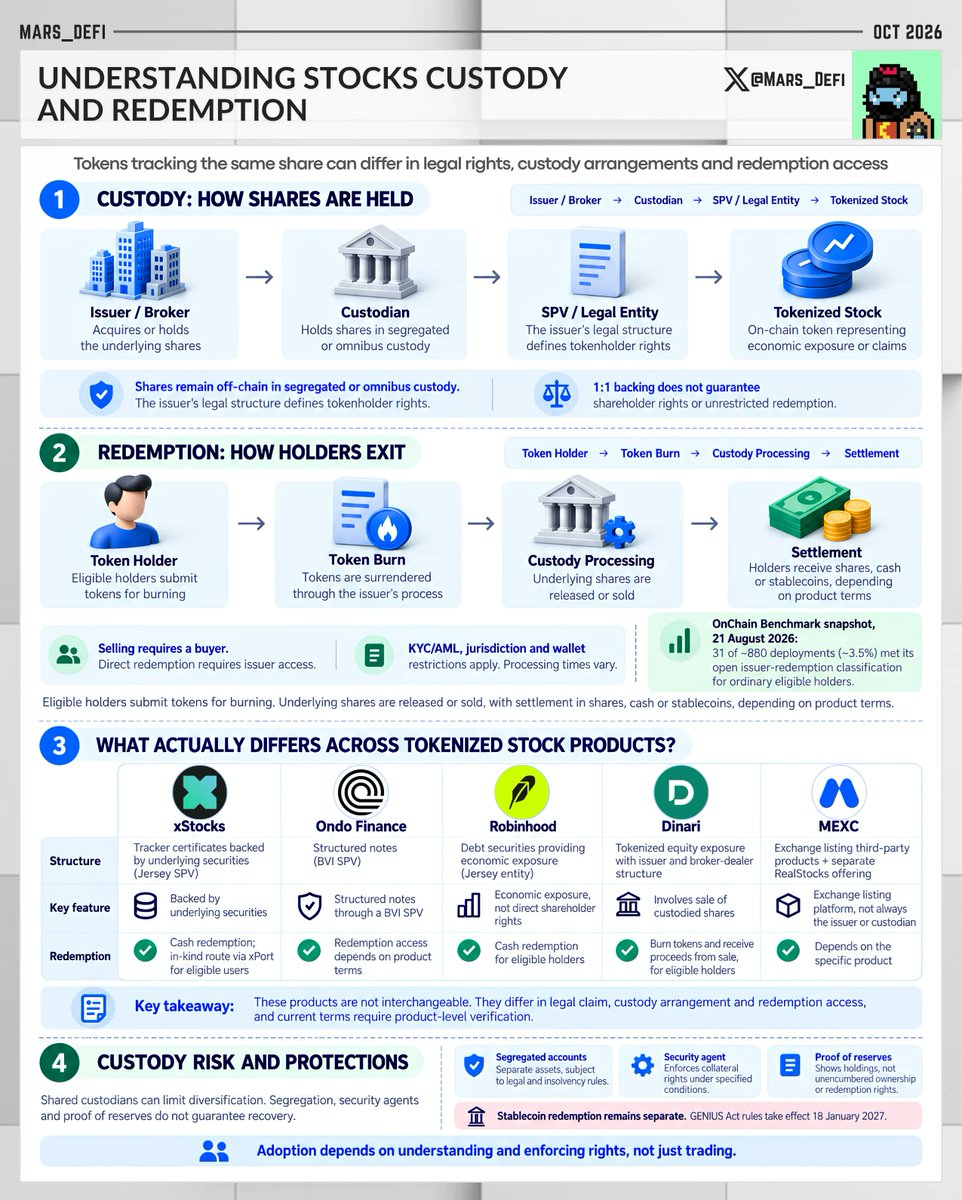
Two tokenized stocks can track the same share price while offering very different legal rights, custody protections, and redemption access.
Even 1:1 backing doesn't guarantee holders own the underlying shares or can redeem them on demand.
So what actually separates these products?
Let's break it down.
—
● The Infrastructure Behind Tokenized Stocks
Four layers connect traditional equities to onchain markets:
Traditional stock market -> Broker and custodian -> Issuer and legal structure -> Onchain token
Each layer serves a different purpose, making three distinctions important:
• Backing: Are the underlying shares actually held?
• Ownership: What legal rights does the token holder receive?
• Redemption: Can holders exchange tokens for cash or underlying shares?
A token can be fully backed without granting direct shareholder rights or unrestricted redemption.
Understanding this distinction starts with how shares become tradable tokens.
—
● How Tokenized Stocks Move From Shares to Redemption
The process generally follows four steps:
1. Acquire: The issuer or broker purchases and custodies the underlying shares.
2. Mint: Eligible participants complete KYC/AML checks before tokens are issued.
3. Trade: Tokens trade across supported CEXs or DEXs, depending on liquidity and restrictions.
4. Redeem: Eligible holders exchange tokens for cash, stablecoins or securities under the product's terms.
Importantly, holders have two potential exit routes:
• Secondary sale: Sell tokens to another buyer at the prevailing market price.
• Direct redemption: Return tokens to the issuer through its approved redemption process.
The distinction matters because selling requires market liquidity, while redemption requires issuer access.
—
● Tradable Doesn't Mean Redeemable
A token can remain freely tradable even when direct redemption is restricted by KYC/AML requirements, jurisdiction or wallet whitelisting.
Holders without redemption access must depend on secondary-market buyers to exit.
This creates another problem of limited arbitrage.
When eligible participants cannot freely mint or redeem, token prices can diverge from the underlying shares despite continued trading.
The result is that two products tracking the same stock can behave differently under market stress.
—
● Same Asset Exposure, Different Rights
Tokenized-stock providers use different legal and redemption structures.
• @xStocksFi: Supports cash redemption and an in-kind redemption route through xPort, subject to eligibility.
• @Ondo : Uses structured notes issued through a BVI SPV, with redemption governed by product terms.
• @RobinhoodApp: Offers Jersey-issued debt securities providing economic exposure rather than direct shareholder rights.
• @DinariGlobal: Redemption reportedly involves selling custodied shares and distributing proceeds to eligible holders.
• @MEXC: Lists third-party tokenized stocks alongside its separate RealStocks offering, without necessarily acting as issuer or custodian.
Although these products provide similar market exposure, their ownership claims, custody arrangements and redemption rights differ.
Current product terms remain essential for accurate comparisons.
—
● The Hidden Risk: Custody Concentration
Different issuers do not necessarily mean different custody arrangements.
Multiple tokenized-stock providers may depend on the same underlying broker or custodian.
This creates concentrated intermediary exposure, where holding several different tokens may provide less diversification than investors assume.
The next question is whether custody protections adequately address that risk.
—
● What Custody Protections Actually Cover
Several mechanisms aim to protect underlying assets, but they serve different purposes.
• Segregated accounts: Separate designated assets from others, subject to legal and insolvency rules.
• Security agents: May enforce collateral rights or liquidate assets under specified conditions.
• Proof of reserves: Verifies assets held at a particular moment, but doesn't establish unencumbered ownership or redemption rights.
None of these protections independently guarantees asset recovery if an issuer fails.
Their effectiveness ultimately depends on enforceable legal claims and the underlying custody structure.
—
● Redemption Access in Numbers
Reported industry data highlights the gap between token issuance and actual redemption access.
• ~880 tokenized-stock deployments reportedly existed as of August 2026.
• ~31 reportedly supported open issuer redemption, according to OnChain Benchmark.
• ~94% of tokenized US equity custody or clearing was reportedly linked to Alpaca Securities.
These figures require source verification, but they highlight two important questions: how widely redemption is available and how concentrated the underlying infrastructure has become.
—
● Where Stablecoins Fit Into the Picture
Stablecoins increasingly provide a settlement layer for tokenized financial assets, but their legal obligations remain distinct.
The GENIUS Act establishes rules covering payment stablecoin reserves, redemption and custody, with @USOCC involved in implementation.
While stablecoins can facilitate tokenized-stock settlement, stablecoin redemption rights do not extend automatically to the underlying equity tokens.
The reported January 18, 2027 effective date also requires confirmation against official OCC documentation before publication.
—
Tokenization makes equity exposure transferable onchain, but it doesn't eliminate the legal, custody and redemption structures supporting it.
As tokenized equities scale, adoption will depend on more than trading access or 1:1 backing.
The real test is whether holders can understand, exercise and enforce their rights when liquidity disappears or intermediaries fail.