Our article in @Nature (https://t.co/VBG24GEE9h) describes the work of the @WHO Working Group on Covid-19 vaccines, and the complicated policy decisions which had to be made early in the pandemic when vaccines were scarce. Extremely thankful for the opportunity to be involved.
Excited to see this important work published in @JAMAHealthForum with outstanding @US_FDA colleagues! We describe important steps towards improving regulations and practices on informed consent in research. (https://t.co/ECzHaGSl4S).
@HopkinsMedicine@BrighamWomens@HarvardMed
No pay. No work hour limits. Poor teaching. Stolen possessions.
These were the conditions that led the first resident physicians to unionize in 1934.
Our new paper in @NEJM examines the history of house staff unions and their impact on the profession
https://t.co/XTjKWZrcg2
My comments in @TaraBannow's story @statnews re @Ascensionorg:
Ascension will never behave exactly like a for-profit company because it doesn’t have shareholders scrutinizing its quarterly earnings, said Ge Bai, a Johns Hopkins University professor of accounting and health policy. That said, it will never be a church, either, as purely charitable organizations would go out of business in today’s health care industry, she said.
As health care gets increasingly complex, Ascension is simply moving the direction all nonprofit health systems will: further from their charitable origins and more toward operating like for-profit companies, Bai said.
“We’ll see that trend accelerate,” she said. “The ocean water does not allow some kinds of fish to survive. So eventually you will have this ocean populated by the kind of fish that can survive in this environment.”
@JHUCarey@JohnsHopkinsSPH@BSPH_HPM
https://t.co/CE1ft3oxwO
Our new paper shows how restrictive abortion policies can increase infant mortality. Some— but not all— of the increase we found was likely due to forced continuation of pregnancies with known lethal congenital anomalies.
Absolutely heartbreaking study to work on.
Our paper on the global production of APIs experiencing US #drugshortages found that facilities producing APIs with shortages were very large - some produced 100+ APIs. No diff in year of last FDA inspection or in receiving a warning letter. with @MatthewA_Crane@JAMA_current
Study evaluates the characteristics of generic active pharmaceutical ingredients (APIs) used to manufacture drugs with shortages in the US and facilities producing APIs worldwide.
https://t.co/QZrT229LTL
Excited to share our new paper in @JAMA_current exploring the role of APIs in drug shortages (https://t.co/Ib1ExR7UqV)! Appreciate the incredible mentorship of @dr_msocal and Gerard Anderson. This work sheds light on critical issues in healthcare supply chains. @HopkinsMedicine
As he says, academia’s very heavy emphasis on novelty incentivizes people to do the kind of work that’s not so useful to policymakers who mostly need to get the basics right — better data, a clearer sense of the overall state of the literature.
https://t.co/4LKWAnIzGA
Very excited to share that I matched to @BrighamWomens for my residency training in Internal Medicine! Enormously grateful for my family, friends, and mentors for all their support!
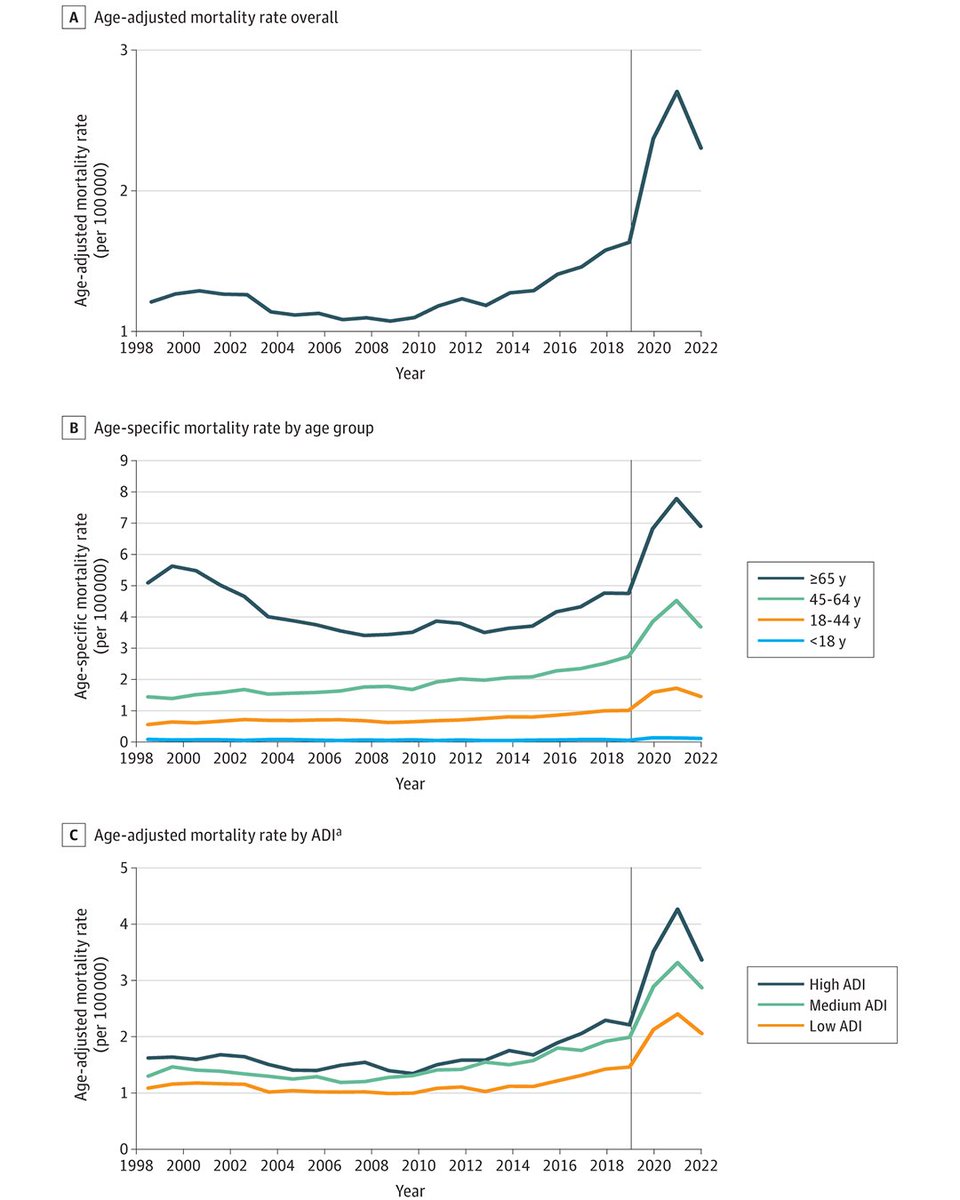
Study analyzes trends in US mortality attributed to both diabetic ketoacidosis and hyperosmolar hyperglycemic state from 1999-2022.
https://t.co/K5ip8sxLDr
Our new study in @JAMA_current (https://t.co/vy9cIcLUCP) describes recent mortality patterns of DKA/HHS. Grateful for outstanding mentorship of @JRomley@alisongemmill@CchristmColleen & trainees Audrey Lam, Emil Ekanayake, Yazan Alshawkani! @HopkinsMedicine @SchaefferCenter
Reported incidence of Creutzfeldt-Jakob Disease (CJD) has risen considerably in recent years, disproportionately affecting older and female individuals. Study findings may reflect improved detection of CJD with new diagnostic tools. https://t.co/aWoAuz6bLt
Our research in @JAMANeuro explores how Creutzfeldt-Jakob disease epidemiology has changed recently, an interesting question of aging trends and evolving diagnostics. w/ excellent team @sameer_nd@alisongemmill@JRomley and John Probasco https://t.co/TPb5WRg5qi
Our work in @TheLancet examines figures in leading academic journals across disciplines. We found best practices in accessibility through alt-text are not followed. Publishers and journals should improve their policies. @bermaninstitute @SchaefferCenter https://t.co/uFk83j5S6G
Off-label or unapproved ketamine is being advertised directly to consumers online as a treatment for mental health conditions or other indications. Regulations on this advertising are unclear, and some advertisements contain false or misleading claims. https://t.co/fxIkosLE5R