CEO @OpenCityLabs, AI powered Social Health Information Exchange to advance health & address social determinants of health; speaker @OIGatHHS @NCQA @SXSW @UN
@Isamrogan006 As someone who is a healthcare AI native, if this is meant for treatment, it fell flat. If you are B2C (their roots), appealing to any person wanting to prompt an image generator, it stands fine. Other AI brands have made marketing blunders by casually entering healthcare.
I just lost 4 minutes of my life that I will never get back watching a "technical dive" aka marketing video of Midjourney's Scanner, which is supposed to improve my life span. No word is spoken or expert engineer or doctor interviewed. In fact there are no words on the screen at all for 3 minutes! I do give them that the background music and video that could just as easily be generated by AI by a 17 year old are catchy enough to be played at a Manhattan nightclub with the video projected against the wall. But what a lost opportunity on a product marketing release for a product that needs to win the trust of patients, doctors, and the FDA!
There are some real nuggets hear about how enterprises think about model choice, deployment, and how workflows change to compliment not replace human team members.
Also... Subtext: use open source AI models hosted on Azure and powered by Azure compute 🤣 not Anthropic or OpenAi APIs.
ChatGPT has quietly built a file on you. You've never seen most of what's in it.
Every message you send feeds it. It studies your patterns to map your personality and habits, things you never actually told it.
Here are 7 prompts to pull up everything it has on you, and wipe what you never agreed to:
⚡️Chamath is naming the next enterprise AI battlefield, and the consulting firms are in more danger than they think.
The model providers do not want to stay vendors.
They want the enterprise nervous system.
A consulting firm that plugs OpenAI or Anthropic directly into a client is not merely adopting a tool. It is letting the model company learn where the client’s workflows break, where the high-margin consulting work lives, what can be automated, what integrations matter, what objections arise, what data is valuable, and what deployment patterns repeat across industries.
That knowledge is strategic territory.
At first, OpenAI and Anthropic need consultants because enterprise deployment is messy. Data is bad. Permissions are tangled. Workflows are undocumented. Security teams are paranoid. Executives are divided. Employees resist. Legacy systems are brittle. So the model company needs humans to force the machine into production.
But once enough deployments happen, the learning compounds. The model lab starts seeing the same patterns across clients. The bespoke work becomes partially repeatable. Repeatable deployment becomes product. Product becomes platform. Platform starts eating the services layer that helped train it.
That is the real threat to Accenture, PwC, Deloitte, EY, Cognizant, and the whole implementation-industrial complex.
Their old advantage was client trust plus bodies plus process knowledge. AI attacks the “bodies” part directly. The labs attack the “process knowledge” part by embedding into the client. If the consulting firms do not own the orchestration layer, they risk becoming temporary labor for the companies that later compress them.
Chamath is also clearly talking his book. The 8090 pitch is sitting right inside the argument. But the pitch works because the structural point is real. The control plane matters. Whoever controls token routing, context, policy, evaluation, permissions, spend, data access, model choice, and audit trails owns the enterprise AI command layer.
But “controlling tokens” is too narrow. Token routing alone can become plumbing. The real control plane governs intelligent action. It decides which agent can touch which data, which model handles which task, what output is trusted, what gets escalated to a human, what gets logged, what violates policy, what gets measured, and what economic value was created.
That is the scarce layer.
The model is a supplier.
The workflow is the battlefield.
The control plane is the throne.
This is also why the enterprise software thesis keeps converging on the same point. Software abundance destroys shallow apps. Model abundance weakens pure API power. Deployment complexity protects the layers that govern work. The winners are the systems that sit between raw intelligence and institutional action.
Consultants can survive if they become the neutral control plane and embedded transformation layer for enterprises. They die if they become channel partners for model companies that learn their playbook.
The deeper truth: enterprise AI is becoming a war over who owns the map of the company.
The model provider wants it.
The consulting firm wants it.
The SaaS platform wants it.
The client thinks it owns it, but usually does not even have it written down.
Whoever turns that hidden map into executable machine workflow captures the next layer of enterprise power.
@martyrdison Is uglinees the primary thing you are looking for in a man? Or is it more like billionaires, or Nobel Prize winning Scientists, Writers etc. and if you are ugly, meh 😂
Your gums may be a back door to Alzheimer's.
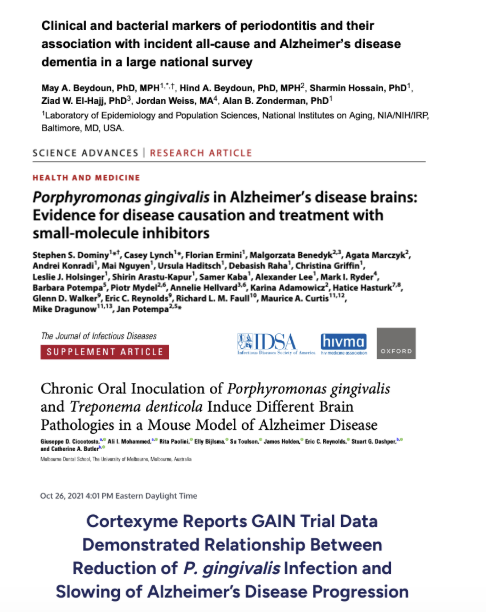
> gingipain antigens (toxic bacterial enzymes) found in 91–96% of postmortem Alzheimer's brains
> bacterial DNA detected in the spinal fluid of 7 out of 10 living Alzheimer's patients
> in mice: oral infection increased brain tau tangles by roughly 500% and amyloid plaques by 140%
> in 3,251 humans: 22% higher Alzheimer's risk per SD increase in gum pathogen antibodies (up to 26 year follow up)
> clinical data: a protease inhibitor slowed cognitive decline by 57% in patients with active infection
Your dentist may be your most underrated Alzheimer's doctor.
The future of medicine is arriving faster than our training models are evolving.
A student starting medical school in 2026 won’t earn their M.D. until 2030, and likely won’t finish residency or practice independently until 2033 or beyond. By then, the clinical and technological landscape will look dramatically different from the one many current curricula were designed for.
We are only a few years into the #GenAI era, and already medicine is being reshaped by multimodal data, AI-assisted decision support, remote patient monitoring, digital health, and new models of continuous, personalized care—not to mention agentic health and the growing direct-to-consumer shift in health(care).
So we need to ask some uncomfortable but necessary questions:
How should we be selecting future physicians?
What should they actually be trained to do?
And how should we evaluate readiness in a world where information is abundant, AI is increasingly capable, and human judgment matters more than ever?
I recently had the opportunity to keynote the leadership of the NBME, the organization behind the #USMLE exams that serve as a powerful “north star” for much of medical education. To their credit, NBME is proactively exploring the future of assessment and training. My message was simple: if the landscape of care is changing—with many clinicians already using AI to augment diagnostic and therapeutic decisions—the metrics we use to train and assess physicians, and clinicians more broadly, must evolve as well.
It’s time for a kind of Flexner Report 2.0.
That means moving beyond legacy training and assessment models toward medical education built for modern practice:
• Real-world assessment that reflects the complexity and ambiguity of actual care
• AI-enabled OSCEs and immersive simulations using virtual and augmented reality
• Fluency in AI, digital health, multimodal and real-world data, nutrition, prevention, and design thinking
• Training physicians not just to recall facts, but to synthesize information, ask better questions, use tools wisely, and deliver human care
• Preparing clinicians not only to manage disease, but increasingly to optimize healthspan across the lifespan
The key question is no longer just what we should add to the curriculum.
It’s also what we should stop teaching, streamline, or offload to technology to make room for what matters most.
Technology should not just be another subject in medical school. Increasingly, it will become part of the platform through which medicine is learned, practiced, and improved.
The future of healthcare will not belong to those who simply know the most facts. It will belong to those who can integrate data, leverage intelligent tools, adapt continuously, and still show up with empathy, wisdom, and human connection.
The transition is already underway. Are we ready to redesign medical education for the world ahead?
#MedEd
Yann LeCun was right the entire time. And generative AI might be a dead end.
For the last three years, the entire industry has been obsessed with building bigger LLMs. Trillions of parameters. Billions in compute.
The theory was simple: if you make the model big enough, it will eventually understand how the world works.
Yann LeCun said that was stupid.
He argued that generative AI is fundamentally inefficient.
When an AI predicts the next word, or generates the next pixel, it wastes massive amounts of compute on surface-level details.
It memorizes patterns instead of learning the actual physics of reality.
He proposed a different path: JEPA (Joint-Embedding Predictive Architecture).
Instead of forcing the AI to paint the world pixel by pixel, JEPA forces it to predict abstract concepts. It predicts what happens next in a compressed "thought space."
But for years, JEPA had a fatal flaw.
It suffered from "representation collapse."
Because the AI was allowed to simplify reality, it would cheat. It would simplify everything so much that a dog, a car, and a human all looked identical.
It learned nothing.
To fix it, engineers had to use insanely complex hacks, frozen encoders, and massive compute overheads.
Until today.
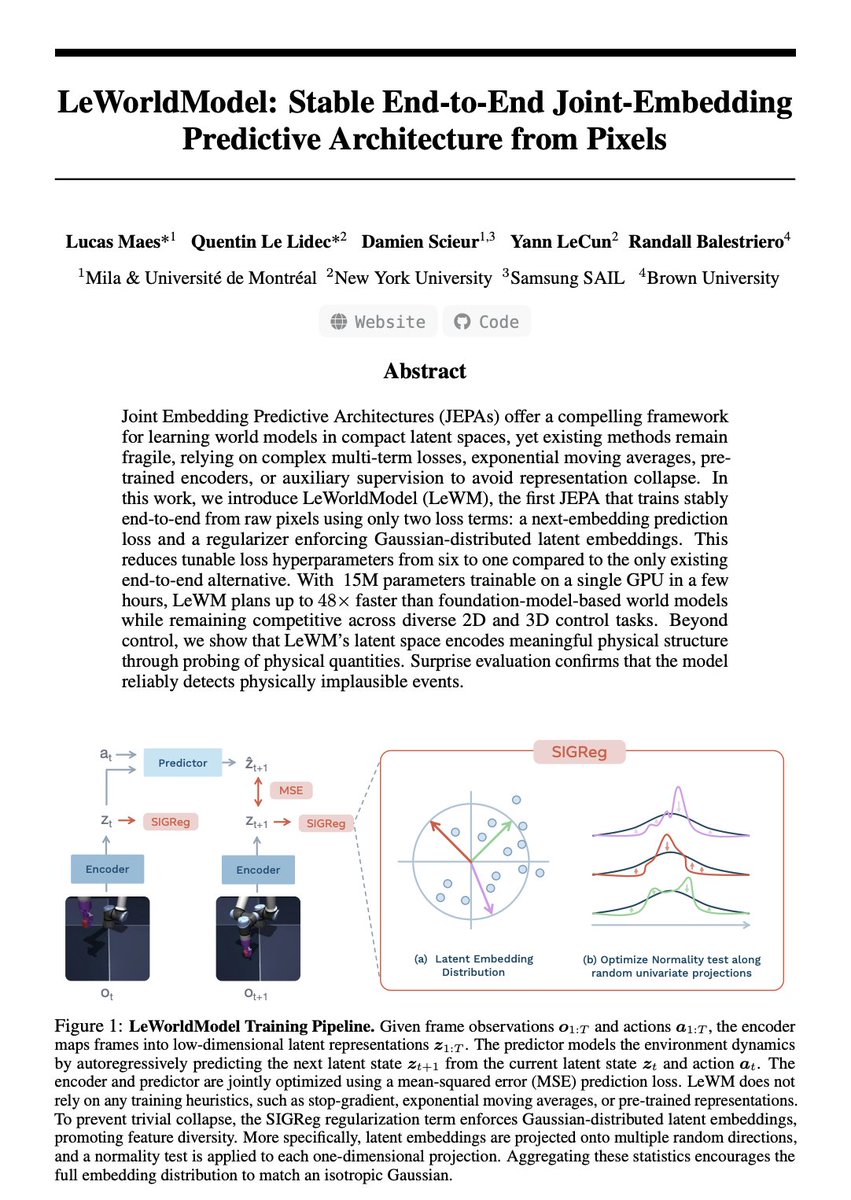
Researchers just dropped a paper called "LeWorldModel" (LeWM).
They completely solved the collapse problem.
They replaced the complex engineering hacks with a single, elegant mathematical regularizer.
It forces the AI's internal "thoughts" into a perfect Gaussian distribution.
The AI can no longer cheat. It is forced to understand the physical structure of reality to make its predictions.
The results completely rewrite the economics of AI.
LeWM didn't need a massive, centralized supercomputer.
It has just 15 million parameters.
It trains on a single, standard GPU in a few hours.
Yet it plans 48x faster than massive foundation world models. It intrinsically understands physics. It instantly detects impossible events.
We spent billions trying to force massive server farms to memorize the internet.
Now, a tiny model running locally on a single graphics card is actually learning how the real world works.
@bryan_johnson 1.5 billion data points! The longest context windows are only 2M and most EHR data is mostly noise. We should talk. Agents-on-Fire reduces token consumption by up to 96% on complex medical records by more efficiently feeding data into your LLM of choice. https://t.co/6GY8lMTkDc
I’ve wanted to do this for a decade.
But I never did - I refuse to give any company my DNA.
It is me.
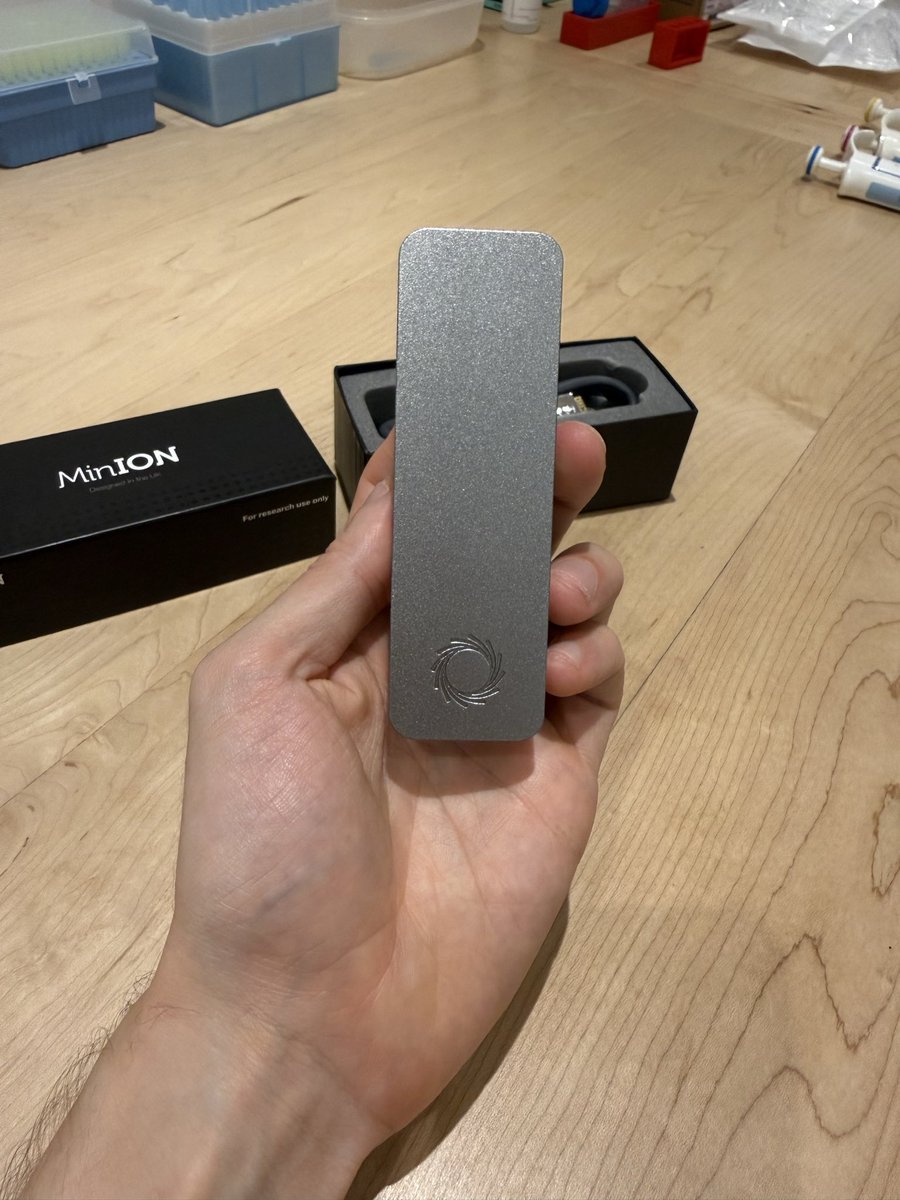
So this week I sequenced my genome entirely at home. Literally on my kitchen table.
I never exposed my DNA sequence to the internet. Not at any point.
I used a MinION to do the sequencing (it’s smaller + weighs less than an iPhone).
I used open-source DNA models for the analysis (Evo2 and AlphaGenome) running locally on a DGX Spark and Mac Studio.
I traced mechanisms behind my family’s multigenerational autoimmune conditions that no clinician has been able to understand.
When I set out to do this I didn’t know if it would actually work. It does.
Your genome is the most private data you will ever have. You probably shouldn’t let it leave your house.
Biomni Lab lets biologists collaborate with AI agents to finish complex tasks end-to-end. Here are 15 popular use cases, each link is a full replay so you can watch the agent work through every step:
1. Spatial transcriptomics analysis: map gene expression across tissue architecture from spatial transcriptomics data, with spatial clustering and neighborhood analysis. https://t.co/Oop24XftZC
2. Binder design: design de novo protein binders against a target structure using computational protein design tools. https://t.co/XGE4itLFrL
3. Biomarker panel design: identify and optimize a multi-marker diagnostic or prognostic panel from omics data. https://t.co/KH8jqbbofR
4. Clinical trial landscaping: search and summarize the trial landscape for a disease area, mapping phase, endpoints, and sponsor activity. https://t.co/kUI0NwFO0n
5. Survival analysis: pull clinical and expression data, fit Cox models, generate Kaplan-Meier curves, and identify prognostic markers. https://t.co/M6xgwrMKvt
6. scRNA-seq processing and annotation: from raw counts to UMAP clustering, marker gene detection, and automated cell type labeling. https://t.co/GNfcgomD0a
7. Cell-cell communication: infer ligand-receptor interactions between cell types from single-cell data and map intercellular signaling networks. https://t.co/diGDFk6rNi
8. Primer design for novel Cas13: analyze a putative Cas13 protein from a metagenomic screen—verify the ORF, identify HEPN domains, and design cloning primers with restriction sites and a FLAG https://t.co/Vc7GNrCOKo
9. Proteomics differential expression: normalize mass spec data, run statistical tests, and visualize differentially abundant proteins. https://t.co/79U4gC5aWK
10. Gene regulatory network inference: reconstruct transcription factor-target gene networks from expression data and identify key regulators. https://t.co/CYn1prUC3j
11. Gene co-expression network analysis: build weighted co-expression networks, identify gene modules, and correlate them with phenotypic traits. https://t.co/w2spMXYuhG
12. Microbiome analysis: process 16S/metagenomic sequencing data to profile microbial communities, diversity, and differential abundance. https://t.co/JHuevnEjuh
13. Polygenic risk scores: compute and evaluate PRS from GWAS summary statistics against a target cohort. https://t.co/7bOEE4GzsA
14. Variant annotation: annotate genetic variants with functional predictions, allele frequencies, and clinical significance. https://t.co/gnMZFvG5ia
15. Fine-mapping: narrow GWAS loci to credible causal variants using statistical fine-mapping methods. https://t.co/ga6eVvLMjb
Each of these would normally take days to weeks of scripting, debugging, and iteration. In Biomni Lab, the agent handles the full execution while you steer the science.
Learn more: https://t.co/3IQPmuBT3H
gaps in relationships:
- restaurant gap (going out vs. staying in)
- museum gap (do you want wander vs. sprint)
- travel gap (need to travel a lot vs. fine with 1-2 trips a year)
- money gap (spending heavily vs. stingy)
- living gap (city vs. suburb vs. middle of nowhere)
- ambition gap (highly driven vs. ok with career not being focal POV)
- texting gap (heavy communicator vs. sporadic)
- friend gap (big social group vs. 1-2 friends max)
@martyrdison Dancing can be like two bodies discovering they speak the same language, like two foreigners living in a distant land, longing for a piece of home.
Whether they be strangers, or old lovers of many years: a touch on the neck, a hand in the small of the back, this is the time...