Ouch. It stings a bit to see New York City nestled comfortably in the "Bad Value" section of this chart.
Big comeback by Buffalo, NY though. Kudos to them! 💪
Quality of Life vs. Cost in 99 Cities Across the Americas 🌆
This graphic by Valerii Emelianov is one of the many incredible data-driven charts and stories from creators featured on our website. ✅
https://t.co/wd6h4WRkEV
“AI is a dangerous technology but we have earned it,” says @hodlipson.
“In the past we navigated through other powerful technologies such as nukes and genetic engineering. We can handle AI.”
Another great podcast from @_BeyondPodcast_
https://t.co/ddw9k7SQbH
Data center developers have announced more than 100 GW of their own power plants. That's equivalent to the power demand of 10 New York Cities.
The growth of this trend forced our team at Cleanview to rethink how we track them.
Our original plan was to publish a quarterly report on this topic. But we soon realized this was too infrequent given the speed at which this trend was evolving.
To illustrate what I mean, consider a few data points:
- The amount of operating behind-the-meter capacity has nearly doubled since we published our last report.
- Capacity under construction has roughly quadrupled.
- Anthropic has gone from an insignificant buyer of behind-the-meter gas power to one of the largest.
So we decided to scrap our original plan and build something much better. Today we’re excited to announce Cleanview's live behind-the-meter gas plant tracker. It covers more than 100 gas plants built to power data centers, and we update it every day.
Over the coming weeks, I plan to share insights from this growing dataset. In the meantime, if you’d like to see the new product or connect with our team, send us a note.
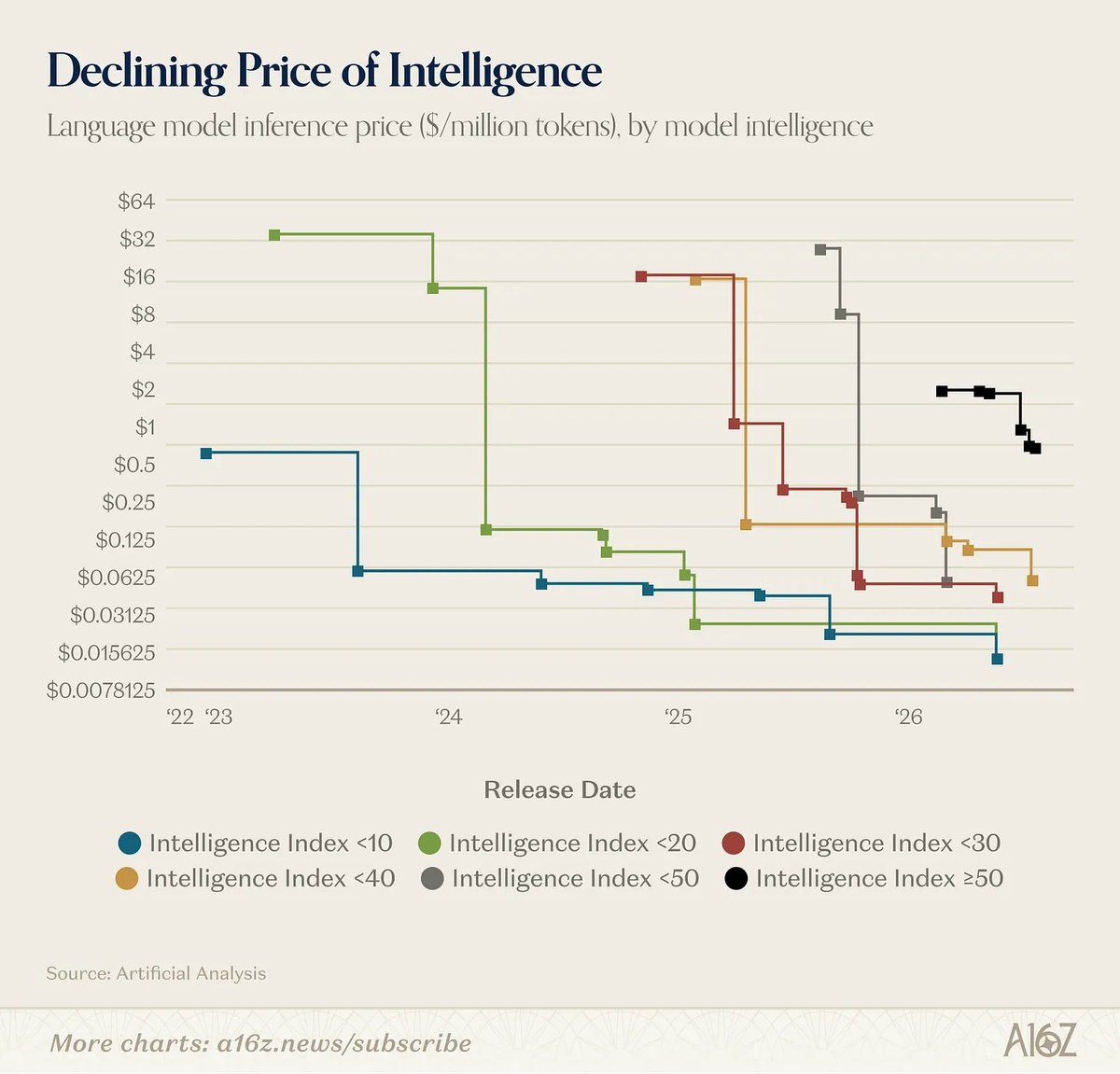
Karan Singhal of @OpenAI on the collapsing cost of intelligence, as seen on their health benchmark:
"GPT-6 Luna is our current cheapest frontier model on the API... It performed better than 5.6 Sol, which was literally our best model a month ago. And it performs better despite being 34x cheaper."
Most tiers of model intelligence became more than 100x cheaper within roughly a year
One tier went from ~$32 to ~$0.02 per million tokens in two years
Waymo is working around the restrictions on Chinese electronic components by importing bare chassis and outfitting them in Arizona. 5,100 Ojai vans in process, aiming for a launch at the end of 2026.
Alphabet’s Waymo is importing thousands of Chinese-built robotaxis, drawing bipartisan security and economic concerns in Washington.
Waymo is on pace for about 5,100 Zeekr Ojai vans by the end of 2026, more than doubling its fleet, according to MoffettNathanson. Customs records show over 3,200 have already arrived via the Port of Los Angeles. The vans come from Zeekr, a Geely brand linked to the CCP.
They arrive from Ningbo as bare chassis with no Chinese sensors or software. Waymo adds its autonomous tech in Arizona, cutting costs to roughly $100k per vehicle versus $200k for its Jaguar models while sidestepping current Commerce Department bans on Chinese connected-vehicle tech.
Bipartisan lawmakers are closing the gap with the Connected Vehicle Security Act (S.4429). If it passes, Waymo must phase out the Chinese-origin vans by 2030. The company says it shares no data with Zeekr and supports the bill’s aims, but the fight pits cheaper robotaxi scaling against efforts to keep Chinese-linked vehicles off US roads.
F.03 just crossed 9 straight days walking on this treadmill: 348 miles and 1.2 million steps
Started as a side project to stress the robot for any failures. Let's see how long it can go
@SpeakerMenin@grok@spacexai That’s it?
With all the good things (plus the inevitable economic disruption) that AI is bringing to New Yorkers, we’re focusing on “nudes?”
Bring Your Own Research. Now available in @Supertake.
Starting today, you can upload docs, PDFs, images, even hand-written notes.
Supertake uses these to help inform your take creation and agentic management.
(Try it with Anthropic’s S-1 if/when they drop it!)
NYC is splintering into the "AI ladder" and the "everybody else" ladder.
Don't get me wrong, I use subscription AI tools every day and never want to go back. But the hard reality seems to be, that NYC's economy is not ready for the AI transition.
@TechNYC is exploding and only going to grow bigger. The valley companies such as @AnthropicAI and so. many others are taking on massive spaces. We saw this in 2003 when Google brought the engineers. The amount of talent pouring into NYC who are going to leave those companies and start the next great companies will be unprecedented combined with the compounding effects of the last 25 years.
https://t.co/qzai1Xy6Cy
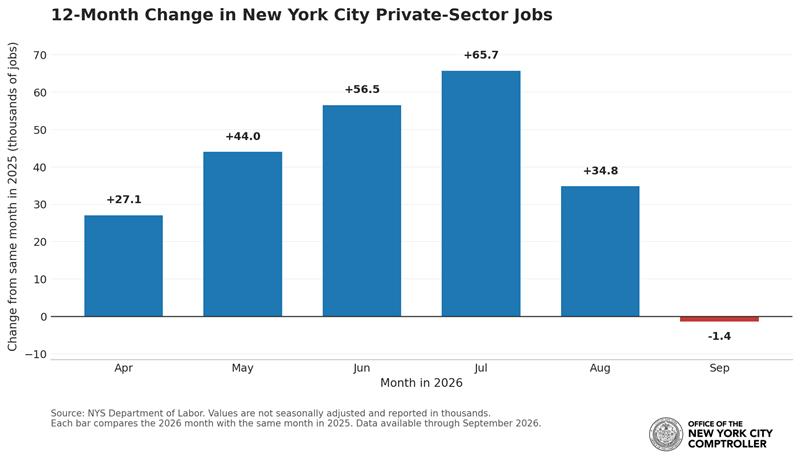
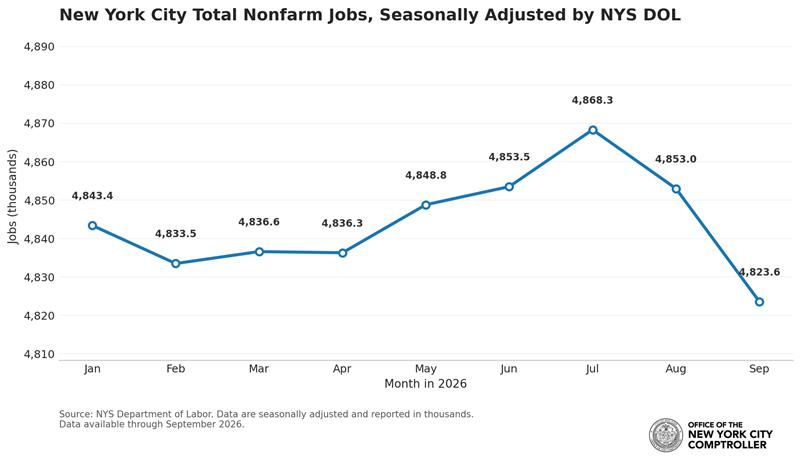
September jobs data are out for NYC.
Multiple indicators point to a loss of momentum in NYC’s job market in 2026.
1. Total jobs slipped after midsummer:
Physics is also cooked: “GPT-6-Astra harnessed in Codex, obtains the final answers with a near-perfect accuracy of 98% at an average cost under 3$ per problem.”
These are: “suite of 50 unpublished research-level theoretical physics problems with verifiable answers. Without AI assistance, a typical problem in our collection could be solved by a world expert in about a day or less but would take considerably longer for experts in adjacent specialties.”
Estonia’s 11th unicorn is officially Skeleton Technologies. 🇪🇪 But if you count Starship Technologies, the real number is 12.
With 12 billion-dollar startups for a population of 1.3 million, Estonia is an absolute outlier—competing only with Israel and Singapore for the world's highest unicorn density!
https://t.co/eELTmi99NJ
Dusting off this tweet from April because this gap in shared understanding of LLM capability is *widening*. It's now less "two groups of people speaking past each other" and more a sharp funnel.
- Napkin math somewhere around 6B people (~75% of the population) have barely come in contact with LLMs at all.
- Around 1-2B (~20%) are casual and infrequent users of free-tier ChatGPT-like products. This group sees derpy chatbots and treats them a bit like a better Google search, a writing aid, or etc. Maybe an agent tries to book you a flight. I have non-tech friends who (reasonably, imo) say they have not much use for it at all. Even many professionals outside of math&code are in this tier. For example, execs and many other functions spend a lot of their time talking to other people, so while they understand what is happening intellectually, it is still second-hand and a bit abstract.
- Now we get to professional use of frontier-grade LLMs in math&code. Somewhere around 20M people (0.2%) see first-hand that large, complex projects that used to take them weeks/months can now be completed by agents with a prompt. Building apps, copying apps, translating apps, decompiling apps from binaries... This has all happened very quickly and recently - less than 1 year ago, I was writing code manually by hand, typing memorized computer code commands into a code editor character by character, occasionally pressing Tab to autocomplete a little chunk of code.
- And finally we get to the ~5,000 people (~0.00006%) with access to frontier-grade systems internally. The external world has seen the preview. It looks like swarms of thousands of agents collaborating over weeks on software mega projects: minting zero days, running cyber attacks and defenses at machine speeds, discovering new science, advancing the frontier of mathematics. Things that would have taken top professionals in the industry years of work. Meanwhile, human review and comprehension are starting to fall behind. For example, people are still involved in the "archeology" of the OpenAI-HF incident from many months ago. Mathematicians may be poring over the 722 manuscripts on frontier mathematics for a while.
The funnel is driven by a combination of factors:
1. The impact scales with ambition, problem size, and horizon. A question with a paragraph answer barely stresses the system. You need a reservoir of big, difficult problems that you really care about. This aspect drives the consumer / professional dimension of the funnel.
2. The jaggedness of the system (which I have written about a lot separately). Capability peaks in domains that are digital, verifiable and economically valuable. This is because LLM capability emerges from reinforcement learning on verifiable rewards on a curated environment mixture driven by revenue potential. This aspect primarily drives the area (e.g. math&code) dimension of the funnel.
3. Access. Free-tier, paid-tier, internal.
So this is the weirdness of the moment. The general public has mostly not interacted with these systems. When they have, it looks like a derpy chatbot. The majority of professionals still see only a modest uplift. And a small sliver of professionals are experiencing the vertigo of the curve going vertical. And it is all happening at the same time.
Most of the recent math results were not reached by a swarm, the way Navier–Stokes was. I think that part got lost in the excitement around the release. OpenAI's unnamed internal model, which I'm going to call Aeon, reached most of them in one shot, from a single prompt, with no interruptions. This model did not even exist before the end of August, and it is still training. Notice how the returns are not dropping off? That chart is from a month ago. It is a log scale. What does Aeon look like now?
On average, each result used three hours of thinking. Aeon was given 4000 problems to work on by OpenAI. How many more have been solved in the last three days? That number is not zero.
It's like hearing notes in a song that is slowly rising. I don't think Pacing the Frontier was just about Hugging Face or hacking. They've seen how close we are to closing the loop, and as the hour draws near, their resolve begins to quaver. The last piece was model creativity, and I think that threshold was crossed internally by Anthropic and OpenAI in September. You see it in Opus 5.5, which gets it from Fable 5.5. You see it in the math results from Aeon.
All that was needed to start the event was the ability for models to think of novel ways to improve themselves. That was the last piece. This is directly analogous to the ability to think of strange, alien ways to solve math problems: solutions so inhuman that they are difficult to express in existing human terms, so the proof winds up incomprehensible. I think these same kinds of alien solutions are now being applied to model improvements internally. That's what all this recent consternation is really about. They see the invisible frontier. And they see what is about to happen.
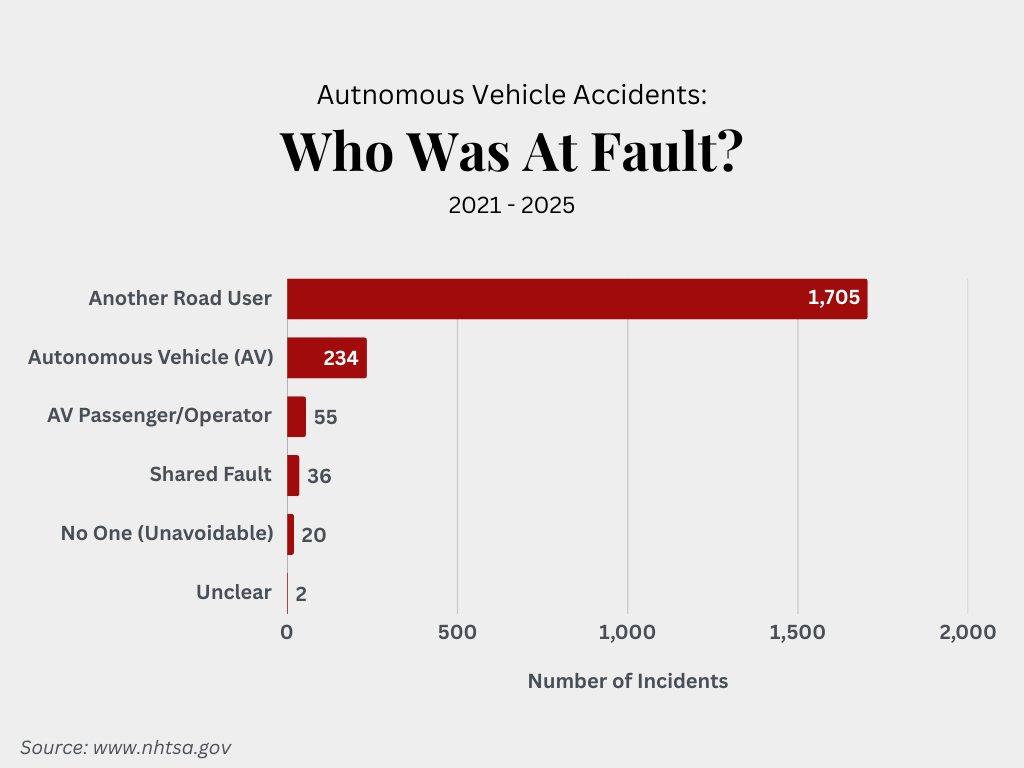
@TransAlt Meanwhile, in other cities where robotaxis are not banned (as they are in NYC), autonomous vehicles continue to outperform human drivers, thereby saving lives.