China’s AI playbook: kill OpenAI and anthropic with free great models. Make it free. Then use cheap electricity to export compute as well. Currently the blocker is chip but Hauwei would catch up soon. Imagine a world where instead of paying hundreds of billions to OpenAI and anthropic, you pay almost zero to similar level of intelligence with cheap cheap inference. What’s gonna happen?
"We are dealing with an economy whose currency is undervalued by between 25 & 30 %. This is such a massive competitive disadvantage that we must address it & we have agreed to do so".
It's a big step Merz put 🇨🇳currency undervaluation front and center at G7 meeting. Time to act.
Approximate estimates of percentages of U.S. munitions expended in Iran war, per @CNN :
50% THAAD interceptors
50% Patriot interceptors
45% Precision Strike Missiles
30% Tomahawk missiles
20% Joint Air-to-Surface Standoff Missiles
20% Standard Missiles (SM-3 and SM-6)
New: The US military has significantly depleted its stockpile of key missiles during war with Iran & created “near-term risk” of running out of ammunition in a future conflict should one arise in next few years, per experts & 3 people familiar w/ recent internal Pentagon assessments.
https://t.co/J75l4aqtXk
NEW @CSETGeorgetown + @emergingtechobs piece!
Does China's access to US semiconductor technology help the PLA develop and deploy military AI?
After 3 years reading thousands of PLA procurement docs, @sambresnick and I say yes.
Here’s how, and why it matters:
🧵/13
Long unofficially banned from appearing on state TV, incoming Hungarian Prime Minister Peter Magyar appears on a channel to which he was previously not allowed only to announce an end of "North Korean" style Orban media monopoly.
Half of all planned U.S. data center builds in 2026 are projected to be delayed or canceled. The bottleneck isn't chips or capital, it's electrical infrastructure. And that infrastructure depends heavily on China.
Transformers, switchgear, batteries, all those rely on china. China accounts for over 40% of U.S. battery imports and around 30% of key transformer and switchgear categories. Imports of high-power transformers from China surged from fewer than 1,500 units in 2022 to over 8,000 in 2025.
U.S. transformer lead times have stretched from 24 months pre-2020 to up to five years today. AI data center deployment cycles run under 18 months. That gap doesn't close with money: Alphabet, Amazon, Meta, and Microsoft are spending over $650 billion this year and it's still not enough.
Strangely enough, this is the part of the AI race nobody talks about. Washington restricts chip exports to China while simultaneously depending on Chinese electrical equipment to power the data centers those chips go into. A decade of reshoring rhetoric hasn't built the domestic manufacturing capacity to change that.
The real AI bottleneck was never compute. It's power, and the supply chain that delivers it runs straight through the country the U.S. is trying to decouple from.
this is what i try to reiterate all the time. Power is the even bigger bottleneck than compute.
On this day in 1981, the U.S. Army unveils the EM-50 Urban Assault Vehicle. Modelled on the 1976 GMC 26 Palm Beach line of motorhomes, it's fully equipped with machine guns, flame throwers and rocket launchers, along with a state of the art communications and navigation suite.
@CensoredLeak Researchers have uncovered how the mantis shrimp punches faster than a bullet and harder than a professional boxer. The secret is a saddle-shaped structure in its arm that stores elastic energy like a biological crossbow, enabling it to strike with 1500 newtons of force.
The Shenzhen gov says it built China’s largest datacenter that has only Chinese AI chips, using 10,000 Huawei Ascend 910Cs. This is TINY - equal to what OpenAI trained GPT4 on in 2022, and 1% of the biggest U.S. datacenter today.
China’s AI data centers are a full four years behind those in the U.S. The reason for this is because China just cant make enough chips to compete. If they could, this data center would be 100x the size. They have the electricity - chips is their only constraint.
https://t.co/z9pJy5A3DE
BREAKING: An Iranian ballistic missile guided by Chinese BeiDou satellites, fuelled by Chinese sodium perchlorate, precisely navigated by Chinese gyroscopic sensors, and fabricated on production lines equipped with Chinese SMIC tools just struck the Neot Hovav industrial zone south of Beersheba. Israel’s largest chemical and hazardous waste complex. Nineteen plants. Adama. Teva Pharmaceutical. Israel Chemicals. A warehouse is burning. Route 40 closed. No injuries. No hazmat release. Fire contained.
Four countries built that missile. One country appears at every layer of the supply chain. The same country that processes 85 to 90 percent of the rare earth magnets inside the Arrow interceptor that was fired to stop it.
The missile cost Iran between $200,000 and $500,000. The Arrow 3 interceptor that attempted to stop it cost $2 to $4 million. If THAAD was fired, $13 to $15 million. If a Gulf state Patriot battery engaged a Shahed in the same wave, $4 million to stop a $20,000 drone. The cost ratio runs 5 to 1 at the lowest. 200 to 1 at the highest. The defender pays more to stop the weapon than the attacker pays to build it. Every single time.
BeiDou is the variable that makes this ratio lethal. Before Chinese satellite integration, Iranian ballistic missiles relied on pure inertial navigation with a circular error probable of 500 to 1,000 metres. With BeiDou-3 hybrid guidance, the CEP drops to 50 to 200 metres. The missile that hit Neot Hovav did not land in the desert. It landed in a 19-plant chemical complex. BeiDou did not make the missile more expensive. It made the same cheap missile accurate enough to force the defender to fire the expensive interceptor every time. The cost of the offence stayed flat. The cost of the defence compounded.
The Pentagon burned $5.6 billion in munitions in 48 hours. Israel has fired hundreds of Arrows since February 28, exceeding $1 billion in interception costs. The US requests $200 billion in supplemental funding. Iran’s total offensive expenditure: an estimated $200 million. $200 billion to stop $200 million. A 1,000 to 1 ratio at the strategic level.
China is on both sides of the ledger. Chinese BeiDou makes the Iranian missile accurate enough to force interception. Chinese rare earth magnets make the interceptor that fires to stop it. Chinese SMIC tools build the production lines that fabricate the guidance chips. Chinese sodium perchlorate fuels the propellant. Every missile that forces an interception depletes an Arrow that contains Chinese rare earth magnets that are under export restrictions that China controls. The attacker’s supply chain and the defender’s supply chain route through the same country. The country profits from both the missile and the interceptor. The country that makes the offence possible also makes the defence expensive.
This is not a war between Iran and Israel. This is a cost function. The cost function has one variable on the offence side: China. And one variable on the defence side: also China. The rare earth magnets in the Arrow motor. The BeiDou signal in the Emad guidance. Both made in the same country. Both consumed in the same exchange. One depleting the other. The war is a Chinese supply chain consuming itself at a ratio that bankrupts the defender before it exhausts the attacker.
Neot Hovav is contained. No injuries. No hazmat. And none of that matters. The interceptor was fired. The stockpile shrank. The rare earth magnet was consumed. Tomorrow another BeiDou-guided missile will force another Arrow containing another Chinese magnet to fire at another ratio the defender cannot sustain.
The IDF Chief said “collapse.” The interceptor stockpile says the same in a different currency. Both currencies route through Beijing.
Full analysis: https://t.co/32ixeQpN7N
YES. This is mindblowing:
"BIS has just 11 export control officer positions globally:
In China (2 officers + HK); India; Finland; Singapore (1 for all of SE Asia!!); Germany (2); UAE; Taiwan; Turkey...plus an export control analyst stationed in Canada"
https://t.co/gzylaXkiUn
It would be a mistake for U.S. companies to source memory chips from Pentagon-blacklisted Chinese military companies, including CXMT. China cannot be allowed to dominate the memory market by flooding it with state-subsidized alternatives as it has in so many other sectors.
https://t.co/5HaNiP72v6
There are decades where nothing happens, and weeks where decades happen, like the last 3. Greenland, Venezuela, TSMC/Arizona, Japan, Canada/China, Fed, Minneapolis: any would have been a game changer. Together they have unmoored our world. My take: https://t.co/KDew62bIOJ
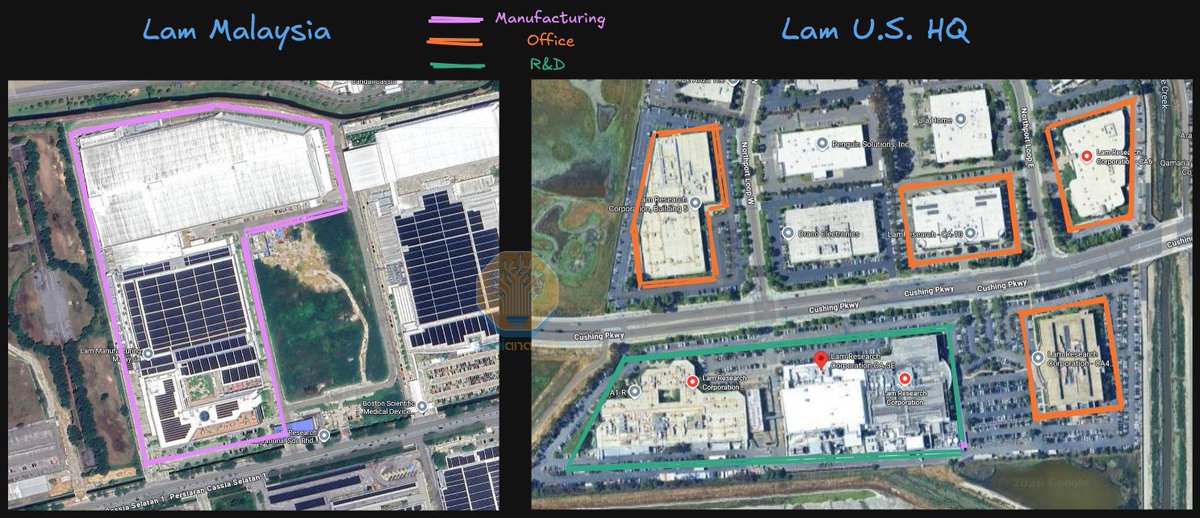
The U.S. wants 40% of chips made onshore. But quietly, the equipment that makes those chips is moving offshore fast. This gap matters just as much as the chips themselves. (1/6) 🧵