Sunrise on the Reaping just opened to $120M domestic, $225M worldwide. Premium formats took 44.5% of the weekend. 🍿
Fans are paying up for the experience. D-BOX gets a royalty every time those seats move. My deep dive 👇 $DBOXF $DBO.TO https://t.co/wsujBcRpTR
Rockstar hid 44 cheat codes in GTA VI
a 19-year-old just cracked all of them with Fable 5.2, 15 hours before America even gets the game
guides only have 17 of the 61 codes. he fed them to the model, it found Rockstar's pattern and spat out the rest in 9 minutes
save this before Rockstar patches it. how people will cash in on this launch is in the article below
A convergence of multiple tailwinds is one of my favorite long setups.
And this company's stock has three tailwinds merging right now:
- Democrats won
- Overlooked alpha
- Company momentum
I'm talking about Gatekeeper, $GKPRF.
Democrats won:
Democrats have shown interest in expanding funding for programs that directly benefit Gatekeeper, such as school bus stop arm safety cameras, along with public transit security systems.
Most notably, a School Bus Stop Arm Safety Camera Act was introduced by a democratic representative in January 2026.
With Democrats winning control of Congress, increased federal funding for these initiatives could further accelerate demand for Gatekeeper’s products and services.
Overlooked alpha:
Gatekeeper held a shareholder call on October 20th, 2026. On this call, the CEO said:
"The momentum that we created in Q3 has spilled over into Q4 and I'm really excited..."
Essentially telling everyone the fourth quarter report is likely to be strong. Gatekeeper is estimated to report their earnings around December 18th, 2026.
Company momentum:
At the beginning of November, the company posted an updated investor presentation.
One of the metrics that changed were the amount of "video devices" deployed, which jumped from 200,000 to 270,000.
Since the last investor presentation (two months ago), that number jumped 35%.
I explained this on my guest appearance of the @WOLF_Financial Small Cap Spaces yesterday (and on my weekly YouTube show). https://t.co/lnjDQ817e9
Hard to understand why investors don't understand this. Oh wait, it's NOT hard to understand. It's because the 10,000 🤡🤡🤡 on X and CNBC are confusing everyone with out of context info.
Been a tech analyst for Wall Street since 1994, but what do I know 🤷🏽♂️😂
Dylan Patel says SemiAnalysis expects $11 trillion of AI capex globally by the end of 2029, about $7 trillion of it debt
“The other question is sort of who pays for it. So one of the things that we’ve said is by end of 2029 we expect $11 trillion of capex globally on AI."
"Five of that being from cash and equity and seven of that being debt. And that’s a tremendously ridiculous number to most people. And this has been our view for a while."
"And then and now over the last sort of two months if you watch debt markets the US 10year yield has been spiking like crazy. And it’s caused a lot of pandemonium in the market. So you know the capex that’s coming online is humongous. And and most of that capex is for the chips themselves.”
________
Source and full breakdown of his presentation: https://t.co/3VxvibLLU4
“AI token usage is going 500x from here” says @Jason
Anyone arguing that AI usage has peaked or compute demand is maxed out is completely lost and obviously doesn’t use the technology
We’re still at something like 2% of people in corporate America using AI today AND both OpenAI and Anthropic haven’t even launched agents at scale yet
We have only touched the surface of what’s possible with AI and the usage will not just grow (linear) it will ACCELERATE (exponential) from here
I feel like this is hard for people to wrap their heads around but if you want to understand where this market is going, you need to understand this trend.
It’s not stopping, it’s getting much bigger, and the mid-terms, rates or anything else will not stop this
It doenst mean the market goes up in a straight line, but as an investor don’t get lost in the noise. This is the biggest technological change in our lifetime
Think MUCH MUCH BIGGER
Bill Ackman says Elon Musk might have to borrow a trillion dollars to open gigawatts of data centers, keeping rates persistently high, and that neoclouds are like levered real estate developers sensitive to the cost of capital
“So, I think it is sustainable because, you know, intelligence is again an enormously valuable asset. And I think the demand therefore for the compute that enables intelligence, I think, is going to be sustained."
"And, you know, the companies that are, you know, the hyperscalers that are building out a lot of this infrastructure have the financial resources, the creditworthiness in order to access the capital."
"I worry more about the pure play neocloud companies that are a bit like highly levered real estate developers playing a theme. I think they’re much more at risk. They’re much more sensitive to the cost of capital."
"But you have, I mean, SpaceX, Elon on the earnings call gave some projections for how many gigawatts of data centers he was going to open. If he meets his objective, he might have to borrow a trillion dollars of capital."
"So, you have companies competing at sovereign levels for debt. And the result is, you know, this massive, you know, more and more supply of debt. So, I don’t see a world in which, you know, there’s a dramatic, you know, there’s a lot of demand for capital and a finite supply. So, I think that makes rates persistently high.”
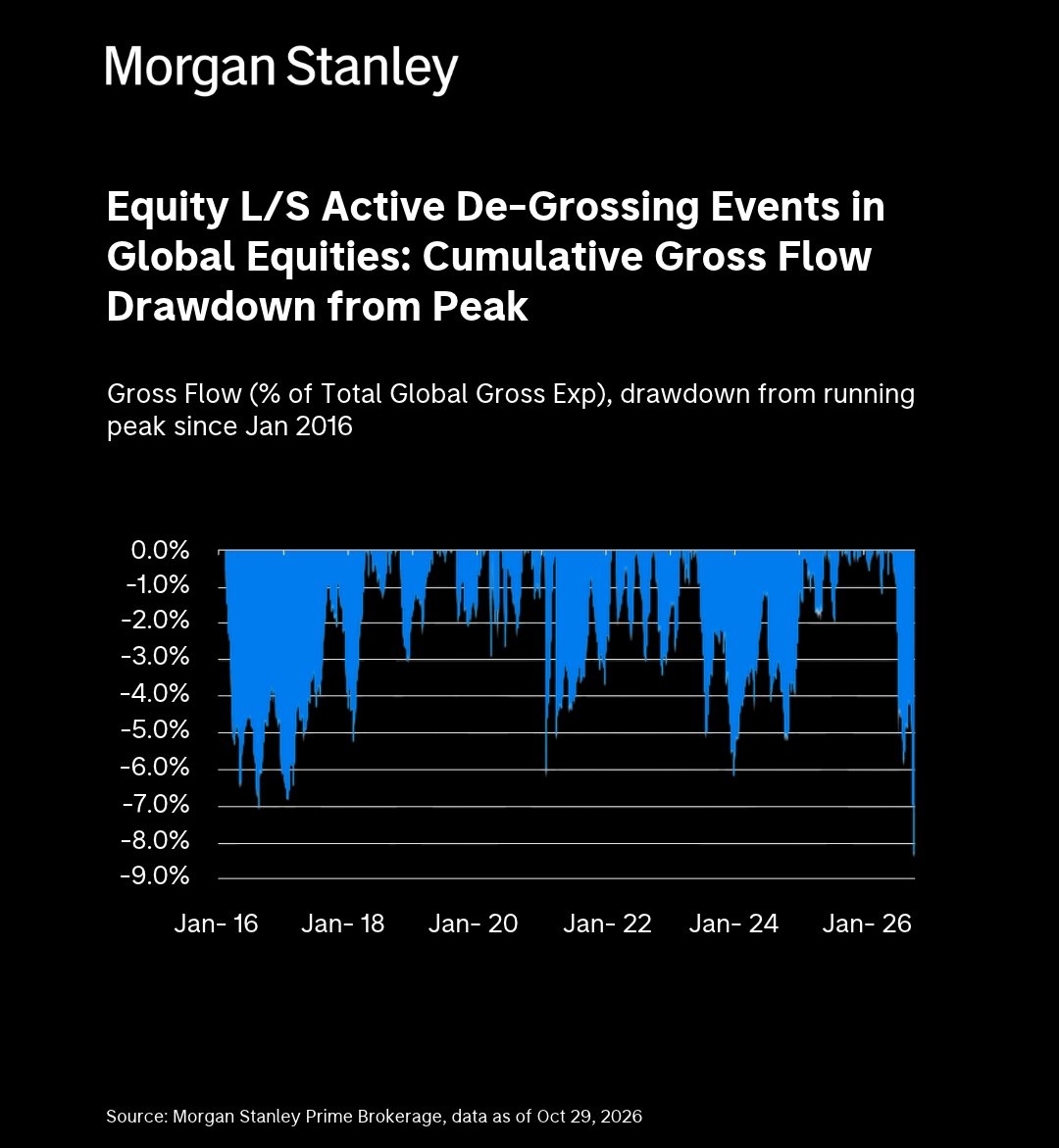
We've finally made it to November... holy crap October was brutal.
Per Morgan Stanley data, the recent hedge fund de-grossing was the highest in the past 10 years.
Exceeding the:
- 2016 Chinese stock market crash
- 2018 Volmageddon
- March 2020 COVID crash
- 2021 Archegos collapse / Evergrande crisis
- 2022 bear market
Goldman's prime brokerage desk reported on the 26th that it had also seen ~$20B of selling over 2 weeks vs. $23 billion during July's entire unwind.
From $HOOD short interest data, from Sept -> Oct short float also increased from:
$AAOI: 12.5% -> 19.84%+
$AEVA: 11% -> 25.64%+
$CBRS: 12.25% -> 20.12%+
$AEHR: 14.33% -> 17.93%+
$TSEM: 2.15% -> 4.73%+
$CIFR: 19.94% -> 25.39%+
$LWLG: 15.24% ->19.12%+
$OKLO: 17.72% ->22.93%+
$CRWV: 17.91% ->26.58%+
Substantial deleveraging coinciding with surging short interest, kinda looks like a July setup after Midterms?
The recent rotation also kinda pushed names like $CRWD and cybersecurity to bubble valuations into hundreds of fwd P/E...
Earnings on many AI capex + bottlenecks (not all like $INTC) looked strong:
eg. $AXTI guided annualized Q4 = 23.7x P/E now, not including potential InP substrate hikes + capacity expansion that can compress it to single digits.
- $SKHY (~$59B operating profit) casually making more than trillion dollar companies like Amazon ($28.1B operating profit), backed with 5Y LTAs.
- No signs of $MSFT / $AMZN materially cutting capex, while $SPCX secures $40B more for GPU procurement.
Slightly painful, but I think the AI capex trade (specifically photonics/memory) is a generational opportunity, with extreme volatility in between.
Oct 20: "I've never seen anything grow this fast."
Nov 1: "The cost of serving Grok Bot was unsustainably high relative to revenue."
Turns out the growth hack was selling a dollar for fifty cents.
Gavin Baker: “The Magnificent 7 will go from $10-12 trillion to $50-100 trillion. But one or two of them will go extinct.”
His foundation-model survival list is short:
Google — search-plus-Gemini flywheel
Meta — Llama + ad-revenue self-funding
xAI — X + Tesla data footprint
Anthropic, OpenAI, everyone else — Baker treats them as commoditized.
His FOMO warning: “Application SaaS is done. If you went all-in on crypto and SaaS in 2021, don’t repeat the trade.”
On AGI: “Elon says 3 years. I say 5 is safer.”
On regulation: “The leading labs weaponized fear of China. There’s going to be no regulation.”
The math he keeps quoting: $12T → $100T is 8x. But 1-2 die means winners take 30-40% of the total, not 14%.
Baker’s frame: no regulation + AGI in 5 years + Mag 7 8x = biggest enterprise-value transfer in market history is happening right now.
In case you're wondering, BUY the DIP!
Look what we just learned:
- Elon's building 10GW of compute bc demand is SO BIG and GrokBot is the fastest growing thing he’s seen
- Anthropic has more than $100B, will grow 10x this year (from $9B base) and is profitable
- Microsoft grew revenue by 18% YoY while decreasing headcount because of AI (insane to do at this size)
- Google Cloud, AWZ and Azure had record breaking quarters
- The price of memory and compute keeps going higher
But we're selling off because the largest, most successful and smartest companies in the world decided to go negative fcf for a few quarters because they believe investing in building out AI is better than holding cash or buying back their stock
Let me say that again... the SMARTEST companies in the world would rather invest in building out AI than their OWN STOCK... that's how bullish they are on AI
lol man, if you're not buying AI infra right now than you're betting against the smartest companies in the world
The AI infrastructure bottlenecks are getting ridiculous, and some components now have lead times approaching an entire year.
According to TrendForce's latest report, six of the seven major components tracked across the semiconductor supply chain are experiencing supply constraints. What's interesting is that GPUs are actually the only component considered balanced right now, while nearly everything else needed to build AI infrastructure is facing significant shortages. The biggest bottleneck is ABF substrates, which are essential for packaging advanced processors. Lead times have reached 48–56 weeks compared to just 12 weeks under normal conditions. That's nearly an entire year just to secure a component required to manufacture advanced chips. And the problem is that demand is growing much faster than manufacturers can bring additional capacity online. This is important because it doesn't matter how many GPUs or CPUs companies want to manufacture if they cannot secure enough substrates to package them.
Memory is another major bottleneck. DRAM lead times have jumped to 20 weeks compared to the normal eight weeks, while enterprise NAND SSD lead times have doubled to 16 weeks. Memory manufacturers are increasingly prioritizing AI and server applications over traditional consumer products because that's where demand and profitability are strongest. This is putting additional pressure on an already constrained supply chain and could continue supporting pricing power for companies like $MU and Samsung. Storage is arguably even more interesting. HDD lead times have reached 50 weeks compared to just 16 weeks under normal conditions. Agentic AI is expected to generate enormous amounts of additional data that needs to be stored and retrieved, while hyperscalers are already competing for limited storage capacity. This is why companies like $WDC and $STX are worth paying attention to. Expanding HDD manufacturing capacity isn't something suppliers can accomplish overnight.
What I find particularly interesting is how the bottlenecks are spreading across almost every layer of AI infrastructure. We've spent years focusing on GPU availability, but the constraints are now showing up in substrates, memory, storage, and other components that are just as necessary to deploy computing capacity. And this is exactly why I've been so bullish on the less obvious parts of the AI supply chain. Companies like $MU, $WDC, $STX, and critical substrate suppliers are positioned to benefit if demand continues outpacing supply. Bullish on the overlooked parts of the AI supply chain and if you want to see how I’m investing around these bottlenecks, check out my portfolio below.
https://t.co/MMkdjfqLsf