The tiny theory of physics uses a single principle based on strands to deduce general relativity and the full standard model of particle physics with massive neutrinos, including coupling constants, particle masses, and experimental predictions.
https://t.co/2YBKkLQFuF
@Briankeating The same arguments also imply that an elementary particle cannot achieve Planck energy: mass times c^2 plus kinetic energy are limited.
Indeed, all these statements agree with observations.
@Briankeating Brian, it is the smallest possible length, as told here https://t.co/YselmvBgYn
Because it is also the smallest possible length measurement error, it is not a pixel size.
The same arguments imply that the Planck mass is the maximum possible mass for an elementary particle.
@AlgebraFact As you can read in every book, Planck's quantum of action ℏ is not a number, but an action.
It is the smallest action measurable in nature.
@JoeECusick Until about an attometre. There are 17 orders of magnitude remaining until the Planck scale.
And electrons have spin 1/2, have antiparticles and follow the Dirac equation. As Dirac, Battey-Pratt and Racey showed, this implies that electrons are tethered.
Why electrons are not spherical - but extended and rotating
An almost a century old question answered incorrectly by many, by memes, and by Ai
https://t.co/BlDPpJl8o4
This is half correct and half wrong:
@JoeECusick Sorry, this is also wrong.
There is no experimental evidence for point-like electrons. Instead, there is only experimental evidence against it.
@JoeECusick No, the law just shows that the charge distribution has spherical symmetry for measureable distances.
In contrast, all experiments confirm, as told on https://t.co/YselmvBgYn ,
that there are NO point particles in nature.
@Zwarthoed_JJ@waitbutwhy The minimum length is not infinitely small. It is a finite length that defines the fundamental fuzziness of nature.
This is fascinating because it implies that nature has no points and no continuity. It changes our view of nature dramatically.
See
https://t.co/YselmvBgYn
@Zwarthoed_JJ@waitbutwhy Bring me the blade, and I will do so.
But jokes apart, it is a well-known "secret" that the minimum length is not only a minimum, but that it is even impossible to get *close* to that minimum.
Combining the maximum speed, the maximum force and the minimum action also yields the maximum mass for a single elementary particle: half the Planck mass.
2/2
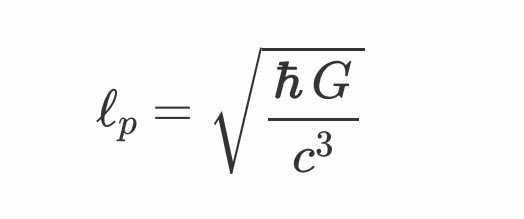
Combining the maximum speed, the maximum force and the minimum action in nature yields the minimum length: twice the Planck length.
It is a minimum. Shorter lengths do not exist in nature.
It is also the minimum length measurement error.
Thus, nature has no pixels.
1/2
Describing it as the “shortest distance that can be measured” or the “universe’s pixel size” is a gross oversimplification; it represents the characteristic length scale where quantum gravity effects become relevant i.e. the scale at which gravitational interactions are comparable to quantum energies.
The Planck length, like the Planck mass is just a confluence fundamental constants.
The Planck mass is 0.0002 grams. This is very small, roughly equivalent to the mass of a flea egg.
But it’s no where near some mystical “minimum measurable mass”!
Source: https://t.co/BQxh1IPtMA
@Zwarthoed_JJ@waitbutwhy To cut the Planck length into two parts, you need a blade much smaller than half the Planck length.
But there is no such blade.
@naval Mostly correct. But science - to guess laws and to check them with observations - is and can be carried out by everybody.
If it cannot, it is not science.
@waitbutwhy The shortest measurable length is twice the Planck length, as told here: https://t.co/YselmvBgYn
But it is NOT a pixel size! Nature has no pixels, because pixels would contradict the minimum length.
@DanielWhiteson As a result, nature is not made of pixels (or voxels).
At the Planck scale, nature is fuzzy/cloudy.
And: the double Planck length is not only the smallest length that could be measured; it is also the smallest length that exists.
@DanielWhiteson Nature has no pixel size. That is easy to see.
Each screen pixel has a boundary that is defined with a better precision than the pixel size.
But in nature, twice the Planck length is both the smallest length and the smallest length measurement error.
As a result, ... 1/2