#THE_MEDIATOR Look carefully at the photograph from Islamabad on 18 June 2026. Its true significance lies in a single word.
The PrimeMinister of Pakistan @CMShehbaz is not signing the Islamabad Memorandum as a witness, nor merely as the host who lent his capital’s name. He is signing it as the #Mediator, beneath the signatures of the President of the United States and the President of Iran.
Pause on that word.
A mediator is not a spectator.
A mediator is not a courier.
A mediator is the trusted bridge between two adversaries who cannot—or will not—speak directly to one another. When major powers entrust that role to a country, they are not doing so out of courtesy. They do it because they respect that country’s credibility, discretion and judgment.
For decades, Pakistan was often cast in a different role useful for corridors, airbases and back-channel messages, but rarely invited to sit at the highest table. The photograph from Islamabad marks a quiet but profound change. Pakistan is no longer standing outside the room.
It is seated at the table.
Its signature appears on the document not because geography demanded it, but because both Washington and Tehran accepted that Pakistan could help bring one of the region’s most dangerous confrontations to a negotiated conclusion.
That is diplomacy at the highest level.
This new standing carries consequences that extend well beyond this agreement.
First, Pakistan’s role is now part of the permanent historical record. Future historians examining how this crisis ended will find Pakistan’s name on the document not as a footnote, but as the mediator.
Second, credibility is one of the rarest assets in international relations. Every successful mediation strengthens the confidence other nations place in Pakistan’s judgment. That confidence becomes strategic capital.
Third, this moment deepens Pakistan’s relevance across the broader Middle East. A country able to maintain working relationships simultaneously with Washington, Tehran, Riyadh, Beijing and the Gulf states possesses something increasingly uncommon in modern diplomacy: access to all sides without complete dependence upon any of them.
Fourth, it helps rehabilitate Pakistan’s international reputation. For years, powerful narratives sought to define Pakistan primarily through the lens of instability. This photograph offers a different image—Pakistan helping resolve a major international crisis rather than contributing to one.
Above all, reputation cannot be purchased.
It cannot be manufactured through propaganda. It is earned through performance.
Investment follows reputation.
Partnership follows reputation. Influence follows reputation.
There is one final achievement that deserves recognition.
One of the gravest dangers during this conflict was that it might widen into a broader Sunni-Shia confrontation across the Muslim world. That catastrophe was avoided. Pakistan, maintaining working relationships with both sides, was among the very few countries capable of helping prevent that fracture from becoming irreversible.
History naturally celebrates those who win wars.
It should also honour those who prevent wars from becoming larger than they otherwise would have been.
A mediator’s work does not end with a signature.
Peace must still be maintained.
Trust must still be justified.
Diplomatic stature must still be earned, again and again.
But for today, this achievement deserves to be recognised plainly and without false modesty.
Only a short time ago Pakistan was widely described as diplomatically isolated.
Today it stands recorded in an international agreement as the mediator between the United States and Iran.
That is not a routine diplomatic event.
It is a significant milestone in Pakistan’s diplomatic history. It marks the moment Pakistan demonstrated that it could do more than observe history. It could help shape it. Well done, Pakistan. Now prove that the trust placed in you was justified.
Iqbal Latif
Pakistan Prime Minister Shehbaz Sharif signed the Islamabad MoU between the US and Iran as a guarantor. - The MoU has been already signed by the US President Donald Trump & Iran's President Masoud Pezeshkian. It ends all the rumors about Pakistan's role in this historic deal.
The agreement reached between US and Iran is titled as the Islamabad MoU.
It was endorsed by Pakistan's PM as the mediator -- Even when Pakistan was not there in Tehran or in France at G7, it was literally in the room when the matter was being finally inked.
Compare this with the fake claims of one of Pakistan's neighbours claiming to a vishwaguru, same who got humiliated in May 2025 during the 04 day war.
So much for those tall claims.
Pakistan saved Iran, Pakistan saved Lebanon, Pakistan saved the Gulf economy, Pakistan brought the oil and gas prices down globally!
GREATEST DAY FOR PAKISTAN🇵🇰
Another brilliant piece @DanQayyum Congratulations on historic breakthrough in Peace talks between Iran & US, brokered by Pakistan: ‘the discipline & singlemindedness that built the deterrent also built the mediation. The chorus declaring both impossible was the same’! So aptly put. Pakistanis have lived upto Quaid-e-Azam’s dictum: ‘Let it not be said that we did not prove ourselves equal to the task’! The Quaid’s Faith in Pakistan & Pakistanis stands vindicated!
🚨 Pakistan's Sky Warrior Has Arrived: Shahpar-III. 🇵🇰
This Isn’t A Drone. This Is Dominance In The Skies.⚔️☁️💥
Shahpar-III Pakistan’s Indigenous Beast With: 🇵🇰🚀
• 30+ Hours Of Unrelenting Flight🔥
• 6 Precision Missiles Ready To Strike⚔️
• Cutting-Edge ISR & Combat Power💥
• 100% Made In Pakistan 🇵🇰
This is Pakistan’s Message to the World: Our skies. Our Rules.💪
The US, Israel and Iran have all bumbled through this war and missed opportunities, but Pakistan deserves great credit for consistently working very hard as an intermediary for peace between capricious and obdurate enemies. Bravo, @CMShehbaz and COAS Munir.
Time for Sovereign AI. Pakistan cannot afford to wait.
In a first, the U.S. government has ordered Anthropic to deny the entire world access to its two most powerful new AI models: Claude Fable 5 and Mythos 5. Whatever the official reason, the message is clear: America doesn’t want the rest of the world using its most advanced AI models. AI is the new weapon.
This reminds me of Huawei’s founder Ren Zhengfei, who said in the 1980s: a country without its own technology is like a country without an army.
AI is creating a new have/have-not world, where the entire world depends on just two countries: the U.S. and China.
As a nation, we have missed too many trains like technology revolution and internet boom etc. We cannot afford to miss this one.
Western and Chinese AI models don’t properly understand our context: languages, history, culture etc. We may not be able to build the world’s most powerful AI. But we can build sovereign AI, trained on Pakistani data, Pakistani context, Pakistani knowledge.
With this, our data stays inside Pakistan. Our services cannot be switched off by a foreign government. What happened on Friday can never happen to us again.
This train is still at the station. But not for long. Don’t miss it.
The Islamabad Memorandum of Understanding has never been closer. Pending its finalization, the media should refrain from entering speculation about its content.
In line with our responsible and transparent approach, all details will be shared with the public in due course.
Third Indian vessel hit by U.S. Navy in last one week, MT Jalveer has just been hit by the United States Navy off the coast of Oman. Indian crew onboard.
Indian Navy unable to escort its ships or provide rescue, have requested Oman to rescue its nationals from the ship.
6,000 years ago.
Before the Pyramids.
Before Mesopotamia.
Before the Bronze Age reached Europe.
A craftsman in Balochistan had already invented the casting technique NASA would use 6,000 years later.
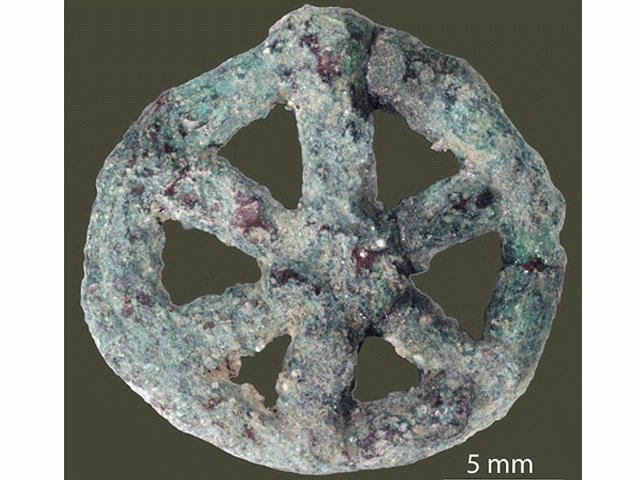
The Mehrgarh Wheel Amulet. Sibi District. Balochistan. 1985.
A 2 centimetre corroded copper wheel with six spokes. It sat in storage for decades. Dismissed as a simple prehistoric trinket.
Then scientists at the SOLEIL synchrotron in France put it under UV photoluminescence imaging and published what they found in Nature Communications in 2016.
No seams. No joints. No soldering. Cast as a single seamless piece from pure copper at 1,085 degrees Celsius.
The oldest known example of lost wax casting in human history.
The process: sculpt the shape in beeswax. Encase it in clay. Fire it in a kiln. The wax melts out. Pour in molten copper. Smash the clay. Pull out a perfect metal object.
This is the same method used to cast surgical implants today. The same concept behind precision aerospace components. The same technique NASA used to build parts for the International Space Station.
The craftsman who made this wheel was not guessing. The scanning revealed they deliberately kept the wax model thin and uniform so molten copper would flow evenly through all six spokes simultaneously. They understood fluid dynamics. In 4,000 BC. In Balochistan.
Pakistan is not just a young nation with an ancient medieval past.
Pakistan is where the human mind first learned to master metal. 🇵🇰
Did you know the casting technique used by NASA was invented 6,000 years ago in Balochistan?
📍 29°23′14″N 67°43′37″E
@NASA@UNESCO@Nature@archaeologyart@Pakistan
@praveenswami Thanks for ur suggestion. I am sure those shal add to my personal library, if not already done. Meanwhile, lets enhance our efforts to spread better public awareness and benefits of a peaceful mutual coexistence. Deterrence - must be strengthened - for peace, not war.
Commander Pakistans’ newly raised rocket force Lt. Gen Nauman Zakaria hinting at future war scenario between India and Pakistan. “Matter of seconds not minutes” but everything being done to deter India with no plans of any aggression.
Excellent 👌
The subcontinental nuclear landscape represents a structurally distinct paradigm within deterrence theory, primarily due to the intersection of compressed geographic proximity, structural asymmetry, and high technological ambiguity.
When analyzing this dynamic through a strategic studies len, particularly accounting for incidents like the 2022 BrahMos missile misfire, the traditional Cold War frameworks of crisis stability and escalation control face severe operational limitations.
1. Strategic Geography and Compressed Decision Windows
Zero Strategic Depth: Unlike the transcontinental vectors of the US-Soviet deterrent framework, the contiguous borders of India and Pakistan eliminate geographic buffers. Flight times for theatre ballistic missiles range from 180 to 300 seconds, compressing the strategic decision-making loop to near-zero.
Capital Proximity: Core political command-and-control (C2) nodes, including New Delhi and Islamabad/Rawalpindi, are situated within the immediate operational envelope of short-range delivery systems. This geographic reality incentivizes a "decapitation strike" logic, heightening first-strike vulnerabilities during heightened geopolitical friction.
2. Technological Ambiguity and Verification Deficits
Warhead-Delivery Ambiguity: The deployment of dual-capable delivery systems (such as India’s Prithvi/Agni variants and Pakistan’s Ghaznavi/Shaheen series) introduces profound target discrimination challenges. National command authorities cannot distinguish between conventional and nuclear payloads via radar telemetry, inducing a structural pressure to assume the worst-case scenario.
Early Warning Asymmetry: Subcontinental deterrence lacks the redundant, space-based infrared early warning architecture that stabilized the late Cold War. Relying primarily on ground-based radars shortens the verification window, elevating the risk of inadvertent escalation stemming from system errors, false telemetry, or accidental launches.
3. Accidental Launch Risks and Crisis Management Deficits
The BrahMos Precedent: The inadvertent 2022 BrahMos cruise missile launch from India into Pakistan highlighted critical gaps in institutionalized crisis management. The absence of automated, real-time verification mechanisms meant that escalation avoidance relied heavily on operational restraint rather than bilateral institutional protocols.
Institutional Deficits: While the Cold War produced highly formalized structures like the Nuclear Risk Reduction Centers (NRRCs), South Asian crisis management mechanisms remain under-institutionalized. Existing hotlines are frequently underutilized during active crises, increasing the reliance on third-party diplomatic mediation to de-escalate.
4. Postural Incongruence and Escalation Dynamics
Asymmetrical Doctrines: The interaction between India's declared No-First-Use (NFU) policy has historically predicated on de-mated warheads. Pakistan's reliance on early first-use options to counter India's conventional superiority requires highly responsive, assembly-ready nuclear configurations.
Command and Control Vulnerability: In a hyper-compressed timeline, perceived changes in an opponent's operational readiness exert intense "use-them-or-lose-them" pressures on command structures, undermining pre-war crisis stability.
5. Unlike India, neither in Europe nor in Russia, nuclear weapons are a political slogan to win elections.
#ModiKaKhadiYug
#modimagic #indiaisraelpartnership #India #bharathkanth @PravinSawhney
@praveenswami In the case of India Pakistan, the reaction time would be very compressed, only a few mins. This raises the risk of accidental nuc confrontation. That's the danger which, I think, is being highlighted here.
@praveenswami The calculus is based on the CW era when nuc doctrines were first matured, and into the modern era. "The reaction time available to belligerents to authorize and execute a counter-strike is roughly 10-30 mins for ICBMs, and 5-15 mins for SLBMs or IRBMs" (Google).
@praveenswami The Gen represents the strategic community who study n evaluate Pak India nuc threat environment on daily basis, which surpass all previous calculus. Plz understand the dangerous implications of extremely compressed time factor along with other threat elements in this case.