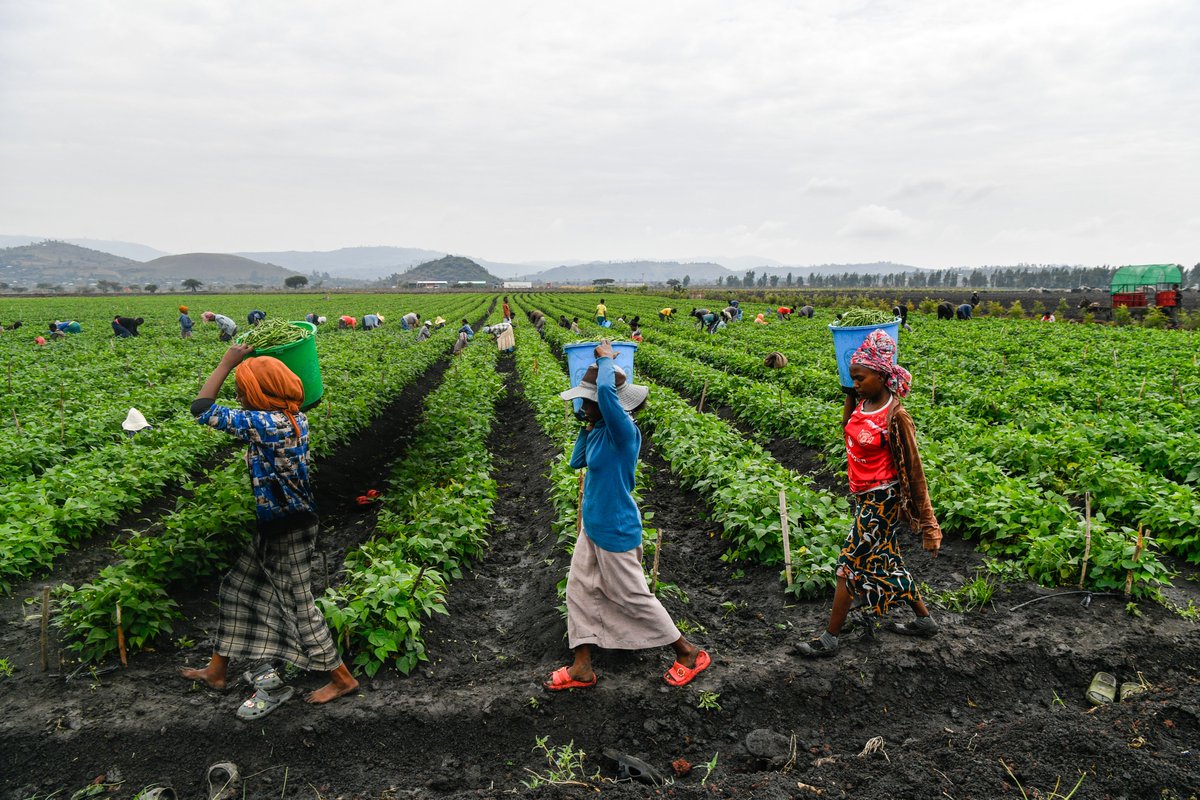
A record 1.2 billion young people will enter developing-world labor markets over the next decade, even as AI raises new questions about the future of work, Harry Jacques writes from Southeast Asia in F&D magazine. https://t.co/bWZH9raKhx
A new perspective! 🛰️
Voyager 1 had been in space for two weeks and was 7.25 million miles (>11 million km) away OTD in 1977 when it captured this view of the whole Earth and the Moon in the same frame. It was our first image of the kind, but definitely not our last.
1. Voyager 1, 1977
2. DSCOVR, 2015
3. Artemis I, 2022
4. Artemis II, 2026
No matter where you are, we all see the same Moon. 🌕
Sept. 19 is International Observe the Moon Night, an annual celebration dedicated to our closest celestial neighbor. Learn more and find ways to celebrate near you: https://t.co/OgllHIbnbK
Today in 1977, Voyager 1 took this image of the Earth and Moon in a single frame, captured from 7.25 million miles away. It was the first of its kind taken by a spacecraft.
This weekend, people all over the world will observe the Moon together, and you're invited! Join a local or virtual International Observe the Moon Night event, register as an individual observer, or gather your own Moon observing crew.
Get started: https://t.co/j7cfgBHtNO
"Robots Building Robots" is now a reality in China! UBTECH Humanoid Robot Smart Factory has begun production in China's Liuzhou.
Powered by the digital "smart brain" for whole-factory scheduling, one industrial humanoid robot comes off the line every 10 minutes. The factory's planned annual capacity is over 10,000 units.
When they say: Please, for the love of God, regulate us. Give us licences, audits, and bans before our digital God destroys us all.
Here is what is actually being requested. Three things, in order.
A regulatory body that they control, to prevent competition from catching up. Written with their people, staffed by their alumni, and calibrated to what they can already afford. Compliance is a fixed cost, which means it is trivial for the incumbent and fatal for the challenger. Not technology, but paperwork becomes their moat.
Immunity from liability. This is the one nobody talks about and it is the most valuable of the three. Today, if your model causes harm, it is your fault. Once licensed, audited, and approved, it is the regulator’s fault – you followed the rules. The licence converts responsibility into a receipt.
Too big to fail status, which means taxpayer funded bailouts in case of problems. Declare it critical infrastructure and the state now has an interest in your survival. Which means, when something goes wrong, the losses are public and the gains stay private. We have watched this film. Banking, 2008, same argument, same vocabulary.
Note the pattern: every one of the three transfers something from them to the public – risk, competition, cost – while the language is entirely about protecting the public from them.
The sincerity of the fear is beside the point. Sincere people can still ask for exactly what an insincere person would ask for, and the request should be judged by what it does rather than by what motivates it.
The alternative is unglamorous and works: competition, adversarial testing between rivals who want to find each other’s flaws, and full liability after real harm. Nobody gets a licence. Nobody gets immunity. Nobody gets a bailout. You build, and you answer for what you built.
That is the arrangement that made the West rich. It has never needed anyone’s permission to work.
Equal pay is more than a paycheck. It’s dignity, opportunity, and justice.
Women in wage employment in agriculture earn just 78¢ for every $1 earned by men. Closing the gap strengthens livelihoods, food security, and resilient agrifood systems for all.
#EqualPayDay
Friedrich Hayek – The Man Who Gave the Counter-March Its Strategy.
Gramsci invented the long march through the institutions. Dutschke gave it its name. They built the infrastructure of the left’s cultural dominance – and it worked. But there was a man on the other side who understood the mechanism just as clearly and built a counter-strategy that produced Thatcher, Reagan, and Milei. His name was Friedrich Hayek. And his strategy is still underused – including in Poland.
1. The key text is not The Road to Serfdom. It is a 1949 essay almost nobody has read: The Intellectuals and Socialism. Why do socialist ideas keep winning politically, even when the evidence against them accumulates? Because you are watching the final stage of a process that began decades earlier. Before any idea reaches parliament, it circulates among academics. From them it passes to the secondhand dealers – the writers, teachers, journalists who translate abstract ideas into the common assumptions of an entire society. By the time the politician acts, the intellectual work is already done. The politician is not the beginning of change. He is its final expression.
2. He called them secondhand dealers in ideas – the most important role in the intellectual supply chain. The academic produces the idea. The secondhand dealer makes it thinkable for millions who will never read the academic paper. If he wrote the essay today he would add influencers, podcasters, and profiles like this one to the list. The mechanism is the same. The distribution is faster. Which is why the counter-march can now move at a speed Hayek could not have imagined.
3. He did not stop at the essay. He built institutions. The Mont Pelerin Society – 1947. The Atlas Network – founded after Hayek explained the way to change society was not to enter politics but to change the intellectual climate first. These institutions spent decades producing ideas considered radical and politically impossible – and then Thatcher happened. Then Reagan. Then Milei. Thatcher said of them: "There were not many of them, not everyone wanted to listen – but they were right, and they saved Great Britain."
4. The difference between the Gramscian left and the Hayekian right is not the strategy. The strategy is the same: change the intellectual climate, move the Overton Window, wait for the political moment when what was previously unthinkable becomes inevitable. The difference is that the left funded it systematically for fifty years. The right understood it in theory and underfunded it in practice – treating independent think tanks as expensive hobbies rather than load-bearing infrastructure for ideas you want to become policy.
5. Both sides understood the mechanism. One funded it properly. The other kept looking for the politician — the next Reagan, the next Milei — without understanding that before each of them there were decades of institutional work that nobody filmed. You cannot skip the intellectual work and go straight to the politician. Someone must produce the ideas. Someone must translate them for millions. Someone must fund the institutions that do both for twenty years, including when the ideas are unfashionable.
6. The series you are reading is the Hayekian strategy running at 2026 speed. The secondhand dealing – civilizational argument translated into the format that reaches millions who will never read Gramsci or Hayek but who recognize the mechanism when they see it named. Musk and Milei repost it because they recognize the intellectual supply chain working in real time. The Overton Window is moving. The counter-march has a distribution platform the left cannot control.
7. Hayek died in 1992, vindicated on everything, implemented insufficiently. And then the tide came back – because the intellectual infrastructure was never built at the scale the long march had built theirs. We are building it now. This series is part of it. The work is not finished. It has barely begun.
Ad astra ⭐
At 7:26am ET (1126 UTC) on Aug. 30, @NASARoman took to the skies en route to its new home 1 million miles away from Earth. It should reach its final destination in one month: https://t.co/GD5THXPBLn
A Tiangong Ultra humanoid robot clocked 39.70 seconds to rank the first during a preliminary event at the second World Humanoid Robot Games in Beijing on Saturday night, beating the men's 400m world record of 43.03 seconds along with other robots. #China#HumanoidRobots#Robotics #RobotGames #Beijing
For two hundred thousand years, intelligence has been the rarest resource on earth. Locked inside individual human minds. Non‑scalable. Scarce. Every advance in civilization — every leap in science, art, industry, and statecraft — flowed from that scarcity.
Artificial intelligence breaks that pattern. It makes intelligence abundant. It makes it cheap. It makes it scale. This is not just another wave of automation or software. It is the industrialization of intelligence itself.
When intelligence becomes a utility, it stops being a tool that sits on top of society and starts becoming the foundation of society. It is a transformation as profound as the harnessing of electricity — but on a higher plane. Electricity powered machines. Industrial intelligence powers knowledge. And knowledge shapes everything.
This shift will reorder the very structures that underpin nations. The two pillars that define sovereignty — economic strength and security — are being rebuilt on a substrate of machine intelligence. Nations that master this new utility will not simply gain efficiency. They will redefine what prosperity, power, and freedom mean in the 21st century.
For me, this is the central story of our time. It is not about the latest app. It is not about hype cycles. It is about the first time in history that intelligence itself — the raw material of progress — has become infinite and industrial. The question is not whether it will transform society. It already is. The question is who will shape that transformation.
The landmark EU Deforestation Regulation (EUDR) requires businesses to demonstrate that the products they sell or export to the EU do not come from land that was recently deforested or degraded.
Just weeks before the EUDR was to go into force on Dec. 30, 2025, the European Parliament voted to delay entry into application of the law until Dec. 30, 2026 for large corporations and until June 30, 2027 for small businesses with fewer than 50 employees and earning less than 10 million euros ($11.7 million) in annual sales of covered products. The vote on the amendment also weakened the regulation by removing books and publications from the list of products it covered.
Dive into the legislation's details and potential impacts➡️ https://t.co/bXhSsr3MFD
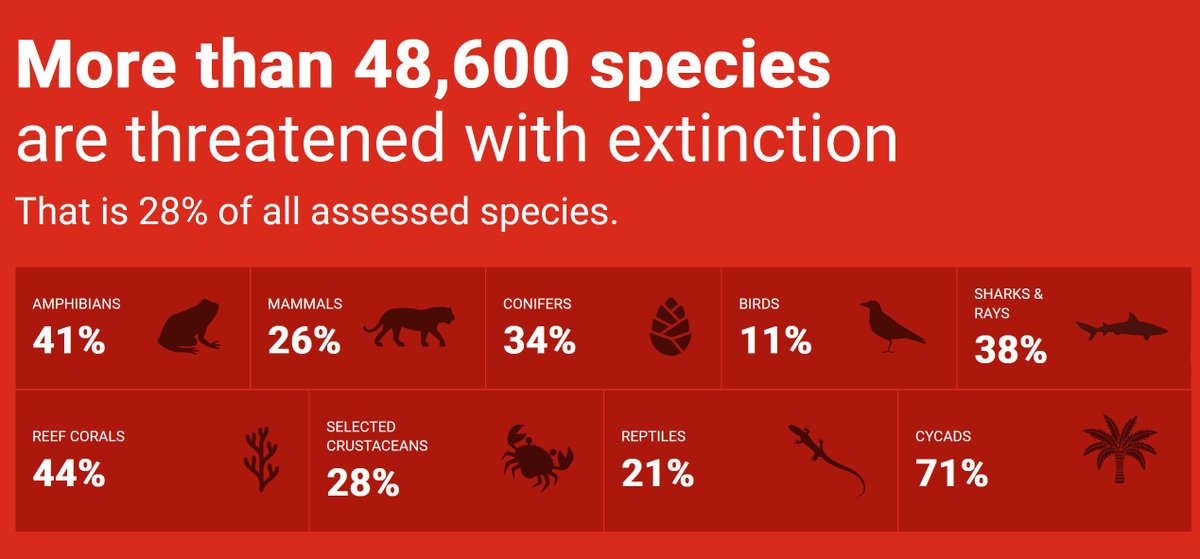
The number of assessed species on the IUCN Red List is now 172,620, with over 48,000 threatened with #extinction.
The IUCN Red List of Threatened Species™ is a critical indicator of the health of the world’s #biodiversity.
https://t.co/8inxfbzt0W
Throughout #COP30, we’ve seen growing interest in how nuclear energy, science & technology are tackling pressing environmental challenges.
Watch the building momentum for nuclear. Join us for more events and visit the #Atoms4Climate Pavilion throughout the week at @Cop30noBrasil! ⬇️
When pharmaceuticals leak into nature, they don’t disappear.
They change animal behaviour, disrupt hormones, enter crops and fuel antimicrobial resistance #AMR.
What harms the environment harms us.
Let’s #BeatChemicalPollution: https://t.co/uhdQ1Rrqj6
#WAAW