#WATCH | Bengaluru, Karnataka: On Dadasaheb Phalke Award conferred on him, actor Anant Nag says, "...I am thankful...Last year, when I got Padma Bhushan, and the Dadasaheb Phalke Award this year - I dedicate it to the people of Karnataka and Kannadigas...PM tweeted this, and that itself is a very special thing for me."
Congratulations to the legendary Anant Nag Ji on being conferred the Dadasaheb Phalke Award.
For several decades, his effortless performances, remarkable versatility and brilliance have left a very strong mark on Indian cinema, particularly Kannada cinema. In whichever role he has played, he brought rare depth and authenticity.
This is indeed a richly deserved honour for a truly distinguished artist.
https://t.co/V1qtFp0ZkB
North Indians see gaNesha primarily as a member of mahAdeva’s family
He is pArvatI-suta. Brother of skanda. His limited veneration is in that familial context
While in the Deccan, though that link to mahAdeva is acknowledged, there is a v vibrant tradition that regards gaNapati as the Supreme being
vinAyaka here is a sovereign divine principle on his own with deep links to shAkta ideologies like shrI vidya
Evident in the gaNapati upAsanA that someone like muttusvAmI dIkShitar was well known for , while also being a shrI vidyA proponent
This gANapatya ideology more or less doesn’t exist in the north . However it is the dominant form in which gaNapati is conceived down south even by regular smArtas and vaiShNavas
In the South Indian / Deccan milieu , his familial association with shiva is almost secondary and not that vital
Postscript : Historically however , what I am saying wasn’t always the case . The origins of the gANapatya tradition might well be in northern and western India
All complex systems exhibit some degree of friction, latency, and hysteresis among its components.
This is not a flaw, but rather is an essential property that contributes to a system’s resiliency. Without these properties, a system will either be brittle, failing catastrophically at points of pressure, or will it run with uncontrollable abandon until it exhausts some resources or when its most fragile component fails.
This, by the way, is one of the reasons why we keep humans in the loop in all critical software-intensive systems.
Your GPU can be fast and still waste time. ⚡
If your CPU keeps waiting for the GPU—and your code writes temporary data to memory only to read it back—you’re leaving performance on the table.
Bernhard Manfred Gruber explains how Thrust transform iterators can eliminate that unnecessary memory traffic.
🎥 https://t.co/yVhBhpoRcb
#CPP #CUDA #GPUProgramming #Performance
Think your multithreaded C++ code is efficiently using multiple CPU cores?
Don't forget about the cache.
Mikhail Matrosov explains how cache-line contention can create false sharing and undermine multi-core performance.
🎥 From Using std::cpp 2026: https://t.co/nJWvu3cMVT
#CPlusPlus #Multithreading #PerformanceOptimization
It is meaningful that India came to celebrate Dr SL Bhyrappa.
His doctoral thesis bore a title that defined his entire destiny: Satya mattu Soundarya - Truth and Beauty.
His scholarly journey was hard-won. In his autobiography ‘Bhitti’, Bhyrappa recalls a childhood marked by severe poverty, the early loss of his mother, an unstable home and the loss of siblings and relatives during the plague.
Raised for periods in relatives' homes, he pursued his education through hardship.
These realities that he had lived gave his writing its maturity, restraint and unsentimental realism.
- Smt @nsitharaman in New Delhi (1/n)
AI might be better at reading your code than writing it.
That makes LLMs incredibly useful for one often-neglected task: documenting an existing C++ codebase.
Mateusz Pusz shares practical advice for using AI to speed up documentation in this short.
▶️ https://t.co/qZXJzhRNaR
#CPP #AI #Programming
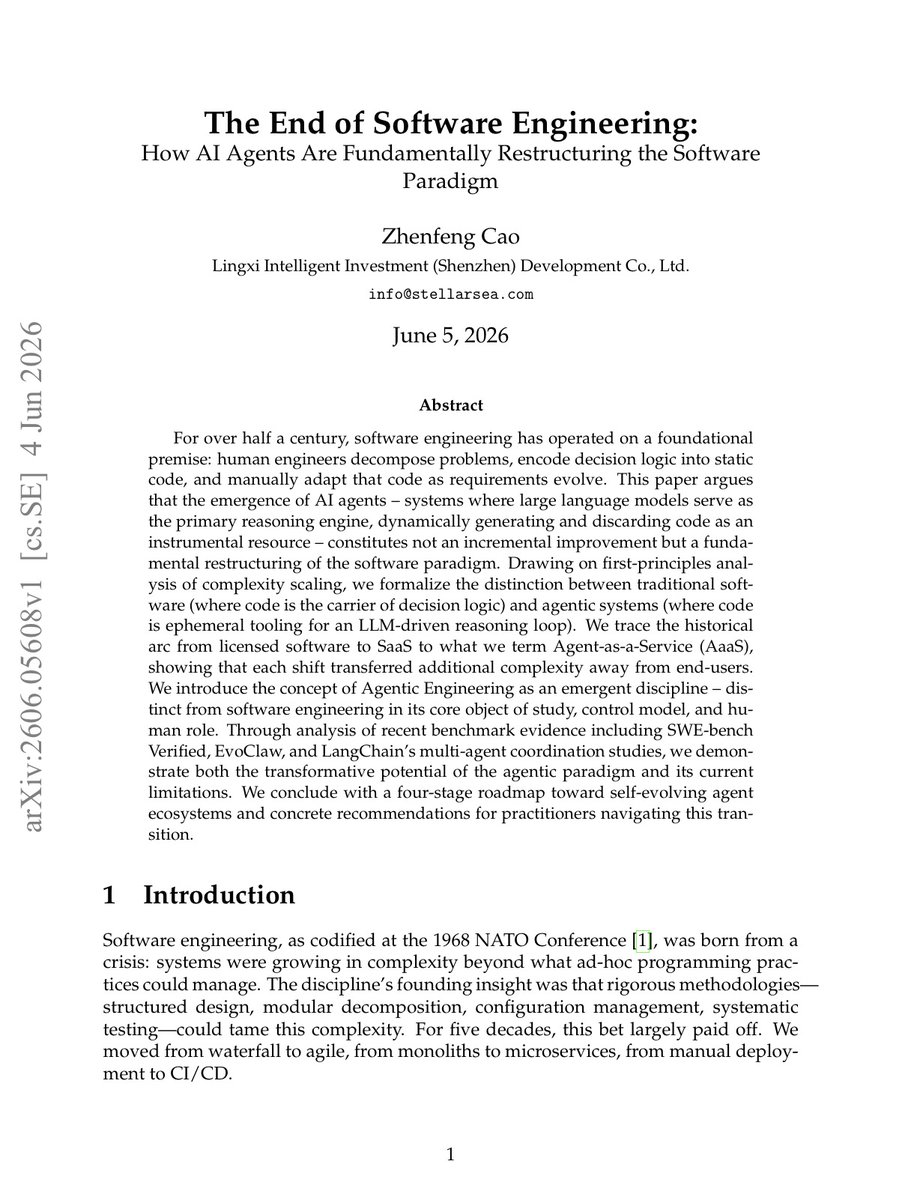
Chinese researchers just published a paper with a brutal title: "The End of Software Engineering."
The core point is that writing code is completely finished as a skill.
Your brain can only hold so much state and so many dependencies before it hits a wall.
An agent doesn't have that ceiling, and its capacity only grows with compute.
So the human stops being the one who writes the code.
You become the intent architect, the one who directs the agents and audits the result.
Code becomes the throwaway, and judgment becomes the job.
That's exactly why i wrote the guide below on how to build your own agent system from scratch.
You can also find the full paper this is based on below.
This person claims "C doesn't reflect modern computer architecture". That's kinda correct, C was designed for PDP-11s et al.
Instead, "modern computer architecture reflects C". That's the part they don't get. All modern CPUs are designed with C as the programming language.
I'm thrilled to announce that I was on @jstrosch's Reverse Engineering podcast, "Behind the Binary," to discuss IOKit, C++ dynamic class resolution, and vtable hijacking! 🎮
You can listen here, or wherever you get your podcasts:
https://t.co/zDX7eqswKw
Thank you so much for having me, Josh!
@Google@Mandiant
Boost Blueprint 116: Boost.Process
Boost.Process v2 launches a real process. Arguments go in as a list, so there is no shell and nothing to quote: a malicious filename cannot become a command. stdio is wired to pipes you can read, and the exit code is one you can trust
Built on Asio, so waiting is async. async_wait plus a timer gives the timeout std::system never had, and interrupt, request_exit and terminate give you an escalation path
Same code on POSIX and Windows
Level up your C++ architecture. Follow @Boost_Libraries for the #BoostBlueprint series
#cpp
Your entire existence revolves around movies and caste, but take a break and Watch this video completely.
Kannada - ವಿಶ್ವ ಲಿಪಿಗಳ ರಾಣಿ is the most Goated language humans ever spoke.